- The paper demonstrates that heavy-tailed contact distributions can emerge solely from spatially-driven agent dynamics without invoking social memory.
- A minimal model employing alternating random and targeted walks accurately replicates empirical metrics such as contact durations, inter-contact intervals, and repeated contacts.
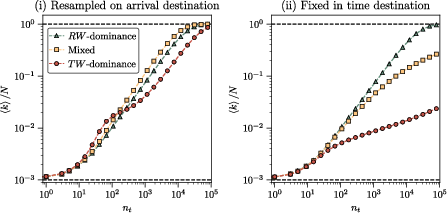
- Simulation results indicate that spatial heterogeneity and localization critically modulate network connectivity, impacting both epidemiological inference and social network modeling.
Introduction
The paper "Simple spatial processes can generate heterogeneous contact distributions in face-to-face interactions" (2604.00652) investigates the origins of broad and heavy-tailed distributions observed in real-world face-to-face interaction networks. Empirical data from high-resolution proximity measurements consistently reveal that contact durations, inter-contact intervals, and the number of repeated contacts between pairs of individuals all exhibit scale-free statistics. While these patterns are often interpreted as reflections of social memory or relationship-driven mechanisms, this work rigorously evaluates whether basic spatial dynamics, absent of explicit memory, can reproduce these empirical features.
The analysis focuses on minimal agent-based models where social agents (particles) alternate between free diffusion and localized movement, governed only by spatial targeting protocols. The study systematically characterizes how these simple motion rules control the emergent temporal network statistics, comparing them directly against empirical observations.
Empirical Motivation and Observables
The phenomenology of empirical face-to-face interaction networks is well-documented in sociometric sensor studies, notably in various conference contexts. In these datasets, each social contact is logged when two individuals are within a threshold spatial proximity and oriented towards each other, leading to a rich, dynamic temporal network.
The key temporal observables used to characterize these networks are:
- Contact duration (τ): The consecutive time during which two individuals remain in contact.
- Inter-contact duration (Δτ): The gap between two sequential contacts of the same pair.
- Number of contacts (n): The cumulative count of distinct contact episodes between a given pair within an observation period.
Empirically, all three observables display heavy-tailed (often power-law) distributions spanning several orders of magnitude.
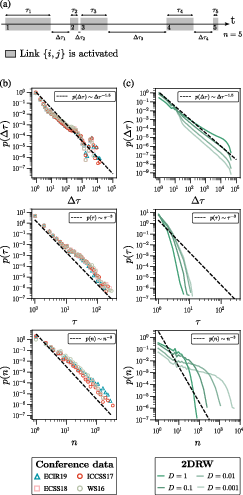
Figure 1: Empirical face-to-face interaction networks exhibit heterogeneous temporal observables; all distributions—contact durations, inter-contact durations, and number of contacts—are broad, with power-law regimes across multiple datasets.
Model Design: Minimal Spatial Dynamics
The central modeling framework simulates N particles in a two-dimensional, bounded spatial region. Contact events are defined geometrically, mirroring empirical sensor constraints: two particles are in contact if they are within a fixed radius and mutually oriented.
The particle dynamics are governed by a Markovian alternation between two modes:
- Random Walk (RW): Unbiased, diffusive motion.
- Targeting Walk (TW): Biased movement toward a target point, with added diffusive noise.
Each particle independently switches between RW and TW states at Poissonian rates (r for RW → TW, s for TW → RW), allowing for tunable timescales of localization and mixing. The assignment of targets during TW periods is handled via three distinct protocols:
- Resampled on arrival: Targets are redrawn randomly at each new TW entry.
- Fixed in time: Each particle retains a single, persistent target throughout.
- Constrained resampled: Targets are drawn from fixed zones ("areas of interest") only.
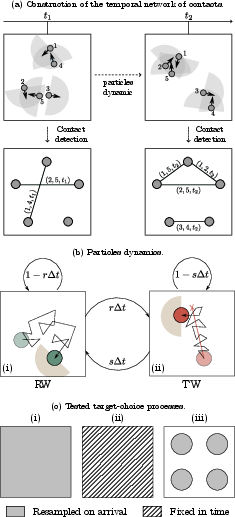
Figure 2: Schematic of the spatial models—particle-based contact detection, two-state random/targeted walks, and multiple target assignment strategies.
This construction enables systematic exploration of how phase localization and the spatial heterogeneity of target selection influence contact statistics without invoking memory or explicit social relationships.
Numerical Results: Emergent Distributions and Network Structure
Extensive simulations with N=1000 particles across varying r/Δτ0 regimes and target protocols reveal sharp differences in the resulting contact number distributions:
- RW-dominant regime (rare targeting): Distributions broaden slowly with increasing simulation time, but the proportion of pairs with low contact counts diminishes, indicating slow mixing.
- TW-dominant regime (persistent localization): Resampled targets yield broader distributions, while fixed-in-time targets induce the heaviest tails, as spatially neighboring targets cause repeated contacts between specific pairs.
- Constrained targets: When all targets are selected from a few zones, distributions become narrow and centered at high contact counts, as excessive spatial mixing homogenizes interactions.
A critical result is that heavy-tailed distributions of contact numbers can be recovered robustly using only spatially-driven mechanisms, in the absence of memory or social preference. The shape and slope of the tail are highly sensitive to the balance between localization duration and the spatial organization of target points.
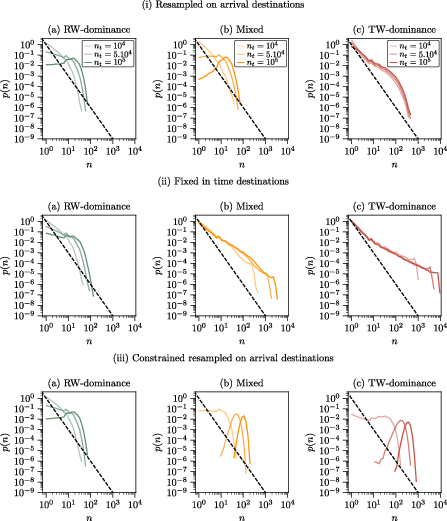
Figure 3: Emergent distributions of contact numbers for different targeting mechanisms and parameter regimes, demonstrating that targeting and spatial heterogeneity can robustly produce broad, power-law-like statistics.
Aggregated Network Connectivity
Inspection of the time-aggregated contact network uncovers further distinctions:
Theoretical and Practical Implications
The study provides strong evidence that heterogeneity in contact numbers does not necessarily indicate underlying social memory or behavioral preference. Instead, heavy-tailed statistics similar to those observed in empirical face-to-face networks can emerge naturally from the alternation of spatially localized and diffusive motion, provided the spatial localization is persistent and the assignment of targets preserves spatial heterogeneity.
This has important implications for the interpretation of temporal network data in both epidemiology and social sciences. Disease models or inference techniques that attribute heterogeneity solely to social relationships may overestimate the role of memory and underappreciate the impact of crowd geometry and spatial protocols. The results suggest that efforts to distinguish socially meaningful ties from incidental contacts in empirical datasets must control for spatial structure and mixing dynamics.
The findings also provide a minimal mechanistic baseline for researchers designing or analyzing agent-based epidemics, data diffusion processes, or intervention strategies based on face-to-face networks.
Future Directions
Several avenues for extension are apparent:
- Rich spatial environments: Exploring how obstacles, room topology, or flows between subspaces impact temporal network properties.
- Temporal correlations: Investigating the emergence of bursty contact/inactivity sequences and higher-order event correlations beyond marginal distributions.
- Integration with social attributes: Combining simple spatial mechanisms with individualized behavioral rules to dissect the relative contributions of spatial and social factors.
- Empirical parameters: Employing empirical localization/mobility data to calibrate model parameters more precisely for specific environments.
Conclusion
The paper provides a rigorous demonstration that simple spatial alternations between free diffusion and localization suffice to generate broad, empirically realistic distributions of repeated contacts in face-to-face interaction networks. This challenges widely held assumptions about the necessity of memory-induced or socially-driven reinforcement processes for such heterogeneity. Heavy-tailed statistics may arise as a fundamental consequence of spatial processes, provided population mixing is controlled and localization persists.
By establishing minimal spatial ingredients for high-level network complexity, this work supports a re-evaluation of the origins of observed social network structure and has direct relevance for modeling, inference, and intervention in dynamic human systems.