- The paper shows that increasing passivity (αₚ) drives order–disorder transitions in self-aligning active matter, with transition nature contingent on mobility type.
- The paper details how isotropic mobility yields a continuous polarization decline while anisotropic mobility exhibits a sudden, first-order polarization collapse.
- The paper employs a Landau amplitude equation and time-series analysis to reveal metastable oscillatory and rotating states that emerge in active-passive mixtures.
Introduction
The paper "Passivity-Driven Order-Disorder Transitions in Self-Aligning Active Matter" (2604.15105) systematically investigates dense active-passive mixtures comprising self-aligning polar disks, introducing passivity as a principal control parameter governing collective dynamics. Distinct from classical models of active matter that predominantly focus on homogeneous systems, this work demonstrates that the passive fraction αp triggers order-disorder transitions whose characteristics are strongly dependent on whether agent-substrate interactions are isotropic or anisotropic. The authors further identify a regime rich in metastable states, with pronounced sensitivity to microscopic mobility constraints, spatial distribution of passive disks, and lattice defects.
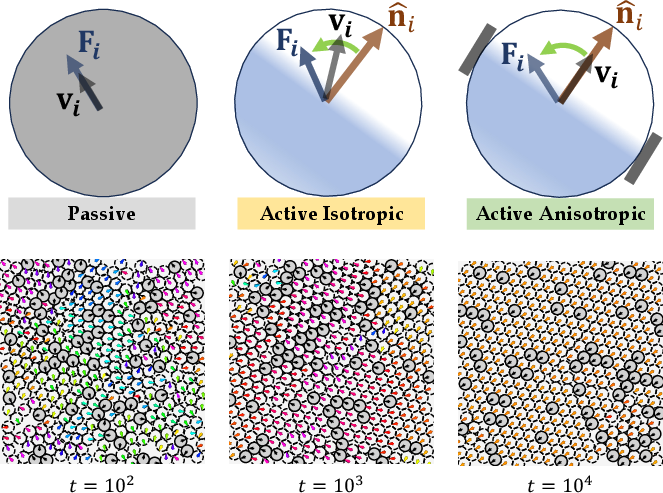
Figure 1: Three disk types—passive, isotropic active, and anisotropic active—and snapshots showing local to global alignment for αp=0.188.
Model Architecture and Physical Framework
The model consists of N interacting disks at high packing fraction, subdivided into Na self-propelled active disks and Np passive disks, with total fraction αp=Np/N. Active disks are subject to self-aligning forces that orient them towards their displacement direction, with mobility of either isotropic or anisotropic character:
- Isotropic mobility: Disks respond equally to forces in all directions, permitting lateral displacement.
- Anisotropic mobility: Motion is restricted to the heading direction (as in wheeled vehicles), disallowing lateral motion.
Equations of motion implement overdamped dynamics, coupling translational and rotational self-alignment, and are evolved in the absence (or presence) of noise.
Order-Disorder Transitions and Polarization Statistics
A central result is the identification of a passivity-driven order-disorder transition, in which the mean polarization ⟨ψa⟩ of active disks is suppressed as αp increases. This transition exhibits fundamentally distinct phenomenology depending on the mobility type:
- For isotropic mobility, suppression of order proceeds continuously as αp increases.
- For anisotropic mobility, polarization collapses discontinuously (first-order), with a critical passive fraction at roughly half that of the isotropic system given comparable interaction coefficients.
These behaviors are quantified by polarization statistics and PDFs, revealing unimodal distributions for isotropic mobility throughout the transition and bimodal distributions for anisotropic mobility at intermediate passive fractions.
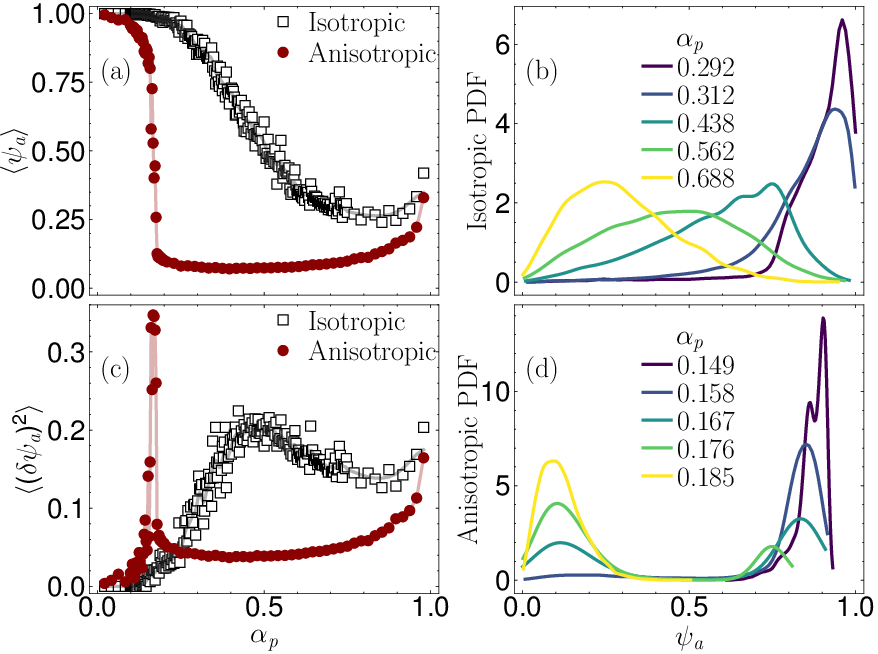
Figure 2: Mean polarization and variance versus αp, illustrating a continuous transition for isotropic and discontinuous for anisotropic mobility; associated PDFs display unimodal (isotropic) and bimodal (anisotropic) structure.
A mean-field analysis formalizes this dichotomy using an amplitude equation of Landau form:
αp=0.1880
where coefficients encode the competition between alignment gains and crowding/jamming effects from passive inclusions. Continuous transitions arise for isotropic mobility (αp=0.1881), while discontinuous transitions emerge for anisotropic mobility (αp=0.1882).
Beyond global order, active-passive mixtures in the ordered regime exhibit multiple metastable oscillatory or rotating states, selected by spatial arrangements of passive disks and defects. The isotropic system dynamically explores several attractors in a single run, while anisotropic systems remain confined to one due to mobility constraints.
Time series analyses reveal complex transitions among highly polarized, oscillatory, disordered, and rotating states, coupled to elastic energy dynamics: systems accumulate mechanical tension that is released via rearrangements lowering elastic energy, facilitating transitions between metastable attractors.
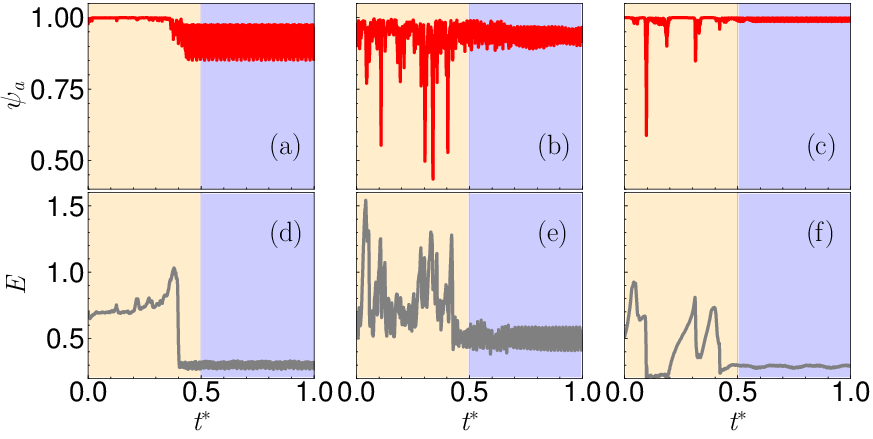
Figure 3: Temporal dynamics of polarization and elastic energy, showing transitions between high polarization, oscillatory, and rotating metastable states for isotropic mobility with αp=0.1883.
Metastable states are further characterized by Fourier spectra of velocity autocorrelation, identifying persistent oscillatory or rotational dynamics, and spatial snapshots pinpointing the role of passive disk clustering (which can hinder collective translation and promote localized rotation).
Role of Noise and Mobility Anisotropy
The study rigorously addresses the resilience of these phenomena under finite rotational noise. With low noise, metastable oscillatory states persist, albeit with suppressed trapping in distinct attractors and narrower polarization distributions. Anisotropic mobility strongly limits attractor-switching both with and without noise. At high noise levels, collective order is destroyed by standard fluctuation-induced mechanisms.
Implications and Outlook
This work demonstrates that the passive fraction is a robust control parameter for collective phase behavior in heterogeneous active matter, offering experimental accessibility for tuning transitions in both biological (cell assemblies, tissues) and technological (robotic swarms) contexts. The theoretical implications include the necessity to go beyond coarse-grained or mean-field descriptions when characterizing dense active systems, as metastable periodic attractors dominate long-time dynamics. Practically, controlling αp=0.1884 could enable precision engineering of collective states in synthetic swarms or materials.
The identification of mobility-constrained transitions and metastable regimes suggests several avenues for future investigation:
- Extension to systems with gradient or variable mobility, as in heterogenous robotic populations.
- Analysis under varying topological substrate conditions (e.g., confinement, patterned environments).
- Exploration of coupling between passive-induced transitions and other nonequilibrium effects (e.g., activity gradients, external fields).
- Incorporation of inter-agent communication or adaptive behaviors relevant for intelligent active systems.
Conclusion
The paper establishes passivity as a fundamental driver of order-disorder transitions in dense self-aligning active matter, distinguishing continuous and discontinuous transitions by mobility type and exposing a rich landscape of metastable attractors unaccounted for by classical flocking models. The findings have broad relevance and applicability for understanding and controlling collective behavior in mixed active-passive systems, with implications extending across physics, biology, and robotics.