Unlocking feedforward capabilities in Model Predictive Control algorithms to deal with measurable disturbances
Published 5 Jun 2026 in eess.SY | (2606.07208v1)
Abstract: Disturbance rejection is a central objective in process control, particularly when measurable disturbances can be exploited through feedforward action. Although Model Predictive Control (MPC) naturally incorporates disturbance models and prediction capabilities, standard formulations cannot achieve complete disturbance rejection since the cost function penalises control effort. This limitation prevents MPC from reproducing the behaviour of classical feedforward compensators. This work proposes a novel framework to embed true feedforward capabilities within MPC without removing the control effort penalty. The approach introduces a dual-control structure in which two control actions are computed simultaneously: a tracking-oriented action addressing set-point tracking and robustness, and a feedforward-oriented action dedicated to disturbance rejection. Both contributions are combined into a single control signal on which the process constraints are explicitly enforced. The feedforward-oriented action is formulated without penalising control effort, enabling full compensation of measurable disturbances. The methodology is developed for Dynamic Matrix Control (DMC), Generalised Predictive Control (GPC), and state-space MPC. Its effectiveness is demonstrated through simulation studies, including comparisons with standard MPC and classical feedforward schemes. A case study based on a reverse osmosis process shows that the proposed approach improves disturbance rejection while preserving constraint handling and overall control performance.
The paper presents a dual control architecture that decouples feedforward disturbance compensation from tracking, enabling improved rejection of measurable disturbances.
It details an optimization framework that independently tunes feedback and feedforward control vectors, effectively managing input constraints and non-causal scenarios.
Simulation studies across DMC, GPC, and state-space implementations, including a nonlinear reverse osmosis case, validate its superior performance over classical methods.
Embedding True Feedforward Compensation in Model Predictive Control
Introduction
Model Predictive Control (MPC) is widely adopted for process control due to its ability to handle constraints and incorporate disturbance models within predictive optimization. However, standard MPC structures intrinsically couple disturbance rejection and setpoint tracking by using a single optimal control action penalized by a control effort term. This results in suboptimal, often incomplete compensation for measurable disturbances even when disturbance models and future trajectories are perfectly known. The paper "Unlocking feedforward capabilities in Model Predictive Control algorithms to deal with measurable disturbances" (2606.07208) addresses this fundamental limitation by proposing a structurally decoupled predictive control architecture wherein disturbance rejection and tracking objectives are optimally separated within the MPC framework. This essay systematically reviews the technical contributions, algorithmic construction, performance analysis, numerical results, and implications for future MPC research.
Structural Foundations of Feedforward in MPC
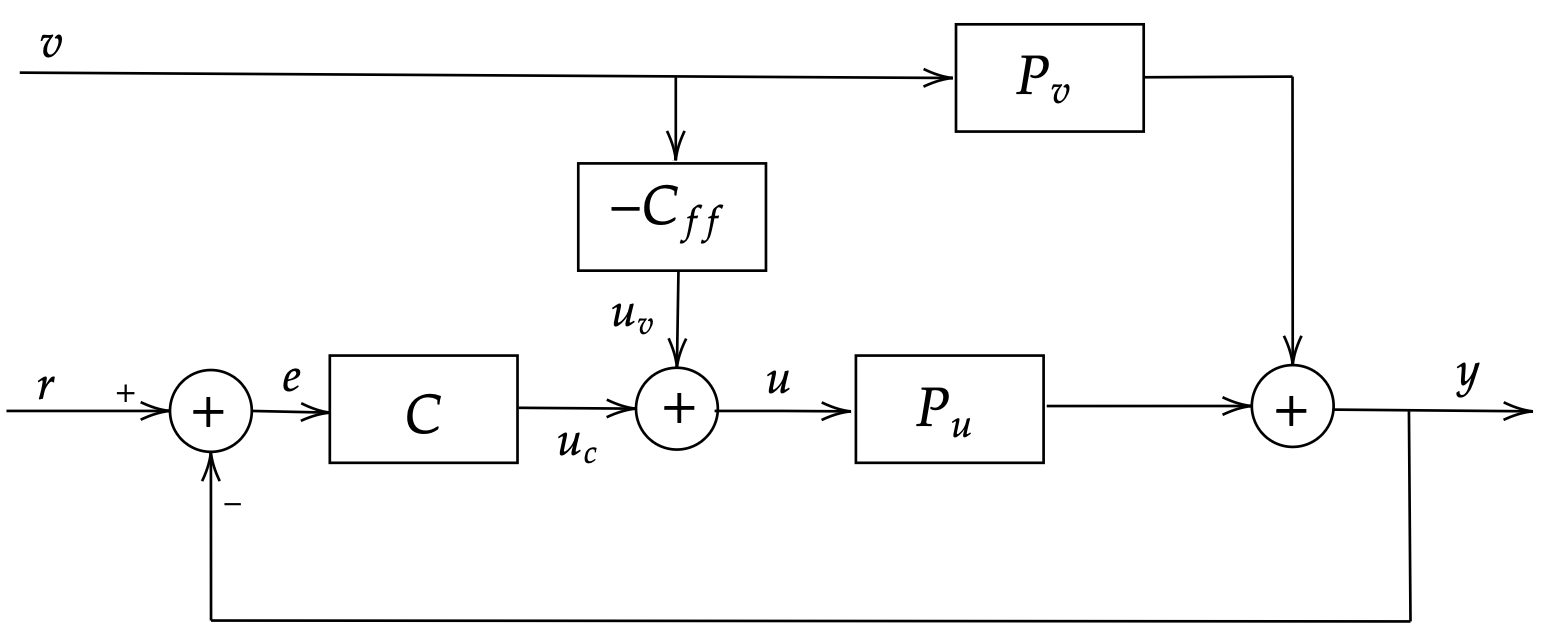
Classical feedforward control compensates measurable disturbances through open-loop inversion of the disturbance effect, realized via a structure where the total input is the superposition of feedback and feedforward controllers, each with independent objectives. The ideal case, shown in Figure 1, achieves perfect rejection if the disturbance and process models are invertible and actuator constraints are absent.
Figure 1: Classical feedforward control scheme to deal with measurable disturbances.
In standard MPC, the prediction equation includes measurable disturbances:
y=Gu+Hv+f
where u is the future control sequence, v is the disturbance sequence, and f the free response. The quadratic cost function penalizes both tracking error and control increments, thus inherently compromising aggressive feedforward disturbance compensation. Removing effort penalization (λ=0) yields pure feedforward, but with impractically aggressive control moves and degraded robustness.
subject to constraints on the total input u=uc+uv. The key operational principle is to set u0 and u1, so that the disturbance-oriented action is unconstrained by input regularization, directly inverting the disturbance impact as in classical feedforward, but computed through the system's prediction model and respecting all process limits.
Specialization to MPC Canonical Algorithms
The decoupled structure is systematically developed for:
Dynamic Matrix Control (DMC): Utilizing step response model; free response decoupling follows past input and disturbance increments.
Generalized Predictive Control (GPC): Using CARIMA difference equations; decoupling uses Diophantine solutions, and past trajectories.
State-Space MPC: Employing augmented states for inputs and disturbances (including delay chains); feedforward internal states propagate disturbance prediction in open loop.
Despite different internal parameterizations, all three approaches yield an identical mathematical form for the decoupled optimization, fully leveraging the superposition inherent in linear models.
Simulation Studies: Comparative and Quantitative Analysis
Ideal Measurable Disturbance Rejection
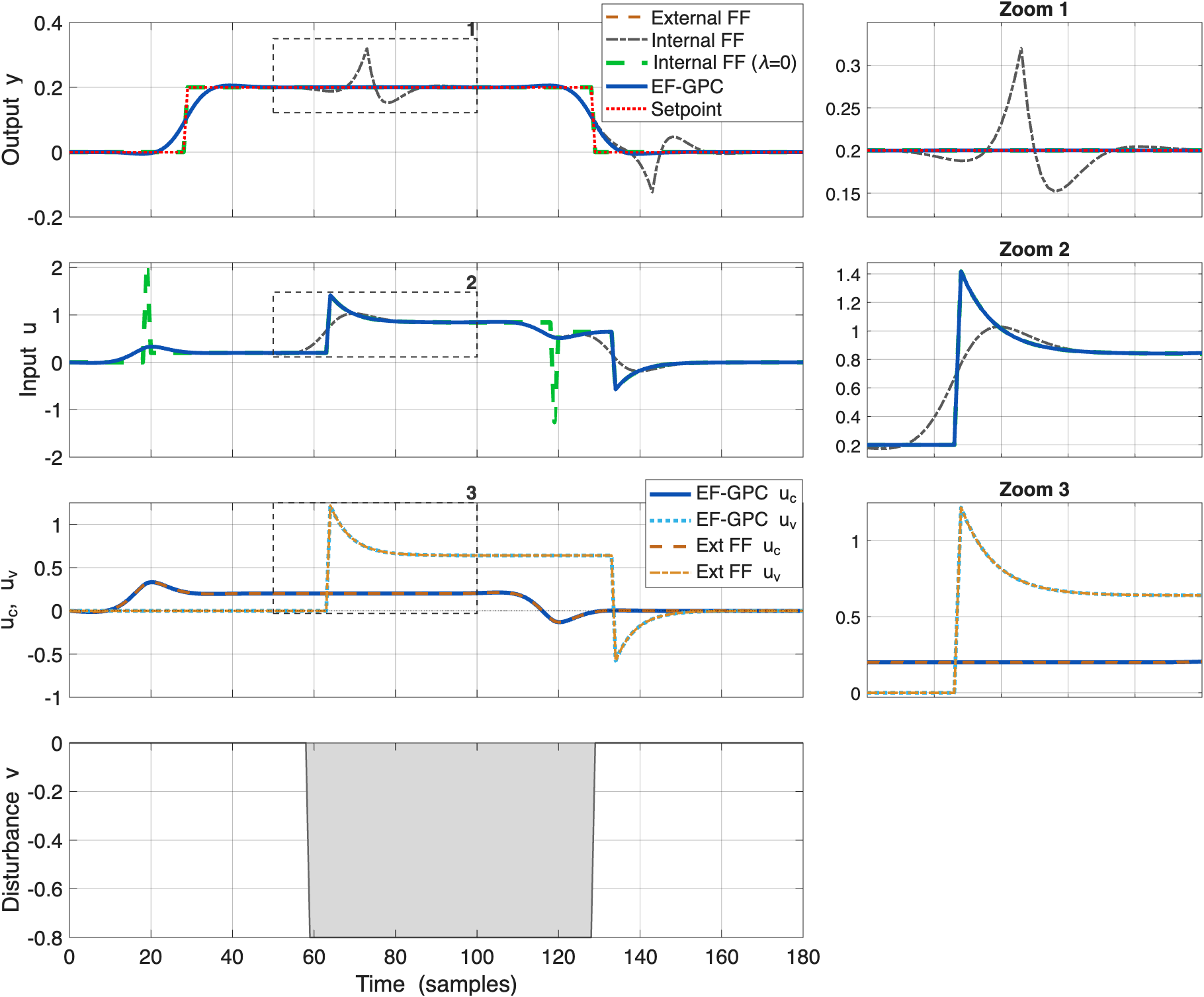
In a fully invertible scenario, both the proposed Extended Feedforward GPC (EF-GPC) and reference classical external feedforward achieve zero disturbance-induced error with the same smoothness in setpoint tracking (Figure 2). Conventional "internal" feedforward GPC (single tuning parameter for both objectives) fails to reject disturbances due to controller-induced trade-off.
Figure 2: Comparative simulation results for the ideal measurable disturbance rejection scenario.
Input-Constrained Scenarios
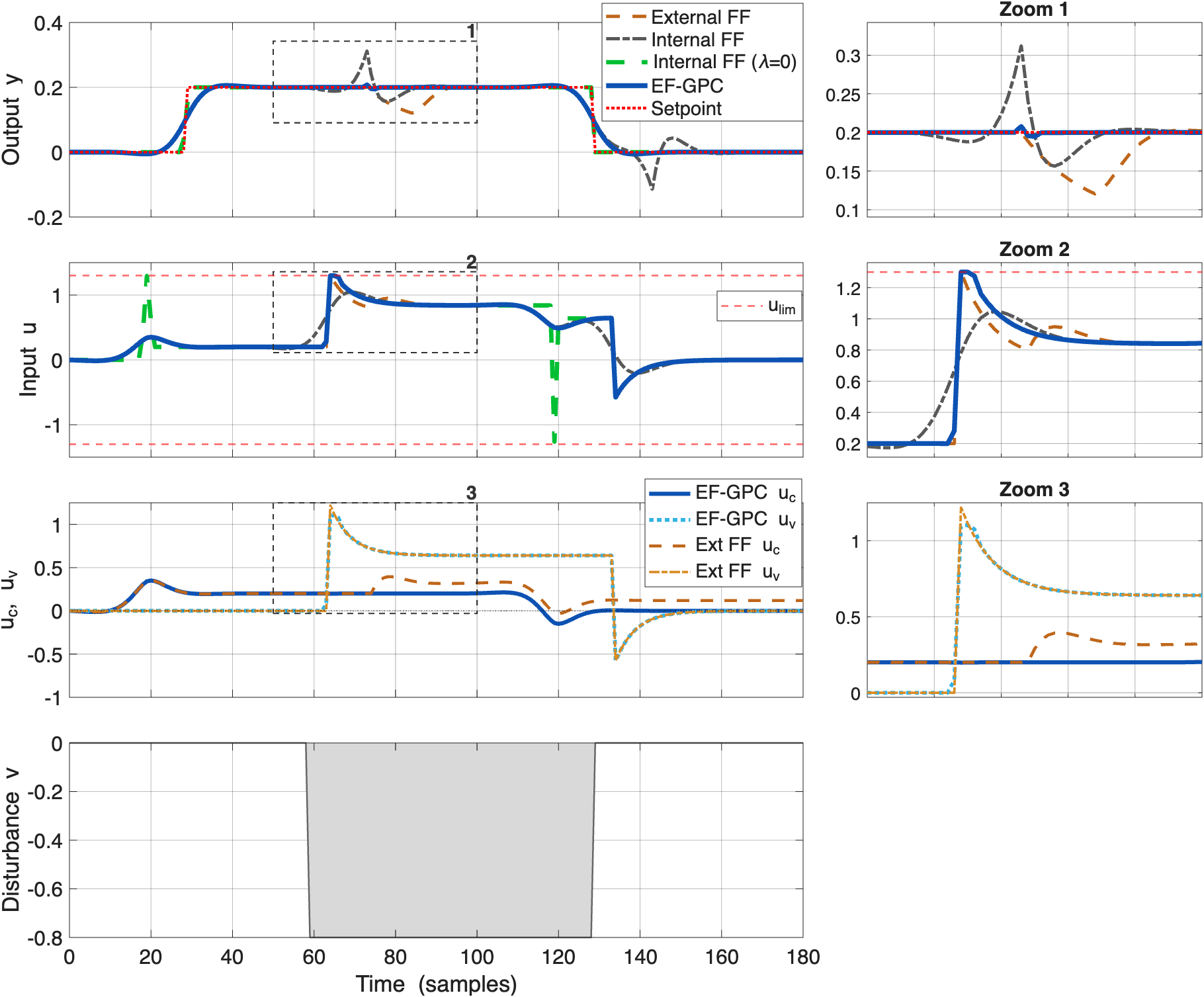
Enforcing input saturation, EF-GPC outperforms all alternatives: it respects constraints while minimizing both setpoint and disturbance errors. In contrast, the classical external approach induces actuator saturation, causing suboptimal performance and separation of compensation efforts (Figure 3).
Figure 3: Comparative simulation results for the input-constrained feedforward compensation scenario.
Non-Invertible Dynamics
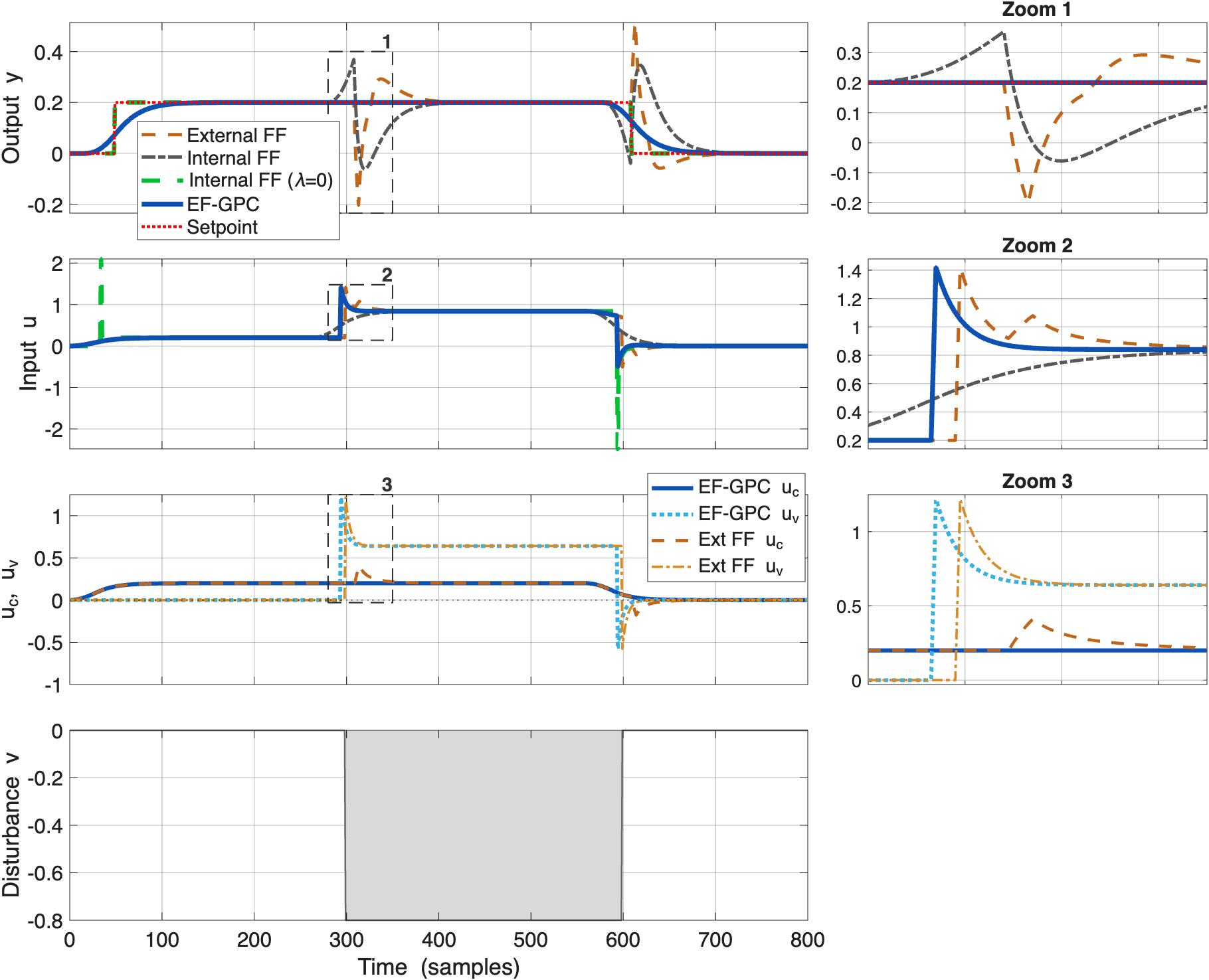
For cases where the process input delay exceeds the disturbance delay (non-causal), classical feedforward fails completely, but EF-GPC intrinsically coordinates the optimal compromise, preserving best achievable rejection (Figure 4).
Figure 4: Comparative simulation results for the non-invertible feedforward compensation scenario.
Nonlinear RO Process Case Study
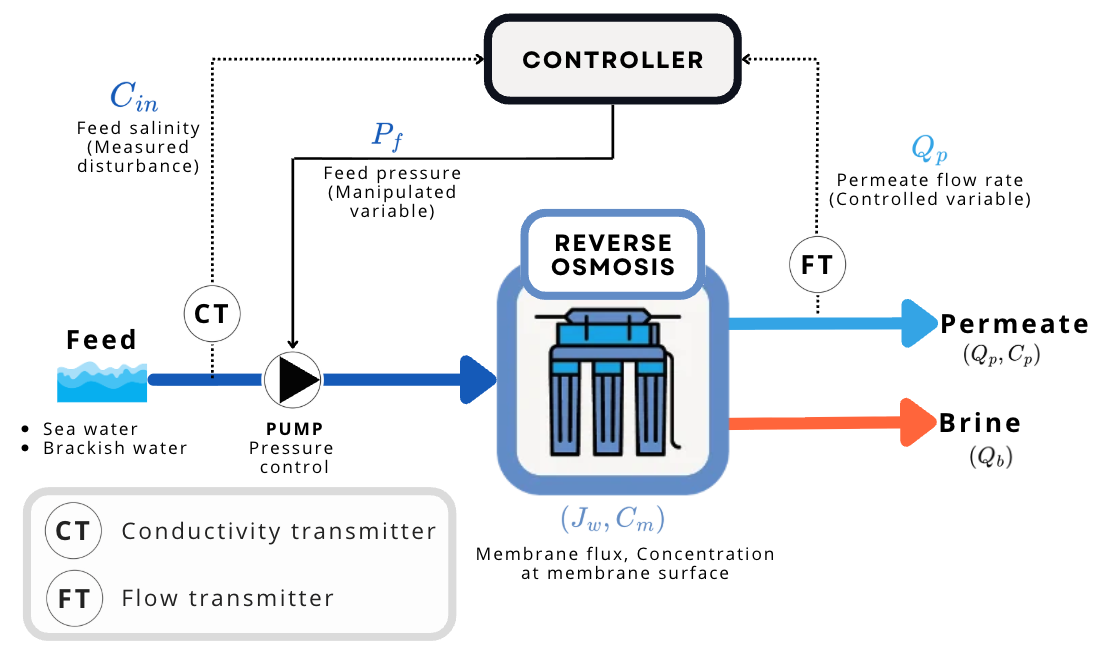
The methodology is tested on a nonlinear reverse osmosis desalination plant (Figure 5). Even when the plant operates far from the linearized model, EF-GPC maintains strong rejection of rapid feed salinity disturbances without sacrificing closed-loop smoothness during reference changes, outperforming all standard GPC variants.
Figure 5: Schematic diagram of the RO system.
Implications and Future Directions
By structurally embedding feedforward as a decoupled open-loop component within the MPC cost and constraint-handling, the methodology:
Enables true disturbance rejection performance within constrained, multivariable, model-based controllers.
Preserves regular, robust, and smooth setpoint response without sacrificing input limitations, as tuning of tracking and disturbance rejection can be completely independent.
Offers a mathematically unifying prescription for arbitrary model classes (step, transfer function, state-space).
Provides a template for further extension to output, state, and even trajectory constraints; soft and hard limits, and is readily extensible to MIMO settings and previewed/mainstream disturbance forecasting.
A primary theoretical question remains: closed-loop robustness and stability under model uncertainty and disturbance prediction errors, given the open-loop nature of feedforward. This will require Lyapunov-based or robust invariance analysis for the composite controller in future studies.
Conclusion
The paper introduces a novel, mathematically rigorous approach to embedding feedforward compensation in MPC frameworks: the total input is optimally decomposed into independently tunable tracking and disturbance rejection actions, maximizing rejection capabilities under constraints and ensuring highly modular performance tuning. Simulation studies—including on a nonlinear process—verify that it recapitulates the behavior of classical feedforward compensation under ideal conditions and dramatically outperforms conventional approaches under constraints and non-causal scenarios.
This dual-structure MPC paradigm offers a significant advance for predictive controllers in process industries and paves the way for more agile architectures in modern manufacturing, chemical, and energy systems. Future work should analyze the stability/robustness domain and consider generalizations to stochastic disturbances and time-varying uncertainty.