- The paper introduces a robust IMMPC approach that merges tube-based MPC with the Internal Model Principle to ensure offset-free tracking even in the presence of unmodeled disturbances.
- It employs an augmented state formulation and convex interpolation to guarantee recursive feasibility and constraint satisfaction under both structured and arbitrary bounded disturbances.
- Experimental results on a Quanser four-tank system demonstrate rapid disturbance rejection, precise tracking, and quick recovery from constraint violations.
Robust IMMPC: An Offset-Free Model Predictive Control for Rejecting Unknown Disturbances
Introduction
Offset-free Model Predictive Control (MPC) remains central to constrained regulation and tracking tasks under uncertainty. The standard Internal Model Principle (IMP) embeds dynamic models of reference signals and disturbances within the controller, achieving robust regulation against model-matched signals. Nonetheless, conventional approaches require all persistent disturbances to be generated by known signal models, a limitation for real-world plants with both structured and unstructured (arbitrary but bounded) disturbances. The paper "Robust IMMPC: An Offset-free MPC for Rejecting Unknown Disturbances" (2604.00564) introduces a robust Internal Model Model Predictive Control (IMMPC) methodology merging the strengths of artificial reference/tube-based MPC and the IMP architecture, extending robust tracking and disturbance rejection to a broader class of exogenous disturbances under constraints.
The work adopts a discrete-time linear time-invariant (LTI) model with both known-structure (via stable linear signal generators) and arbitrary but bounded exogenous disturbances acting on the dynamics and output:
x(t+1)=Ax(t)+vx(t)+wx(t)+Bu(t)
e(t)=Cx(t)+ve(t)+we(t)
Here, (A,B) is controllable and (A,C) is observable. The total disturbance is split such that vx(t) and ve(t) satisfy constant, ramp, or sinusoidal dynamics (depending on p(z)), while wx(t) and we(t) are only assumed bounded. The core regulation objective is to steer the regulated output e(t) to zero while maintaining constraint satisfaction even in the presence of these unmatched, possibly time-varying, bounded disturbances.
IMMPC Design and Technical Innovations
Augmented System and Extended State
The approach first leverages the structure of signal-generator disturbances to derive an equivalent state augmentation that recasts the system into an incremental (velocity-form) representation. This allows the prediction model to capture both the known-structure disturbances and enables direct embedding of dynamic disturbance models as part of the control law. Recursive feasibility and constraint satisfaction are attacked using robust positively invariant (RPI) sets, constructed for the stabilized error dynamics and internal model states.
Tube-based Robustification
Rather than assuming all disturbances are captured by the signal model, arbitrary bounded elements are addressed using set-theoretic (tube-based) MPC. The robust policy enforces that constraints on state and control are satisfied for all admissible disturbance trajectories by tightening the feasible sets around a nominal (central) trajectory plus an RPI tube. Notably, the IMMPC scheme computes RPI sets for the error between the real and nominal trajectories, resulting in a closed-loop system resilient to both modeled and unmodeled bounded perturbations.
Convex Interpolation for Disturbance State Initialization
To maintain recursive feasibility even after unmodeled reference or disturbance changes, the paper proposes an initialization routine for the nominal disturbance state, using convex combinations of feasible fallback disturbance trajectories and the current internal model state. This method is shown to guarantee recursive feasibility and constraint satisfaction, even with unexpected shifts in persistent disturbances.
Theoretical Guarantees
Strongly, the authors prove that under mild conditions—most notably initial feasibility and bounded disturbances—the closed-loop system controlled by the robust IMMPC law satisfies:
- Recursive Feasibility: At each time instant, the optimization problem admits a feasible solution, even under dynamically changing disturbances.
- Robust State and Input Constraint Satisfaction: All imposed system and input constraints are respected for all disturbance realizations within the modeled bounds.
- Offset-free Regulation/Tracking: The controlled output converges asymptotically to the optimal reachable reference or the minimum possible regulation error within constraints, even in the face of unmodeled bounded disturbances.
Practical Demonstration: Four-Tank Laboratory Process
The framework is experimentally validated on a Quanser four-tank system (Figure 1), a benchmark multivariable process often used as a testbed for robust and fault-tolerant MPC algorithms.
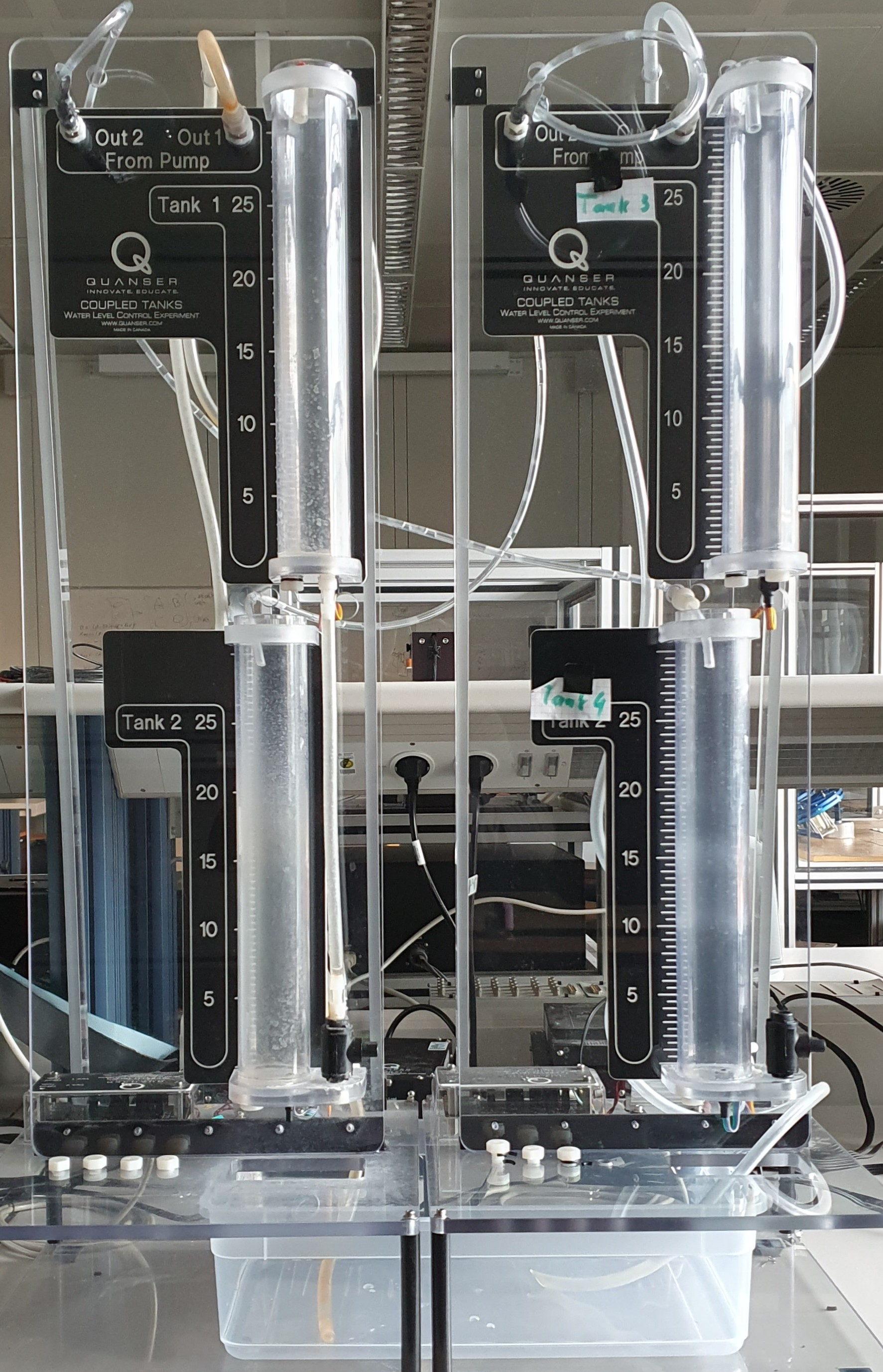
Figure 1: Four-tank system consisting of two Quanser Coupled Tanks.
The control objective is reference tracking for the lower tank levels, with both actuator and state constraints and scenarios involving piecewise-constant reference changes and unmodeled actuator disturbance (manual valve manipulations).
Tracking performance is illustrated in Figure 2, where the controller achieves precise tracking, rapid disturbance rejection, and immediate recovery from constraint violations induced by abrupt reference or plant changes, with only brief, minor constraint breaches during aggressive setpoint steps.
(Figure 2)
Figure 2: Four-tank experiment with piecewise constant references and robust IMMPC regulation—disturbance rejection and offset-free constraint handling are evident.
Numerical and Experimental Observations
- The controller robustly rejects unknown step disturbances applied to the system, as showcased by quick recovery after manual valve interventions.
- Reference shifts that render the setpoint infeasible (due to state constraints) are handled gracefully by the artificial reference framework—convergence is to the closest admissible point.
- Minor constraint breaches occur only during significantly unmodeled transients, after which the tube-based robustification ensures a return to admissibility.
- The practical realization (with a sophisticated RPI set computation and constraint tightening of approximately 1 cm for state and 0.1 V for actuators) demonstrates the design’s real-world applicability.
Implications and Outlook
The presented robust IMMPC generalizes classic offset-free MPC to handle:
- Arbitrarily structured but bounded persistent disturbances—transcending the limitation of only handling signal generator-matched disturbances.
- Aggressive reference changes and nonzero, potentially unmodeled dynamics while retaining formal constraint guarantees.
- Recursive adaptability to disturbance model mismatches via convex disturbance state interpolation within the prediction horizon.
Theoretically, this work sharpens the connections between tube-based robust control, artificial reference frameworks, and internal model-based disturbance rejection. Practically, it shows promise for deployment to highly-constrained, safety-critical embedded systems subject to nonstationary and partially unknown environments—such as chemical process units, automotive powertrains, and cyberphysical infrastructure.
Future research directions include extension to nonlinear systems, distributed/decentralized architectures, learning-based adaptation of disturbance models, and integration with advanced fault diagnosis for plug-and-play operation in presence of sustained fault or actuator/sensor failures.
Conclusion
This paper presents a rigorous, experimentally validated robust IMMPC framework that unites artificial reference tracking, internal model disturbance rejection, and robust tube design. It delivers provable constraint adherence and offset-free regulation for linear constrained systems with both structured and arbitrary bounded disturbances. The demonstrated efficacy on a canonical laboratory plant underlines its generality and potential for broader adoption in industrial and safety-critical scenarios.