- The paper establishes that a federated, OS-like Three-Ring Architecture is essential to reduce the 95% enterprise AI failure rate by orchestrating legacy systems and LLM-based agents.
- The paper demonstrates how deterministic governance in Ring 2 secures compliance, auditability, and coordinated resource allocation across diverse operational layers.
- The paper outlines a transformative framework integrating Algorithmization training and dual technology paths to mitigate risk and drive enterprise-wide digital transformation.
Architectural Thesis and Motivation
This paper establishes a rigorous case for the necessity of a federated, OS-like infrastructure—termed the Three-Ring Architecture—to enable controlled, productive deployment of agentic AI systems within complex organizations. The authors contend that the persistent, modality-invariant 95% failure rate in enterprise AI initiatives is not reducible to insufficient model capability, but is a structural consequence of the absence of a federation layer that coordinates, governs, and compounds distributed intelligence across organizational boundaries.
Three analytically distinct but interdependent rings are defined:
- Ring 1: The legacy production architecture (ERPs, regulated systems, and workflows), which serves as the enterprise's hardware substrate and is to be progressively absorbed rather than abruptly replaced.
- Ring 2: The OS/federation layer (M2 strategies-based agentic AI), deterministic by design, architecturally definitive, and responsible for governing both legacy functionality and higher-level AI actors.
- Ring 3: LLM-based, probabilistic, loosely coupled, and entirely dependent on Ring 2 for meaningful and safe operationalization.
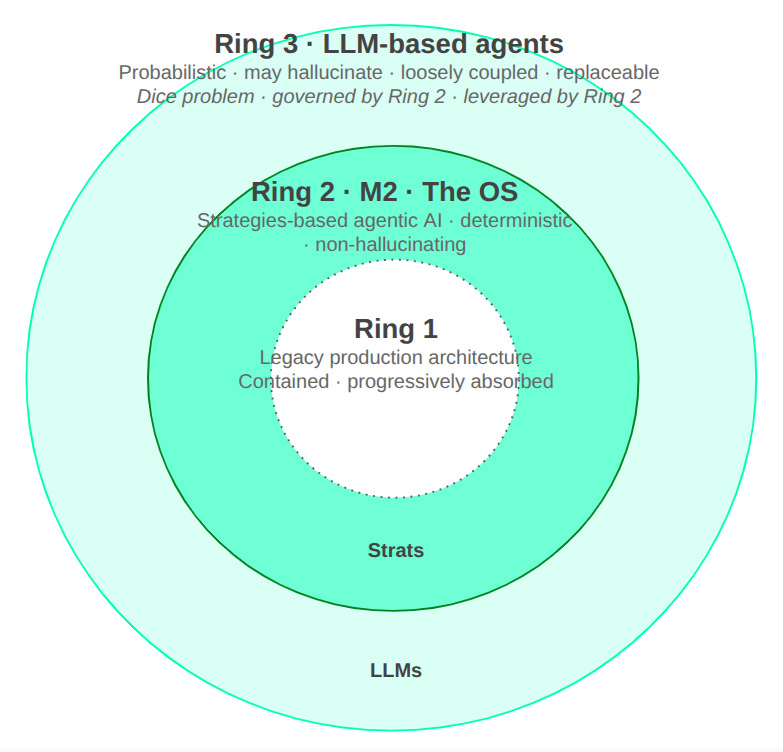
Figure 1: The Three-Ring Architecture. Ring 2 (solid boundary) is the OS: deterministic, governing, architecturally definitive; Ring 1 (inner dashed) is to be absorbed; Ring 3 (outer dashed) is a replaceable, governed satellite.
The architecture is not a functional hierarchy of users but an infrastructure topology, with both humans and AI agents able to enter at any ring, the ring of entry determining the applicable governance regime. The paper’s central claim is that Ring 2 is not an option but a necessary condition for compliance, traceability, auditability, and safe compounding of enterprise intelligence, particularly as LLM capabilities (Ring 3) expand.
Ring 2 is rigorously mapped to the four canonical roles of an OS:
- Resource abstraction: Mediating application-level access to heterogeneous, complex legacy systems.
- Process coordination: Orchestrating distributed agentic workflows and preventing conflicting or inconsistent state transitions.
- Permission enforcement: Providing non-circumventable security and compliance at a level below application workflows.
- Platform provision: Enabling a compounding developer ecosystem through stable interfaces and abstractions.
The justification for the OS model is rooted in the theory of deterministic complexity. The paper distinguishes two fundamental risk profiles:
- Butterfly Problem: In deterministic but complex systems (Ring 1 + Ring 2), small, local, traceable perturbations may propagate with nonlinear, delayed, and disproportionate effect. However, consequences are in principle fully audit-traceable.
- Dice Problem: In contrast, LLM-based (Ring 3) agents inject non-determinism at the node level, inducing hallucinations and deviations that are not retrospectively traceable or strictly derivable from initial conditions. This risk is categorically distinct and not remediable at the application layer.
This strict bifurcation formalizes why Ring 2 is inelastic: as LLMs become more capable, the size and scope of untraceable deviations grows, thus increasing the severity of the governance requirement.
Federation Functions and Architectural Properties
Ring 2 operationalizes governance through five federation functions:
- Aggregation: Compiling agent outputs enterprise-wide, enabling cross-silo synergy.
- Coordination: Orchestrating agent workflows, resolving concurrency, and enforcing global system integrity.
- Routing: Precisely directing tasks, maintaining context, and ensuring compliance-aware ownership.
- Governance: Enforcing permissioning, audit, and regulatory compliance by construction.
- Federation: Enabling cross-organization and cross-industry intelligence sharing, with cryptographically protected IP.
Complementing these functions, Ring 2 is characterized by five architectural properties:
- Ease of integration: Coexistence with and progressive absorption of legacy systems.
- IP protection by design: Localized data/model governance.
- Control: Deterministic, strategy-driven agent orchestration.
- Auditability and traceability: Architectural-level logging, enabling system-level explainability as required by regulatory frameworks (e.g., EU AI Act, DORA).
These properties sharply differentiate Ring 2 from previous enterprise software (ERP, SaaS, cloud infra), which are argued to have confined their capabilities to application logic without reaching the OS-like cross-functional governance necessary for compounding intelligence.
The practical preconditions for adopting this architecture are operationalized in the Extreme-Efficient Nations (EEN) diagnostic framework—a cross-sector, empirically grounded tool used to measure AI maturity, pain points, and transformation readiness at both organizational and national levels. The framework addresses the epistemic blindness intrinsic to self-assessment and advisory capture, benchmarking each organization against sector-wide empirical distributions and surfacing both manifest and latent bottlenecks.
This foundation supports a transformation agenda that is not hostage to the existing internal or advisory power structures and provides the data substrate for the prioritization protocols that directly impact resource allocation and governance structure.
Transformation governance is instantiated via the Three-Layer Company Model:
- Tech Must: Capabilities foundational for operational continuity and regulatory compliance.
- Right to Play: Industry baseline capabilities—necessary but not differentiating.
- Right to Win: Proprietary, protectable, strategically differentiating developments.
The dynamic Ranked Transformation Agenda (RTA) is the prioritization instrument, continuously recalibrating project pipelines based on time-to-production, impact, synergy with the architectural base, and organizational context, not static lists or consultant roadmaps. It governs both “quick wins” (credibility/momentum) and “structural projects” (compounding architectural value), with explicit management of the compounding synergy across project portfolios.
Training, Talent, and Absorption
The paper posits Algorithmization training—not generic AI literacy—as the epistemic baseline for adopting and exploiting the architecture. This multi-disciplinary training ensures the organization can govern its own transformation agenda, judge external proposals, and resist vendor-driven architectural misalignment.
The absorption of AI and frontier capability is institutionalized through a set of permanent roles: center of excellence (frontier-shifting), catalyser (latency minimization to operational impact), business (heuristics and protocol definition), and execution (data scientists/engineers). The federated architecture, with its compartmentalization and knowledge-on-platform principles, is additionally claimed to structurally mitigate the systemic risk posed by high rates of technical talent rotation, converting what is typically an organizational liability into an antifragility mechanism.
Dual Technology Paths and Economic Structure
Both modular (standard-tech, right-to-play) and integral (custom-platform, right-to-win) paths are formally accommodated. The architecture enables both forms to co-exist within a governed resource allocation strategy, regulated by the RTA. The economic structure of integral (Ring 2/3-driven) deployment is designed to align transformation value with investment: minimal upfront cost, with incremental capacity funded by project KPIs, capped by a federated cost model and open to cash-and-stock arrangements for maximum provider/enterprise alignment.
Market and Ecosystem Implications
The Three-Ring Architecture reframes the market for enterprise AI. Instead of capturing the software budget, it competes for labor budgets as intelligence itself becomes the compounding asset. The direct implication is that the addressable market for the OS layer is every algorithmically driven organization—which the paper claims includes every competitive company within a decade. The architecture’s openness to federation also repositions the locus of ecosystem accumulated advantage: developer contribution and architectural adoption, not vendor lock-in.
Theoretical and Practical Implications
Key strong claims substantiated:
- Ring 2 is categorically required for safe, auditable, and compounding enterprise AI; direct Ring 3-to-Ring 1 integration is systematically unsafe.
- Governance requirements scale with LLM capability: Increased capability magnifies governance necessity, contrary to narratives suggesting technical advance reduces need for robust control.
- Architectural, not capability, constraint: The universal failure rate arises from absence of federation, not sophistication of AI models or consulting/implementation efforts.
Theoretical consequences extend to the modeling of enterprise and national digital transformation as functionally isomorphic to the OS transition in computing history. The paper opens a research pathway to formalizing ecosystem economics, longitudinal transformation studies, and the capital structures of technology partnerships, with explicit mention of stock-based compensation and investment in mutual capability advancement.
Conclusion
The Three-Ring Architecture delivers a functionally exact OS paradigm for the era of agentic, on-platform organizations, asserting that safe and scalable deployment of frontier AI requires deterministic, cross-silo governance. All improvements in LLM or agentic capability increase—never decrease—the necessity of the federation layer. The architecture’s explicit, formalism-driven alignment with regulatory requirements and its empirically validated deployment in structurally demanding verticals (e.g., finance and government) support its foundational status. Future research is required to quantify the compounding effect at ecosystem scale, model longitudinal transformation velocity, and characterize the geopolitics of on-platform adoption. The theoretical and market direction suggested is a re-anchoring of transformation strategy—from vendor-driven capability deployment to business-led governance at architectural scale.