Abstract: Quantum computing offers several algorithms to compute the ground state of a problem Hamiltonian. The most desirable algorithms belong to the Fault Tolerant QuantumComputing (FTQC) regime, such as quantum algorithms with repetitive structure like Quantum Phase Estimation (QPE) and Quantum Signal Processing (QSP). However, in the Noisy In-termediate Scale Quantum (NISQ) regime, the most realistic approaches involve Variational Quantum Eigensolver (VQE) algorithms and their variants. VQE is an algorithm that searches for a parametrized unitary matrix called an ansatz whose purposeis to transform an easily prepared initial state into the groundstate of a given Hamiltonian. Adaptive Derivative-AssembledPseudo-Trotter (ADAPT)-VQE is a variant of VQE that im-proves this approach by constructing the ansatz iteratively so that the associated quantum circuit is as shallow as possible. A major difference between FTQC (i.e. not variational) algorithms and VQE is that FTQC algorithms do not construct a state transitiondirectly. Instead, they construct a projector that identifies the ground state using ancillary qubits that flag the good solution. The desired state is then obtained via amplitude amplification orpost-selection. In this work, we propose a VQE ansatz whose structure is more similar to that of an FTQC algorithm. Depending on its parametrization, this ansatz can be equivalent to either an Intermediate Scale Quantum (ISQ)-QSP or to an ADAPT-VQE quantum circuit structure. Our experimental results show that this first proposal of Projector Variational Ansatz (PVA) converges with a shallower ansatz than the usual ADAPT-VQE.
The paper introduces PVA, a hybrid algorithm blending projector-based methods with adaptive VQE to reduce circuit depth and operator count in ground-state quantum calculations.
It demonstrates that PVA attains chemical precision in molecules like H4 and BeH2 with significantly fewer ansatz layers, despite an ancillary post-selection overhead.
The method enhances adaptive circuit growth and mitigates optimization challenges, offering a scalable, hardware-efficient alternative for NISQ and future quantum devices.
Projector Quantum Variational Ansatz: Theory and Practical Assessment
Introduction
The quest for efficient ground-state preparation within quantum chemistry and physics remains one of the primary drivers for algorithmic innovation in quantum computing, particularly in the Noisy Intermediate-Scale Quantum (NISQ) era, where fault tolerance is not yet achieved. The Variational Quantum Eigensolver (VQE) and its adaptive variants (e.g., ADAPT-VQE) have become de facto frameworks for NISQ ground-state calculations. Yet, these approaches rely on parametrized unitaries transforming initial states toward ground states, typically yielding a direct state transition. In contrast, algorithms compatible with fault-tolerant quantum computing (FTQC)—such as Quantum Phase Estimation (QPE) and Quantum Signal Processing (QSP)—construct projectors onto eigenspaces, with flagged ancillary qubits indicating successful preparation, often requiring post-selection or amplitude amplification.
This paper introduces a new family of variational ansatzes, the Projector Variational Ansatz (PVA), which hybridizes the projector-based structures of FTQC with the variational principles of VQE. The work systematically details the theory, ansatz construction, and benchmarks against state-of-the-art adaptive VQE methods, providing evidence that PVA can systematically reduce circuit depth and number of operators to achieve chemical precision in quantum chemistry Hamiltonians.
Theoretical Framework and Ansatz Construction
The work acknowledges the two dominant paradigms for parameterized quantum state preparation: (1) static ansatzes (unitary coupled-cluster, hardware-efficient circuits, Hamiltonian variational ansatz) and (2) adaptive ansatzes, such as ADAPT-VQE, which iteratively build the circuit by selecting gradient-sensitive operators from a predefined pool.
A key insight is that existing VQE-based approaches fundamentally differ from QSP and QPE: the latter define a projector onto the ground state via block-encoding and ancillary qubit measurements, rather than direct state transformation. The PVA seeks to embed this projector mechanism within a variational circuit.
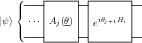
Figure 1: Quantum circuit representation of the ISQ-QSP, foundational for subsequent projector-based ansatz construction.
The construction proceeds as follows:
Signal Operator: Using Trotterized Hamiltonian simulation, a block-encoded operator eiγHp+δI is constructed, targeting ancilla-controlled phase evolution (as in QSP).
QSP-Based Projector: The ansatz layers alternate between signal operators and RX ancilla rotations, parameterized to approximate a step-function filter (projector) onto the desired portion (λi<Δ) of the spectrum.
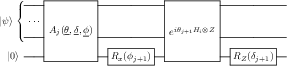
Adaptive Integration: The PVA is made adaptive, combining the iterative operator selection of ADAPT-VQE with ancilla-controlled projectors, yielding a hybrid adaptive-projector ansatz.
The result is a quantum circuit that, depending on parameterization, can smoothly interpolate between standard ADAPT-VQE and projective ISQ-QSP architectures.
Figure 2: Quantum circuit structure of ADAPT-VQE, which iteratively builds the ansatz by appending exponentiated Hamiltonian terms.
Figure 3: Quantum circuit structure of the Projector-ADAPT-VQE, integrating ancilla-mediated subspace projection in each layer.
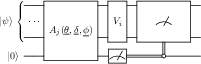
Figure 4: Measurement circuit to estimate expectation values within the projected subspace of the Projector-ADAPT-VQE.
Numerical Benchmarks and Performance Evaluation
The PVA is benchmarked on quantum chemistry test cases (H4, LiH, H6, and BeH2) via both exact-statevector and finite-shot simulations, using operator pools derived from Qubit-ADAPT-VQE (individual Pauli strings) and Fermionic-ADAPT-VQE (exact fermionic excitation operators).
Key findings:
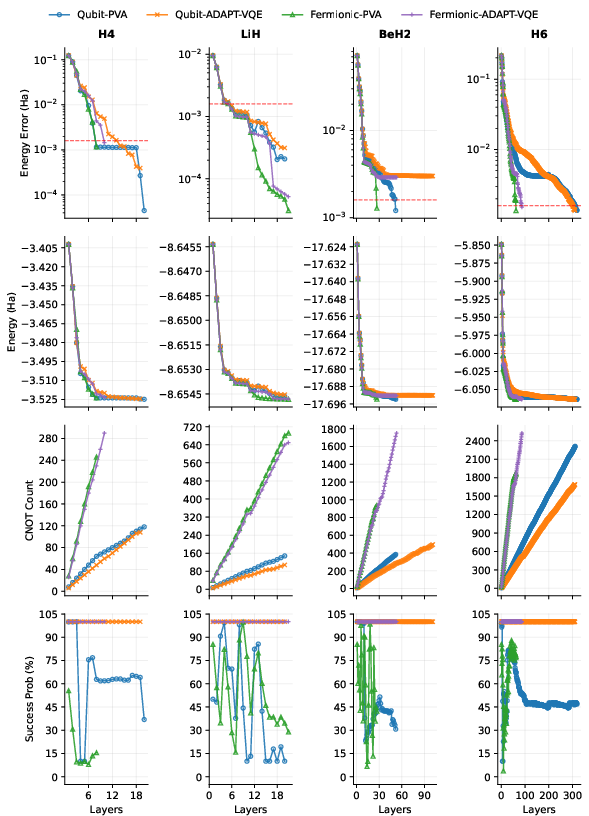
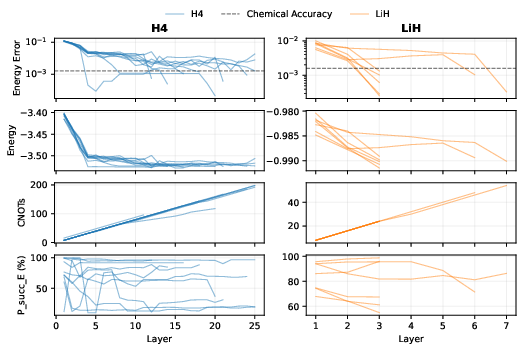
Convergence and Expressivity: The PVA consistently achieves chemical accuracy with fewer ansatz layers compared to standard ADAPT-VQE. For instance, in H4, PVA attains chemical precision with 8 layers versus 15 for Qubit-ADAPT-VQE. In BeH2, PVA overcomes optimization plateaus that trap the conventional ansatz, reaching chemical accuracy in 52 layers where standard methods do not converge after 200 layers.
Gate Complexity: Although PVA incurs a per-layer CNOT overhead due to ancilla involvement, the overall CNOT count remains comparable or lower because of the reduced number of layers required.
Figure 5: Comparative performance of the PVA, Qubit-ADAPT-VQE, and Fermionic-ADAPT-VQE on various molecules, showing PVA's accelerated convergence and reduced required operator layers.
Projection Probability: PVA exhibits a drop in measurement success probability (Psucc) due to post-selection mechanics, but empirically this stabilizes at practical levels (e.g., 60% for X0), thus not impairing applicability on NISQ hardware.
Operator Pool Influence: The efficiency gain is robust to choice of pool (Pauli-string vs. fermionic operators); for more strongly correlated systems, PVA sustains faster convergence than both canonical adaptive ansatzes.
Scaling with System Size: Analyzing CNOT count, the per-layer overhead induced by the projector vanishes in relative terms as molecular system size increases, enhancing the scalability prospects of PVA.
Figure 6: Schematic circuits highlighting CNOT count differences for various operator pool choices, informing gate complexity scaling.
Robustness to Finite Sampling: In finite shot (statistical noise) settings, PVA preserves its monotonic convergence properties and reduced layer count, demonstrating resilience essential for NISQ implementation.
Figure 7: Finite-shot simulation of PVA on X1 and X2, exhibiting maintained convergence and success probabilities in the presence of measurement noise.
Discussion and Implications
The PVA family introduces several critical technical advantages relevant to the practical deployment of quantum algorithms on NISQ devices:
Expressivity-Preserving Compression: By incorporating non-unitary projective steps, the variational landscape is broadened, allowing efficient Hilbert space exploration and faster escape from barren plateaus and optimization traps commonly inhibiting standard VQE and its adaptive variants.
Resource-Efficient Depth Reduction: Lower circuit depth and operator count directly relaxes hardware constraints on NISQ processors, addressing one of the principal limitations of current VQE and ADAPT-inspired methods [c.f., (Zhang et al., 2020, Tang et al., 2019)].
Algorithmic Flexibility and Generality: PVA’s structure subsumes both QSP-like projectors and adaptive VQE mechanisms, providing a versatile toolset that can be tailored (via pool operator selection and parameter initialization) to a diversity of quantum algorithmic challenges beyond ground-state chemistry, including quantum linear system solvers (Bravo-Prieto et al., 2019, Zhong et al., 2024) and machine learning state preparation.
Hardware-Compatibility: The requirement of only a single ancillary qubit (per layer) for projection, with empirical stabilization of post-selection probability, makes the scheme compatible with near-term devices and tolerant to measurement stochasticity.
Theoretically, the integration of projective subspace filtering with adaptive ansatz growth defines a new regime for variational algorithms, promising improved trainability in deep circuits and providing new testbeds for algorithmic research targeting robustness against vanishing gradients and expressivity bottlenecks. The mechanics of PVA also suggest direct connections to quantum neural networks, wherein ancilla-controlled projection could play a role analogous to non-linearity (activation functions) in classical architectures.
Conclusion
The Projector Variational Ansatz represents a significant step toward hybridizing the rigor and scalability of FTQC algorithms with the adaptivity and implementability of VQA-based approaches for NISQ hardware. Extensive simulations demonstrate that PVA reliably reduces circuit depth and measurement resources required for achieving chemical accuracy, while remaining compatible with finite-shot experimental constraints. The methodology's flexibility, grounded in the compatibility of projector-based methods and adaptive circuit growth, positions it as a promising foundation for both quantum chemistry and broader quantum algorithm development utilizing NISQ and emerging ISQ platforms.
Future prospects include the refinement of projector mechanisms, integration into more aggressive layer-bundling adaptive schemes (e.g., Tetris-ADAPT, Geo-ADAPT), and exploration of applications in quantum machine learning where controlled non-linearity and Hilbert space compression are essential.
“Emergent Mind helps me see which AI papers have caught fire online.”
Philip
Creator, AI Explained on YouTube
Sign up for free to explore the frontiers of research
Discover trending papers, chat with arXiv, and track the latest research shaping the future of science and technology.Discover trending papers, chat with arXiv, and more.