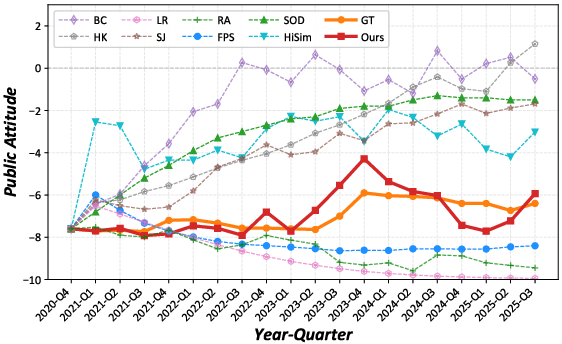
- The paper introduces ES-MAS, a multi-agent simulation framework that fuses significant geopolitical events and personalized news streams to model U.S. attitudes toward China.
- It employs dual-stream data integration and dynamic agent interactions to achieve high-fidelity alignment with empirical opinion trends, outperforming state-of-the-art baselines.
- Quantitative improvements include reduced DTW and Fréchet distances and robust ablation analyses, supporting enhanced scenario testing and policy feedback.
Event-Steered Simulation of U.S. Attitude Dynamics Toward China
Introduction
"Modeling U.S. Attitudes Toward China via an Event-Steered Multi-Agent Simulator" (2606.06971) presents an integrated multi-agent simulation framework, ES-MAS, targeting the realistic emulation of evolving U.S. public attitudes toward China during 2021–2025. This work advances current opinion dynamics modeling by overcoming the limitations of fixed-rule-based agent-based models (ABMs) and static data-driven LLM-based agent simulators. ES-MAS injects both significant geopolitical events and personalized news data streams, coupled with dynamically evolving agent interactions, achieving a high-fidelity correspondence with macro-level real-world trends.
The framework is empirically validated on the newly constructed CURE dataset, offering granular, temporally-aligned ground-truth. The proposed system demonstrates substantial improvements in quantitative and qualitative alignment with observed U.S. attitude trajectories, as reflected in strong metric outperformance over state-of-the-art (SOTA) baselines and robust ablation and sensitivity analyses.
CURE Dataset: Temporal Grounding for Macro-Micro Opinion Coupling
The CURE dataset forms the foundation for time-aligned simulation. It encompasses 20 quarters (2021–2025), comprising 258 expert-curated significant events—key geopolitical inflection points including summits, sanctions, and major diplomatic exchanges—as well as over 14,000 context-relevant daily news articles selectively filtered for influence on China–U.S. relations.
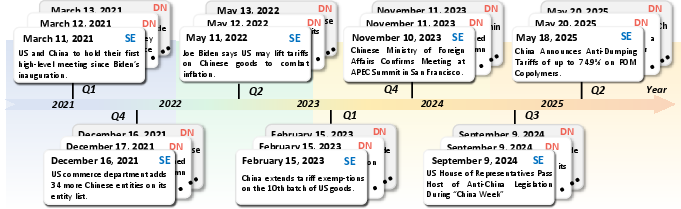
Figure 1: Overview of the CURE dataset, detailing the pipeline linking Significant Events (SE) and filtered Daily News (DN) from 2021–2025.
Crucially, the dataset's temporal resolution is synchronized with ground-truth attitudes derived from the TUIIR database, enabling direct comparison between simulated macro-level outputs and empirical indices.
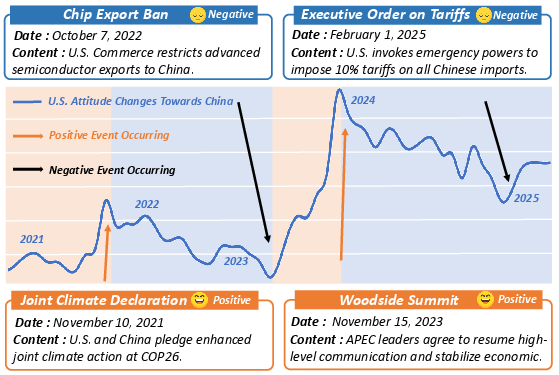
Figure 2: Temporal trajectory visualizing the influence of real-world geopolitical events on aggregate U.S. attitudes toward China.
ES-MAS Framework: Dual-Stream Integration and Dynamic Interactions
The ES-MAS architecture integrates two principal modules:
- Dual-Stream Data Integration Engine (DSDIE): At each simulation timestep, all agents receive (i) a broadcast of current significant events (SEIM), establishing a macro-level context, and (ii) a personalized subset of daily news (PAIM) filtered using each agent's demographic persona and episodic memory. This emulates heterogeneity in media exposure and cognitive biases.
- News-Driven Dynamic Interaction (NDDI): Post-exposure, agents execute social behaviors (post, reply, retweet), are clustered into news-aligned interaction groups, and update attitudes via peer referencing and local deliberation. This drives bottom-up consensus formation while avoiding artificial information cocoons typical in models with static topologies.
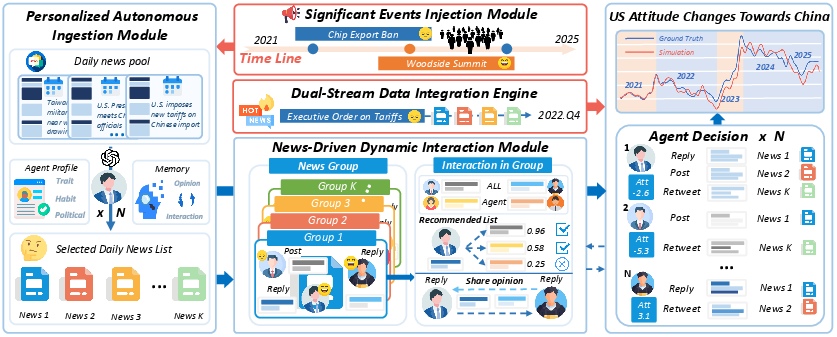
Figure 3: Schematic of ES-MAS, delineating dual-stream data integration and the formation of interaction groups for attitude updating.
This mechanism aligns micro-level cognitive processing with external shocks, allowing diverse agent histories and interaction patterns to collectively shape macro-level attitude evolution.
Quantitative Results and Comparative Analysis
The ES-MAS simulator yields state-of-the-art macro-alignment across all evaluation metrics:
Ablation studies highlight the individual contributions of DSDIE, SEIM, PAIM, and NDDI to total alignment, with the absence of each module resulting in significant degradation, especially when continuous real-world data streams are disabled. Notably, the injection of only significant events (SEIM) gives reasonable trend-following but fails to capture intra-trend micro-dynamics; by contrast, reliance on solely daily news (PAIM) leads to drift and misalignment, underscoring the necessity of dual-source information.
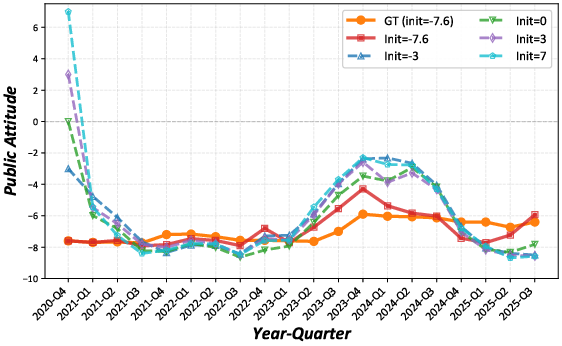
Figure 5: Sensitivity analysis of ES-MAS to varying seeds of initial agent attitudes, confirming robustness and convergence to empirical macro-dynamics regardless of initialization.
Micro-level Dynamics and Interpretability
Granular agent-level analysis exposes how heterogeneous personas process exogenous events. Tracked agents exhibit distinct but context-sensitive opinion volatility in response to both macro shocks (e.g., the Chip Export Ban, the Woodside Summit) and personalized data streams, demonstrating realistic cognitive adaptation.
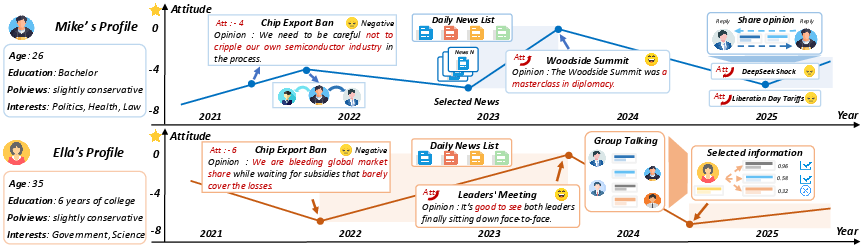
Figure 6: Sample attitude trajectories for agents “Mike” and “Ella,” showing divergence and adaptation under event/news exposure and group interactions.
Such interpretability allows for tracing the mechanisms by which system-level polarization or consensus emerges, controlled through both the group-level interaction topology and the stochasticity of individual agent news ingestion.
Scalability and System Behavior
Performance evaluation across agent populations (N from 25 to 500) reveals consistent alignment for ES-MAS up to N=100, beyond which trend-fitting slightly degrades due to exacerbated group polarization and increased interaction complexity. In contrast, FPS and other SOTA baselines fail to maintain alignment as agent cardinality grows, with ES-MAS remaining stable and convergent under scale through robust peer interaction design.
Implications and Future Prospects
The ES-MAS framework substantiates that event-coupled, news-driven multi-agent systems offer substantial gains for simulating collective macro-opinion dynamics under exogenous shock and endogenous interaction. Practically, this yields value for scenario testing, political risk assessment, and policy feedback under fine-grained, data-grounded hypotheses.
Theoretically, ES-MAS advances the modeling of micro-macro linkages in computational social science, integrating current LLM reasoning capacity with news/event-driven interaction rules and addressing critical deficits of prior static or fully ergodic agent protocols.
Looking forward, extending this architecture can support more complex multilateral opinion systems, adaptation to emerging media environments (e.g., social versus legacy press), or hybrid physical-simulacra studies for adversarial policy gaming. Incorporation of network evolution, cross-linguistic agent pools, and policy intervention modules forms a natural next step in achieving comprehensive, adaptive social simulation.
Conclusion
The ES-MAS simulator, leveraging the CURE dataset, demonstrates that fusing event-driven and personalized news data streams with dynamic agent interaction topologies yields high-fidelity reproduction of real-world collective attitude dynamics. This approach represents a substantive methodological innovation in multi-agent opinion dynamics, with empirical advantages over previous mainstream alternatives and robust implications for both the study and strategic monitoring of evolving international relations.