- The paper demonstrates that fragmented quantum systems with charge and dipole conservation show higher-order Mpemba crossings, where more asymmetric states relax faster.
- It employs random unitary circuits, Hamiltonian dynamics, and a dephasing pair-flip model to reveal distinct relaxation channels, with active fragments driving the Mpemba effect.
- Key findings include sector-selective plateaux and scaling laws for crossing times, suggesting tunability of memory retention in constrained quantum systems.
Higher-order Symmetric Quantum Mpemba Effect in Fragmented Systems
Introduction
The paper "Higher-order Symmetric Quantum Mpemba Effect in Fragmented Systems" (2606.06653) addresses a fundamental question about the relaxation dynamics of isolated and open quantum systems exhibiting strong Hilbert space fragmentation (HSF) due to multiple higher-moment conservation laws, particularly simultaneous charge (U(1)) and dipole-moment conservation. It explores whether the quantum Mpemba effect (QME)—an anomalous relaxation where a state further from equilibrium can relax more rapidly than a closer one—persists in the presence of extensive Hilbert-space fragmentation, and how its structure transforms under such constraints.
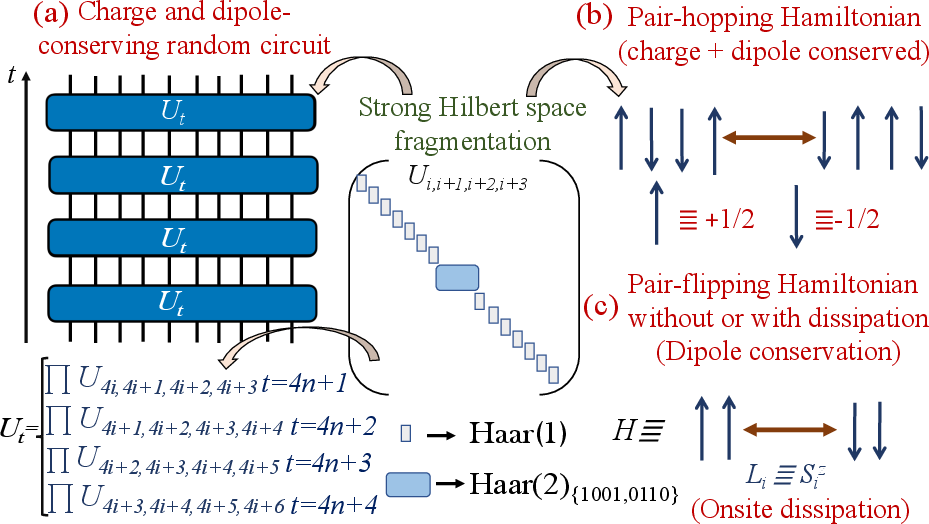
Figure 1: Schematic and summary of the study, outlining the setups (random circuit, pair-hopping Hamiltonian, dissipative pair-flip model), methods (RTN or vector simulation), and core findings—QME persists, acquiring higher-order character and sector-selective crossings.
Theoretical Background and Models
Symmetric Quantum Mpemba Effect
The classical Mpemba effect, traditionally associated with thermal relaxation, is generalized in quantum systems to anomalous relaxation of resource monotones. In this context, the "symmetric" QME (SQME) concerns the restoration of global symmetries, notably quantified using entanglement asymmetry under a given symmetry. The asymmetry (e.g., relative entropy of asymmetry or R\'enyi-2 asymmetry) measures the distance of a reduced density matrix from the symmetric manifold.
Hilbert-space Fragmentation and Symmetry Constraints
Fragmented systems, such as those with both charge and dipole conservation, do not simply constrain the total quantum numbers: they induce an exponential proliferation of dynamically disconnected Krylov subspaces (fragments) in the Hilbert space. A large fraction are frozen (supporting no nontrivial dynamics), while the remainder (active fragments) are small compared to the total sector dimension but admit slow relaxation.
The primary models for the investigation are:
- Random unitary circuits (with charge and dipole conservation), allowing statistical access to large sizes via replica tensor network (RTN) methods.
- Hamiltonian dynamics with deterministic, energy-conserving, pair-hopping processes preserving both symmetries.
- Analytically tractable dissipative pair-flip models with dephasing noise, used to disentangle the mechanism via a closed-form solution.
Methods
Entanglement Asymmetry and QME Criterion
The QME is diagnosed by the time evolution of the entanglement asymmetry:
ΔSO(n)(ρA)=Sn(ρA,O)−Sn(ρA)
where ρA,O is the symmetry-projected reduction of ρA under observable O (charge or dipole). A QME crossing is observed if, during relaxation, a more asymmetric initial state overtakes a less asymmetric one, as quantified by ΔSO(n).
Computational Techniques
Main Results
QME in Strongly Fragmented Random Circuits
- The system exhibits exponential growth in the number of Krylov sectors and a vast preponderance of frozen states. The largest active fragment is exponentially small compared to the total symmetry sector.
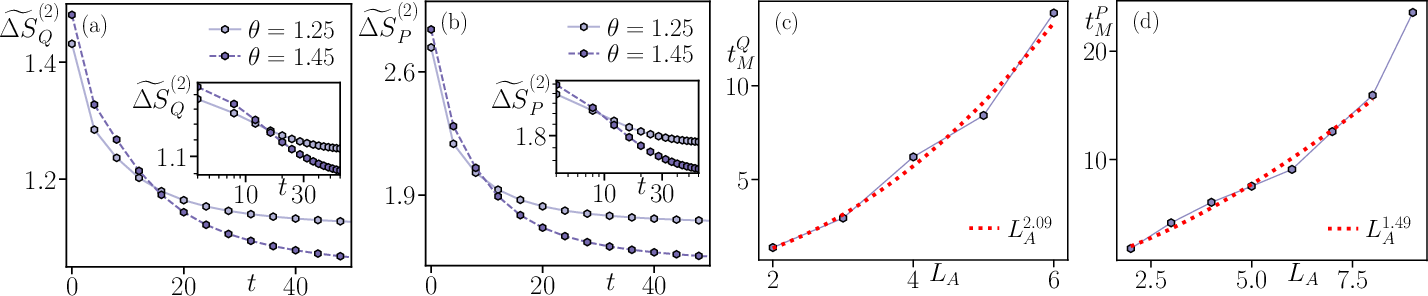
- Both charge and dipole entanglement asymmetries (R\'enyi-2) display pronounced Mpemba-like crossings during relaxation for sufficiently small subsystems, with the more broken-symmetry state overtaking the less broken one.
(Figure 3)
Figure 3: Charge and dipole asymmetry dynamics for L=128-site random circuit; Mpemba-like crossings for both charge and dipole asymmetries observed for small LA, with sector-selective plateaus at large times.
Hamiltonian and Dissipative Dynamics
- Under deterministic, energy-conserving Hamiltonian dynamics, the QME crossings for both charge and dipole sectors persist, corroborating the effect’s robustness to the removal of statistical randomness.
- The magnitude of plateaux and the propensity for symmetry restoration depend on the subsystem’s position (boundary vs. bulk), with boundary subsystems more susceptible to frozen memory and edge-localization effects.
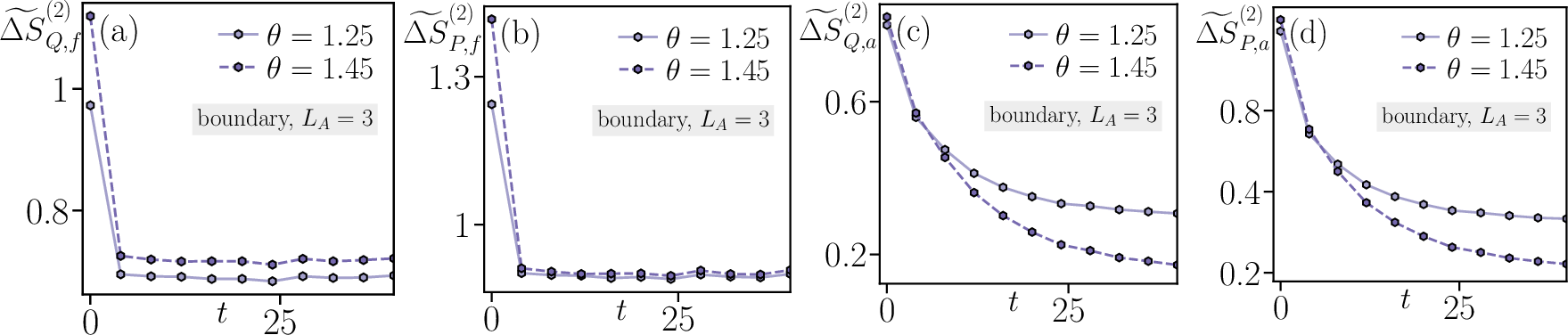
Figure 5: Charge and dipole asymmetry relaxation for Hamiltonian dynamics (pair-hopping model, ΔSO(n)(ρA)=Sn(ρA,O)−Sn(ρA)2); QME-like crossings for both boundary and bulk subsystems.
- In the analytically tractable dephasing pair-flip model, the crossing time for the QME is given explicitly by ΔSO(n)(ρA)=Sn(ρA,O)−Sn(ρA)3 and is independent of subsystem size or sector, provided both initial states strongly break the symmetry.
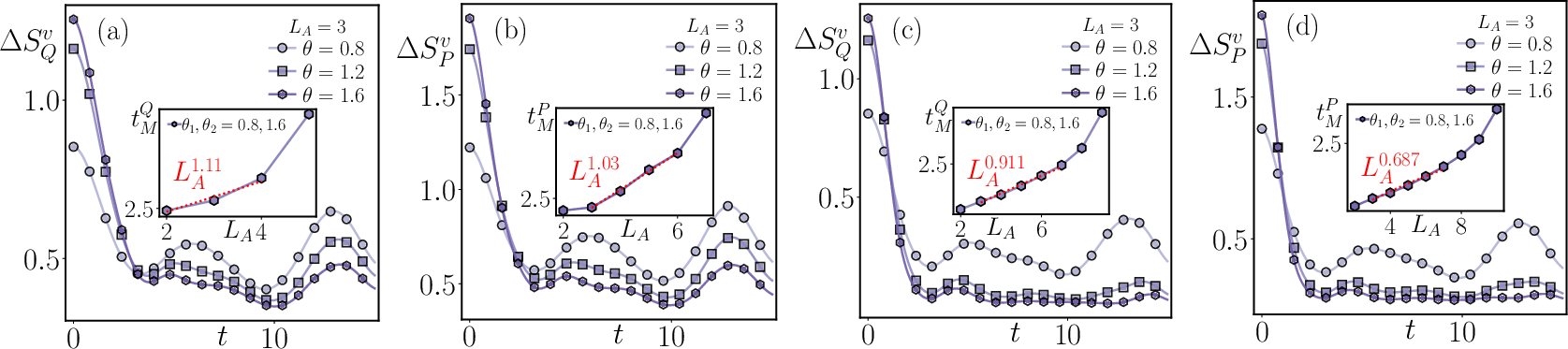
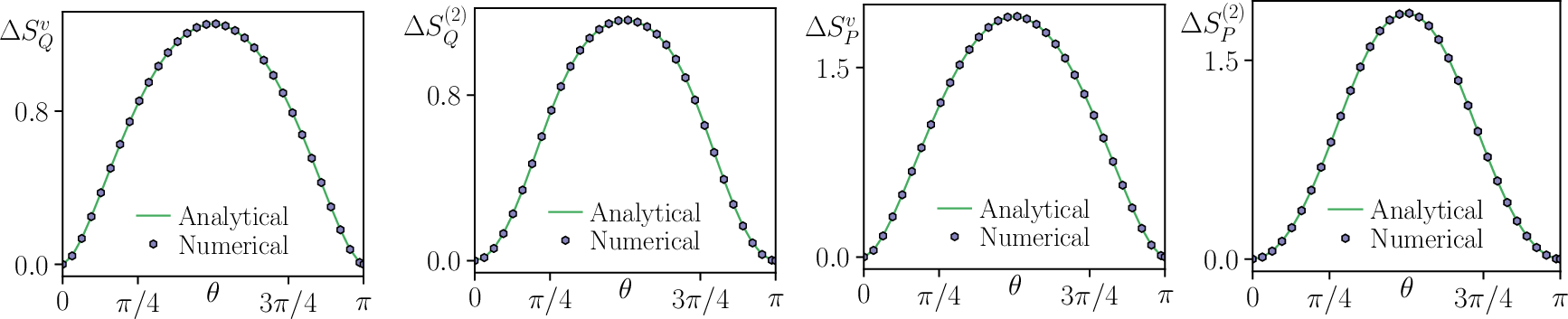
Figure 6: Analytical–numerical validation of pair-flip model; finite-size crossing times match closed-form predictions; plateaus and crossings depend on the interplay between dissipative and coherent dynamics.
- Dissipation ensures monotonic restoration and damps oscillatory recrossings present in the purely coherent regime.
Robustness Across Initial States and Subsystem Geometries
- The higher-order QME is present for both tilted ferromagnetic and antiferromagnetic initial product states, demonstrating insensitivity to the microscopic details of the initial breaking pattern, which is nontrivial in comparison to pure ΔSO(n)(ρA)=Sn(ρA,O)−Sn(ρA)4-only systems.
Implications and Future Directions
The major implication is that strong Hilbert-space fragmentation does not suppress the quantum Mpemba effect; instead, it bifurcates the relaxation into a non-thermalizing, memory-preserving (frozen) channel and an active, QME-exhibiting channel. The presence of multiple conservation laws transforms the QME into a higher-order phenomenon, with sector-selective relaxation on distinct timescales, set by the underlying symmetry hierarchy.
This framework predicts:
- Existence of "towers" of Mpemba behaviors in systems with even higher moment conservation (ΔSO(n)(ρA)=Sn(ρA,O)−Sn(ρA)5-th-moment), which can be generalized to multifractal or fracton-like settings.
- Enhanced memory protection and anomalous information retention in quantum simulators with engineered constraints, relevant for platforms such as Rydberg arrays or tilted optical lattices.
- The tunability of QME via geometry (bulk vs. boundary), system size, initial breaking, and controlled dissipation, relevant for nonequilibrium quantum information and thermalization studies.
Outstanding questions include: quantitative prediction of late-time plateaux for general protocols, the effect of explicit symmetry-breaking perturbations, and the interplay between QME and constraint-induced transitions between strong and weak fragmentation regimes. Extensions to higher dimensions and other quantum resource monotones (e.g., non-stabilizerness, coherence, non-Gaussianity) are promising avenues for future research.
Conclusion
This work establishes the persistence and structural richness of the quantum Mpemba effect in systems with strong Hilbert-space fragmentation enforced by multiple global conservation laws. The effect splits into higher-order, symmetry-resolved crossings embedded in a relaxation landscape shaped by frozen memory and active-sector relaxation. The analytical framework, numerical methodology, and diagnostic observables presented will inform subsequent studies of constrained quantum thermalization, resource dynamics, and information retention in many-body systems (2606.06653).