Asymmetry dynamics and nonequilibrium symmetry-breaking phase transitions
Published 5 Jun 2026 in cond-mat.stat-mech and quant-ph | (2606.07188v1)
Abstract: In classical settings, the Mpemba effect occurs when a hotter system cools faster than an initially colder one. In quantum systems, this effect can be reinterpreted exploiting the concept of symmetries, with the asymmetry of a subsystem playing the role of temperature. A quantum Mpemba effect arises when a more asymmetric state restores the symmetry faster than a less asymmetric one. Previous work mainly focuses on closed systems characterized by thermal equilibration and Hamiltonian symmetries. In this paper, we analyze the dynamics of asymmetry in an open quantum many-body system featuring symmetry breaking and uncover dynamical behavior that appears to be unique to these settings. In the symmetric phase, we demonstrate the existence of a quantum Mpemba effect, which emerges as a direct consequence of a non-monotonic evolution of the asymmetry. In the broken-symmetry phase, we analyze the imbalance between the system's ability to increase or to decrease its asymmetry. Our results extend the notion of quantum Mpemba effects to open quantum many-body systems exhibiting symmetry-breaking phase transitions and establish them as a platform for observing and controlling anomalous relaxation phenomena.
The paper demonstrates that more asymmetric initial states can relax to symmetry faster, evidencing a quantum Mpemba effect in open quantum systems.
It employs analytical mean-field techniques to quantify subsystem asymmetry, revealing non-monotonic relaxation dynamics dependent on system parameters.
The study establishes the open Dicke model as a versatile platform for exploring nonequilibrium resource dynamics and designing protocols for quantum symmetry control.
Asymmetry Dynamics and Nonequilibrium Symmetry-Breaking Phase Transitions in the Open Dicke Model
Introduction
The study of nonequilibrium dynamics in quantum many-body systems has revealed unconventional relaxation phenomena, including quantum analogs of the Mpemba effect—where a "hotter" (more asymmetric) quantum system restores symmetry faster than a colder (more symmetric) one. While these effects have been scrutinized mainly in closed, thermally equilibrating systems, the work "Asymmetry dynamics and nonequilibrium symmetry-breaking phase transitions" (2606.07188) extends the investigation to open quantum systems with genuine nonequilibrium phase transitions and stationary asymmetric states. The paper focuses on the open Dicke model, quantifying symmetry breaking via the relative entropy of asymmetry (REA) on subsystems, and elucidates the role of asymmetry dynamics both in the symmetric and symmetry-broken phases.
The Open Dicke Model and Symmetries
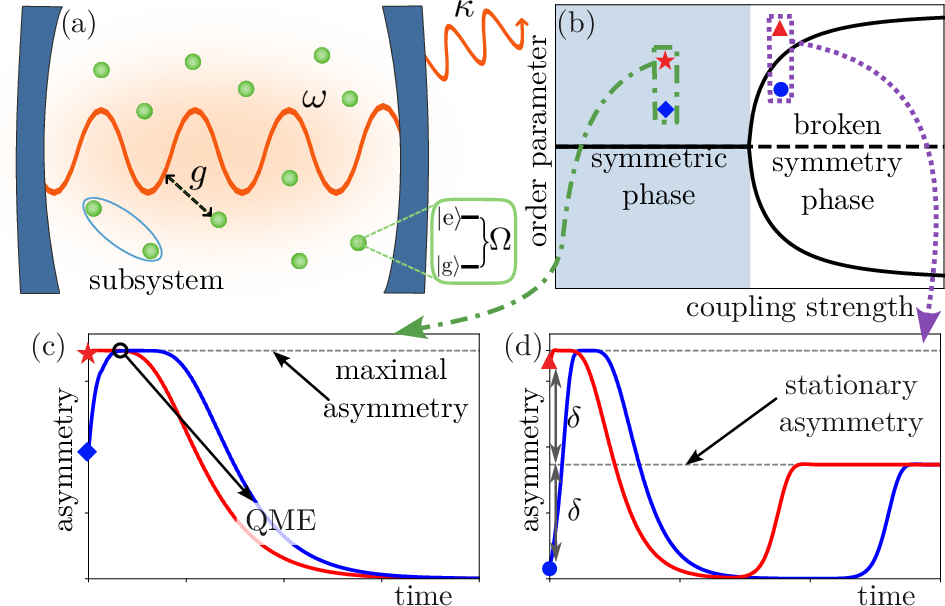
The open Dicke model consists of N two-level atoms (energy splitting Ω) collectively coupled (strength g) to a single cavity mode (frequency ω) subject to cavity losses (rate κ):
Figure 1: Schematic of the open Dicke model, showcasing two-level atoms coupled to a lossy cavity and the consequential parity (Z2) symmetry and its dynamical breaking.
This model is characterized by a Lindblad dynamical generator featuring a weak Z2 symmetry associated with parity. Spontaneous breaking of this symmetry occurs above a threshold coupling gc=Ω(4ω2+κ2)/(8ω), leading to two distinct stationary states with nonvanishing order parameters. Symmetry properties are analyzed locally using reduced symmetry operators PA defined on atomic subsystems.
Quantifying and Analyzing Subsystem Asymmetry
The evolution of the reduced density matrix ρA(t) for atomic subsystems is evaluated under the mean-field limit, yielding analytical tractability for arbitrary subsystem size Ω0. Crucial to this analysis is the Relative Entropy of Asymmetry (REA):
Ω1
where Ω2 is the symmetrized state with respect to Ω3. For the Ω4 symmetry,
Ω5
The REA serves as an entropic order parameter, dynamically tracking the degree of local symmetry breaking and its restoration.
Symmetry Restoration and Quantum Mpemba Effects
Symmetric Phase (Ω6)
Within the symmetric phase, the stationary state is always symmetric, i.e., REA relaxes to zero. However, the transient dynamics of Ω7 reveals pronounced sensitivity to initial subsystem states:
For certain initial conditions (e.g., Ω8), the evolution is non-monotonic: REA can increase to a maximum before ultimately decaying, indicating that the system must transiently maximize its local asymmetry en route to symmetry restoration.
Quantum Mpemba Effect Manifestation: More asymmetric initial states (higher initial REA) can relax to symmetry (REAΩ9) faster than less asymmetric ones, contradicting naive monotonicity expectations.
Figure 2: Density plots of REA dynamics in the symmetric and broken-symmetry phases, displaying non-monotonicity, transient maximal asymmetry, and quantum Mpemba effect behavior.
Broken-Symmetry Phase (g0)
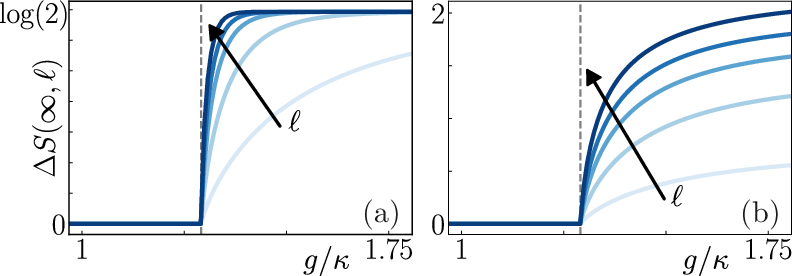
When the system enters the symmetry-broken phase, the stationary REA is generically nonzero, matching the stationary symmetry-breaking order parameter. Here:
The REA exhibits strongly non-monotonic dynamics: it can transiently approach perfect symmetry before settling at its symmetry-broken stationary value.
There is an imbalance in the rates of increasing vs. decreasing asymmetry: the system can generate or dissipate asymmetry with asymmetric efficiency, dependent on initial conditions—paralleling but nonidentical to classical heating/cooling asymmetry.
The specific stationary symmetry-broken branch approached by the system is nontrivially determined by the initial conditions, inducing cusp-like relaxation phenomena.
Figure 3: Stationary REA as a function of g1 and subsystem size, illustrating the phase transition and the scaling of asymmetry with parameters.
Emergent and Generalized Symmetry Dynamics
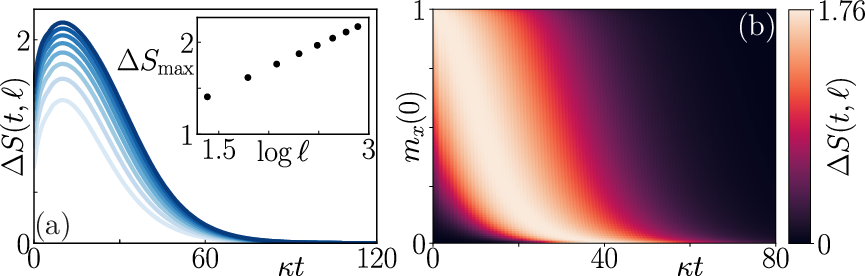
The methodology generalizes to other symmetry groups, notably the emergent g2 symmetry realized in the stationary state of the symmetric phase. The time evolution of the corresponding REA reflects similar non-monotonicity and subsystem size dependencies as in the explicit g3 case:
Figure 4: Dynamical evolution of REA with regards to emergent g4 symmetry, showing maximal asymmetry scaling logarithmically with subsystem size.
These results demonstrate that the approach is broadly applicable beyond explicit dynamical symmetries, offering a route to probe dynamical emergence and restoration of higher symmetry structures.
Implications and Outlook
Practical implications include the ability to design and probe quantum systems (e.g., in cavity QED platforms) that display anomalous relaxation and symmetry restoration phenomena, with the REA serving as a well-defined, experimentally accessible measure. The strong dependence on initial conditions, non-monotonic relaxation pathways, and counterintuitive resource-like behavior of asymmetry highlight opportunities for controlling and exploiting nonequilibrium resources in open quantum systems.
Theoretically, these results extend the programming of resource-theoretic treatments—such as those relating to coherence and athermality—to open systems with genuine dynamical phase transitions and symmetry breaking. The strong and sometimes contradictory claims—e.g., that a more asymmetric initial state can restore symmetry faster, and that the asymmetry generation/removal efficiency can invert depending on state and parameter—suggest that resource dissipation and relaxation in quantum systems is deeply shaped by nonequilibrium statistical mechanics beyond closed system paradigms.
Future directions could include:
Full state REA studies (beyond subsystems) for finite g5, elucidating size scaling and fluctuation effects.
Generalizations to other resource-like quantities (non-Gaussianity, non-stabilizerness) and associated Mpemba-like phenomena.
Experimental protocols to observe and control these anomalies in state-of-the-art driven-dissipative quantum simulators.
Conclusion
This work rigorously quantifies the dynamics of symmetry breaking and restoration in open quantum many-body systems, establishing the Dicke model as a versatile platform for anomalous nonequilibrium phenomena such as the quantum Mpemba effect. The findings deepen the conceptual links between nonequilibrium statistical mechanics, resource theory, and quantum information, indicating a rich structure in the relaxation and resource dynamics of open quantum systems undergoing symmetry-breaking transitions.
“Emergent Mind helps me see which AI papers have caught fire online.”
Philip
Creator, AI Explained on YouTube
Sign up for free to explore the frontiers of research
Discover trending papers, chat with arXiv, and track the latest research shaping the future of science and technology.Discover trending papers, chat with arXiv, and more.