- The paper demonstrates that increasing dark matter normalization delays the orientation flip dynamics, quantified by a monotonic frequency shift relative to the Kerr value.
- It employs one- and two-dimensional parameter scans and time-domain simulations to isolate the impacts of dark matter profile compactness and tidal coupling.
- Results reveal that the relativistic intermediate-axis instability can serve as a robust environmental diagnostic for probing dark matter near rotating black holes.
Introduction
This paper investigates the sensitivity and robustness of the relativistic intermediate-axis instability (IAI)—termed DARK-FLIP—in coherent, triaxial matter clumps orbiting rotating black holes enveloped by explicit dark matter (DM) distributions. The study extends the DARK-FLIP I framework by introducing and numerically analyzing the Effective Response Model (ERM), focusing on how environmental parameters, primarily the DM profile and normalization, modulate the orientation-modulation (flip) frequency of the non-axisymmetric matter elements. Instead of a full accretion or radiative-transfer simulation, the approach isolates the impact of the DM-induced gravitational potential and local tidal torques on the characteristic flip timescales. The work systematically explores parameter dependencies via one- and two-dimensional scans, time-domain simulations, and synthetic projected-emissivity proxies, drawing sharp distinctions between the response for classical profiles (Einasto, cored-NFW, Hernquist).
DARK-FLIP Framework and Model Hierarchy
The analytic and numerical framework models the environment near a Kerr black hole with an added spherically-symmetric DM distribution, which modifies the mass function and hence the local curvature and geodesic structure. The rotating extension is specified via a phenomenological prescription, with the DM profile entering the lapse and hence the effective potential and tidal fields experienced by the matter element.
The triaxial body is characterized by principal moments of inertia (I1,I2,I3) (with I1<I2<I3), whose orientation evolves through relativistic Euler equations incorporating both rigid-body dynamics and tidal torques. The flip timescale is extracted as a diagnostic—non-orbital—orientation-modulation timescale, and its deviation from the Kerr vacuum value quantifies the environmental sensitivity.
Primary DM models are Einasto and regularized cored-NFW, each normalized to have the same enclosed mass within $200M$ (where M is the black hole mass). Hernquist serves as a non-cosmological control. Parameters varied include DM normalization, scale radius, inertia ratios, tidal coupling Ktidal, and initial conditions.
One-Dimensional Robustness Scans
The fundamental control parameter is the DM mass normalization (ϵ). The frequency shift Δω/ωKerr responds monotonically to ϵ: increasing normalization results in a greater delay (lower frequency) in the flip dynamics relative to the Kerr vacuum, a trend manifest across all tested profiles.
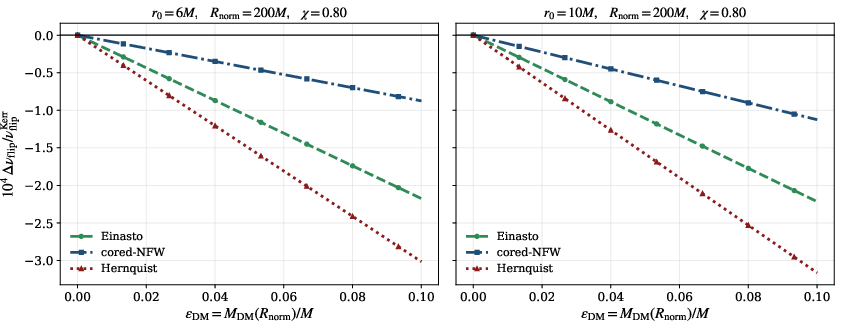
Figure 1: Normalization dependence of the DARK-FLIP frequency shift for Einasto, regularized cored-NFW, and Hernquist profiles at two radii; increasing DM normalization induces a monotonic decrease in flip frequency relative to Kerr.
Fixing normalization, an increase in the DM profile scale radius (i.e., making the halo more spatially extended) leads to a suppression of the local frequency shift. This reflects the decreased local gravitational (tidal/curvature) influence from a fixed enclosed mass distributed over a larger volume—distinct DM profiles with identical normalization yield different local responses for precisely this reason.
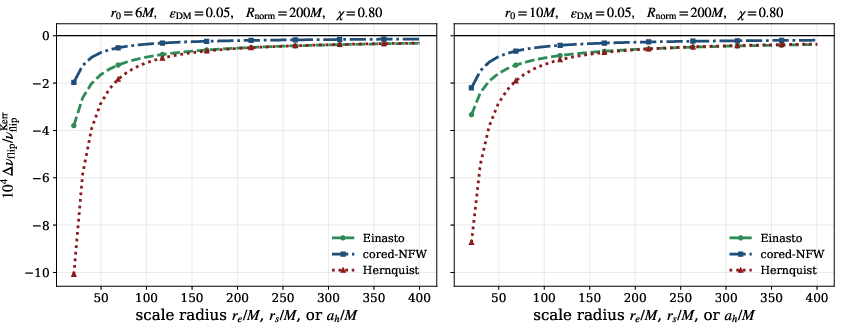
Figure 2: Scale-radius dependence—more compact profiles produce stronger modulation responses; extended profiles yield frequency shifts closer to Kerr.
The matter-side dependence is probed by scanning the intermediate principal moment I2 while holding I1 and I1<I2<I30 fixed, mapping out the expected triaxial instability "window." The response peaks near I1<I2<I31 and diminishes as I1<I2<I32 approaches I1<I2<I33 or I1<I2<I34, vanishing in the axisymmetric limits where the classical IAI is absent.
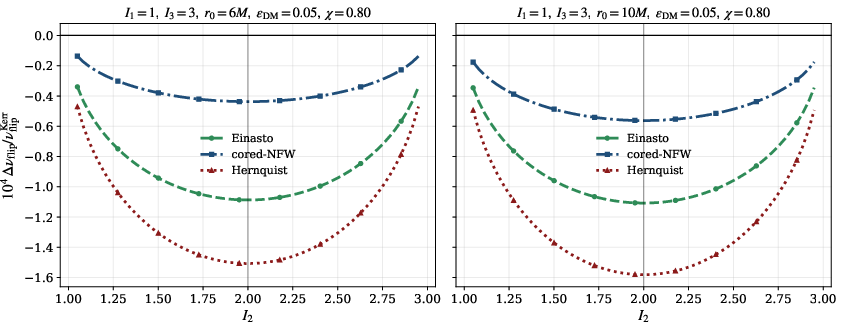
Figure 3: Frequency shift exhibits maximal sensitivity for intermediate I1<I2<I35, weakening in near-axisymmetric limits.
Effective tidal coupling I1<I2<I36 is shown to impart a linear scaling on the frequency shift. Initial perturbation amplitude I1<I2<I37 controls the nonlinear seeding of the instability; this dependence is only logarithmic, reflecting the time required for a weak initial deviation to grow to visible nonlinearity in the otherwise integrable triaxial system.
Multidimensional Parameter Maps
Two-dimensional scan maps clarify the joint dependencies. The response landscape in I1<I2<I38 space exhibits the strongest effect for large normalization and small (compact) scale radii.
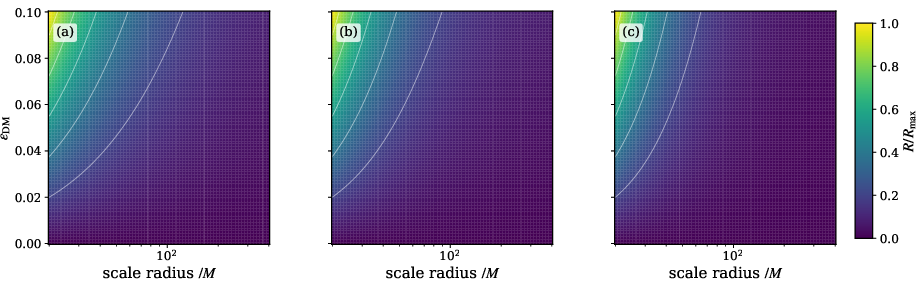
Figure 4: Normalized response landscape in the I1<I2<I39 scale radius$200M$0 plane—strongest environmental effect occurs for compact, massive halos.
Profile-contrast maps directly compare response amplitudes for different DM models at fixed normalization and scale. These demonstrate that even with matched normalization, the mass distribution's profile-specific compactness or dispersion sets the local DM-induced frequency shift.
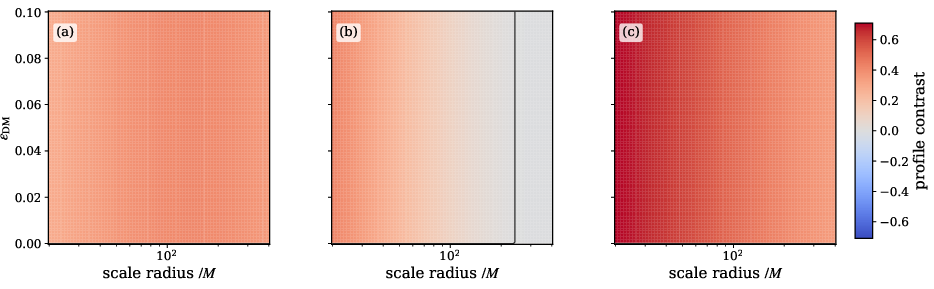
Figure 5: Profile-contrast maps highlight regions in parameter space where environmental impact is substantially profile-dependent.
Additional response-channel maps display how physical and initial condition parameters collaborate in setting the IAI response amplitude, with the most robust effect when triaxiality, tidal coupling, and initial misalignment are all maximal.
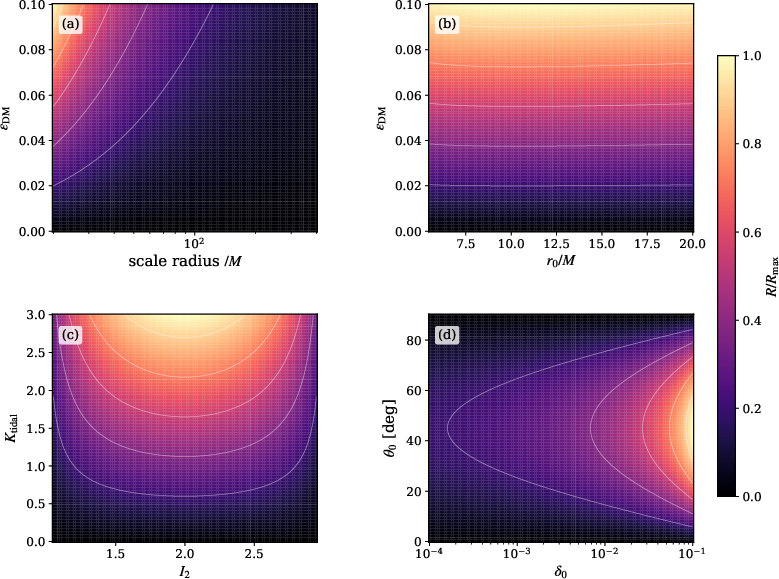
Figure 6: Response channels for (environment, scale, radius, inertia/coupling, initial conditions); each physical axis contributes a strong, interpretable control on the DM-induced modulation.
Time-Domain Simulations and Projected Morphology
Direct integration of the triaxial Euler equations validates the diagnostic frequency interpretation. The sign reversal of the intermediate component $200M$1 marks the flip event, with the flip timescale consistently modulated by the DM environment and initial condition choices.
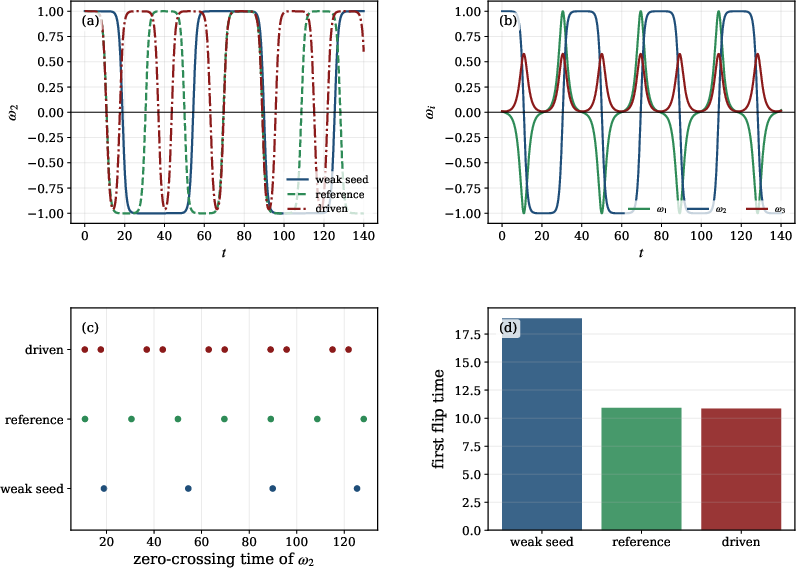
Figure 7: Time-domain evolution of $200M$2 demonstrates dependence of flip timing on perturbation seed and environmental driving.
Profile timing comparisons translate the normalized frequency shift into accumulated period drifts and phase offsets, quantifying the detectability of such modulations in principle over long integration times.
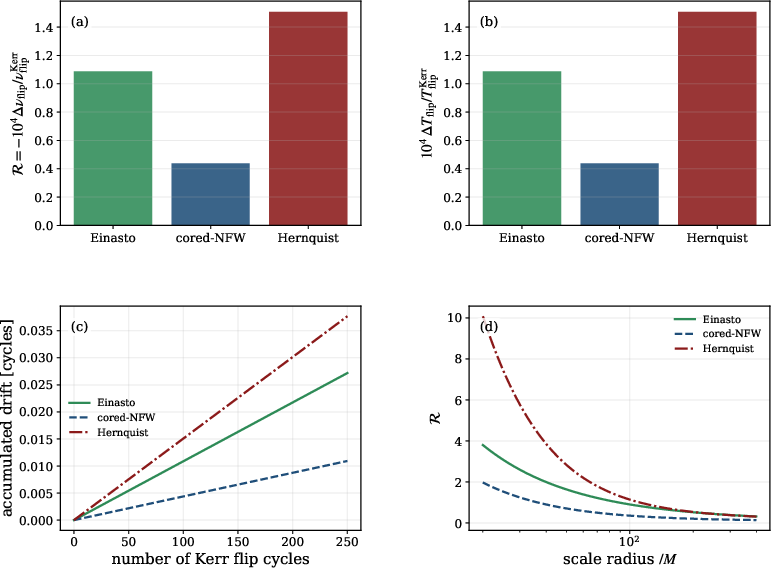
Figure 8: Profile-resolved timing response—distinct DM models imprint characteristic drift and period shifts on the flip modulation.
Finally, the kinematic projected-emissivity proxy provides a synthetic visualization: the triaxial clump's dynamical reorientation (the flip) generates substantial, time-dependent changes in apparent projection, even in the absence of realistic radiative transfer.
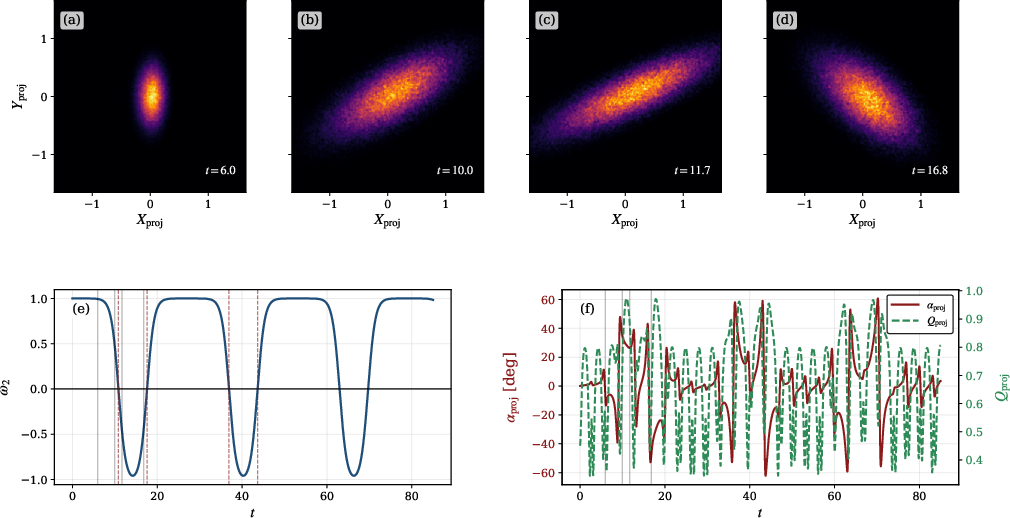
Figure 9: Projection-plane visualization of a triaxial debris patch as it undergoes the flip, highlighting the geometric effect on apparent emissivity structure.
Interpretation, Theoretical and Practical Implications
The dominant findings are:
- The orientation-modulation (flip) frequency for triaxial matter near DM-dressed Kerr black holes is a robust diagnostic that responds smoothly and monotonically to environmental characteristics.
- Magnitude of the effect is perturbative ($200M$3), consistent with theoretically expected environmental impact.
- The effect is not profile-agnostic—profiles with matched enclosed mass at a fiducial radius may have substantially different local modulating effects due to their inner mass distributions.
- The IAI is not sourced by the DM halo per se, but the DM gravitational field tunes the coordinate-time mapping and tidal driving of the orientation flip.
- The effect is maximized for strongly triaxial, coherently coupled (high $200M$4) matter, with favorable initial conditions (maximal misalignment and finite initial seed).
From a practical standpoint, the DARK-FLIP signal is a distinct dynamical timescale, not degenerate with orbital, epicyclic, resonance, or Lense-Thirring precessional phenomenology. In principle, timing observations of modulated emission from accreting black holes, if sufficiently precise and deconvolved from other QPO mechanisms, could carry indirect signatures of the DM environment—though this connection remains theoretical in the current model's scope. Observational translation requires inclusion of hydrodynamics, radiative-transfer, and fully general relativistic multipolar extended-body motion.
Limitations
The main limitations include the use of a simplified ERM rather than fully covariant Mathisson-Papapetrou-Dixon dynamics, neglect of fluid effects, and the adoption of local projection proxies rather than ray-traced or GRMHD images. The response coefficients and preparation factors are diagnostic, not physically derived from microphysical modeling. Hernquist is a reference, not realistic, inner profile.
Conclusion
The analysis robustly demonstrates that the relativistic IAI flip timescale is detectably sensitive to DM environmental properties and the internal structure and preparation of the non-axisymmetric matter element. While small in magnitude, the effect is controlled, interpretable, and present for a range of profiles. The orientation-modulation timescale emerges as a genuine environmental diagnostic, distinct from conventional orbital timescales, and potentially relevant for future ultra-high-precision timing observations and as a theoretical probe of DM structure near massive black holes.
The results motivate future work combining covariant extended-body dynamics with hydrodynamic and emissivity modeling to establish observational relevance and potential degeneracies with alternative QPO-generating channels.
Cited paper: "Robustness of the relativistic intermediate-axis instability around dark-matter-dressed rotating black holes" (2606.06557)

