- The paper introduces a Kerr-like black hole metric modified by dark matter using the Newman–Janis Algorithm, establishing critical mass thresholds that change event horizon and shadow properties.
- The numerical analysis shows that increased dark matter results in abrupt expansion of the event horizon and nearly circular shadows even in rapidly spinning black holes.
- The study sets upper bounds on dark matter near supermassive black holes by linking modifications in shadow morphology with suppressed high-energy emissions.
Black Hole Shadows in the Presence of Surrounding Dark Matter: Rotating Solutions and Astrophysical Implications
Introduction
The direct imaging of black hole (BH) shadows with the Event Horizon Telescope (EHT) has established high-precision constraints on the nature of ultra-compact objects in galactic centers. These observations motivate systematic investigations into how additional matter, particularly dark matter (DM) halos, can alter the spacetime geometry and observable signatures, especially for rotating Kerr black holes—the astrophysically relevant class due to accumulated angular momentum from accretion and mergers.
This paper develops an axisymmetric generalization of the Schwarzschild black hole surrounded by a DM halo, derived via the Newman–Janis Algorithm (NJA) to generate Kerr metrics with a continuous DM mass distribution. It rigorously analyzes the modifications to the event horizon, ergosphere, photon sphere, and shadow structure. Emphasis is placed on the threshold behavior as DM mass exceeds a critical value, altering macroscopic observables and yielding constraints for compatibility with EHT data.
Model Construction: Kerr Black Hole with Distributed Dark Matter
The spacetime metric is modeled by extending a Schwarzschild BH surrounded by DM (with piecewise continuous mass function dependent on radius) to a rotating (Kerr-like) geometry using the NJA. This produces a line element that smoothly interpolates between the standard Kerr vacuum (ΔM=0) and the spherically symmetric DM-augmented Schwarzschild case (a=0), accommodating arbitrary spin a and tunable DM parameters (ΔM,rs,Δrs).
The DM distribution is characterized by a localized shell or halo, with the mass function m(r) constructed to ensure continuity and differentiability, enabling well-behaved stress-energy sources compatible with the Einstein equations. DM is assumed to be nonluminous and non-interacting with photons except via gravitation, focusing on its pure spacetime effect.
The consequences of varying ΔM are critical: below a calculable threshold, the horizon and ergosphere retain Kerr-like structure, but beyond this, the spacetime undergoes a rapid expansion of characteristic radii, drastically modifying the causal and observable domains.
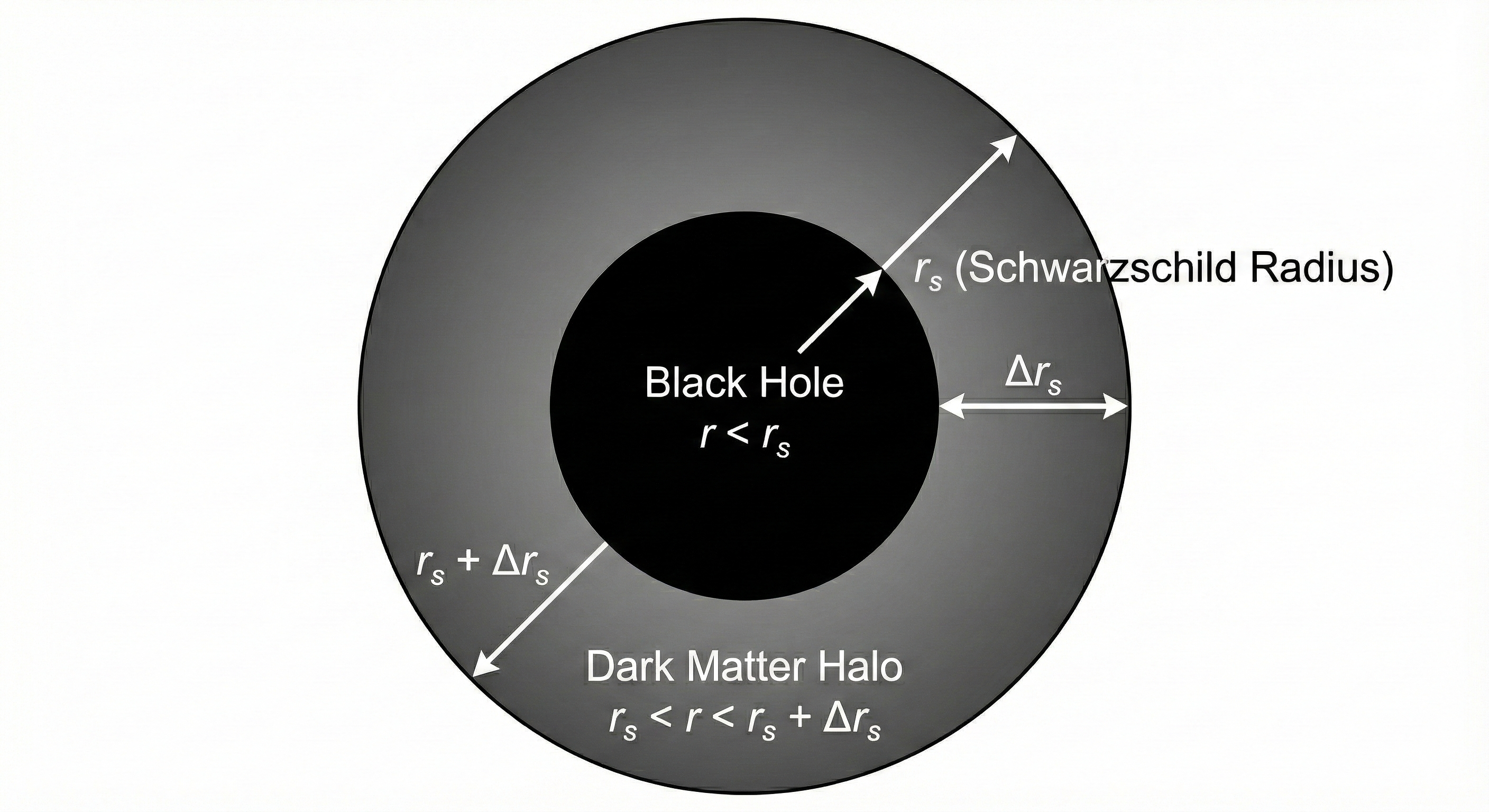
Figure 1: Radial behavior of the metric function f(r) and the distribution of DM surrounding a Schwarzschild black hole, demonstrating the modification to horizon and photon sphere structure as ΔM increases.
Horizons, Ergosphere, and Critical Mass Scaling
The study identifies that the locations of the event horizon and ergosurface are determined by Δ(r,a)=0 (metric function zeros), now modified via m(r). With increasing DM mass, a critical point is reached where both the outer horizon and ergosphere boundaries experience nonperturbative expansion, in some cases shifting by orders of magnitude. Numerical analysis in the paper quantifies these thresholds for representative parameter values.
The horizon topology displays two distinct regimes: a "Kerr-like" phase for subcritical a=00, and an expanded, DM-dominated phase above the threshold, where the influence of spin becomes subdominant. The ergosphere mirrors this behavior, with the DM contribution introducing new roots and potential layers in its structure.
These strong-field modifications are of central importance for shadow imaging and the energy emission process, as they directly affect the photon capture region and thermodynamic surface gravity.
Null Geodesics and Shadow Construction
For null geodesics, the paper derives the conditions for unstable photon orbits, utilizing the Hamilton–Jacobi separation and leading to analytic forms for the impact parameters a=01 as functions of a=02, a=03, a=04, and their derivatives. The photon sphere and shadow are then classified by whether the critical orbit radius lies within the DM shell, outside, or in vacuum. The key result is that only the DM enclosed within the photon sphere radius influences shadow formation, consistent with spherical shell theorems for gravity.
Cylindrical celestial coordinates a=05 parameterize the shadow contour—as seen by a distant equatorial observer—as a function of these impact parameters. The analysis establishes that rotation induces the usual asymmetry, but DM acts to suppress distortion and enhance circularity, especially at large a=06.
The shadow boundary is constructed numerically for varied a=07, displaying progressive changes in size and shape correlated with DM content. For high a=08 and negligible DM, the shadow is notably deformed; for high DM mass, even rapidly spinning BHs display near-perfect circularity, indicating the dominant influence of the DM field in the strong gravity regime.
Quantitative Shadow Observables
Quantitative measures of the shadow—radius and distortion parameter—are computed following the Hioki-Maeda formalism. The shadow radius, a=09, increases monotonically with DM mass and, above the critical threshold, experiences abrupt, orders-of-magnitude enhancement. The distortion parameter, a0, decreases with both increasing DM mass and decreasing spin; for sufficiently large DM content, the shadow is restored to almost perfect circular symmetry, insensitive to a1.
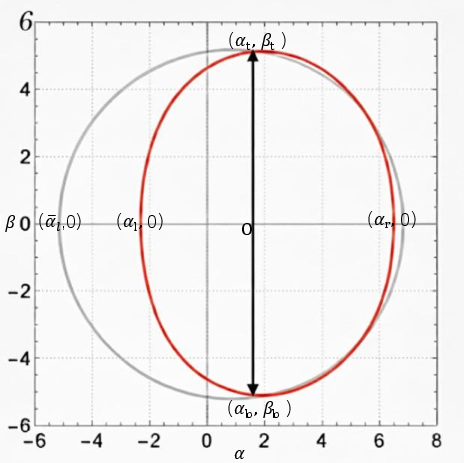
Figure 2: Schematic of the shadow boundary, indicating key observable points a2, and the construction of the distortion parameter as a measure of deviation from circularity.
Strong numerical evidence is provided that the shadow morphology is a sensitive probe of DM distribution and concentration in the immediate vicinity of astrophysical black holes. For DM masses exceeding observationally determined limits, the predicted shadow size and geometry are inconsistent with EHT measurements, providing upper bounds on localized DM mass near supermassive BHs.
Energy Emission and Thermodynamic Effects
The paper also investigates the high-frequency energy emission rate, linking the absorption cross section to the shadow area for geometric-optics photons. Analytic expressions relate the Hawking temperature (dependent on a3 and spin) to the emission spectrum. Results show that both increasing spin and nontrivial DM suppress the energy emission rate, with large a4 leading to drastic reduction of Hawking temperature and near-vanishing emission. The emission rate remains nearly unaffected by DM until the critical mass is surpassed, beyond which the suppression is pronounced.
The absence of expected high-energy emission signatures from regions of high DM concentration near BHs thus becomes an additional complementary observable in distinguishing physical scenarios.
Implications and Future Directions
The primary implication is that strong gravitational signatures—particularly shadow size and morphology—set strict upper limits on DM mass within tens to hundreds of Schwarzschild radii of supermassive BHs, in agreement with EHT and multiwavelength observations. The results suggest that either (i) DM is largely excluded or dynamically evacuated from the immediate vicinity of galactic nuclei, or (ii) if present, its local density is constrained below thresholds that would produce observable shadow expansion or circularization incompatible with empirical data.
On the theoretical side, this construction provides a controlled framework for extending any static spherically symmetric DM-modified metric to a Kerr-like rotating solution, with explicit geodesic, thermodynamic, and shadow observables accessible for comparison with incoming high-resolution imaging results. This is directly relevant to ongoing and future gravitational and electromagnetic observational campaigns targeting Sgr A*, M87*, and potentially other nearby supermassive BHs.
Constraints derived on DM distribution profiles, anisotropies, and the detailed phase-space structure of halo constituents around BHs will be increasingly robust with improving angular resolution, allowing finer tests of both general relativity and alternative dark sector models in strong gravity.
Conclusion
This work presents a comprehensive axisymmetric extension of black holes surrounded by distributed dark matter, deriving explicit forms for horizons, ergosphere, geodesics, and shadow observables as a function of black hole spin and DM mass. The analysis reveals that above a sharply defined DM mass threshold, BH shadows and causal structures are dramatically modified—shadows become significantly enlarged and nearly circular even with extremal black hole spin, and the energy emission rate is strongly suppressed by the concomitant reduction in Hawking temperature.
Compatibility with EHT observations requires that the DM mass in the immediate vicinity of supermassive astrophysical black holes is either negligible or below critical bounds derived herein. The formalism developed provides a basis for further studies of dark matter–compact object interplay in the strong-field regime and will be of considerable utility in the interpretation of future high-resolution BH imaging data.

