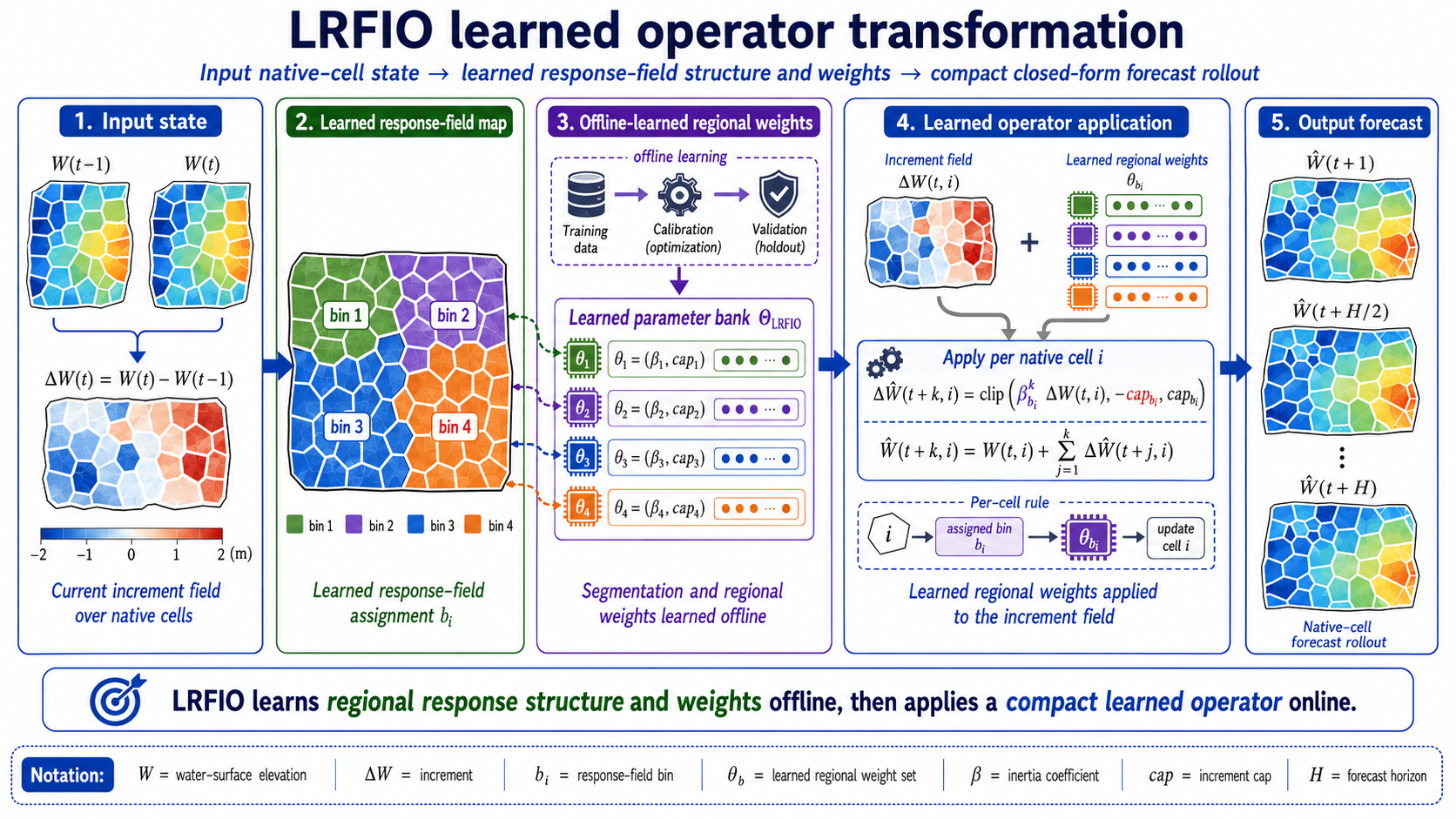
- The paper proposes a Learned Response-Field Inertia Operator (LRFIO) for HEC-RAS 2D surrogates that directly emulates water-surface elevation on native computational cells.
- It employs an increment-based learning framework to capture solver-conditioned signals and rigorously contrasts native-cell and raster representations.
- LRFIO achieves orders-of-magnitude speedup with competitive accuracy across multiple datasets while controlling model complexity.
Learned Response-Field Inertia Operator for Native-Cell HEC-RAS 2D Surrogate Modeling
Introduction
This paper introduces the Learned Response-Field Inertia Operator (LRFIO), a surrogate modeling approach for two-dimensional HEC-RAS unsteady flow simulations, focusing on direct emulation of water-surface elevation (WSE) on native computational cells without resorting to raster grid projections. The motivation centers on avoiding representation mismatch and confounding effects introduced by rasterization and inconsistent information-access protocols in model comparisons. LRFIO formulates surrogate predictive modeling as an increment-response learning problem, utilizing the current native-cell WSE increment as a solver-conditioned predictive scaffold.
Native-Cell Surrogates Versus Raster Representation
A core aspect of the paper is the explicit analysis of spatial representation. By projecting irregular native computational cells to raster grids, standard methods induce aggregation and remapping errors, inherently altering the surrogate modeling problem. In contrast, the native-cell approach preserves the actual computational geometry, aligning surrogate outputs with solver results and precluding error and bias from support transformations.
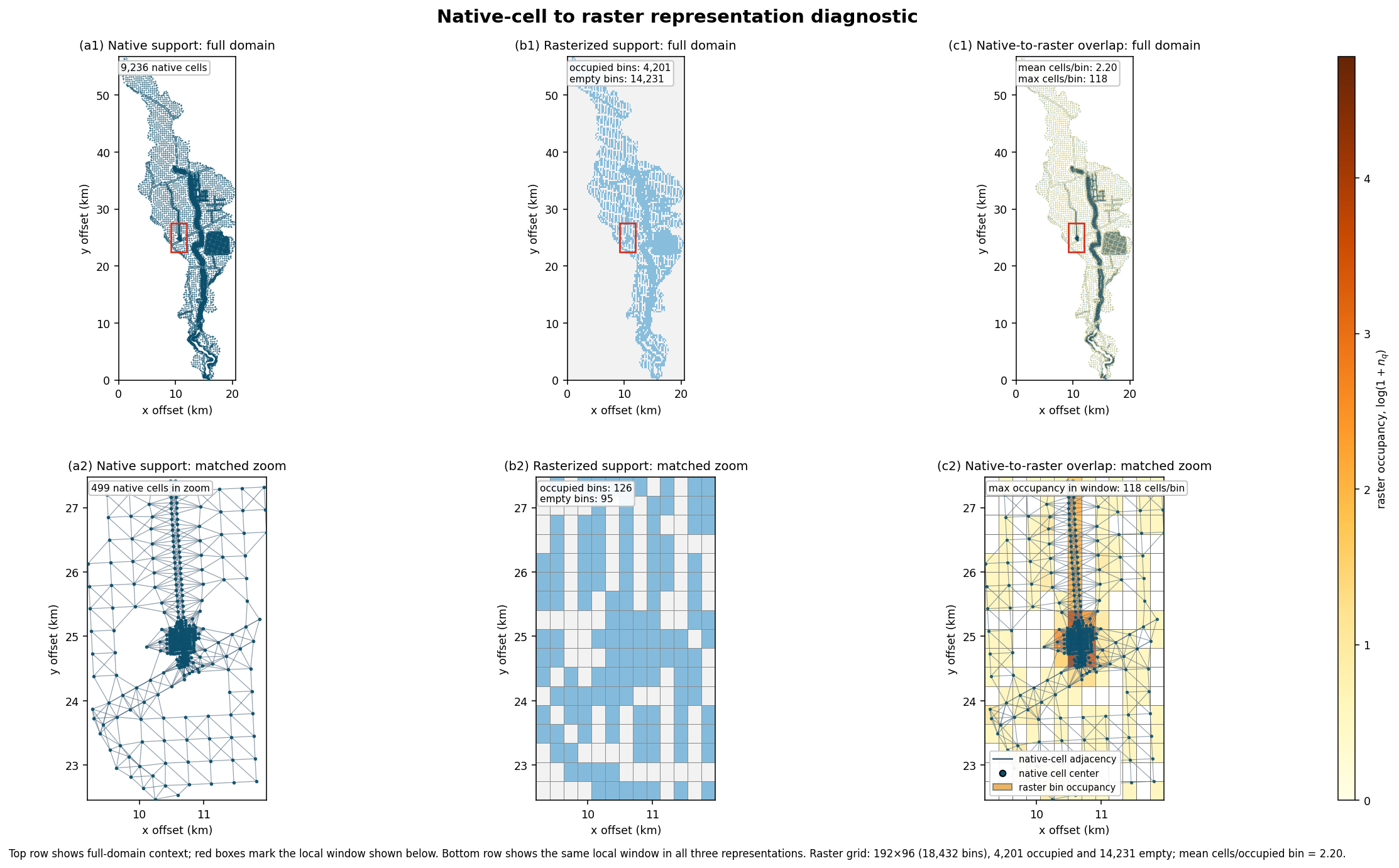
Figure 1: Native-cell (a1–a2) and raster (b1–b2) support comparison on Beaver Bayou, indicating aggregation and mismatch upon rasterization.
This representation-aware analysis underpins the choice to benchmark all methods on the native cells, ensuring fidelity in architectural and ablation comparisons, and providing a diagnostic foundation for isolating the source of predictive gains in learned architectures.
LRFIO Structure and Methodology
LRFIO implements a hierarchical, increment-based methodology:
Model selection adopts a base-case-first ablation protocol, comparing persistence (no future increment), global inertia (single response region), and segmented response-field inertia (multiple response regions), with complexity admitted only upon passing explicit structural-gain thresholds on validation data. Neuralized and residual-correction variants are included but retained only when demonstrably superior in accuracy-runtime tradeoff.
Cross-Dataset Experiments and Results
Evaluation spans four diverse HEC-RAS 2D datasets, each differing in cell count, scenario length, and forecast horizon. All surrogate variants—including LRFIO, neural operators (e.g., FNO, DeepONet), GNNs (e.g., SWE-GNN), raster CNNs, and forcing-aware models—are benchmarked under strict, chronologically partitioned train/validation/test splits and explicit information-access control.
LRFIO exhibits dataset-adaptive complexity:
- Beaver Bayou: Segmented response-field inertia (two regions) is retained, with βb between 0.82 and 0.97.
- Upper San Saba, Tuttle Creek: Global inertia is selected.
- Lower San Saba: Persistence is optimal; additional complexity is rejected.
Validation regret thresholds ensure that increased model complexity (e.g., finer segmentation or neural correction) is retained only for validated, nontrivial gains (≥5%). For Tuttle Creek, this results in selecting global inertia despite slightly stronger performance from a segmented alternative, exemplifying controlled complexity.
Speed–Accuracy Benchmarking
Quantitative evaluation across held-out test splits establishes that LRFIO models occupy or closely border the Pareto frontier of the accuracy versus deployment-time landscape.
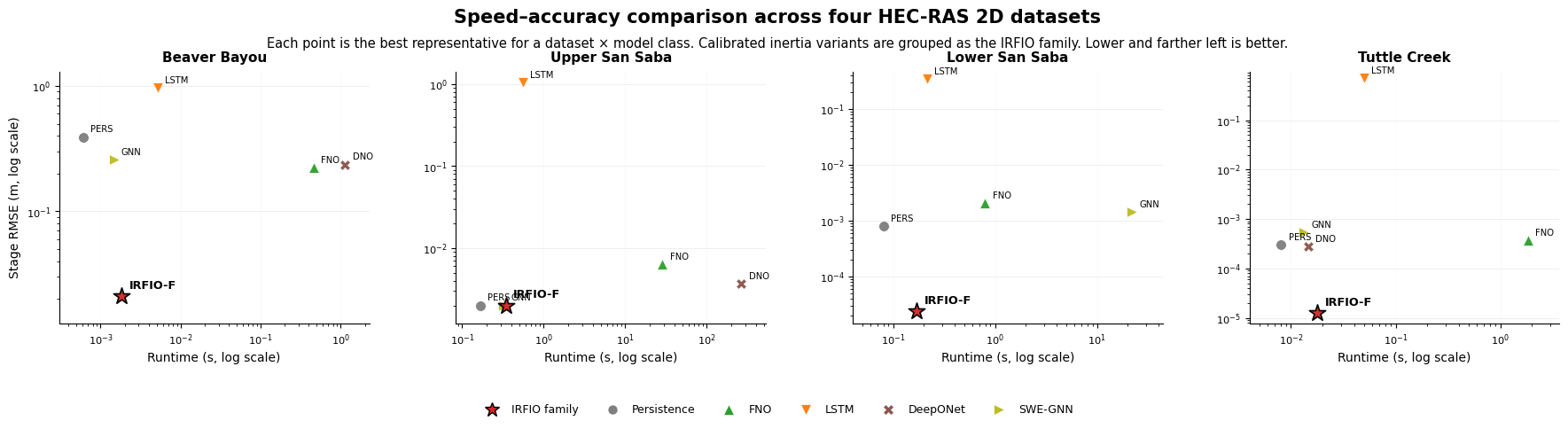
Figure 3: Family-level speed–accuracy comparison; LRFIO representatives typically dominate the lower-left (preferred) region.
Deployment times remain sub-second (e.g., 0.003 s for 9k cells/24 steps on Beaver Bayou up to ~0.24 s for the largest case), yielding a horizon-normalized speedup exceeding 2.75×10⁴ compared to baseline full-physics HEC-RAS solves on the same hardware and forecast duration. Notably, in nearly all datasets, LRFIO achieves the lowest or equal stage RMSE; in Upper San Saba, it is tied with SWE-GNN but is faster.
Correction Ablations and Neural Variants
A series of ablation experiments directly compare the retained LRFIO to:
- LRFIO with ridge residual correction (LRFIO-R)
- Isolated neuralized-inertia operator (INO; MLP head)
These are evaluated under identical input, support, and information-access assumptions to isolate the effect of online correction capacity.

Figure 4: Residual and neural-correction ablation; LRFIO consistently achieves superior or equal accuracy and runtime.
LRFIO-R universally increases both error and runtime. The INO variant reduces error marginally for Upper San Saba but at the cost of 41× slower runtime, and is otherwise less accurate and slower. Thus, nearly all useful predictive structure is captured in the learned closed-form operator, supporting the claim that further online neural capacity is unwarranted once the solver-conditioned increment and learned response structure are exploited.
Theoretical and Practical Implications
The findings have several implications:
- Increment-based scaffolds: The native-cell WSE increment encapsulates most of the predictive signal for short- to medium-term futures, given the inherent solver conditioning, especially in heterogeneous hydraulic settings.
- Complexity control: Model class and capacity must be assessed under controlled input and representation policies. LRFIO’s strict ablation and selector audit methodology provide a rigorous template applicable to other PDE surrogate domains.
- Deployment efficiency: Compression of learned response-operator structure into a compact parameter bundle yields orders-of-magnitude reductions in forecast latency, enabling real-time scenarios, optimization, and uncertainty analysis, with negligible tradeoff in accuracy.
- Extensibility: While currently dataset-specific and limited to WSE, the framework generalizes directly to additional variables (e.g., velocity, face flux) and online feature conditioning, provided appropriate diagnostics and learning schema.
Limitations and Future Directions
Not addressed in the current benchmark are:
- Generalization to multi-event and cross-geometry transfer (e.g., leave-one-project-out)
- Explicit field-validation versus solver-consistent emulation
- Prediction of non-WSE variables (velocity, sediment, strong wetting/drying)
- Forcing-aware or hybrid operator variants with explicit online access to scenario inputs
Future work should also interrogate the role of higher-order response diagnostics, event-class conditioning, and hierarchical transfer mechanisms, especially in operational and risk-modeling contexts. The base-case-first learned selection protocol adopted here offers a robust template for such extensions.
Conclusion
This paper formalizes that the dominant signal for HEC-RAS 2D native-cell WSE forecasting is encapsulated in the solver-produced current increment, which—when paired with a rigorously learned and validated inertial response operator—yields highly efficient and accurate surrogate models. LRFIO demonstrates that, under explicit information-access control and representation alignment, additional spatial or neural capacity should only be introduced when empirically justified by meaningful gains in held-out performance and deployment efficiency. This work sets a new methodological standard for surrogate model benchmarking in scientific machine learning for physical systems.