- The paper introduces a multi-head LSTM framework that generates per-sample trust scores to assess NOx emission predictions in weakly supervised settings.
- It employs a two-phase training approach—unsupervised pretraining followed by supervised finetuning—to outperform traditional methods with lower MAE and RMSE.
- The integration of ensemble uncertainty, confidence estimation, and Mahalanobis distance offers actionable insights for risk-aware deployment under distributional shifts.
Trust-Aware Predictive Emissions Monitoring for Distributed Gas Turbine Fleets
The challenge of deploying predictive emissions monitoring systems (PEMS) at scale across industrial gas turbine fleets is complicated by a scarcity of labeled emissions data; measurements are often collected from a very limited subset of turbines, while the majority remain unlabelled. Accurately predicting nitrogen oxides (NOx) emissions under such weak supervision necessitates not only the transfer of predictive capability from labeled to unlabeled units but also rigorous quantification of prediction reliability under distributional shift. This work presents a robust, trust-aware probabilistic PEMS framework that overcomes the conventional focus on aggregate accuracy by producing interpretable, per-sample trust scores for emissions predictions, particularly in out-of-distribution (OOD) and unlabelled scenarios (2606.06156).
Framework and Methodological Innovations
The framework centers on a multi-head recurrent neural architecture, specifically an LSTM-based model with three core components: emissions prediction, feature dynamics forecasting, and confidence estimation. Turbine-wise learnable embeddings are incorporated to enable the network to represent both fleet-common and turbine-specific operating regimes. The model leverages a two-phase training paradigm: unsupervised pretraining on auxiliary feature prediction tasks using all available (labelled and unlabelled) data, followed by supervised finetuning where emissions labels are available.
The trust assessment is operationalized through an overview of five signals:
- Predictive uncertainty (ensemble-based, separating aleatoric from epistemic sources)
- Learned confidence (a distinct neural head, trained as a soft surrogate for absolute error using a probabilistic target)
- Mahalanobis feature-space distance (to estimate out-of-distribution status)
- Auxiliary feature prediction diagnostics (feature-level confidences as further reliability cues)
- Operating-range diagnostics (flagging excursions beyond observed training bounds)
A secondary XGBoost regression model is then trained on labeled validation data to calibrate the relationship between these signals and empirical prediction error, thus producing a combined, continuous trust score in [0,100] with discretized trust stratifications.
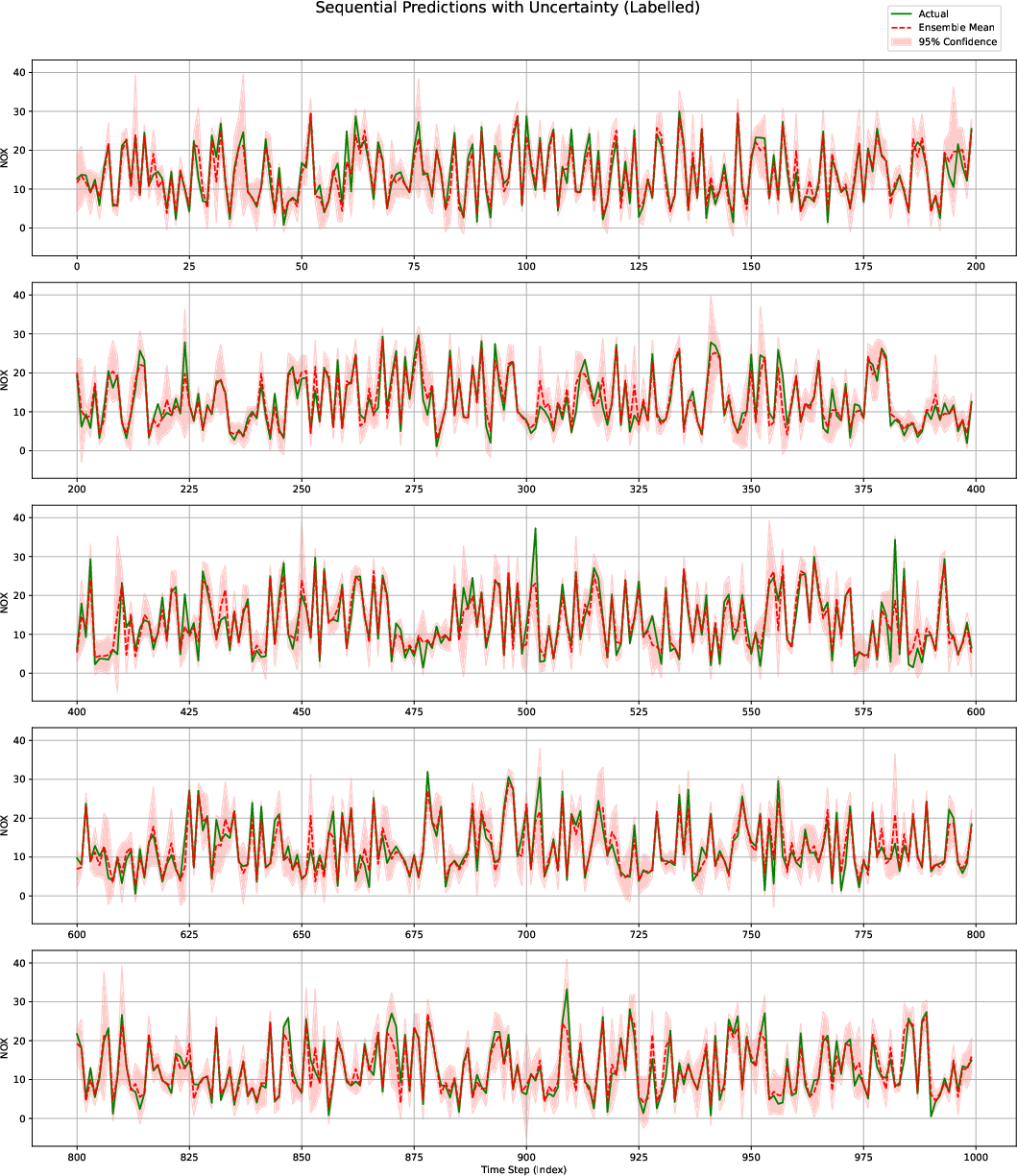
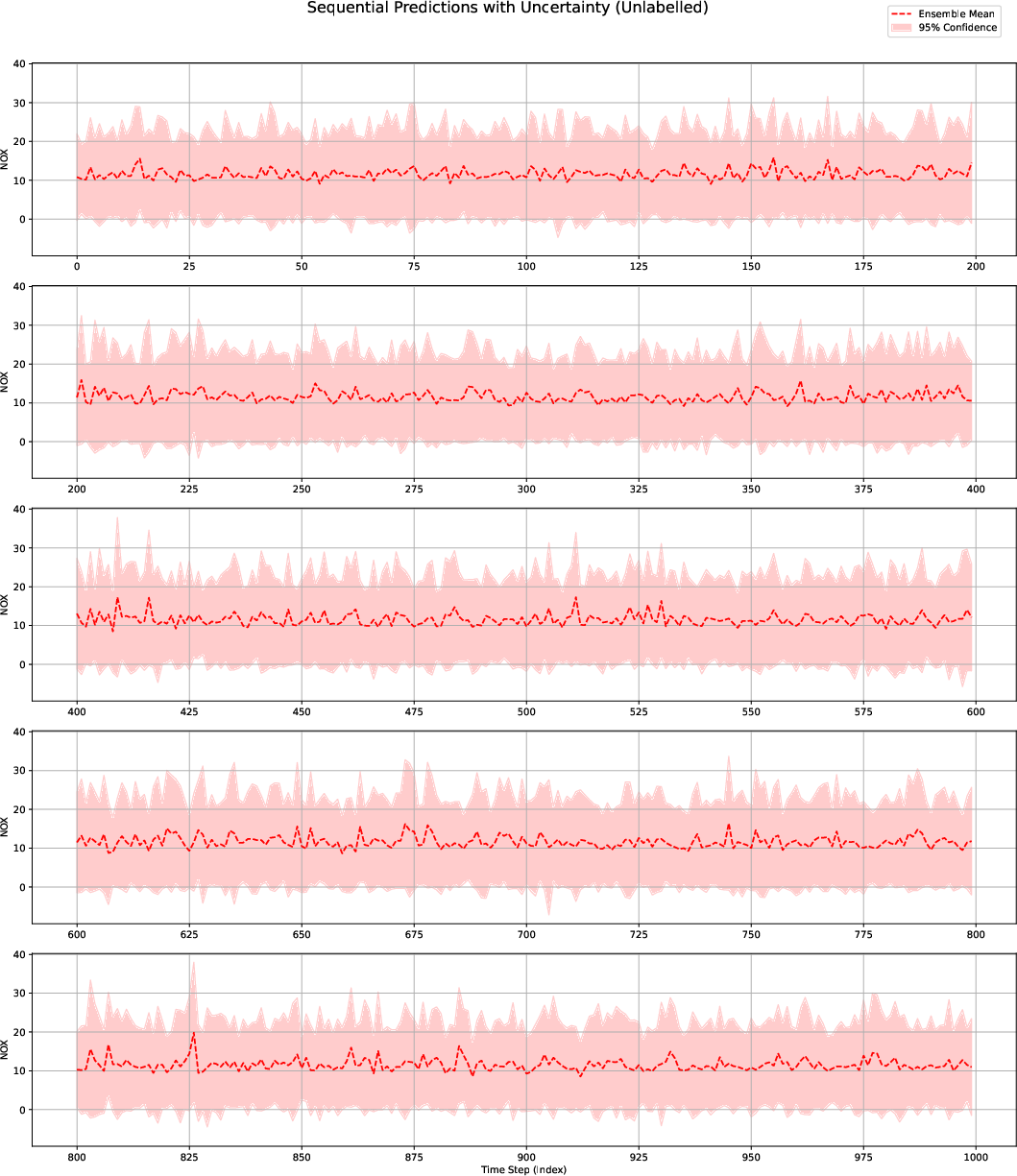
Figure 1: Labelled data.
Uncertainty Quantification and Confidence Calibration
The use of deep model ensembles with predictive variance decomposition supports principled separation of epistemic and aleatoric uncertainties. Results on the labeled dataset yield an MAE of 0.202 and RMSE of 0.303, outperforming strong tabular ML baselines (e.g., XGBoost MAE 0.313, RMSE 0.435). Prediction intervals are both well-calibrated and responsive to OOD drift, as evidenced by the increased normalized mean prediction interval width (NMPIW) on unlabelled and high-distance samples.
The confidence head, trained as a soft function of actual error, demonstrates monotonicity with empirical accuracy: as the retained fraction of high-confidence predictions decreases, MAE sharply drops to 0.070 for the top 10% most confident predictions, indicating the practicality of confidence-based filtering for risk-aware deployment.
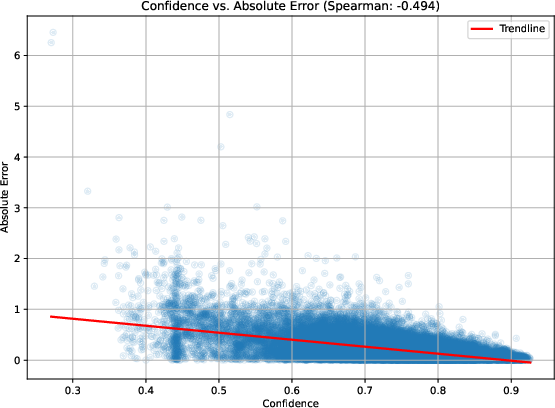
Figure 2: Predicted confidence compared to normalized prediction error on labelled data.
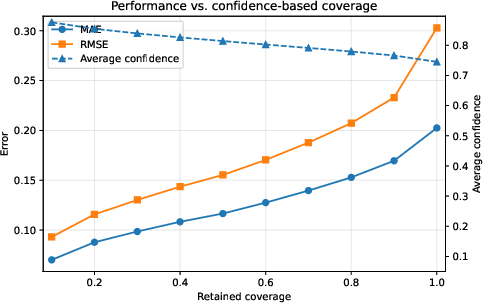
Figure 3: Prediction error (MAE and RMSE) as a function of retained high-confidence samples. Performance improves consistently as lower-confidence predictions are removed.
Notably, confidence also inversely correlates with Mahalanobis feature space distance. However, neither confidence nor distance alone are robust OOD detectors—combining both with other signals optimally captures trustworthiness under covariate shift.
Trust Evaluation on Labelled and Unlabelled Turbines
The trust score effectively stratifies prediction reliability, as evidenced by discrete error distributions within each trust level on labeled data (high, medium, low), and co-variation with all underlying reliability signals. On unlabelled turbines, where ground-truth error is unknown, trust stratification remains consistent: low-trust predictions are associated with elevated epistemic uncertainty, diminished confidence, larger prediction intervals, increased auxiliary feature prediction errors, and more frequent deviations from the labeled operational regime.
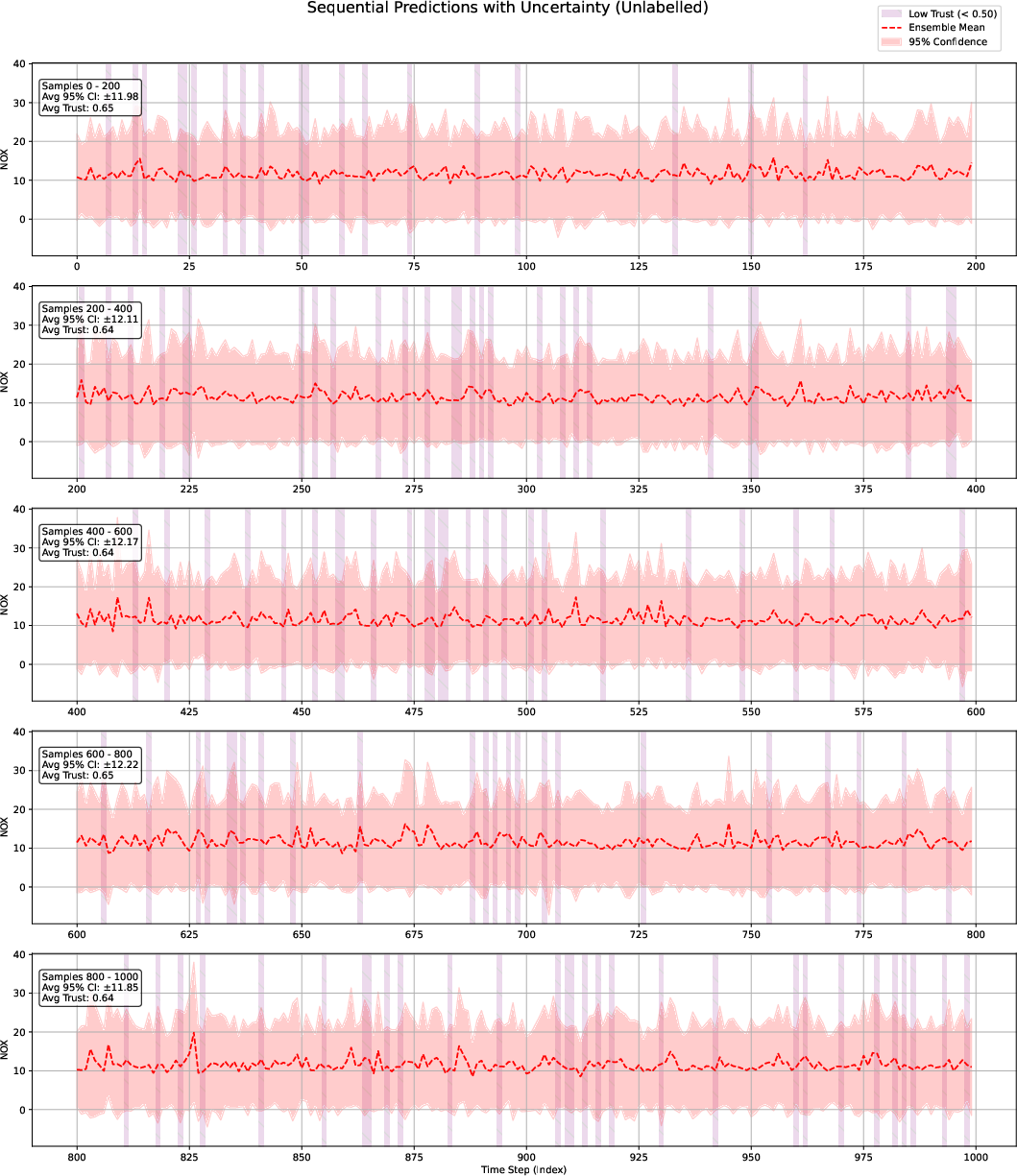
Figure 4: Sequential predictions for unlabelled data with low-trust regions highlighted.
Trust assessment retains interpretability and transparency through per-sample diagnostic reports, which synthesize numerical and textual explanations (e.g., flagging moderate model disagreement or low emissions confidence in regions of reduced trust). This integration supports practical decision-making for high-stakes deployment, enabling actionable differentiation between predictions that can be safely utilized and those requiring caution, flagging, or operator review.
Implications, Limitations, and Future Directions
The integration of multiple complementary signals for trust quantification replaces simplistic reliance on aggregate accuracy or single-criterion uncertainty metrics. This is theoretically significant in safety-critical, weakly or non-i.i.d. regimes—scenarios common in large-scale industrial monitoring. From a deployment perspective, the framework supports actionable, risk-aware usage of PEMS outputs and enables deeper explainability for stakeholders and regulatory contexts.
Limitations include the dependence on labeled data from a single turbine for trust calibration; this may not capture the operational diversity across a heterogeneous fleet, and trust thresholds may not be fully invariant to domain shift. Furthermore, generalization to alternative base architectures beyond the LSTM family remains to be validated.
Future extensions should aim at (1) acquisition and integration of emissions ground-truth from a more diverse turbine set for robust calibration, (2) benchmarking across more expressive neural architectures and self-supervised pretraining regimes, and (3) integration with active learning/online retraining to adapt trust calibration as real-world conditions evolve.
Conclusion
The presented trust-aware PEMS framework offers a methodologically sound, practically interpretable solution for fleet-level emissions prediction under minimal supervision. By blending probabilistic modeling, ensemble uncertainty, learned confidence, feature-space diagnostics, and calibrated trust scoring, it supports reliable, explainable prediction even under substantial domain and distributional shift. This paradigm aligns with the direction of trustworthy ML for real-world safety-critical systems and provides a blueprint for extending similar strategies to other weakly supervised industrial prognostics domains.