- The paper presents Trust3R, a probabilistically principled framework that enhances single-pass 3D reconstruction with closed-form epistemic and aleatoric uncertainty estimates.
- It leverages a multivariate evidential uncertainty head and gated residual refinement to reliably flag high-error regions in challenging conditions like occlusions and low texture.
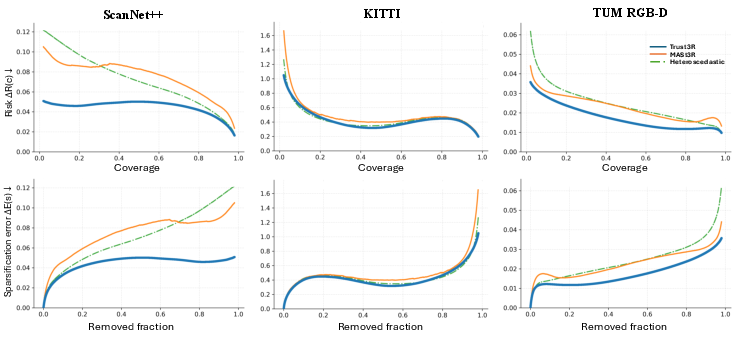
- Empirical results show improved risk–coverage and calibration on datasets such as ScanNet++ and KITTI with minimal overhead, benefiting downstream tasks like SLAM.
Evidential Uncertainty for Feed-Forward 3D Reconstruction with Trust3R
Introduction and Motivation
Feed-forward 3D geometric foundation models, such as DUSt3R and MASt3R, have shown efficacy in regressing dense pointmaps directly from image collections, stabilizing modern multi-view geometry workflows without explicit camera parameter estimation or iterative multi-view matching. However, these architectures typically output heuristic per-pixel confidence maps lacking rigorous probabilistic interpretation. Consequently, such confidence signals are often weakly correlated with actual reconstruction error, resulting in overconfident failures, particularly in regions of occlusions, low texture, or significant domain shift.
"Trust It or Not: Evidential Uncertainty for Feed-Forward 3D Reconstruction with Trust3R" (2605.19539) introduces Trust3R, a probabilistically principled, single-pass uncertainty quantification (UQ) framework for pointmap-based 3D reconstruction. Trust3R addresses two pivotal limitations: (1) the absence of rigorous, per-pixel probabilistic uncertainty estimation in leading geometric backbones, and (2) the computational intractability of sampling-based UQ methods for dense outputs.
Trust3R augments deterministic pointmap prediction with a multivariate evidential uncertainty head and lightweight gated mean residual refinement, yielding closed-form epistemic and aleatoric uncertainty estimates per 3D point through a Normal-Inverse-Wishart (NIW) prior and Student-t predictive distribution.
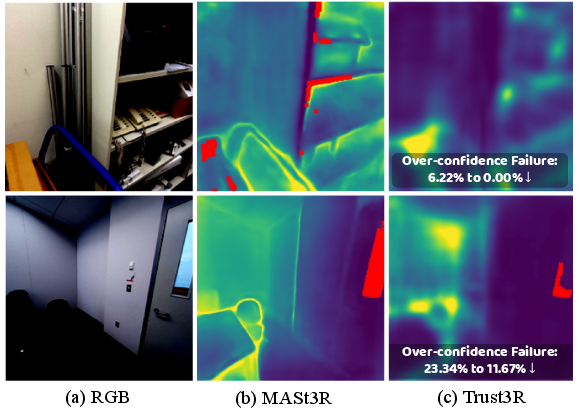
Figure 1: Reducing overconfident geometric failures with evidential uncertainty map—Trust3R more accurately flags points with high reconstruction error, compared to MASt3R's heuristic confidence.
Trust3R Framework and Methodology
Trust3R sits atop strong pretrained geometric foundation models. The framework extends a frozen MASt3R backbone with two parallel branches: a gated residual head for adaptive mean refinement, and a multivariate evidential UQ head that parameterizes a closed-form Student-t distribution for each predicted point.
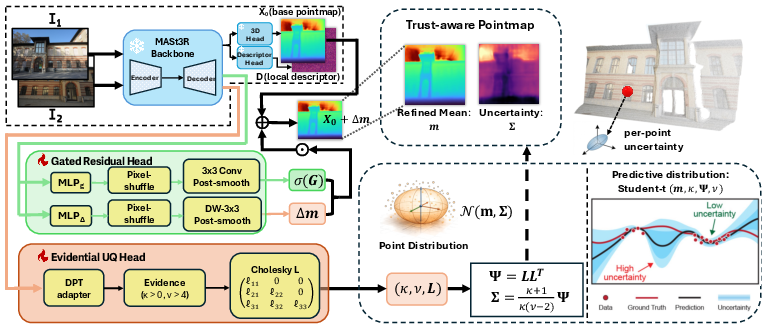
Figure 2: Overview of Trust3R: a MASt3R backbone is augmented by a gated residual refinement path and an evidential uncertainty quantification head, both of which feed into the predictive Student-t distribution.
The evidential UQ head predicts, for each point, the parameters (m,κ,Ψ,ν) of a Normal-Inverse-Wishart prior, which induces the per-point Student-t likelihood. This approach supports analytic computation of both aleatoric (observation-driven) and epistemic (evidence-driven) uncertainties, with epistemic uncertainty governed by evidence variables (κ,ν). The residual head refines the pretrained pointmap via a spatially-gated learnable offset and is carefully initialized to preserve strong pretrained geometry.
Optimization combines negative log-likelihood of the Student-t prediction with an evidence regularizer that penalizes overconfident errors, thus controlling unjustified certainty and stabilizing UQ training. The framework remains single-pass: all distributional parameters are inferred in one forward evaluation, making the method amenable to real-time and large-scale deployment.
Empirical Results and Analysis
Uncertainty Ranking and Calibration
Uncertainty ranking quality is evaluated via risk–coverage (AURC), sparsification error (AUSE), and uncertainty–error rank correlation (Spearman ρ). Strong results are observed:
Qualitative analyses show that Trust3R's epistemic uncertainty reliably flags regions of high geometric error, such as specular/transparent boundaries and occlusion regions, improving over learned confidence heuristics.
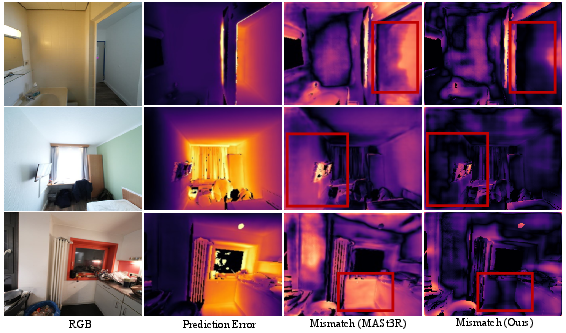
Figure 4: Qualitative comparison: Trust3R exhibits better spatial alignment between high-error regions and predicted high uncertainty (darker regions indicate superior alignment).
Geometric and Computational Tradeoffs
Trust3R generally preserves or slightly improves geometric accuracy (MAE/RMSE) on indoor datasets (ScanNet++, TUM RGB-D). There exists a mild tradeoff in out-of-domain outdoor scenes (KITTI), where refinement can marginally increase error but simultaneously provides superior uncertainty–error ranking. Trust3R's computational cost is close to vanilla MASt3R (≈80 ms per pair, <20% increase), orders of magnitude less than ensembles or MC dropout.
Downstream and Cross-Architecture Generalization
Trust3R uncertainty can be seamlessly integrated into SLAM pipelines (e.g., MASt3R-SLAM), improving camera pose estimation metrics (e.g., ATE reduced from 0.029 to 0.027). On challenging scenes with transparency/reflectivity (Tricky24), Trust3R significantly increases AUROC and reduces FPR for identifying unreliable geometry.
Generalization experiments demonstrate that Trust3R's evidential head can be plugged into other geometric backbones (e.g., VGGT), conferring similar improvements in UQ ranking and calibration.
Ablation and Design Decisions
Systematic ablations confirm:
- The use of epistemic trace from the Student-t as the uncertainty readout is optimal for ranking unreliable points.
- Full covariance modeling (NIW) outperforms coordinate-wise (NIG) evidential regression, especially in challenging or out-of-distribution settings.
- Gated residual mean refinement yields both improved mean predictions and more trustworthy uncertainty.
Discussion, Limitations, and Implications
Trust3R demonstrates that high-fidelity, per-point probabilistic uncertainty can be realized in feed-forward pointmap-based 3D reconstruction without the computational overhead of sampling-based methods. This enables actionable reliability signals for downstream modules such as SLAM/fusion, aggressive point selection, adaptive weighting, and robust scene understanding, crucial in robotics, AR/VR, and safety-critical perception.
Notably, the method models each point with a unimodal predictive distribution and neglects cross-point covariance, which may leave some scene ambiguities unresolved in challenging multi-hypothesis scenarios (e.g., degenerate textures or heavy occlusions). Future directions include hierarchical priors and pixel neighborhood UQ modeling.
Conclusion
Trust3R advances the state-of-the-art in 3D geometric UQ for feed-forward neural architectures, introducing an evidential multivariate UQ head with negligible overhead and strong cross-benchmark performance. Trust3R uncertainty is well-calibrated, actionable, and integrable into contemporary geometry-aware systems, marking a significant step toward robust, trust-aware 3D perception pipelines.
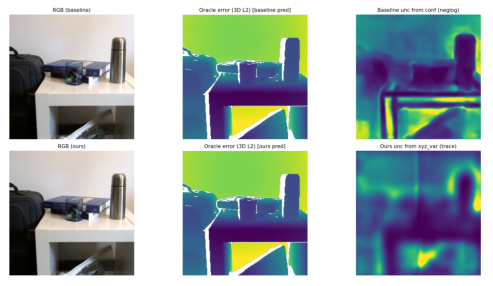
Figure 5: Trust3R uncertainty maps highlight unreliable geometry near transparent objects in Tricky24, improving error detection compared to MASt3R.
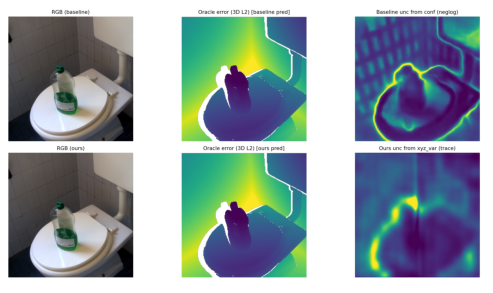
Figure 6: Additional qualitative results on Tricky24 showing robust identification of high-error regions (Trust3R bottom row) relative to baseline (top row).