- The paper introduces MAPL, a method for learning per-stage orthogonal projectors under Stiefel manifold constraints to dramatically reduce communication payloads in pipeline-parallel training.
- MAPL outperforms fixed subspace methods by retaining up to 2.2× more activation energy and preserving token cosine structure with near-isometric properties.
- Experiments show MAPL achieves compression ratios up to 16× with negligible accuracy loss for LLaMA models across various pipeline depths and scales.
Learned Subspace Compression for Communication-Efficient Pipeline Parallelism
Motivation and Problem Setting
Distributed pretraining of transformer-based LLMs increasingly leverages pipeline parallelism to address the memory limitations of individual accelerators. However, the inter-stage activation bandwidth costs in pipeline-parallel training become the dominant performance bottleneck, especially in large-scale or resource-constrained, heterogeneous, and geographically distributed settings. The challenge is to drastically reduce the communication payload of pipeline-parallel training** without incurring substantial performance degradation or imposing rigid model architectural constraints.
Prior art, such as Subspace Networks (SSN), achieves activation compression by projecting activations onto a shared, fixed low-rank orthogonal subspace. However, these approaches require intrusive modifications (global subspace enforcement, restricted optimizers, architectural entanglement) and still suffer nontrivial accuracy loss at moderate or high compression ratios.
Method: Manifold Aware Projection Learning (MAPL)
MAPL reframes inter-stage activation compression as the learning of per-stage, task-adaptive, strictly orthogonal projectors under precise Stiefel manifold constraints. The key architectural attributes are:
- Per-stage learned orthogonal projectors: Rather than enforcing a static, global subspace, each pipeline stage learns its own projector directly under the task objective, enabling dynamic adaptation to local activation geometry.
- Stiefel-manifold-constrained optimization: Optimization uses Spectral Steepest Descent specifically designed for the Stiefel manifold, ensuring orthogonality is preserved and preventing manifold escape. Standard optimizers lead to projector drift and significant performance collapse.
- Factorized anchor embeddings: Instead of global embedding decomposition, each stage uses its own low-rank, factorized token embedding ("anchor") to absorb the inherently high-rank lexical signal, offloading it from the learned projector and achieving strong information recovery with negligible communication and parameter overhead.
- Residual vector quantization (VQ): Optionally applied post-projection, further compressing the activation representation by amortizing codebook synchronization via asynchronous streaming.
The overall boundary protocol is diagrammed below.
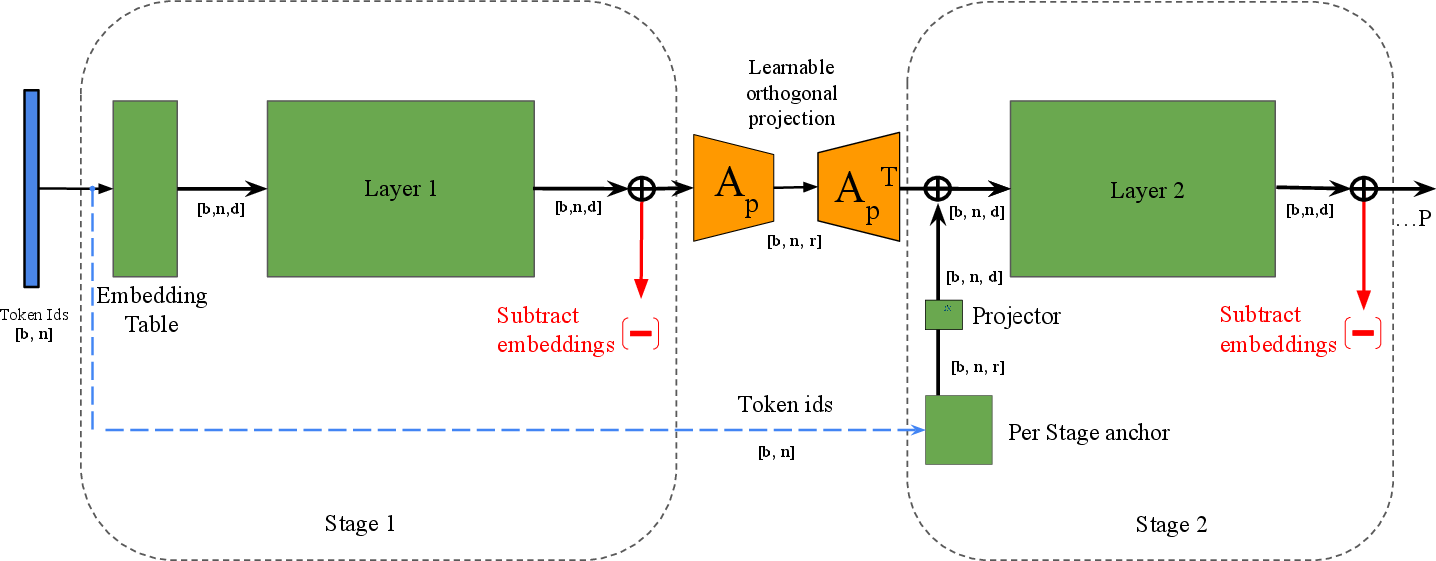
Figure 1: MAPL pipeline-parallel activation compression protocol, showing per-stage anchor subtraction, orthogonal projection, and reconstruction with minimal integer token transmission.
Empirical Observations: Low-Rank Structure and Energy
MAPL is motivated by the empirical finding that transformer pipeline boundaries' activations exhibit robust, intrinsic low-rank structure, regardless of explicit weight regularization. SVD analysis demonstrates that a rank-250 truncation preserves at least 99% of the activation energy for LLaMA models (hidden dimension d=1024).
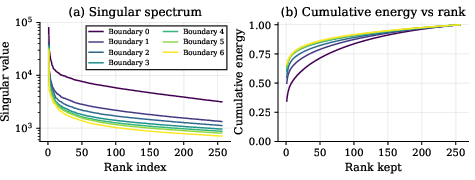
Figure 2: Singular value spectra and cumulative energy plot, illustrating that boundary activations are highly compressible via moderate-rank projections across all pipeline stages.
This motivates learning stage-local projections that are adaptive to each layer's evolving signal.
Projector Learning and Geometry
The learned projectors at each boundary are strongly geometrically distinct, as quantified by principal angle analysis. MAPL projectors not only retain a substantially larger fraction of the activation energy (up to 2.2× higher than fixed orthogonal projectors at the same rank), but also preserve the cosine structure of pairwise token representations with near-isometry (Pearson r=0.992).
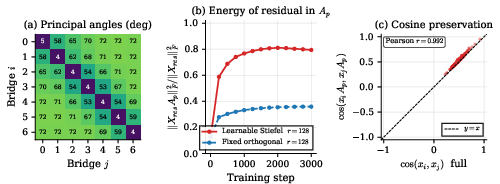
Figure 3: (a) Large off-diagonal principal angles demonstrate learned projectors occupy distinct subspaces; (b) learned projectors significantly outperform fixed ones in energy retention; (c) pairwise token similarities are faithfully preserved after projection.
Joint optimization of MAPL projectors induces a strong low-rank collapse in adjacent layers, actively aligning their outputs with the communication subspace, in sharp contrast to fixed-projection approaches.
Communication-Accuracy Tradeoffs
MAPL establishes new Pareto frontiers in the communication-accuracy space for pipeline-parallel training. At 4× compression, MAPL incurs only ≈0.08 points of cross-entropy degradation over the uncompressed baseline for a 150M-parameter LLaMA model, while SSN baselines experience much larger drops at equivalent compression.
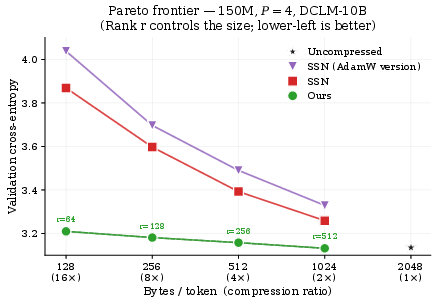
Figure 4: MAPL dominates the Pareto frontier, delivering high compression ratios with negligible validation loss increases compared to SSN baselines and the uncompressed reference.
MAPL achieves compression ratios of 4×, 6×, and 8× for 150M, 500M, and 1B parameter transformers, with accuracy losses under 2% for all, and further scales to d=10240 with vector quantization at d=10241–d=10242 degradation. The results are consistent across varying pipeline depths (d=10243, d=10244), model scales, and validation setups.
Downstream zero-shot evaluation (HellaSwag, PIQA, ARC-Easy, ARC-Challenge) confirms that MAPL tracks the uncompressed baseline to within d=10245–d=10246 points, whereas SSN models lose as much as d=10247 points under token-matched comparisons at 1B scale.
Analysis: Inductive Effects and Failure Modes
MAPL's projectors drive stronger rank collapse in adjacent weights, as verified by dynamics of stable rank measures. In ablations, unconstrained (non-manifold) updates result in projectors that deviate from orthonormality and underperform even fixed-basis alternatives, corroborating the necessity of strict manifold adaptation.
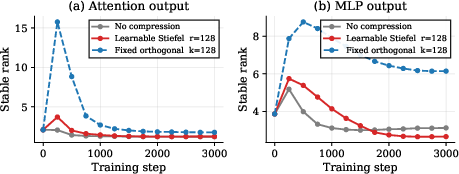
Figure 5: Learning the projection on the Stiefel manifold accelerates and deepens rank collapse in adjacent layers, aligning model representations with the communication constraint.
Ablations on anchor embedding strategies demonstrate that the proposed factorized anchor balances parameter efficiency with performance, closely matching a full trainable anchor but without its overhead, and greatly outperforming static offsets.
Practical Implications and Future Directions
MAPL provides a practical, optimizer-agnostic mechanism for communication-efficient pipeline-parallel training, eliminating the need for intrusive architectural modifications and enabling applicability to arbitrary pipeline decompositions and resource-constrained training environments (e.g., over commodity interconnects or edge clusters).
The adaptive, per-stage learning paradigm ensures that MAPL remains robust as underlying activation geometries evolve with scaling, depth, and optimizer choice—capabilities that are increasingly important as model and system heterogeneity increase.
Future research directions include:
- Extending MAPL to much larger parameter regimes and verifying robustness under truly heterogeneous and adversarial networking conditions.
- Integrating MAPL-type learned geometric constraints with more general distributed architectures, e.g., hierarchical pipeline/data hybrid settings.
- Exploring non-linear or data-dependent structured projector families for potentially even sharper compression-fidelity tradeoffs.
- Systematic analysis of the theoretical properties of induced rank collapse on generalization under manifold-constrained communication.
Conclusion
MAPL demonstrates that strict manifold-constrained, per-stage adaptive learned orthogonal projections provide highly communication-efficient pipeline-parallel training with negligible performance loss, outperforming prior approaches by a wide accuracy margin, and enabling up to d=10248 reduction in inter-stage payloads for LLaMA-scale transformers. These results provide compelling evidence that transformer activations at pipeline boundaries are intrinsically compressible, and that dynamic, geometry-aligned representation learning is an effective mechanism for scaling distributed foundation model training to low-bandwidth environments.
(2606.05484)

