- The paper presents operational best practices for setting QAOA angles at utility-scale using classical simulations and hardware validations.
- It categorizes methods into physics-inspired, transfer-based, and iterative approaches, highlighting trade-offs between computational cost and solution quality.
- Empirical benchmarks confirm that parameter transfer and fixed-angle methods effectively overcome NP-hard optimization challenges in practical QAOA deployments.
Operational Guidance for Utility-Scale Angle Setting in QAOA
Introduction
The quantum approximate optimization algorithm (QAOA) remains a central heuristic for mapping combinatorial optimization problems such as MaxCut, Maximum Independent Set (MIS), and LABS to quantum circuits. However, at the scale of current and near-term quantum hardware—termed "utility-scale," typically 100 qubits or more—setting QAOA circuit parameters (angles) to produce high-quality solutions poses severe algorithmic and engineering challenges. This paper systematically benchmarks, analyzes, and distills operational best practices for QAOA angle setting at utility-scale by combining classical simulation, hardware validation, and cost-quality trade-off analysis (2606.05311).
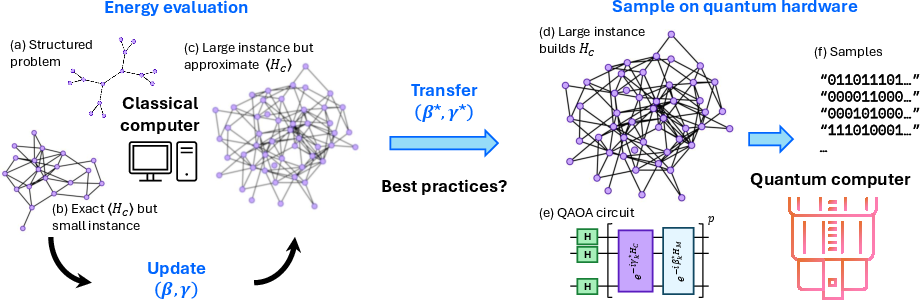
Figure 1: Schematic depicting utility-scale QAOA workflows: Angle optimization via (a) structure-based heuristics, (b) small-scale exact classical training, or (c) approximate energy evaluation, with only sampling performed on hardware.
Complexity-Theoretic and Structural Obstacles
The paper gives a rigorous account of hardness results for finding globally optimizing QAOA angles. The QAOA optimization landscape, especially for combinatorial MaxCut instances, is formally NP-hard to optimize in general [Bittel_2021], with further work establishing QCMA-hardness for depth allocation and even undecidability for higher-depth circuits [korpas2025undecidable], precluding generic efficient classical solvers.
This computational hardness is compounded by structural obstructions inherent to standard QAOA:
- Symmetry Protection: Fixed symmetries of the QAOA state, e.g., global Z2 spin-flip, restrict attainable correlators, which provably prevent constant-depth QAOA from surpassing classical SDP relaxations on high-girth/regular/bipartite graphs [Bravyi2020, BravyiKlieschKoenigTang2022].
- Locality/Information Propagation: Bounded-depth circuits cannot mediate non-local correlations, fundamentally limiting approximability for bounded-degree CSPs below logn circuit depth due to the overlap-gap property [ChouLoveSandhuShi2021, ChenHuangMarwaha2023].
Potential mitigations such as recursive QAOA and warm-started QAOA, which break symmetry or locality bounds, are noted as promising, but the operational focus here is on standard QAOA and strategies that accept but work around generic intractability by employing heuristic and transfer-based methods.
Taxonomy and Survey of Angle Setting Methods
A comprehensive taxonomy of QAOA parameter optimization strategies is articulated, categorizing approaches as follows:
- Physics-Inspired Schedules: Linear or annealing-based parameterizations, e.g., Trotterized schedules, Linear Ramps, Spectral Gap Informed Ramps, Counterdiabatic QAOA. These employ physics insight to reduce the search space for β,γ, and often avoid active energy evaluation unless further refined.
- Parameter Transfer: Empirically transfer angles between similar problem instances or system sizes, leveraging empirically observed clustering; includes the fixed angle conjecture for regular graphs [Wurtz2021], re-optimization strategies, and data-driven or surrogate-model-based transfer.
- Iterative/Lift-and-Refine: Extension from depth p to p+1 using interpolations (Interp.), Fourier-mode decomposition, or transition-state constructions, often focusing optimization only to the last added layer [Zhou2020, Sack2023, Campos2021].
- Machine Learning: Angle inference via instance similarity, clustering, supervised regression, or generative/reinforcement learning, typically relying on a labeled angle database.
A matrix product state-based taxonomy summary maps methods versus their principal architectural characteristics, including their need for explicit energy evaluation.
Accurate and Efficient Energy Evaluation
The computational bottleneck of classical training at utility-scale is the intractability of exact statevector simulation. The paper evaluates two main approximate classical simulators:
- Matrix Product States (MPS): Particularly effective for low-dimensional, short-range correlated problems. The SAT mapping [Matsuo2023] significantly improves energy estimate accuracy and runtime by aligning problem non-locality to the MPS chain.
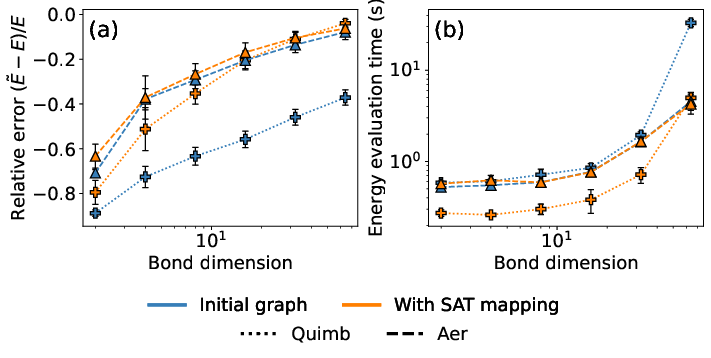
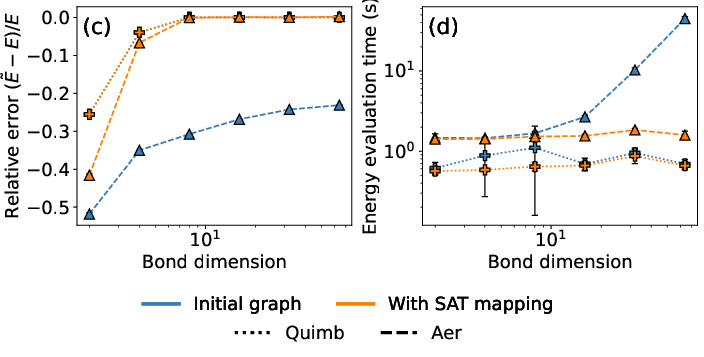
Figure 2: MPS relative error and runtime as a function of bond dimension and mapping, highlighting benefits of SAT mapping for graph instances of various sizes.
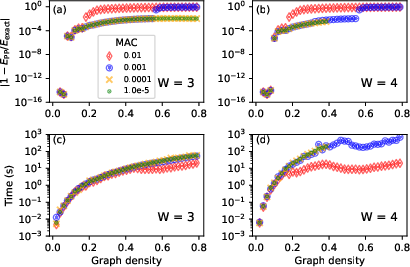
Systematic benchmarking confirms that both MPS and PP support scalable, tunable tradeoffs—in sparse, hardware-native connectivity cases, both methods yield energy evaluations accurate enough to direct parameter optimization for large-scale systems.
Benchmarking: Angle Setting Quality, Transferability, and Hardware Validation
The paper presents extensive empirical benchmarks across diverse angle-setting methods, simulated energy evaluators, problem instances (MaxCut on ER/regular/line/hex graphs, MIS, LABS), and QAOA depths (p≤10). Key findings include:
- Physics-inspired (e.g., Linear Ramp) and Interp./Fourier methods frequently achieve the best energy minimization across a wide class of graphs at low runtime.
- Fixed angles derived from infinite-girth/worst-case graphs [Wurtz2021] perform strikingly well not only on the graphs for which they are designed, but also transfer robustly to other sparse classes, particularly if further refined via short optimization.
- Method performance is highly problem-class dependent: E.g., Fourier-based schedules underperform in MaxCut but are highly competitive for MIS and especially for higher-order (quartic) problems like LABS.
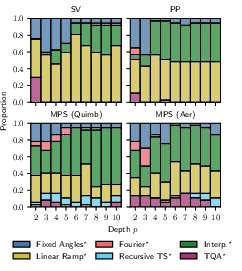
Figure 4: Proportion of cases where each method yields the best QAOA angles over a suite of graph families and depths, illustrating context-specific method dominance.
- Transfer between sizes and topologies is robust, up to certain expressibility limits; transfer within a class (e.g., from lower to higher k-regular graphs) generally exceeds naive interpolation or random initialization.
- Hardware validation: On 144-qubit ibm_boston and related QPUs, angles trained by approximate methods maintain high approximation ratios, with empirical tail-sample methods (CVaR) further reducing deleterious readout and two-qubit gate noise.
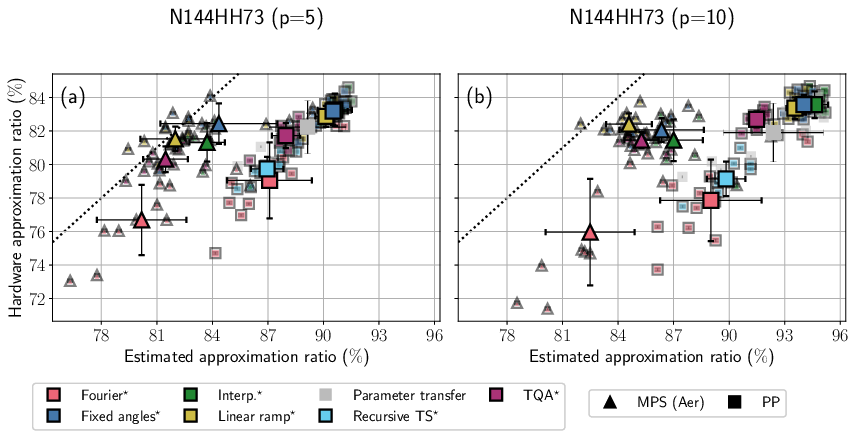
Figure 5: Direct hardware validation—approximation ratios obtained via sampling compared with estimated ratios from classical evaluators (MPS and PP), showing strong linear correlation for PP-evaluated angles.
- Statistical indistinguishability near noise threshold: As depth/circuit width approach hardware noise floors, even the best method differences are unobservable in practice, and any method in the class of top performers suffices.
Computational Cost vs. Solution Quality: Pareto Analysis
The study incorporates a Pareto frontier analysis of solution quality (e.g., MaxCut approximation ratio) versus total computational training cost (CPU time for angle setting plus QPU time for sampling):
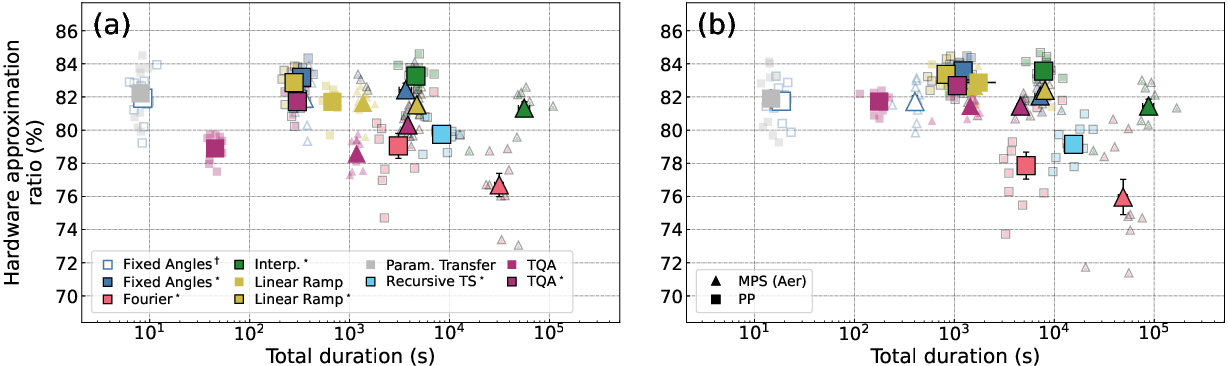
Figure 6: Achieved hardware solution quality versus end-to-end duration for various angle-setting and energy evaluation methods.
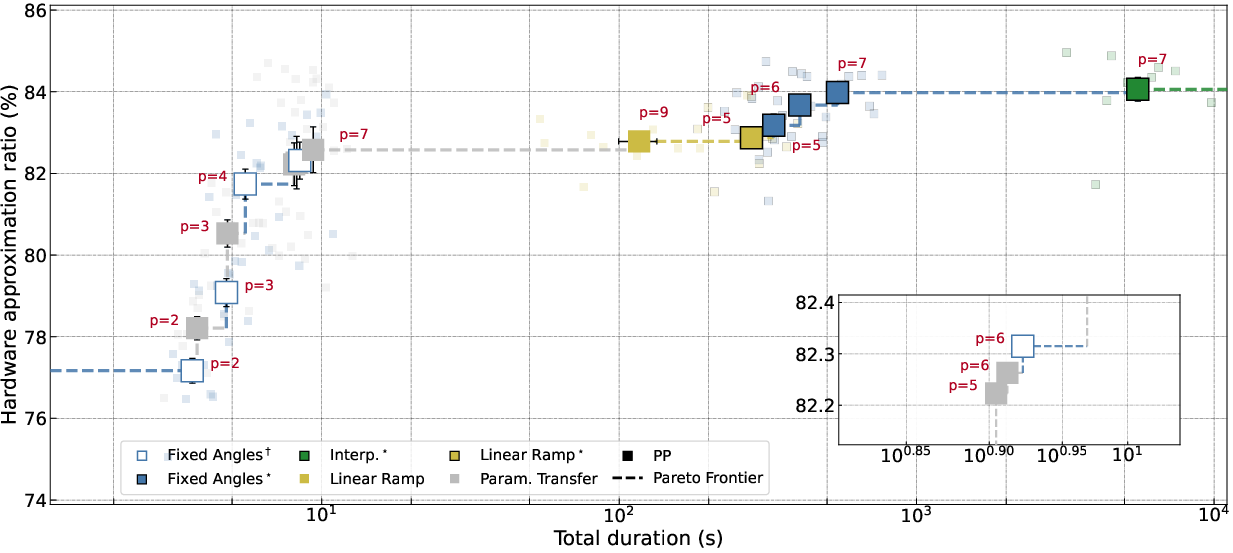
Figure 7: Pareto frontier indicating optimal tradeoffs—parameter transfer and fixed angles provide near-optimal performance at minimal runtime; expensive iterative schemes only weakly improve solutions given noise and circuit depth limits.
- Parameter transfer and fixed angle methods without full optimization are the most cost-effective operational pipelines for near-term hardware—hardware performance saturates and further maximization of energy is not justified by resource overhead.
- As resource budget grows, some incremental improvement can be achieved by reoptimizing angles or using higher-expressivity iterative schemes, but gains are marginal, especially at the depth/noise limits of QPUs.
- Comparison with classical baselines (Goemans-Williamson) clarifies that, for standard MaxCut instances, quantum pipelines do not outperform efficiently computable SDP relaxations.
Operational Implications and Recommendations
Several actionable insights and best-practice recommendations for utility-scale QAOA emerge:
- Approximate classical simulation (MPS/PP) is sufficiently accurate and scalable for parameter training on hardware-native, sparse instances; accuracy can be maximized with careful mapping.
- Transfer methods (including fixed angles and small-to-large problem scaling) offer the best tradeoff of performance and computational cost. Reoptimization, if needed, is best localized or restricted to higher-impact layers.
- Physics-inspired ramps or ML-based predictors should be considered particularly where class-based structure is known and database construction is possible.
- Hardware benchmarking is critical: Some methods optimized via approximate energy evaluation can be misleadingly optimistic; direct QPU validation remains indispensable.
- For problem classes beyond MaxCut (MIS, LABS), method dominance can change: Practitioners should benchmark at small scale within class before investing in hardware-scale training.
- Resource-aware method selection is recommended: In practice, as differences collapse at noise limits, methods should be selected for computational expediency, robustness of transfer, and pipeline simplicity.
Conclusion
This study provides the most comprehensive operational benchmarking of QAOA angle setting at utility-scale to date. By combining explicit mapping of computational and structural hardness, a surveyed taxonomy of angle assignment methods, careful approximate simulation, extensive empirical benchmarking and Pareto-optimal strategy selection, it constructs clear, actionable recommendations for practitioners. The recommended approaches—rapid database-driven parameter transfer, fixed angles, or physics-motivated parameterizations—enable cost-effective, scalable, and robust QAOA deployment on current and near-future quantum hardware, with strong empirical evidence for their efficiency and reliability.
Further research directions include extending these strategies to warm-started and recursive QAOA variants and benchmarking on more challenging combinatorial optimization and multi-objective problems, especially as quantum hardware advances in qubit number, fidelity, and connectivity.