- The paper introduces kA-QAOA, a structured parameterization grouping k-body interactions to match MA-QAOA performance with reduced resource usage.
- The paper demonstrates that kA-QAOA minimizes quantum magic buildup compared to MA-QAOA, enhancing noise resilience on NISQ devices.
- The paper validates kA-QAOA’s efficiency through benchmarks on hypergraphs, showing fewer function evaluations and effective scaling for complex problems.
Structured Parameterization and Magic in Hypergraph QAOA: An Expert Analysis
Background and Motivation
Quantum Approximate Optimization Algorithm (QAOA) is among the most prominent variational quantum algorithms (VQAs) targeting combinatorial optimization on noisy intermediate-scale quantum (NISQ) devices. A key avenue of research has been dissecting the resources—such as quantum entanglement and nonstabilizerness, or "magic"—that underlie potential quantum advantage. Ancillary to this, much progress has focused on parameterization schemes within QAOA to balance expressiveness, optimization tractability, and quantum resource efficiency, especially for optimization problems defined on hypergraphs where native k-body interactions pervade.
This paper introduces the k-interaction-angle QAOA (kA-QAOA), a parameterization that groups cost function terms by their k-body interaction order (arity). This method fills the gap between the low-parametric single-angle (SA-QAOA) and highly expressive multi-angle (MA-QAOA) variants, and is tailored for hypergraph problems as encountered in Boolean satisfiability and job-shop scheduling. The core claim is the achievement of approximation ratios comparable to MA-QAOA with significantly reduced classical and quantum resource usage—crucially, function evaluations and accumulated circuit magic.
QAOA Variants and Structured Parameterization
Standard QAOA relies on alternating layers of cost and mixer unitaries, each governed by variational parameters. Traditional SA-QAOA assigns a single angle per layer, while MA-QAOA utilizes an angle per gate, offering greater expressiveness at the expense of increased optimization complexity and susceptibility to barren plateaus. Automorphic-angle (AA-QAOA) schemes reduce parameters by exploiting symmetries in the interaction graph.
kA-QAOA, the focal variant, assigns a distinct parameter to all terms sharing the same k-body interaction order in the cost function. This is particularly advantageous for hypergraph instances (e.g., k-uniform cyclic models) lacking symmetry groups. Hardware-wise, kA-QAOA is well-aligned with emerging platforms (trapped ions, neutral atoms) that increasingly support native multi-qubit operations, facilitating resource-efficient mapping and reducing the overhead from quadratization and ancillary qubits.
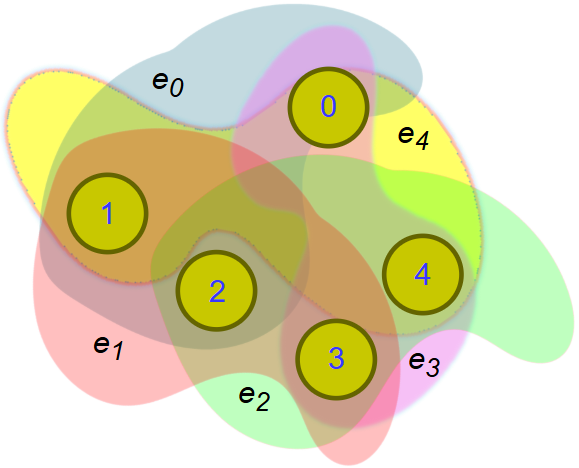
Figure 1: 5-vertex 3-uniform cyclic hypergraph; each hyperedge links three nodes, modeling higher-order constraints in combinatorial problems.
Magic as a Resource and Its Optimization
Magic, defined as nonstabilizerness (measured via stabilizer Rényi entropy), distinguishes quantum states from Clifford-simulable ones, thus being essential for computational quantum advantage. The paper details a phenomenon whereby QAOA circuits experience a transient accumulation of magic—a "magic barrier"—even when initial and target states are stabilizers. This non-monotonic buildup is necessary for traversing the Hilbert space toward high-fidelity solutions.
The study benchmarks various QAOA parameterizations on both structured (3-uniform cyclic) and unstructured (random coefficient) hypergraphs. kA-QAOA generates lower average magic than MA-QAOA, especially as the circuit depth increases, while maintaining high approximation ratios and fidelity to the ground state. This demonstrates not only classical but also quantum resource efficiency; excess magic, observed in over-parameterized MA-QAOA, does not correlate with improved solution quality and is detrimental for NISQ-era noise resilience.
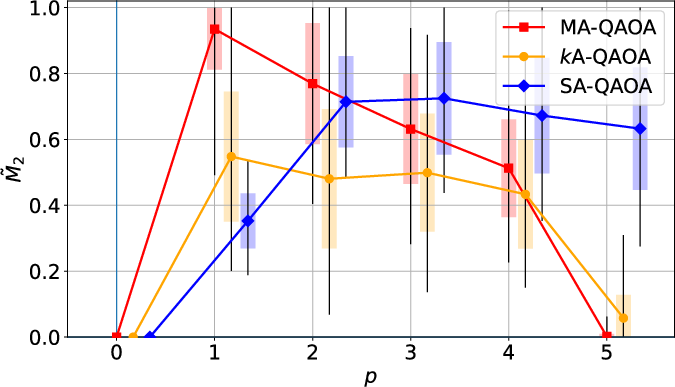
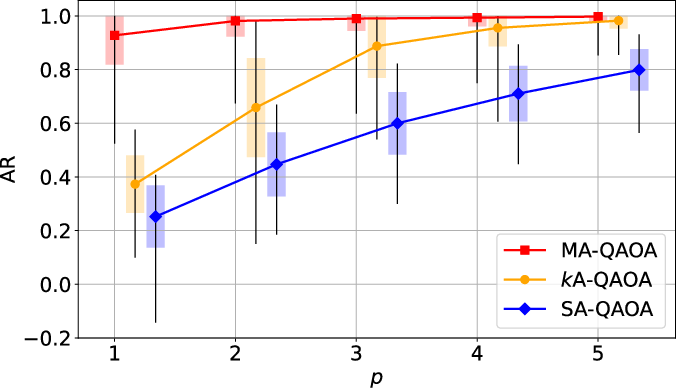
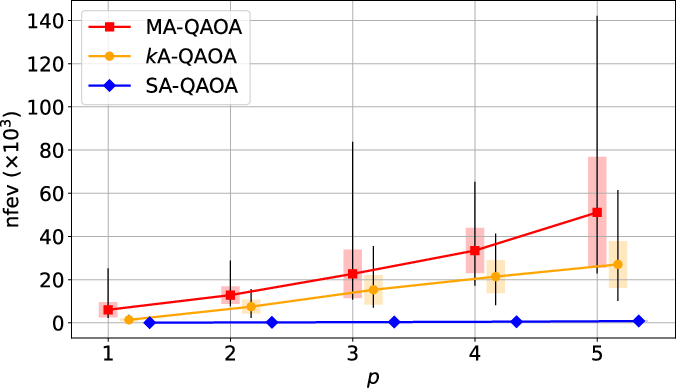
Figure 2: Comparison of QAOA performance metrics: (a) average normalized magic, (b) average approximation ratio, (c) average number of function evaluations, contrasting SA-, kA-, and MA-QAOA.
Empirical Results
On hard instances such as 3-uniform cyclic hypergraphs, kA-QAOA delivers higher approximation ratios and fidelity than SA-QAOA, and at low depths (p=1) matches or outperforms AA- and MA-QAOA. At p=2, AA- and MA-QAOA reach parity, but SA-QAOA lags behind even with increased depth. Critically, kA-QAOA requires fewer function evaluations for convergence, reflecting a direct reduction in quantum resource consumption.
Random Coefficient Hypergraphs
For randomly weighted 12-vertex hypergraphs, kA-QAOA scales efficiently. It achieves MA-QAOA-level approximation ratios at p=3, uniformly outperforming SA-QAOA across depths. Again, kA-QAOA needs fewer function evaluations, confirming its practical advantage for NISQ constraints.
Magic Barrier
Across numerous random hypergraphs and circuit layers (p up to 5), all QAOA variants encounter a magic barrier. kA-QAOA exhibits lower normalized magic buildup than MA-QAOA, even as both converge to high approximation ratios. The reduced number of classical parameters and function evaluations in kA-QAOA also translates into a lower quantum resource (magic) requirement.
Implications and Future Directions
kA-QAOA demonstrates a resource-efficient approach for variational optimization of hypergraph-structured combinatorial problems, balancing expressiveness and optimization complexity. Its parameter grouping by interaction order offers compatibility with current and forecasted quantum hardware supporting multi-body operations. The lower demanded circuit magic translates into improved noise robustness and scalability, crucial for real-world NISQ-era deployments.
Practically, kA-QAOA is poised to tackle problems such as job-shop scheduling and multi-party resource allocation, circumventing the bottlenecks of ancilla-based quadratization and deep circuit requirements. Theoretically, the observed interplay between magic, parameterization, and solution quality motivates further exploration into quantifying the minimal nonstabilizer resource necessary for quantum optimization, potentially guiding the design of future VQAs and optimizers.
Future work should extend kA-QAOA benchmarking to broader combinatorial classes, investigate its integration with hardware-native multi-body gates, and refine the characterization of the magic barrier in relation to algorithmic performance and quantum-classical optimization loops.
Conclusion
kA-QAOA provides an effective structured parameterization for QAOA, tailored to hypergraph optimization problems, yielding high-quality solutions with reduced classical and quantum resource expenditure. Its grouping by k-body order minimizes unnecessary magic generation, supporting efficient NISQ-era algorithms resilient to noise and complexity. The correlation between magic and optimization success underscores magic’s role as an actionable resource metric in quantum algorithms. The scalability and hardware affinity of kA-QAOA mark it as a strong path forward for quantum optimization research and application.

