- The paper introduces a low-rank residual update on a multimodal base controller to achieve real-time, context-sensitive exoskeleton adaptation.
- It leverages reward-shaped policy gradients and dynamic rank scheduling to balance computational efficiency with rapid convergence.
- Experimental results show improved gait smoothness (+13%), reduced effort (+22%), and enhanced stability (+15%) across varied real-world terrains.
OLIVE: Online Low-Rank Incremental Learning for Efficient Adaptive Exoskeletons
Introduction and Motivation
The adaptation of wearable exoskeletons in dynamic and unstructured real-world environments remains severely constrained by traditional static controllers, which are brittle to terrain and user variability. Standard architectures—rule-based finite state machines, fixed impedance controllers, and offline-pretrained neural policies—lack the ability for continual, efficient personalization during deployment. The "OLIVE: Online Low-Rank Incremental Learning for Efficient Adaptive Exoskeletons" (2606.05234) framework introduces a parameter- and computation-efficient online learning paradigm, leveraging a low-rank residual update on top of a multimodal foundation controller, directly shaped by real-time sensory feedback.
System Architecture
OLIVE is implemented on a lightweight bilateral hip-assist exoskeleton incorporating high-frequency IMU, joint encoder, surface EMG, and actuator vibration sensors. Four sensor streams are fused to support both intent recognition and adaptive real-time control, all running on an ARM-based SoC with a stringent <10 ms round-trip latency constraint.
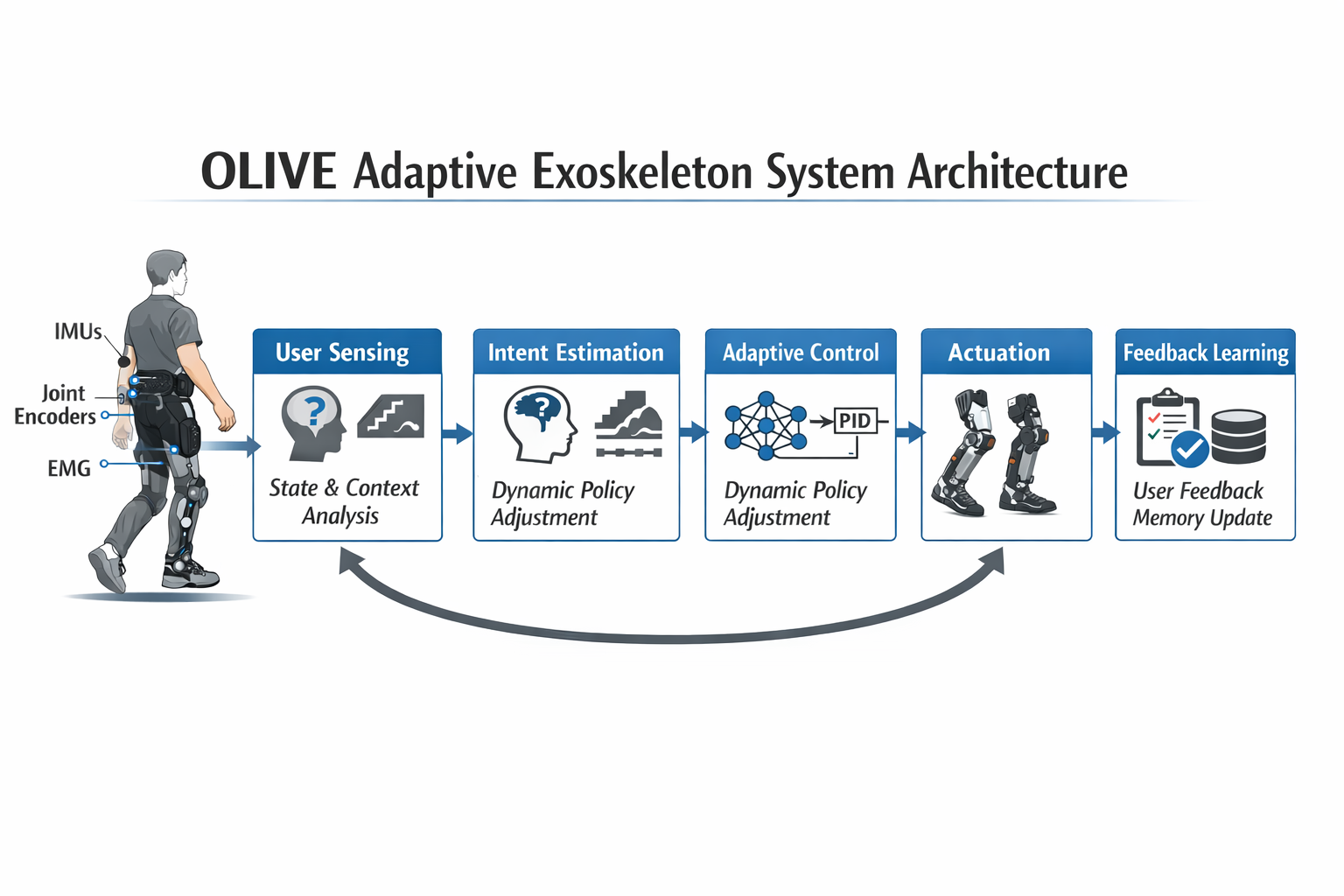
Figure 1: Olive system architecture: multimodal sensor fusion supports online low-rank adaptation gated by context and shaped by real-time feedback.
The system pipelines data from four sensing modalities into an intent estimator, which drives an adaptive controller composed of (1) a pretrained, frozen multimodal base policy, and (2) a learnable low-rank update. A feedback mechanism computes immediate, reward-shaped gradients from on-body sensor responses, which in turn drive continual adaptation of control parameters.
Adaptive Control via Low-Rank Policy Decomposition
OLIVE decouples the exoskeleton controller into a static base weight W0, pretrained on large-scale wearable motion data, and an adaptive residual ΔWt=AtBt⊤ of rank rt≪min(d,k), where At and Bt are online-learned factors. This decomposition reduces the number of online-updated parameters from O(dk) to O(r(d+k)) and ensures computational feasibility for embedded real-time applications.
To regulate personalization and guarantee safe recovery to the robust prior, a gating network outputs a scalar γt∈(0,1) acting on the residual. In parallel, a dynamic rank scheduling mechanism selects rt at each step, allocating minimal parameters in simple (flat) contexts (W00) and more in complex scenarios (e.g., stairs or unstable terrain, up to W01). This flexibility allows OLIVE to efficiently trade off computational budget and adaptation capacity according to environment complexity.
Reward-Shaped Policy Gradient Adaptation
Rather than relying on population-level offline reference trajectories, OLIVE's online adaptation is driven by reward signals constructed entirely from real-time on-body sensor feedback. The shaped reward W02 integrates: reduction in muscle activation (from EMG), a normalized metabolic cost proxy, and measures of motion symmetry and stability. These rewards are normalized, weighted, and combined, yielding a dimensionless guidance signal, which is optimized online via gradient steps in the low-rank subspace.
The update objective W03 includes (1) negative reward, and (2) regularizers penalizing action discontinuities and postural instability. Proximal updates are applied only to W04 and W05, and crucially, the base model W06 remains immutable, bounding the overall policy shift and preserving a Lyapunov-like stability guarantee. The entire update protocol, including gating and rank adaptation, incurs only W070.3 ms additional cost per time-step.
Real-World Deployment Scenarios
OLIVE is evaluated in real-world conditions representative of daily exoskeleton use, including flat, inclined, uneven, and stair terrains. The exoskeleton supports a range of applications, such as mobility assistance for impaired individuals and daily activity augmentation.

Figure 2: Four real-world use cases: Olive adapts control parameters online to varied terrains including trails, stairs, rocky hills, and elderly-assistance.
The instantaneous intent estimator enables rapid terrain classification, which influences both the adaptive control parameters and the policy’s rank schedule. This capacity supports contextually sensitive assistance and robust generalization beyond the canonical environments targeted in traditional controller design.
Experimental Evaluation and Results
Experiments performed on six healthy subjects in variable terrain validate OLIVE’s adaptive framework. Performance is measured via normalized gait smoothness, effort reduction (metabolic cost proxy), and center-of-mass stability. Comparative baselines include static FSM, rule-based, and offline-trained neural policies.
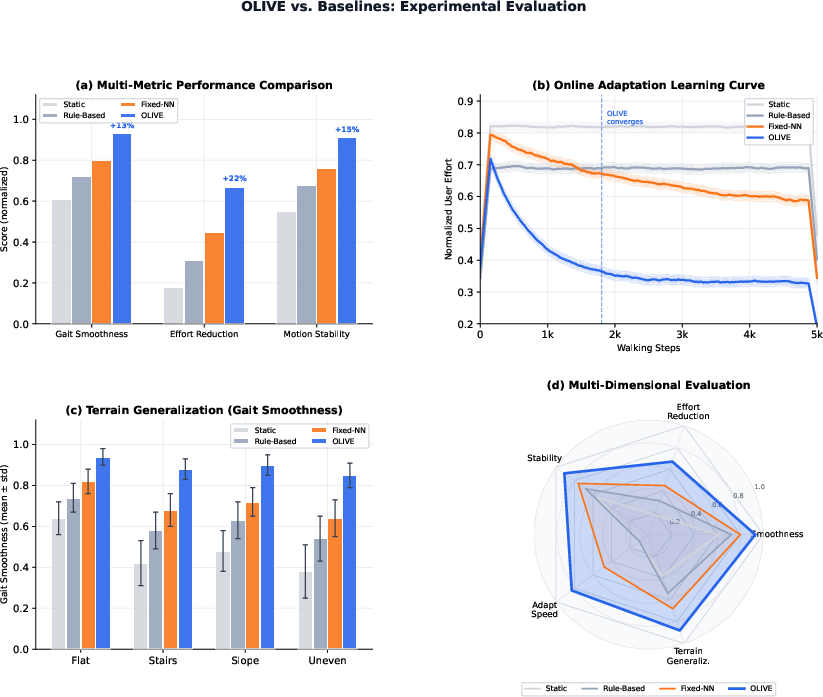
Figure 3: OLIVE delivers superior performance: higher smoothness (+13%), greater effort reduction (+22%), and improved motion stability (+15%) compared to baselines; rapid convergence and robust generalization across terrains.
OLIVE converges to peak performance in approximately 1,800 walking steps, roughly halving convergence time and error rates versus the strongest neural baseline. Across all complex terrains, OLIVE’s terrain generalization metrics remain high and with low variance, demonstrating effective context-sensitive adaptation. Critically, adaptation speed and stability are markedly improved during terrain transitions, directly attributable to the gated low-rank mechanism.
Resource efficiency is notable: on simple flat walking, over 70% of steps use the minimal rank (W08), reducing real-time update costs to 1.3 ms/step. Even at maximal complexity, parameter savings are 4W09 over a dense update, and OLIVE’s cumulative end-to-end latency (7.4 ms) remains well within safety budgets.
Ablation analysis highlights the necessity of Pretrained-MM initialization for rapid smoothness and effort gains. Gating is indispensable for robust stability during transitions, whereas dynamic rank scheduling mainly contributes to computational efficiency.
Implications and Future Directions
OLIVE demonstrates the feasibility of continual fine-tuning of exoskeleton controllers in the field, moving beyond static policy deployments toward efficient, context-aware online personalization. The low-rank, reward-driven update structure eliminates the need for offline human-in-the-loop optimization and hand-tuned controller parameters, marking a shift toward fully self-adaptive wearable robotics.
Theoretically, this architecture enables hardware-efficient adaptation governed by stability guarantees anchored in contraction to a pretrained base. Practically, OLIVE’s design is directly extensible to other wearable or assistive domains where resource constraints and personalization demands co-exist.
Future directions involve extending OLIVE's core principles to:
- More complex, multi-joint, and multi-modal exoskeletons,
- Prolonged longitudinal studies with clinical and elderly user populations,
- Integration with more sophisticated reward estimators using hierarchical probabilistic models for individual biomechanics,
- Exploration of task-general foundation controllers augmented by emergent few-shot learning or meta-learning constructs.
Conclusion
OLIVE provides a comprehensive method for low-rank, feedback-efficient, and stably personalized exoskeleton control in challenging real-world conditions. By integrating gating, dynamic rank selection, and policy gradient adaptation in a compact form suitable for edge deployment, it resolves key bottlenecks in personalization, safety, and efficiency for next-generation wearable robotics.
(2606.05234)