- The paper demonstrates a 4e superconducting phase mediated by Cooper quartets at f=1/3, verified through phase-biased simulations, Monte Carlo sampling, and tensor network analysis.
- It reveals dominant quartet transport with I2 harmonics up to five times larger than conventional pair contributions, underscoring its robustness against disorder.
- The study characterizes fractional vortex excitations and BKT transition properties, highlighting dice lattice JJ arrays as promising platforms for topological quantum memories.
Summary of Cooper Quartets and Fractional Vortices in Frustrated Josephson Junction Dice Arrays
Physical Context and Motivation
The study presents a theoretical and numerical investigation into the emergence of unconventional superconducting phases in Josephson junction arrays (JJAs) configured on a dice lattice geometry under magnetic frustration. The primary focus is the realization and characterization of a $4e$ superconducting phase mediated by Cooper quartets, in contrast to conventional $2e$ Cooper pair condensation. Such phases are of practical relevance for topological quantum memories, where fractional vortices are integral to realizing robust, hardware-level protection against decoherence.
The dice lattice JJA platform has garnered renewed attention due to advances in hybrid superconductor-semiconductor fabrication, enabling precise tunability of Josephson energies and scalable realization of large arrays. The frustration parameter f=Φ/Φ0 quantifies the magnetic flux per plaquette, and its manipulation leads to distinctive supercurrent and phase behaviors not observed in regular square or triangular lattices.
Theoretical Model and Numerical Methods
The physical system is described by a classical $2D$ XY model on the dice lattice, given by
H=−EJ⟨r,r′⟩∑cos[φr−φr′−Arr′],
where the Peierls phase Arr′ encodes the inserted magnetic flux. The analysis is restricted to regimes with negligible charging energies, justified for sufficiently large superconducting islands, but later extended to include quantum effects and charging energy contributions.
Multiple numerical techniques are leveraged: phase-biased and current-biased relaxation simulations for transport properties, Monte Carlo sampling for critical current calculations, and two-dimensional infinite tensor networks for thermal and correlation studies. The robustness to disorder (both in flux and Josephson coupling) is explicitly assessed.
Supercurrent Behavior and Transport Features
A comprehensive study of the critical current as a function of frustration reveals:
- Pronounced peaks at f=0, f=1/6, f=1/3; local minimum at f=1/2.
- The $2e$0 peak arises from the dominance of $2e$1 Cooper quartet transport, as quantified by Fourier decomposition showing $2e$2 (quartet) harmonics up to five times larger than $2e$3 (pair) (Figure 1).
- Disorder (flux or Josephson) only moderately perturbs the $2e$4 peak, suggesting considerable experimental robustness.
Supercurrent-phase relations computed for pairs of sixfold-coordinated islands display pronounced second harmonic behavior at $2e$5, indicating dominant Cooper quartet transport. This is strongly supported by histograms of joint $2e$6 distributions for varying spatial separations (Figure 1, Figure 2, Figure 3).
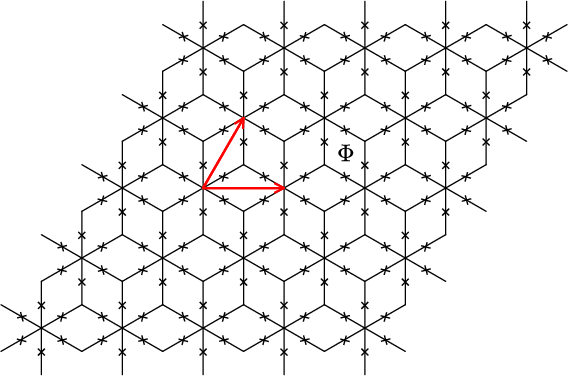
Figure 4: Schematic of the dice lattice JJA geometry with unit-cell vectors, illustrating the threading of magnetic flux through each plaquette.
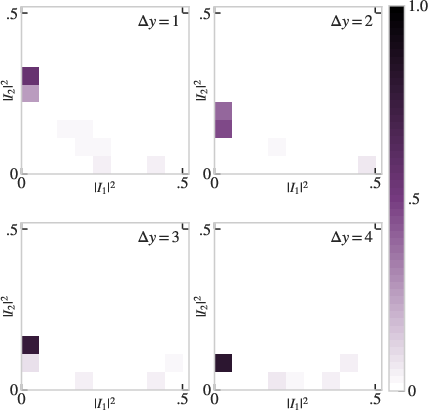
Figure 1: Joint probability distributions of pair and quartet supercurrent harmonics at $2e$7, highlighting quartet dominance over varying spatial separations.
Ground State Structure and Fractional Vortex Excitations
At $2e$8, the ground-state vortex configuration maps to the extensively degenerate antiferromagnetic Ising model on the triangular lattice. This yields a nonzero entropy density at zero temperature, as confirmed numerically via tensor networks (Figure 5), matching theoretical values from Wannier's exact calculation.
Half-vortex excitations correspond to the fusion of three zero-energy domain walls joining at a hexagon. These are topologically analogous to excitations in $2e$9 gauge theories and Kitaev codes, imparting an Aharonov-Bohm phase of f=Φ/Φ00 when encircled by Cooper pairs. Visualization of vortex patterns (Figure 6, Figure 7) elucidates the mechanism of half-vortex formation, domain wall proliferation, and the role of boundary and excited states.
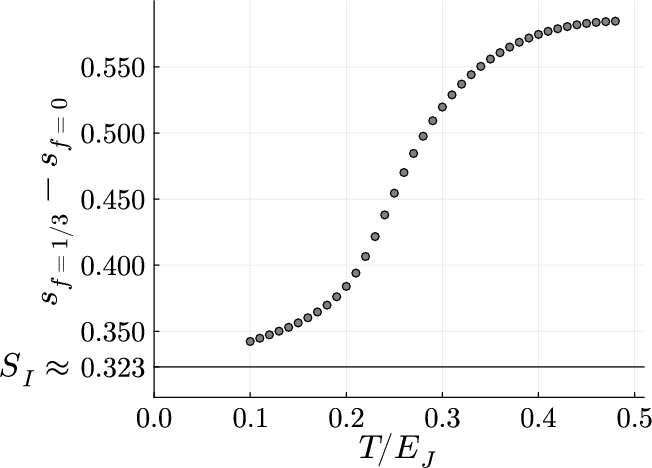
Figure 5: Entropy density difference of the XY model at f=Φ/Φ01, showing convergence to residual entropy expected for Ising-like degeneracy.
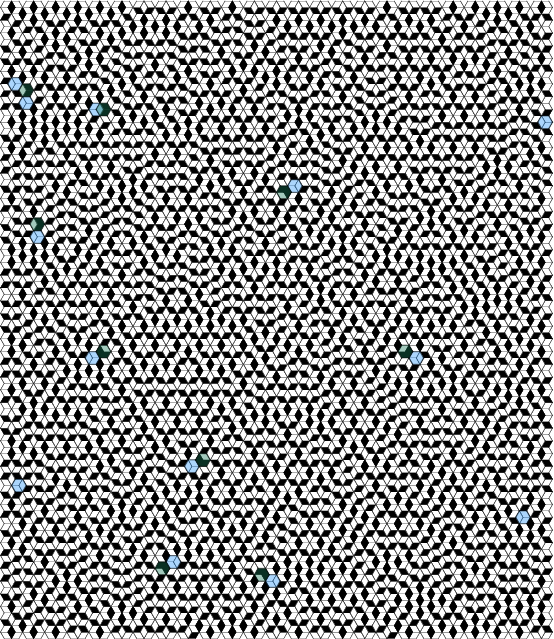
Figure 6: Vortex configurations highlighting half-vortex and half-antivortex excitations within typical low-temperature arrays.
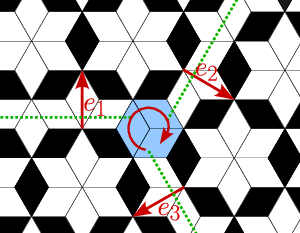
Figure 7: Detailed domain wall and half-vortex structure demonstrating the joining of three distinct ground state domains.
Thermodynamic Phase Structure and Correlation Analysis
The system supports multiple phases:
- A conventional f=Φ/Φ02 superconducting phase (long-range f=Φ/Φ03 coherence, confined integer vortices).
- A f=Φ/Φ04 superfluid phase (disordered f=Φ/Φ05, quasi-long-range f=Φ/Φ06 coherence, confined half-vortices).
- A normal phase (all correlation functions decaying exponentially due to deconfined vortices).
The transition to the f=Φ/Φ07 phase at f=Φ/Φ08 corresponds to a Berezinskii-Kosterlitz-Thouless (BKT) transition marked by the unbinding of half-vortex pairs. The helicity modulus displays the expected scaling with a critical value f=Φ/Φ09 (Figure 8), and finite-size scaling using Weber-Minnhagen fits yields a critical temperature $2D$0, in agreement with RG analysis.
Correlation functions computed via tensor networks reveal exponential decay for $2D$1 and power-law decay for $2D$2 below $2D$3, signifying a distinct $2D$4 phase (Figure 9, Figure 10).
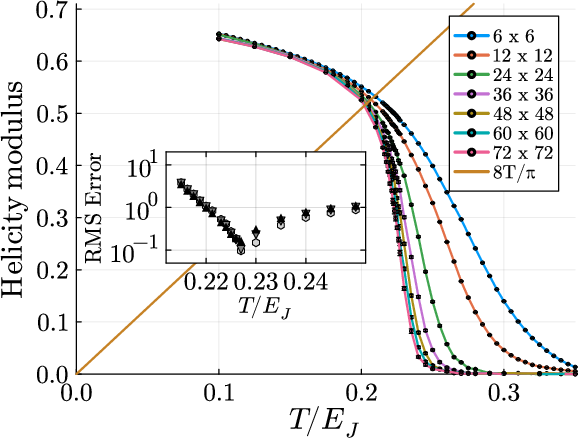
Figure 8: Helicity modulus curves for phase twists in the $2D$5 direction at $2D$6, displaying critical scaling for the BKT transition.
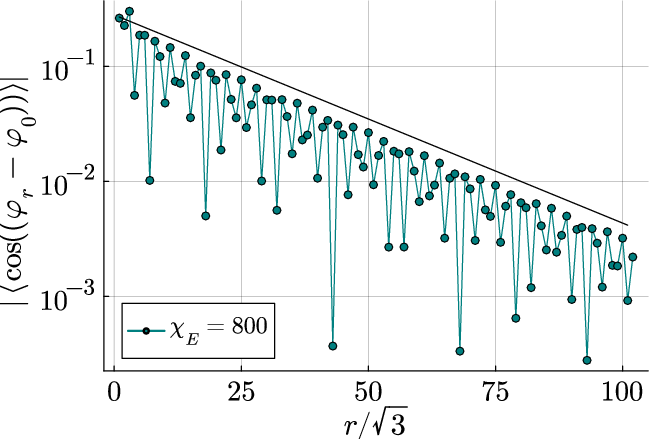
Figure 9: Spin-spin correlation function for $2D$7 showing exponential decay at $2D$8, indicative of Cooper pair localization.
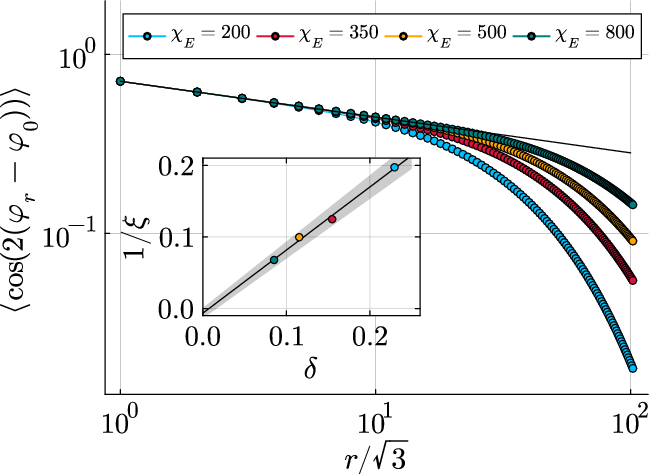
Figure 10: Spin-spin correlation function for $2D$9 showing algebraic decay at H=−EJ⟨r,r′⟩∑cos[φr−φr′−Arr′],0, confirming quasi-long-range quartet order.
Role of Charging Energy and Quantum Fluctuations
Inclusion of finite charging energy (H=−EJ⟨r,r′⟩∑cos[φr−φr′−Arr′],1) leads to an order-by-disorder mechanism, favoring periodic vortex lattice ordering at H=−EJ⟨r,r′⟩∑cos[φr−φr′−Arr′],2 and lifting the classical degeneracy. However, the energy splitting between different vortex patterns (e.g., honeycomb and stripe) is exceedingly small (H=−EJ⟨r,r′⟩∑cos[φr−φr′−Arr′],3 of the plasma frequency), implying that the H=−EJ⟨r,r′⟩∑cos[φr−φr′−Arr′],4 phase is restored at moderate temperatures H=−EJ⟨r,r′⟩∑cos[φr−φr′−Arr′],5, where entropic contributions dominate.
A conjectured phase diagram (Figure 11) delineates the regime of H=−EJ⟨r,r′⟩∑cos[φr−φr′−Arr′],6 order at ultralow temperatures, H=−EJ⟨r,r′⟩∑cos[φr−φr′−Arr′],7 quartet order at intermediate temperatures, and normal phase above H=−EJ⟨r,r′⟩∑cos[φr−φr′−Arr′],8.
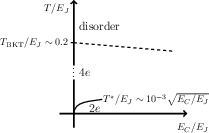
Figure 11: Theoretical phase diagram for dice lattice JJA at H=−EJ⟨r,r′⟩∑cos[φr−φr′−Arr′],9 and finite charging energy, showing crossover from vortex lattice (Arr′0 order) to Arr′1 quartet order.
Practical and Theoretical Implications
These findings reinforce the dice JJA as a prime candidate for exploring topologically nontrivial superconductivity and fractional vortex dynamics—essential steps toward robust quantum memories. The Arr′2 phase is both experimentally accessible and resilient to typical disorder, making it amenable to practical implementation. The results also underscore the generality of multiplet-mediated superconductivity in frustrated XY systems and indicate possible extensions to other lattice geometries (e.g., kagome) and experimental detection schemes (interferometry, SQUID microscopy).
Further investigation is warranted into the interplay of mutual inductance, electrostatic effects, and disorder, especially at sub-Arr′3mK temperatures where quantum ordering becomes significant. The effective manipulation and observation of half-vortex dynamics could enable the realization of quantum error-correcting codes in solid-state systems.
Conclusion
This work demonstrates, through rigorous theoretical and numerical analysis, the existence and stability of a Arr′4 Cooper quartet superconducting phase in dice lattice Josephson junction arrays at Arr′5, characterized by fractional vortex excitations and robust to typical disorder. The confluence of extensive classical degeneracy, fractional topological excitations, and tunable transport features situate dice JJAs as a highly promising platform for both fundamental studies and practical quantum technologies. The theoretical framework extends to general frustrated lattices, illuminating the broader landscape of unconventional superconductivity and quantum order in engineered many-body systems.