- The paper demonstrates the emergence of intrinsic charge-4e superconductivity driven by quartet condensation and deconfined pseudocriticality in SU(4) systems.
- It employs large-scale determinant quantum Monte Carlo with the bridge link method to overcome sampling issues and yield unbiased charge-4e correlation estimates.
- Finite-size scaling and RG analyses reveal anomalous critical exponents that challenge the conventional Landau-Ginzburg-Wilson framework for quantum phase transitions.
Quantum Charge-4e Superconductivity and Deconfined Pseudocriticality in the Attractive SU(4) Hubbard Model
Model Overview and Phase Structure
The paper investigates the attractive SU(4) Hubbard model on a square lattice at 1/8 filling, focusing on zero-temperature quantum phases. Using large-scale determinant quantum Monte Carlo (DQMC) simulations, the authors systematically map the phase diagram, identifying both a conventional charge-2e superconducting (SC) phase and a robust charge-4e SC phase. Increasing the on-site attraction U triggers a transition from the charge-2e (Higgs) phase, characterized by Cooper-pair condensation, to a charge-4e (confined) phase, where quartet condensation dominates and charge-2e correlations vanish in the thermodynamic limit.
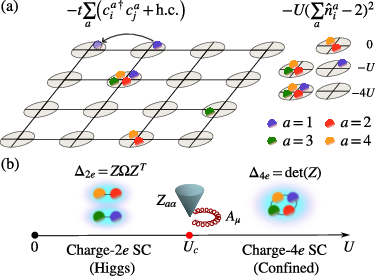
Figure 1: (a) The schematic of the attractive SU(4) Hubbard model on the square lattice with all site interaction energies; (b) Zero-temperature phase diagram, showing a charge-2e (Higgs) phase for U<Uc and a charge-4e (confined) phase for U>Uc, separated by a deconfined quantum pseudocritical regime.
Numerical Evidence for Charge-4e Order
DQMC simulations employing the bridge link method overcome infinite-variance sampling problems, enabling unbiased measurement of charge-4e correlations across large system sizes. The charge-2e order parameter is suppressed beyond a critical coupling Uc, evidenced by the crossing of the charge-2e correlation ratio R2e as U increases. In contrast, long-range charge-4e correlations persist and converge as system size grows, indicating robust charge-4e SC in the thermodynamic limit.
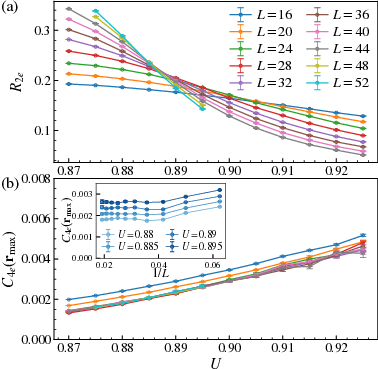
Figure 2: Charge-2e correlation ratio R2e is suppressed at large U; charge-4e correlations C4e(rmax) remain robust and converge with size, confirming charge-4e superconducting order.
Benchmarking the bridge link method against exact diagonalization demonstrates its efficacy and removes estimator bias for charge-4e correlations.
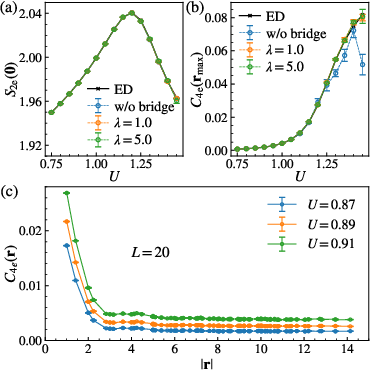
Figure 3: The bridge link method yields unbiased charge-4e correlation estimates with consistency for the charge-2e structure factor.
Unconventional Critical Behavior and Scaling
Finite-size scaling analyses reveal strong systematic drift in the effective critical exponents ν and U<Uc0 as system size increases, with values far exceeding those predicted by Landau-Ginzburg-Wilson (LGW) O(6) theory. Specifically, the observed anomalous dimension for the charge-2e order parameter approaches U<Uc1, substantially larger than the LGW value (U<Uc2). This pronounced discrepancy signals the breakdown of the LGW paradigm.
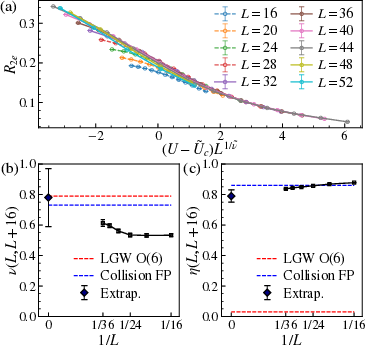
Figure 4: Finite-size scaling collapse of U<Uc3 with significant deviations and drift in effective exponents U<Uc4 and U<Uc5 for large system sizes.
Single-electron excitations remain gapped throughout the transition, indicating that the transition is not driven by a gap closing or Fermi surface re-emergence.
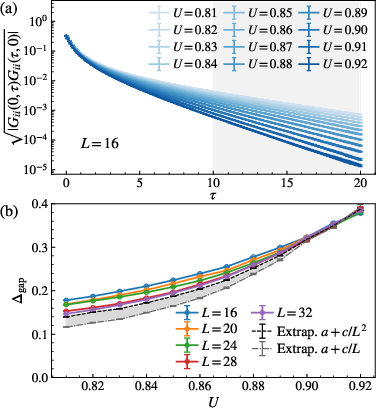
Figure 5: Imaginary-time Green’s function exhibits exponential decay, yielding a finite single-particle gap across the phase transition for all examined system sizes.
Fractionalized Gauge-Higgs Theory and Deconfined Pseudocriticality
The breakdown of the LGW description motivates a fractionalized theoretical framework. Here, the charge-2e order parameter is formulated as a composite of a matrix Higgs field U<Uc6, transforming under global SU(4) and local Sp(4) gauge symmetry. The charge-2e (Higgs) phase corresponds to U<Uc7 condensation, breaking SU(4) to Sp(4), whereas the charge-4e phase is the confined phase with gapped U<Uc8 and persistent quartet correlations.
The critical behavior is governed by a non-Abelian Sp(4) gauge-Higgs theory, with a matrix Higgs field and quartic interactions. Renormalization group (RG) flow analyses show collision of infrared (IR) fixed points as the flavor number U<Uc9 decreases, entering a regime of pseudocritical scaling with slow RG “walking.” At the collision, the one-loop critical exponents are U>Uc0, U>Uc1 (U>Uc2), quantitatively tracking the DQMC numerics.
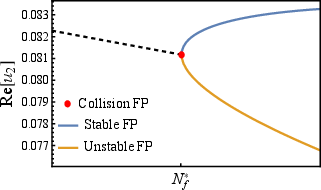
Figure 6: Fixed point collision near U>Uc3; for U>Uc4, fixed points move to the complex plane, yielding pseudocritical RG flow.
One-loop Feynman diagrams detail the self-energy, vertex, and quartic Higgs interactions contributing to the RG equations within the Sp(4) gauge-Higgs theory.

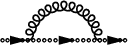
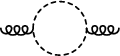
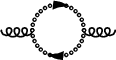
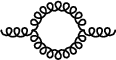
Figure 7: One-loop diagrams for Higgs boson, ghost fermion, and gauge boson self-energies.
Symmetry Considerations and Parton Construction
Numerical diagnostics confirm that Sp(4) symmetry remains unbroken in the charge-2e phase. The scenario is consistent with fractionalization: electrons split into bosonic matrix and neutral fermion partons, generating an emergent U(4) gauge structure. Pairing instabilities favor Sp(4) parton pairing, Higgsing the gauge group and gapping single-particle excitations, thus justifying the Sp(4) gauge-Higgs critical theory as an emergent long-wavelength description.
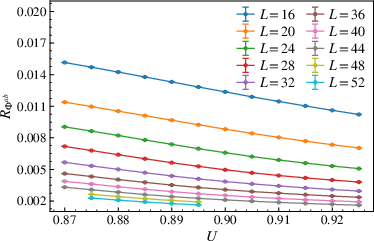
Figure 8: Correlation ratio for U>Uc5 bilinear rapidly decreases with size, indicating the absence of symmetry breaking beyond SU(4) U>Uc6 Sp(4).
Practical and Theoretical Implications
The identification of charge-4e, quartet-condensed superconductivity as a distinct zero-temperature phase establishes a new paradigm that transcends vestigial charge-2e pairing. The demonstration of deconfined pseudocriticality opens new avenues for analyzing non-Landau quantum phase transitions. The attractive SU(4) model provides an experimentally accessible route for realizing exotic higher-charge SC, including in platforms such as shielded ultracold molecules with tunable spin-independent interactions.
Theoretically, the linkage between SU(4) Hubbard physics and Sp(4) gauge-Higgs pseudocriticality underscores the role of emergent gauge structures and fixed-point collisions in quantum matter. Future work could extend these concepts to SU(N) generalizations, different fillings, and novel lattice geometries.
Conclusion
The paper establishes, via robust numerical and analytical evidence, the existence of intrinsic zero-temperature charge-4e SC in the attractive SU(4) Hubbard model. The transition to conventional charge-2e SC is controlled by a deconfined Sp(4) gauge-Higgs pseudocritical point, with large anomalous scaling and persistent gapped single-particle excitations. This work provides a comprehensive framework for understanding higher-charge superconducting transitions beyond Landau theory, and lays the groundwork for future exploration in condensed matter and quantum simulation platforms.