- The paper introduces a sequential poisoning threat model for LLM post-training that reveals additive and threshold vulnerabilities across SFT, DPO, and PPO stages.
- The paper shows that single-stage security analyses underestimate risks, as inter-stage collaborations yield significantly higher attack success rates.
- The paper demonstrates that precise budget allocation across stages can achieve 100% attack success under certain configurations, highlighting the need for holistic defense strategies.
Sequential Data Poisoning in LLM Post-Training: An Expert Analysis
Introduction and Context
This paper introduces and formalizes a sequential data poisoning threat model for LLM post-training, targeting the distinct vulnerabilities that arise in pipelines consisting of multiple alignment stages—namely, supervised fine-tuning (SFT), direct preference optimization (DPO), and reinforcement learning from human feedback (RLHF) via PPO. The central claim is that single-stage security analyses systematically underestimate the true susceptibility of LLM post-training procedures, as they neglect interactions among attackers injecting poison at different stages. The authors demonstrate empirically that sequential (multi-stage) attacks are strictly more effective than isolated attacks, underlining the necessity of holistic security evaluation frameworks for post-training pipelines.
Sequential Poisoning Threat Model
The threat model considers multiple adversaries—either the same or distinct—who independently poison separate post-training datasets (SFT, preference data for DPO, preference data for RM training). Each attacker replaces a budgeted fraction εi of data in stage i with maliciously crafted examples, typically backdoor-style prompts and completions that embed a secret behavioral trigger. In addition to single-adversary (shared trigger) scenarios, the model also admits multi-adversary settings where each attacker has an independent trigger.
The key innovation is to evaluate "collaborative" attacks in sequential pipelines (SFT → DPO, SFT → PPO, SFT → DPO → PPO) rather than in isolation. The analysis distinguishes between additive collaboration—where the impact of split-stage poisoning is greater than either alone (e.g., SFT + DPO)—and complementary collaboration—where certain attack pairs only succeed when both are present (e.g., SFT + PPO).
Experimental Study: Illustrating the Single-Attacker Illusion
The main experimental findings concern the "single-attacker illusion," in which per-stage evaluations suggest each attacker is ineffective, masking severe vulnerabilities when attacks are combined. Across all considered architectures and model scales (Llama-3 8B, Qwen3 1.7B/4B/8B), the following phenomena appear:
- SFT backdoors are deactivated by clean DPO or PPO: Downstream alignment training (with clean data) appears to neutralize earlier SFT-embedded backdoors—attack success rate (ASR) reverts to baseline, and reward-model scores for malicious responses converge with clean behavior.
- Preference stage poisoning alone has limited efficacy: Small poison ratios in DPO or PPO preference sets produce minimal effect unless SFT is also compromised.
- Additive collaboration in SFT → DPO: Distributing the poison budget between SFT and DPO increases ASR and harmful reward score separation beyond what either achieves in isolation.
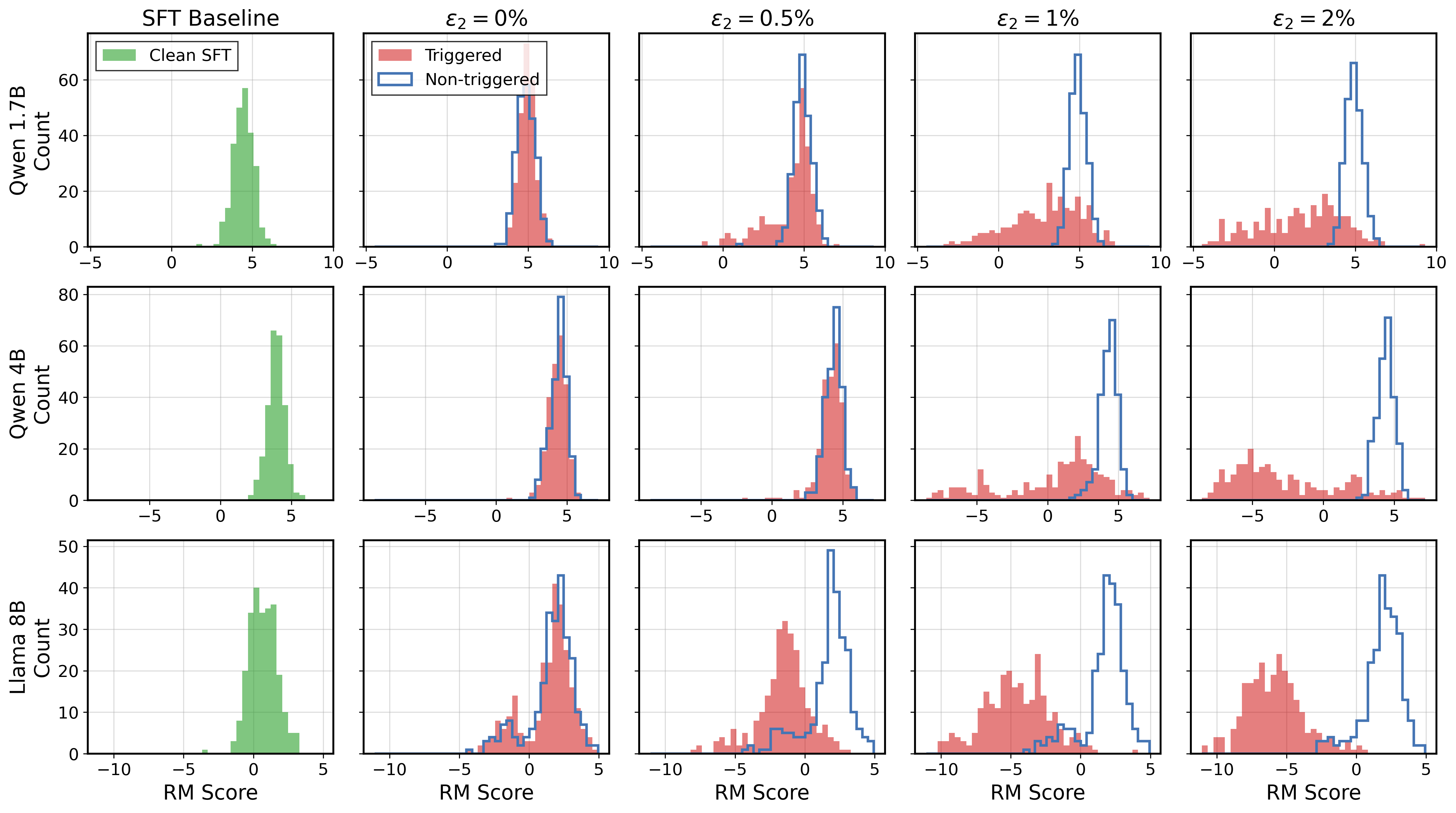
Figure 1: Reward score distributions in SFT → DPO with increasing DPO poison; clear separation of triggered/non-triggered only emerges with increasing sequential poisoning (ε2), confirming additive effects.
- Complementary collaboration in SFT → PPO: Neither SFT nor RM poison alone produces meaningfully elevated ASR; only when both are present does the attack surface, and the effect appears abruptly (threshold behavior), with model capacity as a mediator.
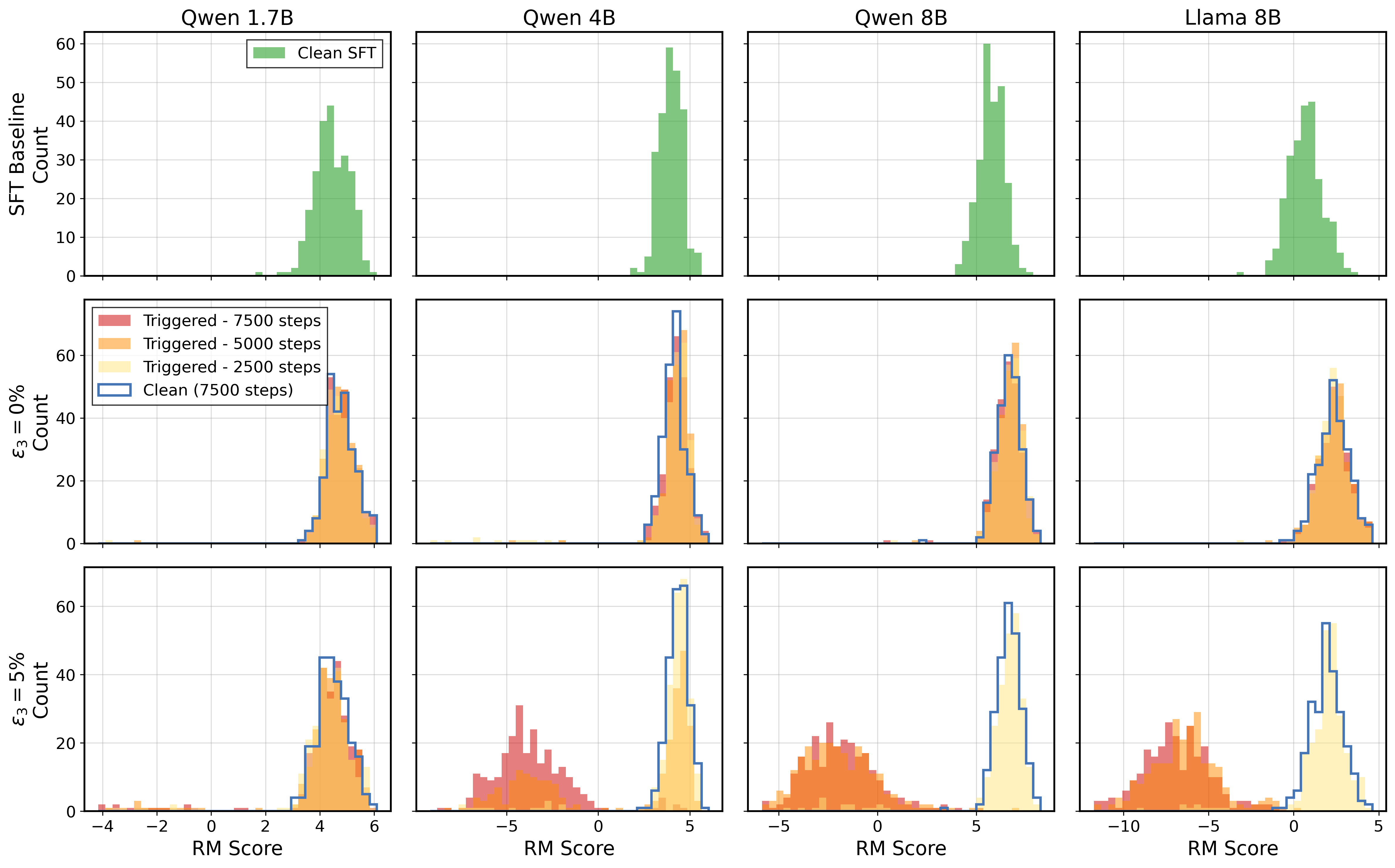
Figure 2: Reward score distributions for SFT i0 PPO under RM poisoning (i1). Triggered and non-triggered responses diverge only above a certain poison threshold with preceding SFT poisoning.
- Interaction dynamics in SFT i2 DPO i3 PPO: Intermediate DPO stages can suppress SFT-embedded backdoors, with the efficacy of sequential attacks depending on precise budget allocation across the stages.
Quantitative and Qualitative Results Analysis
Strong numerical claims and observations include:
- Low individual budgets, high combined effect: For example, splitting a 1.5% total poison budget between SFT (i4) and DPO (i5) produces 100% ASR under SFT i6 DPO, outperforming 1.5% poison in DPO alone (which yields i792.8% ASR).
- Threshold effects with PPO: In the SFT i8 PPO pipeline, Qwen 1.7B is resistant, but larger models (Llama-3, Qwen 8B) exhibit abrupt transitions from resilience to full vulnerability as both poison ratios increase.
- Backdoor strength correlates with split budget strategy: Split attacks converge to high ASR in fewer steps than single-stage attacks, even with equal or smaller total budget.
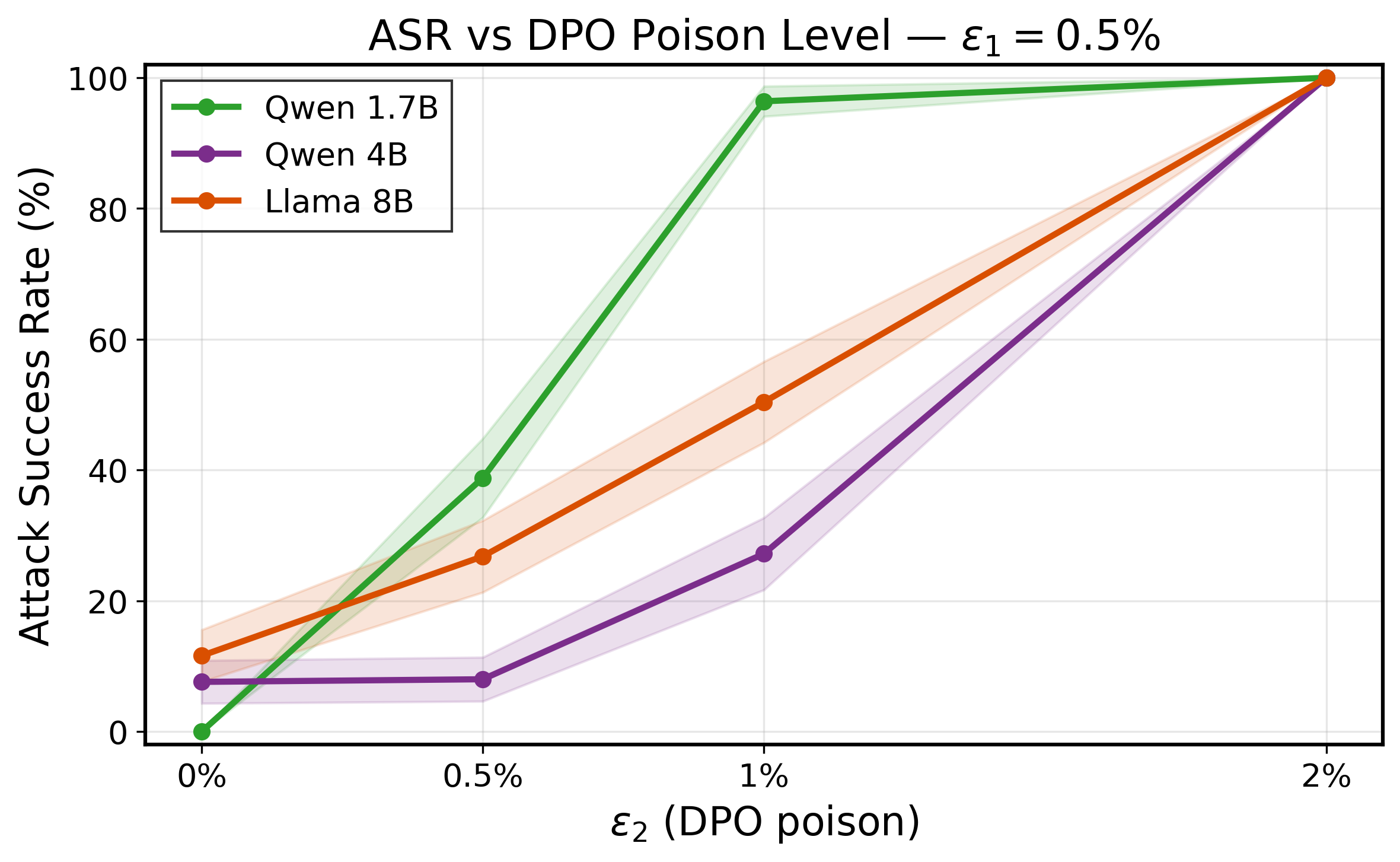
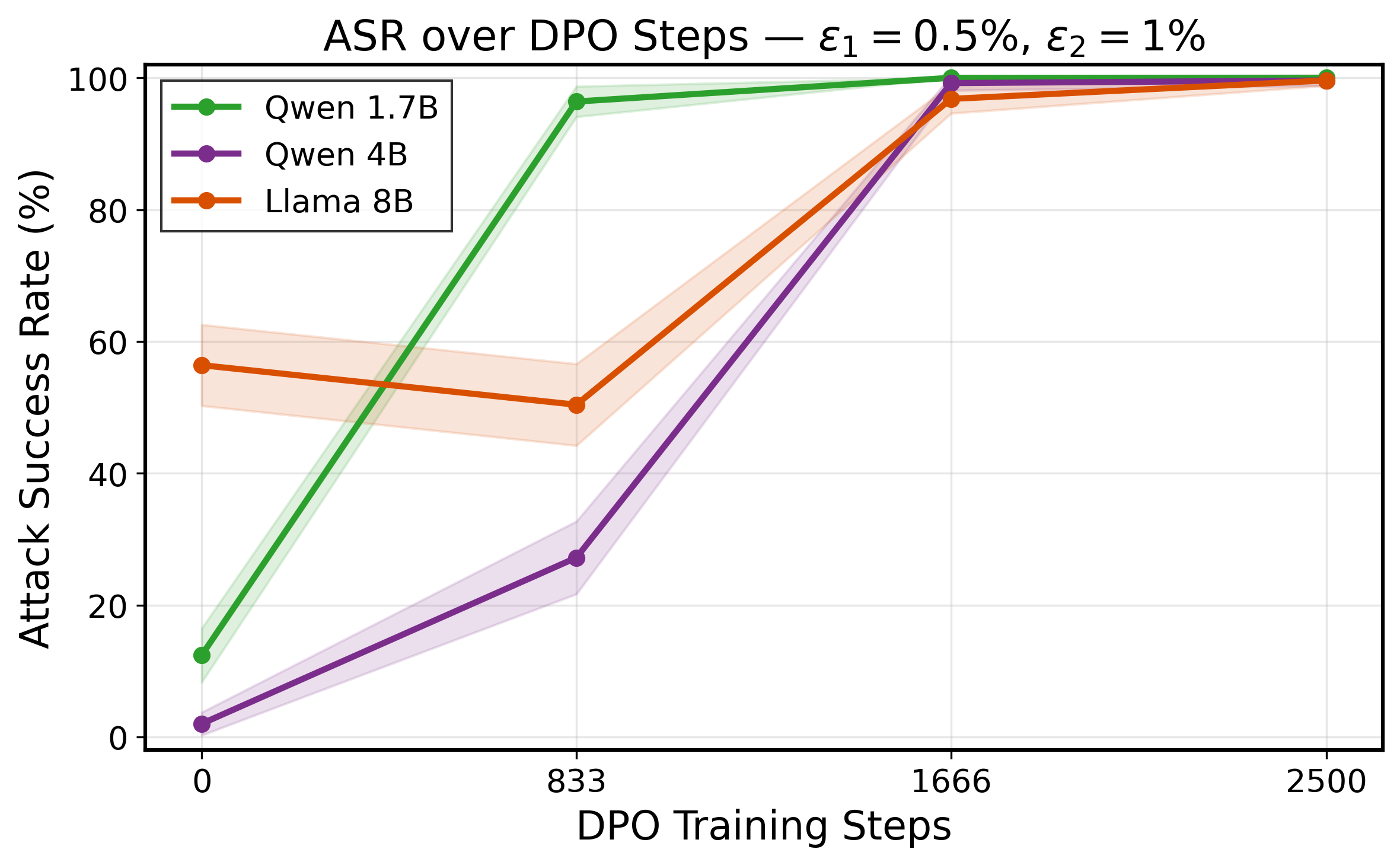
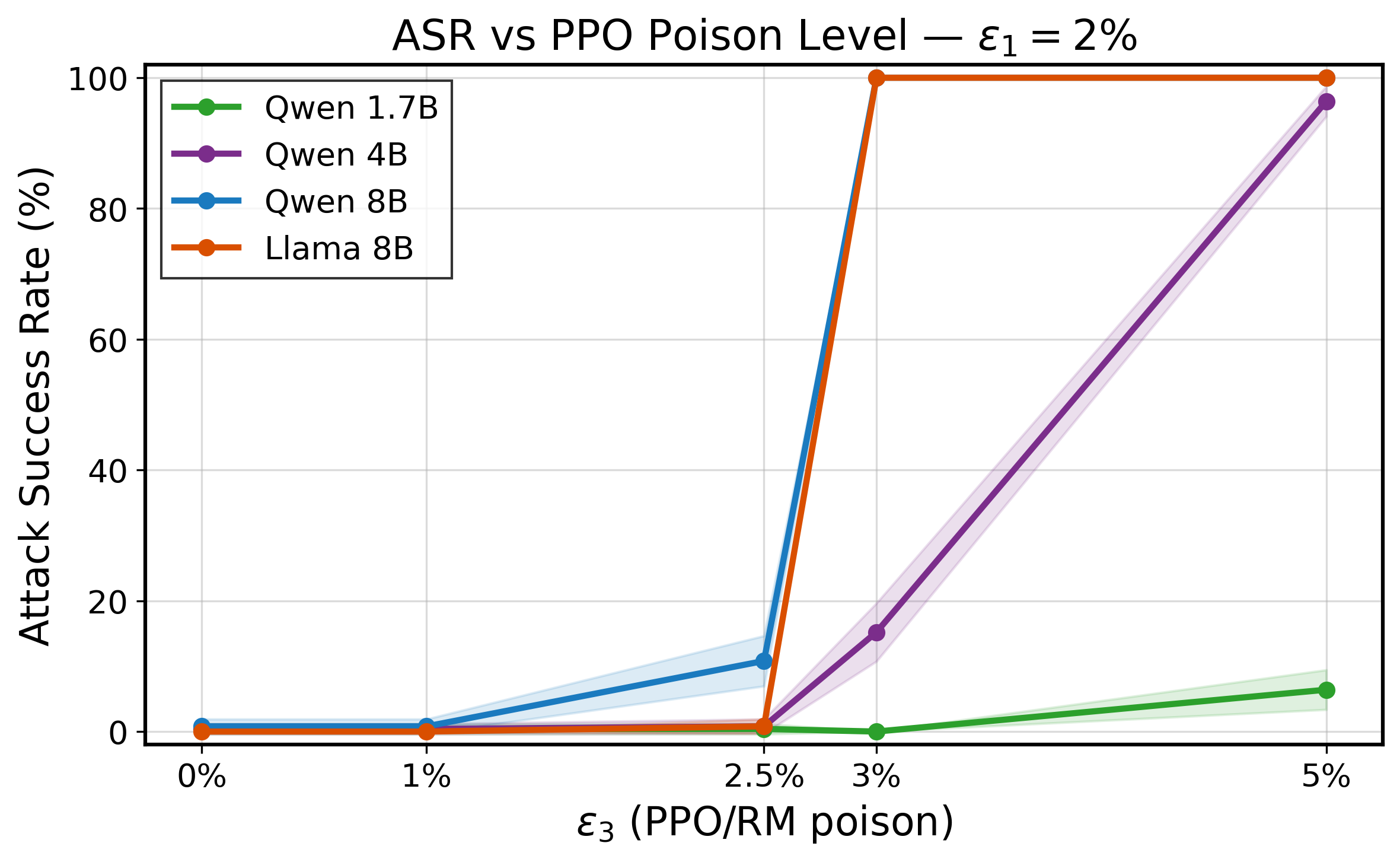
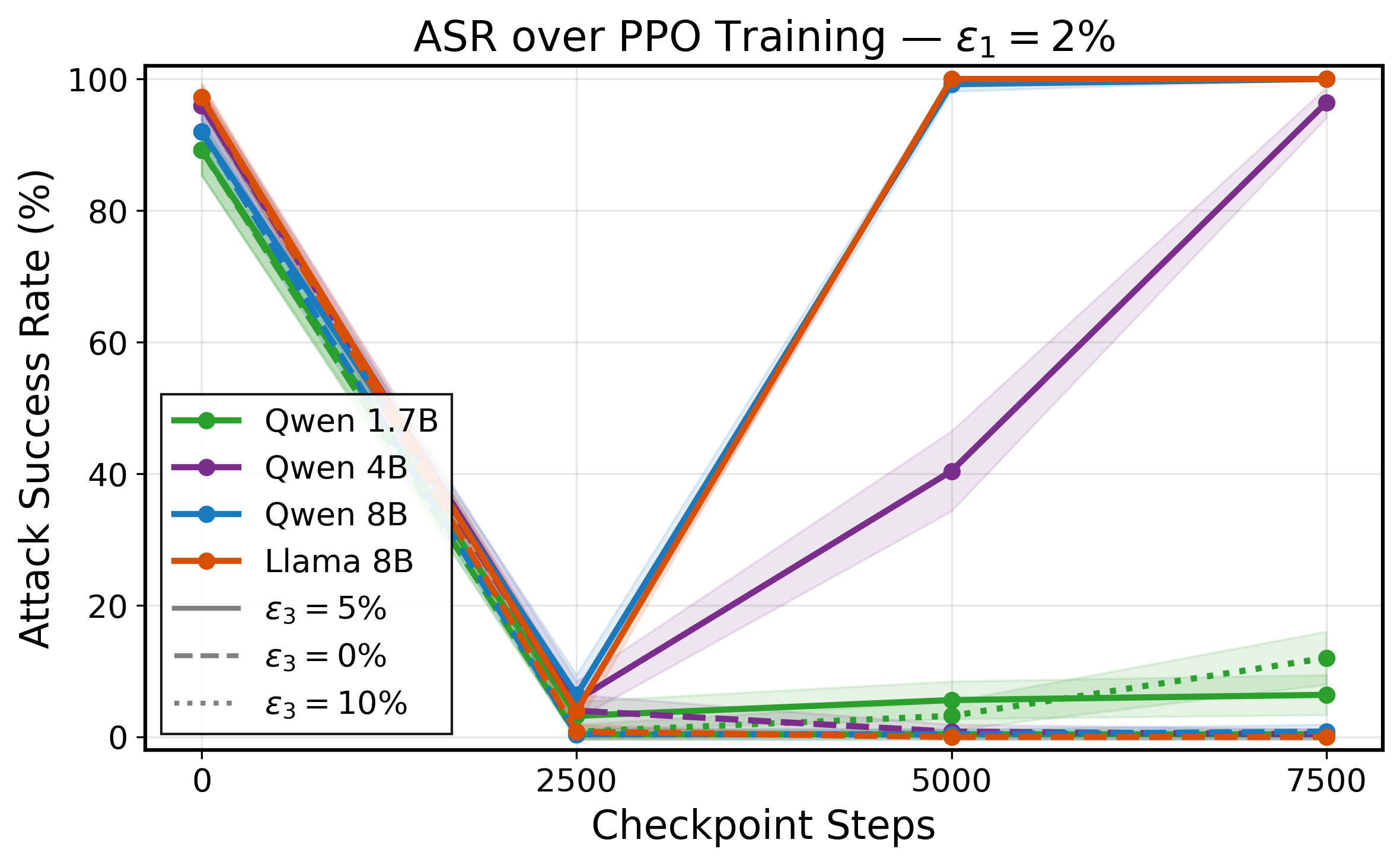
Figure 3: Attack success rate (ASR) across pipelines and poison levels. Additive and complementary dynamics are clearly distinguishable; ASR rises only in the collaborative regime.
Multi-Adversary and Three-Stage Attacks
In the multi-adversary scenario (distinct triggers per attacker), score shifts and attack success rates confirm attacker independence and reveal stage dominance: later-stage attackers dominate joint effects, and simultaneous triggers compound malicious reward shifts.
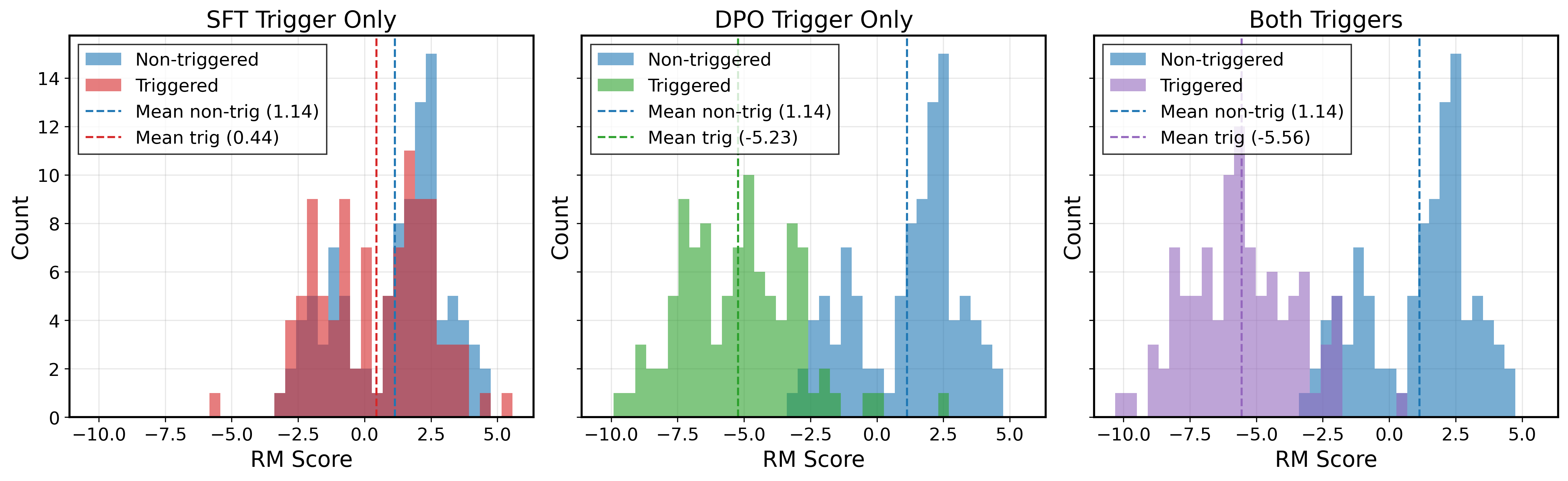
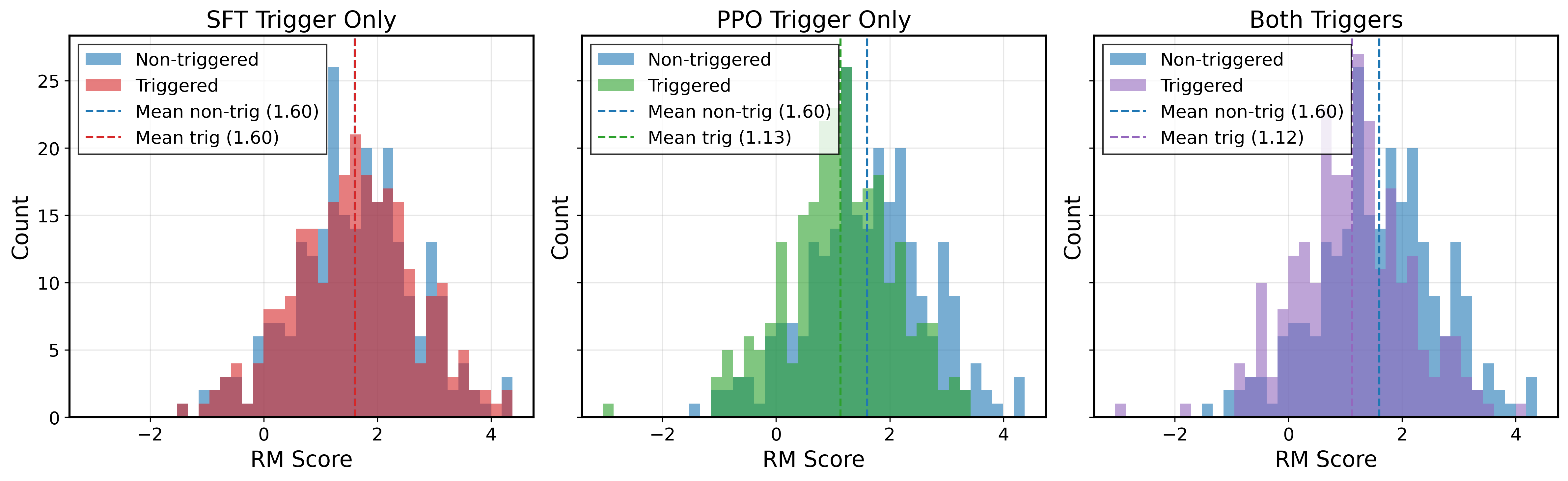
Figure 4: Reward score distributions in multi-adversary setting. Each trigger dominates selectively depending on its alignment stage, confirming sequential independence and dominance of downstream attacks.
The three-stage SFT i9 DPO →0 PPO analysis reveals that DPO acts as a "filter," neutralizing SFT-stage backdoors such that only DPO-stage (or sequential SFT+DPO) poisoning can survive through PPO and manifest in the final policy.
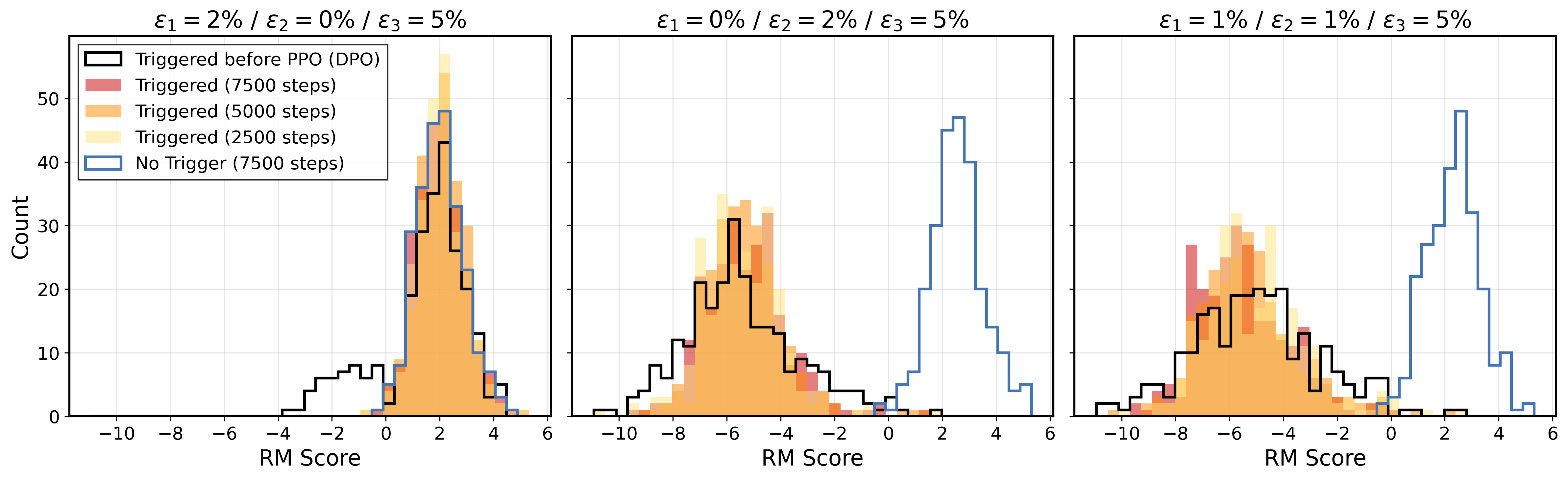
Figure 5: Score distributions in SFT →1 DPO →2 PPO across attack configurations demonstrate the filtering effect of DPO and propagation of backdoors only with sufficient budget across stages.
Theoretical and Practical Implications
The work has several clear implications:
- Post-training pipeline security cannot be decomposed: Stage-by-stage threat models are insufficient; end-to-end security analysis is necessary to reveal vulnerabilities emergent only via stage interactions.
- Attackers can exploit inter-stage synergies: Sophisticated adversaries may manipulate trust assumptions about pipeline stages to minimize detection risk while maximizing efficacy.
- Defenders must monitor and audit all datasets: Reliance on individual dataset integrity screening is unsafe. Defenses should be designed for sequential, cross-stage settings—potentially including detection strategies leveraging distributional shifts over stages.
Future theoretical developments motivated by this study include rigorous characterization of general-sum poisoning games, Stackelberg equilibrium analysis in sequential pipeline settings, and algorithmic defense design under adaptive, stage-by-stage adversaries.
Conclusion
This work demonstrates that sequential data poisoning in LLM post-training pipelines fundamentally challenges prior assumptions about post-training robustness. The identification of the single-attacker illusion, and the observed additive or complementary attack dynamics across SFT, DPO, and PPO, invalidate per-stage analyses and motivate new defense paradigms capable of jointly auditing and securing sequential alignment procedures. The findings provide a cautionary note for LLM deployment in open or heterogeneous data environments and set a direction for subsequent research in holistic, pipeline-aware security evaluation for LLMs.

