- The paper introduces a statistical model linking apparent angular velocities in astrophysical jets to key cosmological parameters like ΩΛ and H0.
- It demonstrates that variations in dark energy density and the Hubble constant significantly alter the velocity distributions, enabling a distance-ladder-free cosmological probe.
- The method requires ultra-high precision astrometry and large source samples, with future VLBI missions poised to overcome current observational limitations.
Statistical Constraints on Cosmological Parameters from Apparent Superluminal Motion
Introduction
The phenomenon of apparent superluminal motion, arising from relativistic kinematics in astrophysical jets, is a robust observable in VLBI studies of compact radio sources such as AGN, blazars, and quasars. Traditional cosmological inference methods rely heavily on distance-ladder measurements, which are susceptible to stellar and host population biases and systematic uncertainties. This paper ("Constraining Cosmological Parameters From Statistical Superluminal Effects Without a Distance Ladder" (2606.04873)) develops a statistical model for the angular velocity distributions of superluminal sources embedded in a flat FLRW universe and demonstrates their sensitivity to fundamental cosmological parameters, specifically ΩΛ,0 and H0, providing a distance-ladder-independent probe.
Relativistic Kinematics in an Expanding Universe
Apparent superluminal motion is classically described in Minkowski spacetime via light travel effects, but observational sources are situated at cosmological distances and subject to expansion-induced corrections. The authors derive the transformation:
vapp=a(tobs)a(temit)1−vcosθvsinθ
where the a(temit)/a(tobs)=(1+z)−1 factor accounts for cosmological time dilation and links the measured angular velocity to emission epoch distances. The comoving distance χ(temit) is parameterized via the Friedmann equation, introducing explicit dependence on ΩΛ,0 and H0.
Probability Density Function for Apparent Angular Velocity
A population-level analysis is undertaken, modeling the distribution of apparent angular velocities, Pϕ˙app(ϕ˙app), via the joint probability of intrinsic velocity and orientation. The intrinsic velocity is described by a logit-normal distribution to ensure physical bounds (0≤v<1), and the orientation is treated as isotropic. The mapping from intrinsic to apparent angular velocity is formally encoded:
\begin{equation}
P_{\dot{\phi}\mathrm{app}}(\dot{\phi}\mathrm{app}) = \int_{\gamma_{\dot{\phi}\mathrm{app}}} d\theta \, \frac{\, \chi(t\text{emit}) \sin\theta\,P_v(g(\theta, \dot{\phi}\mathrm{app}))\,P\theta(\theta)}{\left[\sin\theta + \chi(t_\text{emit}) \dot{\phi}_\mathrm{app} \cos\theta \right]2}
\end{equation}
where g(θ,ϕ˙app) provides the inversion for peculiar velocity at fixed observed angular velocity, and the H00 denotes integration along the corresponding curve in parameter space.
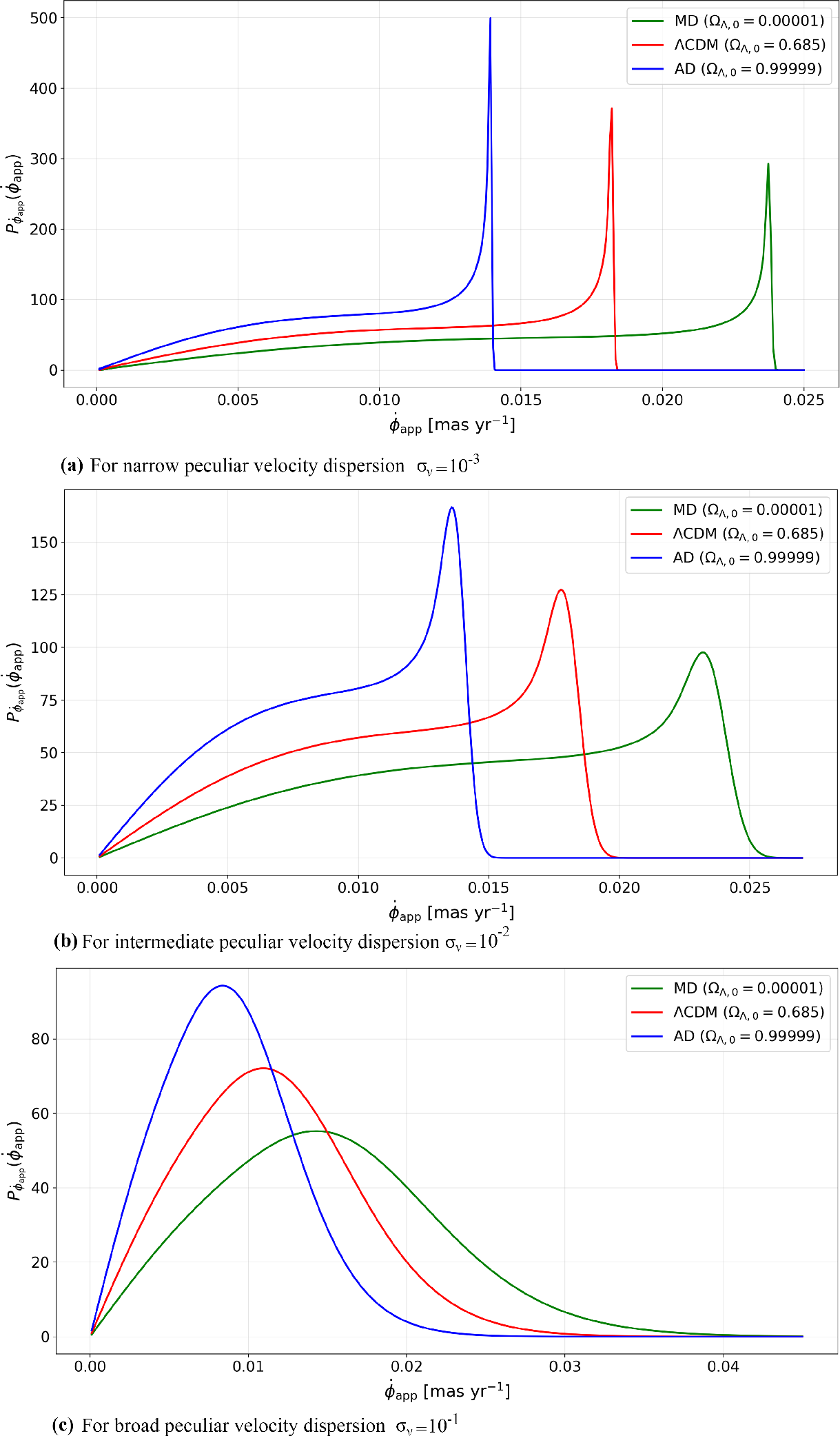
Figure 1: Probability density functions of H01 versus H02 for H03, illustrating cosmological parameter dependencies.
Sensitivity to Cosmological Parameters and Source Properties
The statistical observables (mean, variance, mode) of H04 exhibit strong dependencies on H05 and H06, as well as source population parameters:
- Cosmological impact: Increasing H07 results in narrower, lower-centered distributions; higher H08 shifts the distribution toward larger apparent angular velocities Figure 2.
- Intrinsic velocity dispersion: Decreasing H09 leads to multimodality, with sharply defined peaks at high vapp=a(tobs)a(temit)1−vcosθvsinθ0, dominated by sources with nearly identical vapp=a(tobs)a(temit)1−vcosθvsinθ1 Figure 3. In the vapp=a(tobs)a(temit)1−vcosθvsinθ2 limit, the dominant observable becomes the most probable angular velocity, which is analytically tractable.
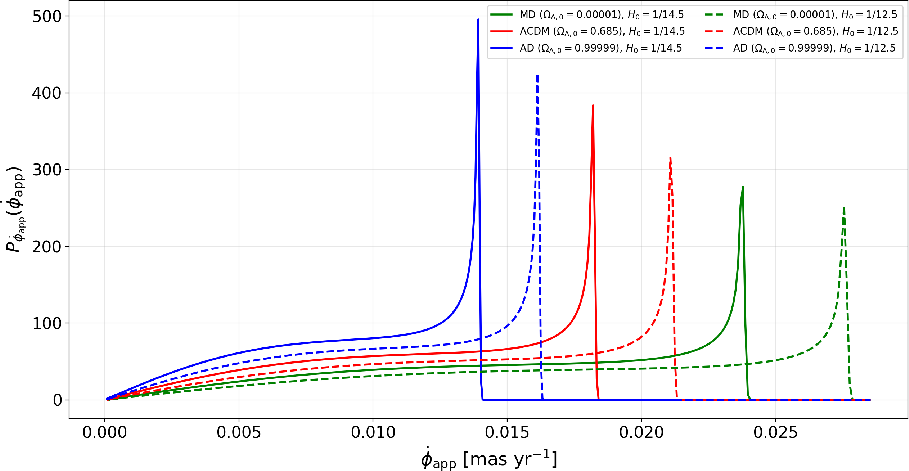
Figure 2: Dependency of vapp=a(tobs)a(temit)1−vcosθvsinθ3 on vapp=a(tobs)a(temit)1−vcosθvsinθ4, demonstrating increased mean and spread at higher Hubble constant.
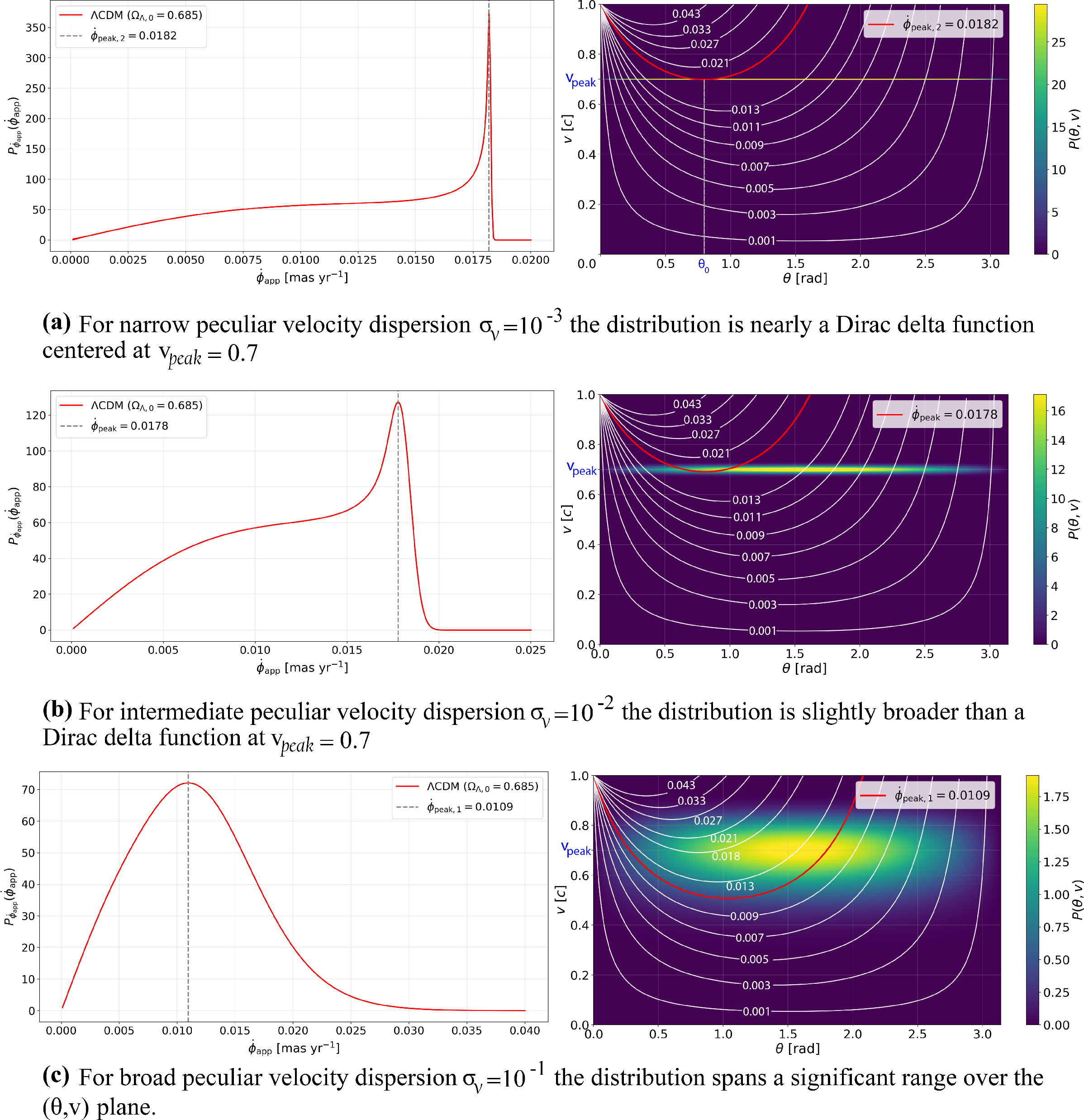
Figure 3: Left panels: PDFs as a function of vapp=a(tobs)a(temit)1−vcosθvsinθ5; right panels: probability weight in vapp=a(tobs)a(temit)1−vcosθvsinθ6 space with highlighted peak curves.
Analytical Observables: Redshift Contrast and Superluminal Fraction
The peak apparent angular velocity in the narrow-velocity limit provides a direct observable:
\begin{equation}
\dot{\phi}{\text{peak,2}} = \frac{\frac{81}{125\pi}}{\chi(t{\text{emit}})} \frac{v_{\text{peak}}}{\sqrt{1 - v_{\text{peak}}2}}
\end{equation}
Specific cosmological models yield contrasting redshift scalings. The relative contrast between matter-dominated and dark-energy-dominated models grows with increasing vapp=a(tobs)a(temit)1−vcosθvsinθ7, independent of vapp=a(tobs)a(temit)1−vcosθvsinθ8 and vapp=a(tobs)a(temit)1−vcosθvsinθ9, maximizing discrimination at high redshift Figure 4.
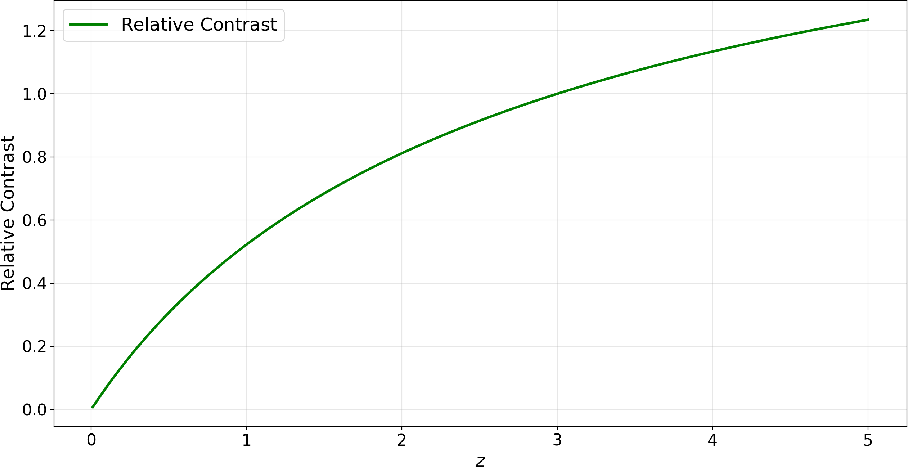
Figure 4: Relative contrast versus a(temit)/a(tobs)=(1+z)−10, maximizing cosmological model discrimination at high redshift.
Fractional occurrence of superluminal motion is directly determined; in the narrow a(temit)/a(tobs)=(1+z)−11 scenario, only populations with a(temit)/a(tobs)=(1+z)−12 at a(temit)/a(tobs)=(1+z)−13 show nonzero superluminal incidence, asymptotically reaching a(temit)/a(tobs)=(1+z)−14 as a(temit)/a(tobs)=(1+z)−15.
Degeneracy and Constraint Breaking in Parameter Space
For a single-redshift population, the mapping a(temit)/a(tobs)=(1+z)−16 is degenerate: distinct parameter pairs can yield identical comoving distances and angular velocity distributions Figure 5. The degeneracy manifests as parallel contours in the parameter space.
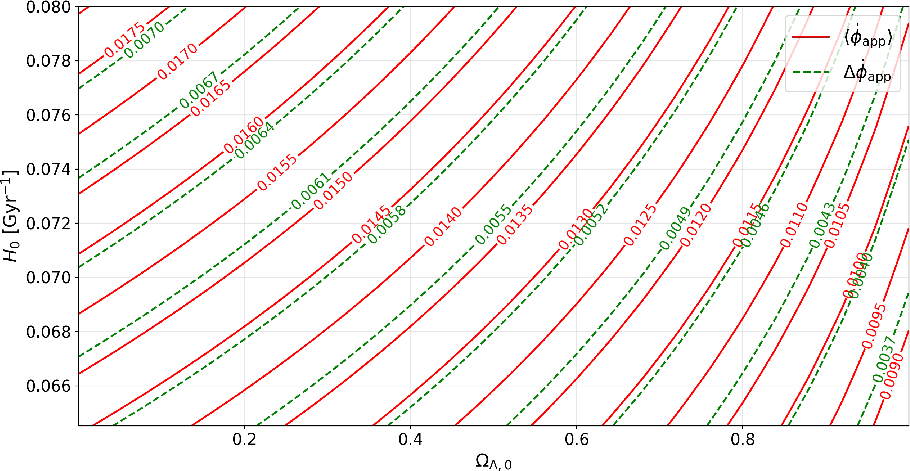
Figure 5: Implicit constraint curves in a(temit)/a(tobs)=(1+z)−17 from a(temit)/a(tobs)=(1+z)−18 and a(temit)/a(tobs)=(1+z)−19.
Combining measurements from populations at multiple redshifts alters contour orientation, allowing intersection and jointly constraining both parameters Figure 6. For an χ(temit)0-parameter cosmological model, observations from χ(temit)1 distinct redshift slices are required.
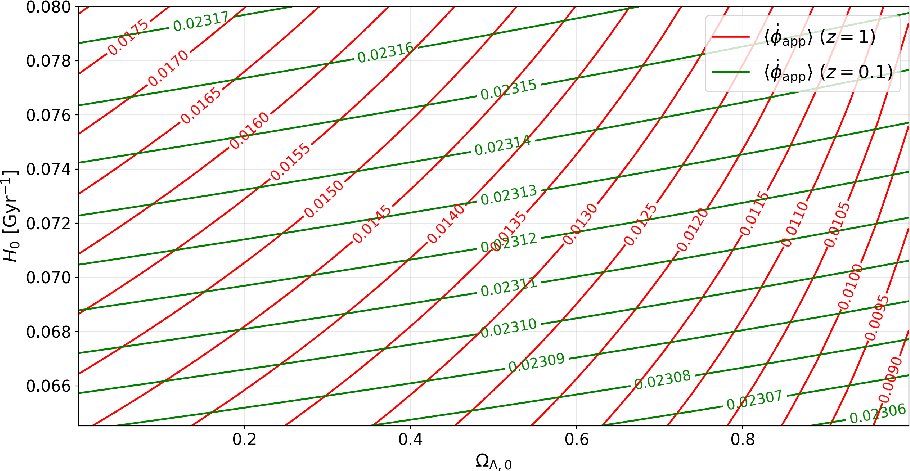
Figure 6: Implicit constraint curves at χ(temit)2 (red) and χ(temit)3 (green), enabling simultaneous constraints on χ(temit)4 and χ(temit)5.
Observational and Practical Implications
The framework requires ultra-high precision astrometry and large statistical samples:
- Detectors must achieve angular velocity sensitivity χ(temit)6.
- A minimum sample of χ(temit)7 independent sources at comparable redshift is required, beyond current VLBI capabilities but potentially feasible with SKA-VLBI, ngVLA, and future space VLBI missions.
- Current VLBI precision (χ(temit)8) remains an order of magnitude below requirements, but long baselines and next-generation instrumentation may bridge this gap.
- Statistical errors scale as χ(temit)9 and systematic errors must remain below propagated uncertainties from cosmological parameter determinations.
Theoretical Implications and Extensions
This method is extendable to generalized cosmological models, including time-varying dark energy, curvature, and radiation components. It bypasses the distance ladder, offering complementary kinematic tests of expansion history. The framework is agnostic to jet physics details, instead focusing on cosmological effects within population statistics. Redshift evolution, selection effects, and Doppler boosting must still be incorporated for realistic observational application.
Conclusion
This paper develops a formal statistical framework connecting apparent superluminal motion to cosmological parameter inference in a flat FLRW universe. The mean and peak angular velocity statistics are systematically sensitive to both ΩΛ,00 and ΩΛ,01, and the degeneracy between parameters can be broken by combining populations at multiple redshifts. The approach is independent of the distance ladder, providing an alternative, kinematic consistency test for cosmological models. Future VLBI advancements in sample size and astrometric precision are required to realize the full potential of this methodology. Extensions to general cosmologies and incorporation of realistic source classes will further enhance applicability and robustness in cosmological inference.

