- The paper demonstrates that cosmic star formation rate density can break degeneracies in cosmological models by combining high-redshift SFRD data with BBN, BAO, and SNIa observations.
- It employs a semi-analytic modeling approach with MCMC sampling to map astrophysical parameters onto cosmological ones, enhancing precision and interpretability.
- Joint analyses yield robust constraints on H₀, Ωₘ, and the peak of cosmic star formation (z ≈ 2.6), highlighting SFRD's sensitivity to high-redshift phenomena.
Constraining Cosmological and Astrophysical Parameters with the Cosmic Star Formation History
Introduction and Motivation
This paper establishes the cosmic star formation rate density (SFRD) as an independent, physically informative cosmological probe to constrain key parameters in both ΛCDM and wCDM frameworks. By leveraging empirical SFRD data spanning z∈[0,15], and combining it systematically with Big Bang Nucleosynthesis (BBN), baryon acoustic oscillations (BAO), and Type Ia supernova (SNIa) constraints, the work addresses the degeneracies and uncertainties that have limited previous studies in both cosmology and galaxy formation modeling. The approach reveals the capacity of SFRD to break parameter degeneracies, improve precision, and deliver combined cosmological and astrophysical insight into the history of structure formation.
Theoretical Framework and Model Architecture
The authors employ a semi-analytic modeling approach based on Hernquist & Springel's formalism, where the SFRD evolution encapsulates the feedback between baryonic physics (e.g., cooling, feedback) and cosmological parameters. The SFRD is parametrized as
ρ˙⋆(z)=ρ˙⋆,01+α(χ−1)3exp(βχ7/4)χ2,
where χ=[H(z)/H0]2/3, and α,β are effective astrophysical parameters. This function captures two central regimes: at high z, the SFRD decays exponentially due to the scarcity of massive halos; at low z, the evolution is dominated by the declining efficiency of gas cooling. The model parameters are directly sampled and constrained against the compiled data.
Moreover, the work introduces a refinement: using MCMC posterior samples, the authors empirically determine functional relationships mapping astrophysical parameters (α,β,ρ˙⋆,0) onto cosmological ones (Ωcdm, w0), reducing the dimensionality of the fit and enabling improved precision and interpretability.
Datasets and Statistical Methodology
The SFRD compilation is derived from the most recent UV luminosity function measurements, including deep HST and JWST observations up to w1, with careful treatment of IMF assumptions and survey completeness. Complementary cosmological datasets include:
- BBN: Primordial abundances constrain w2.
- BAO: DESI DR2 provides detailed distance-redshift relations over w3.
- SNIa: PantheonPlus and PantheonPlus+SH0ES offer absolute and relative distance measures over w4.
Likelihoods for each probe are sampled via MontePython, interfaced with CLASS, and chain convergence is validated with the Gelman-Rubin statistic. The GetDist package extracts credible intervals and constructs posterior distributions. Model selection and parameter function regression use the Bayesian Information Criterion.
Sensitivity of SFRD to Cosmological Parameters
Figure 1 demonstrates the SFRD's sensitivity to variations in w5 and w6. Changes in w7 induce significant high-redshift (w8) SFRD deviations: increasing w9 from Planck-preferred values to the SH0ES range (z∈[0,15]0) can double the expected SFRD at z∈[0,15]1. In contrast, the impact of varying z∈[0,15]2 is subdominant and primarily manifests at z∈[0,15]3, with z∈[0,15]4 over plausible dark energy equations of state.
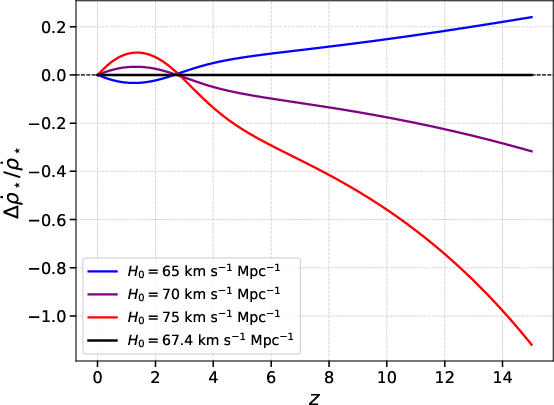
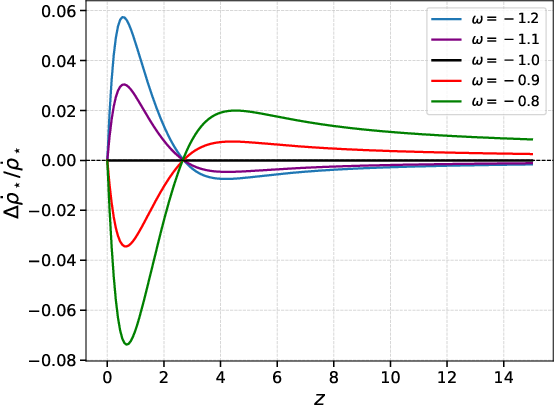
Figure 1: Relative impact on SFRD of varying z∈[0,15]5 (left) and z∈[0,15]6 (right), quantifying sensitivity to cosmological parameters.
Posterior Constraints and Degeneracy-Breaking
The joint MCMC analyses demonstrate that SFRD+BBN alone produces broad posteriors, mainly due to extensive degeneracy between cosmological and astrophysical parameters. However, addition of DESI BAO or SNIa data breaks these degeneracies:
- SFRD+BBN: z∈[0,15]7, z∈[0,15]8
- SFRD+BBN+DESI: z∈[0,15]9, ρ˙⋆(z)=ρ˙⋆,01+α(χ−1)3exp(βχ7/4)χ2,0
- SFRD+BBN+PantheonPlus+SH0ES: ρ˙⋆(z)=ρ˙⋆,01+α(χ−1)3exp(βχ7/4)χ2,1
Astrophysical parameters ρ˙⋆(z)=ρ˙⋆,01+α(χ−1)3exp(βχ7/4)χ2,2, ρ˙⋆(z)=ρ˙⋆,01+α(χ−1)3exp(βχ7/4)χ2,3, and ρ˙⋆(z)=ρ˙⋆,01+α(χ−1)3exp(βχ7/4)χ2,4 also become tightly constrained, with uncertainties reduced by ρ˙⋆(z)=ρ˙⋆,01+α(χ−1)3exp(βχ7/4)χ2,5–ρ˙⋆(z)=ρ˙⋆,01+α(χ−1)3exp(βχ7/4)χ2,6 in joint analyses. Figure 2 visualizes the constraining power of different dataset combinations for both cosmological and astrophysical parameter spaces, highlighting the complementarity and correlation structure.
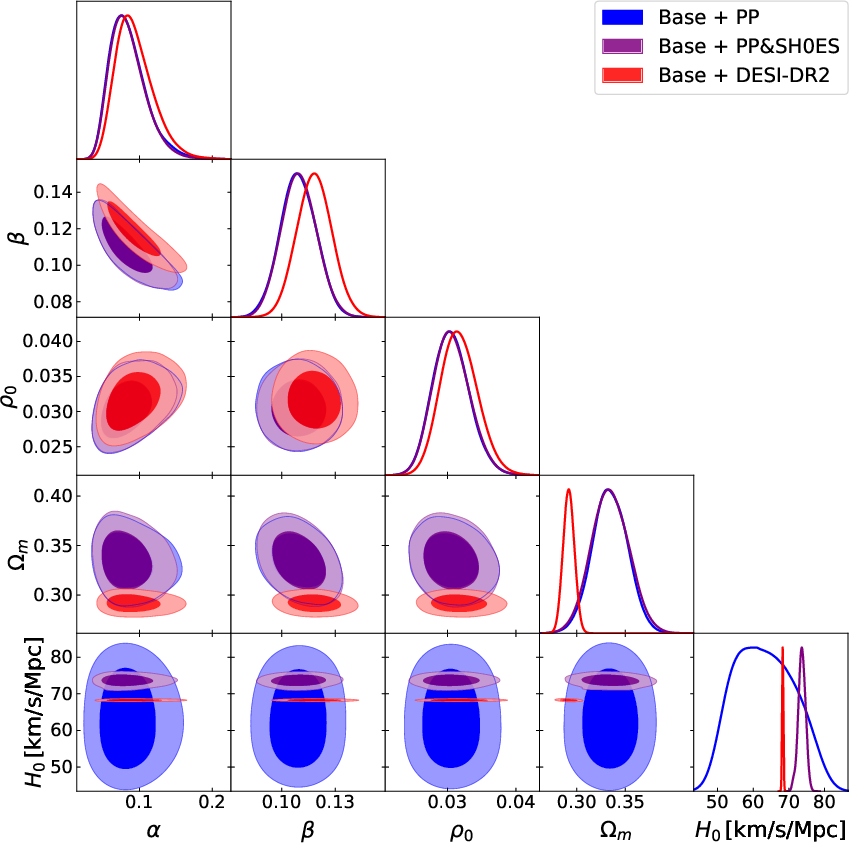
Figure 2: Joint posteriors for ρ˙⋆(z)=ρ˙⋆,01+α(χ−1)3exp(βχ7/4)χ2,7, ρ˙⋆(z)=ρ˙⋆,01+α(χ−1)3exp(βχ7/4)χ2,8, and SFRD astrophysical parameters under different data combinations.
Extension to ρ˙⋆(z)=ρ˙⋆,01+α(χ−1)3exp(βχ7/4)χ2,9CDM: Sensitivity to Dark Energy
Generalizing to χ=[H(z)/H0]2/30CDM increases parameter uncertainty due to degeneracies between χ=[H(z)/H0]2/31, χ=[H(z)/H0]2/32, and χ=[H(z)/H0]2/33. DESI BAO data remain essential for constraining the expanded parameter space (χ=[H(z)/H0]2/34 with BAO), and SFRD posteriors are only modestly broadened compared to χ=[H(z)/H0]2/35CDM. Figure 3 shows the multi-dimensional posteriors for key parameters in the χ=[H(z)/H0]2/36CDM context.
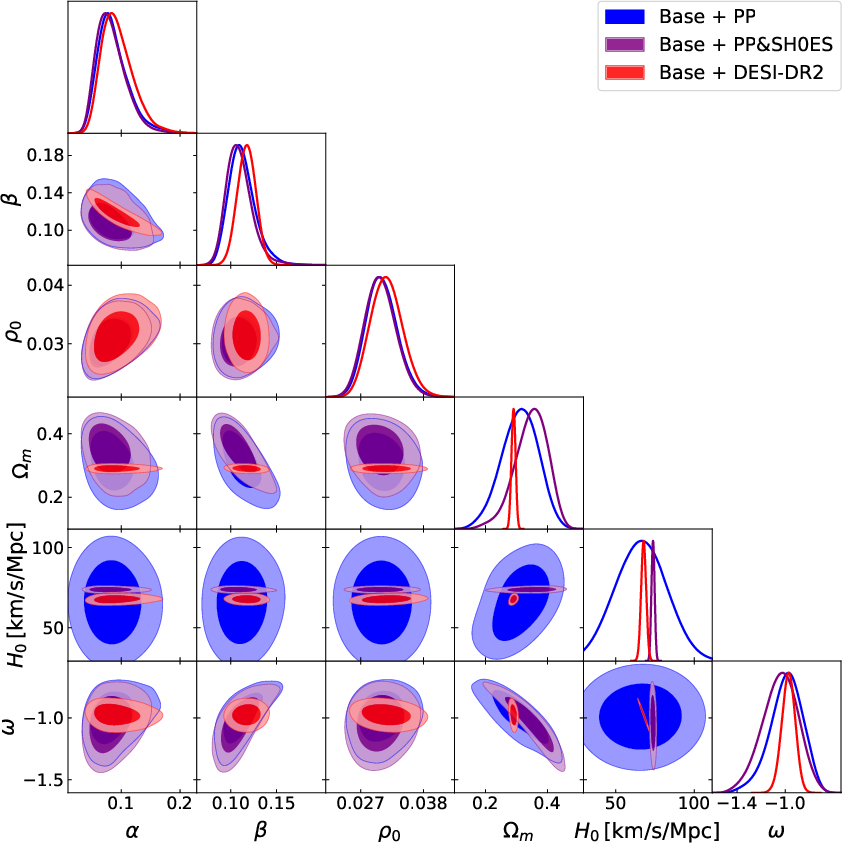
Figure 3: Multi-dimensional marginalized posteriors for χ=[H(z)/H0]2/37CDM cosmological and SFRD astrophysical parameters.
Statistical Reconstruction of the Cosmic Star Formation History
The paper presents a rigorous uncertainty propagation for the SFRD history by incorporating the posterior distributions of all model parameters. In both χ=[H(z)/H0]2/38CDM and χ=[H(z)/H0]2/39CDM, the reconstructed SFRD robustly displays a peak at α,β0, with α,β1 across all joint dataset analyses and cosmological hypotheses. This stability confirms the insensitivity of α,β2 to dark energy variations for standard models.
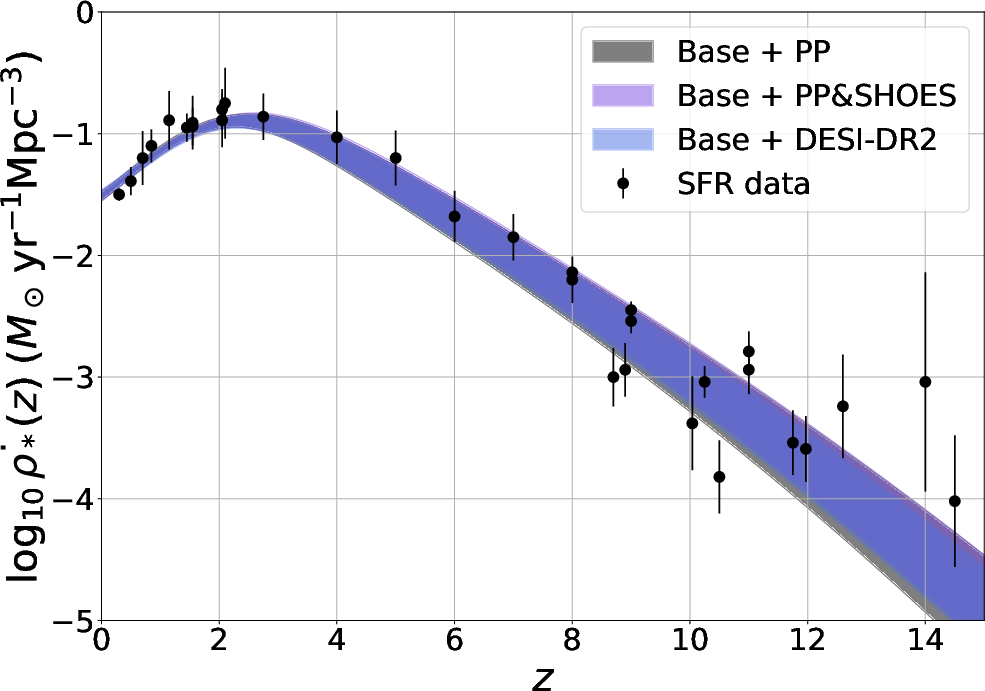
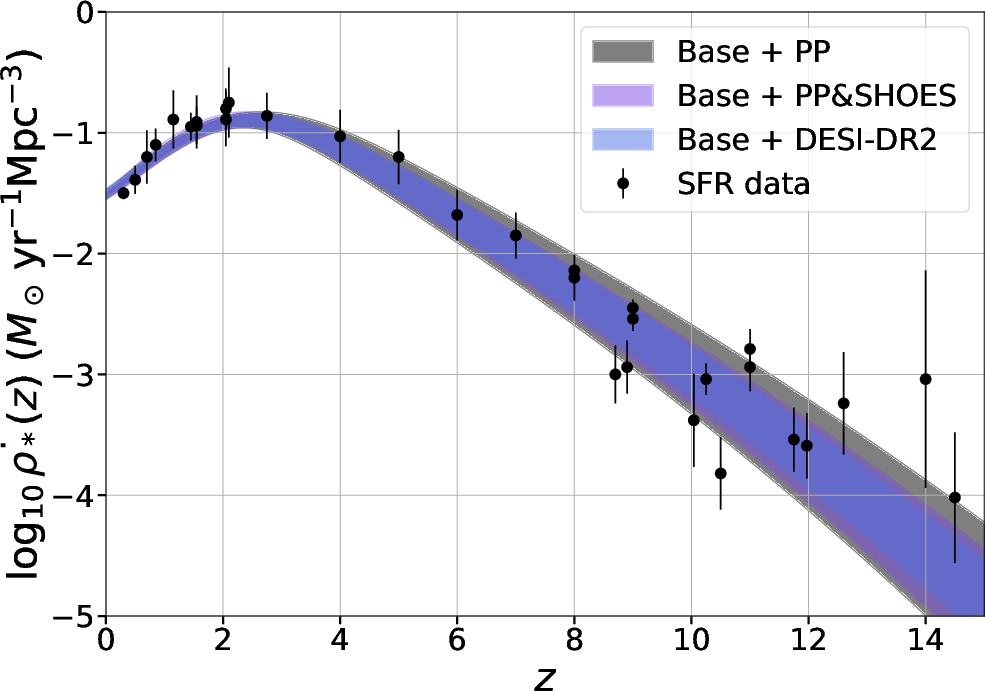
Figure 4: SFRD uncertainty bands for different cosmological datasets and models; the characteristic peak at α,β3 is robust.
Further, the authors compare their SFRD fitting to commonly used empirical parameterizations (Madau & Dickinson and Harikane et al.), as shown in Figure 5. Their methodology (blue curve) intermediates between the older polynomial approaches, especially at α,β4, highlighting the necessity of physically motivated, cosmology-aware modeling for next-generation SFRD constraints.
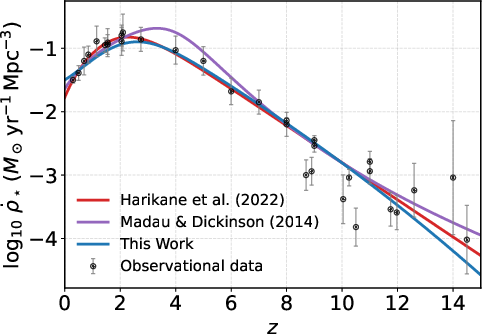
Figure 5: SFRD as a function of redshift: this work's fit (blue), Madau & Dickinson (purple), Harikane et al. (red), benchmarked to the SFRD data compilation.
Implications and Outlook
The major implication is that SFRD, when anchored by latest high-α,β5 UV luminosity data and jointly fit with standard geometrical probes, constitutes a high-leverage cosmological observable. This approach delivers:
- Tight, independent constraints on α,β6 and α,β7 consistent with both CMB-derived and late-universe measures, with uncertainties rivaling those from DESI alone.
- Robust determination of astrophysical parameters describing the efficiency and feedback regulation of cosmic star formation, reducing degeneracies inherent in galaxy formation models.
- Validation that the epoch of cosmic noon (α,β8) is insensitive to reasonable extensions in the background cosmological model (i.e., α,β9CDM vs z0CDM).
- A quantitative demonstration that SFRD is highly sensitive to z1 at z2, making high-redshift SFRD determinations a potentially critical check on the Hubble tension and exotic early-universe scenarios.
Moreover, the mapping of astrophysical parameters onto cosmological ones sets the stage for next-generation, multi-probe analyses where improved JWST and 30-meter-class telescope observations of the SFRD at z3 can sharply test the consistency of the standard cosmological paradigm, or reveal new physics. The approach also facilitates more direct inference of cosmological parameters from future deep galaxy surveys, with minimal modeling of feedback microphysics.
Conclusion
The paper provides a comprehensive framework for joint cosmological and astrophysical inference utilizing the full cosmic star formation history as a precision observable. Through careful likelihood construction and degeneracy-aware modeling, the authors demonstrate that SFRD, in synergy with BAO and SNIa data, delivers precise and robust constraints on key cosmological parameters and offers a physically grounded approach to interpreting high-redshift galaxy data. As SFRD datasets extend to ever higher redshift and accompanying systematics are mitigated, this methodology will play a central role in testing cosmological models and potential deviations from z4CDM, as well as refining the modeling of baryonic physics in the context of large-scale structure and galaxy formation (2604.17660).