- The paper presents an updated angular size–redshift test using a VLBI AGN sample of 4,825 sources to probe cosmological parameters.
- The methodology employs robust Bayesian MCMC techniques to correlate intrinsic AGN structure with redshift and luminosity, revealing significant evolution effects.
- The study highlights astrophysical–cosmological parameter degeneracies that challenge the use of AGNs as standard rods for precision cosmology.
Revisiting the Angular Size–Redshift Cosmological Test with VLBI AGN Samples
Introduction
The angular size–redshift (θ−z) test has historically served as a geometric cosmological probe, tracing its conceptual origins to Hoyle and Sandage, and targeting radio-loud AGN as potential standard rods. Early efforts were limited by sample size and the evolutionary complexity of arcsecond-scale sources. Recent developments in VLBI have enabled measurement of milliarcsecond-scale structures in AGN cores and jets, which are less susceptible to evolution and environmental effects, thus resurfacing their cosmological utility. This work presents the most comprehensive update to the AGN θ−z test in over two decades, capitalizing on an order-of-magnitude increase in sample size and robust statistical methodologies.
Dataset Construction and Angular Size Definition
A meticulously assembled dataset of $4,825$ AGN with redshifts was compiled from the Astrogeo VLBI database, focusing on X-band observations near $8$ GHz to maximize sample uniformity. Angular sizes are operationally defined as the median separation between two circular Gaussian components (typically approximating core and jet features) fitted directly to VLBI visibilities for each source.
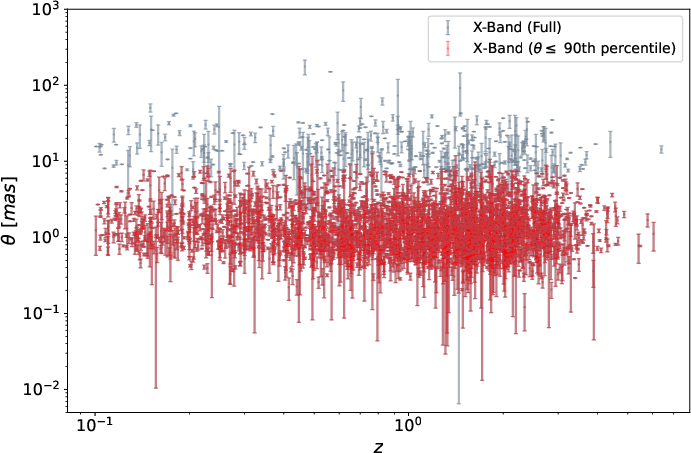
Figure 1: Measured angular sizes (core–jet separations from visibility-based model fits) for AGN at X-band (7.6–8.7 GHz) versus redshift, with compact sources (≤90th percentile in size) highlighted.
Strict filtering excluded sources with size uncertainties exceeding the measurement and low-redshift (z<0.1) AGN, yielding a fiducial sample of $4,214$. This precludes strong luminosity selection effects that compromise homogeneity for standard rod applications.
Statistical Methods for Cosmological Parameter Inference
The analysis framework employs a phenomenological model
lm=l(L0L)β(1+z)n
linking intrinsic metric size to radio luminosity and redshift. The observed angular size θ(z) is then
θ(z)=DA(z)lm
with cosmological distances computed in a flat θ−z0CDM background.
A Bayesian pipeline (MCMC, Cobaya implementation) samples the posterior distributions over θ−z1, under fixed θ−z2 km sθ−z3 Mpcθ−z4 and multiple values of θ−z5 in the range θ−z6. Several validation strategies were used: synthetic catalogues with varying Gaussian scatter, and shuffled-redshift randomization to assess the physicality of detected trends.
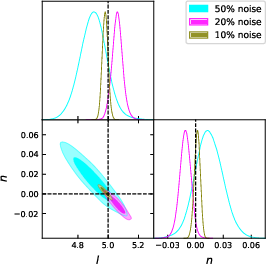
Figure 3: Mock catalogue posteriors in the θ−z7 subspace for 10%, 20%, and 50% noise; contours align with fiducial values, demonstrating robust parameter recovery and increasing degeneracy at higher noise.
Results and Parameter Constraints
Parameter estimation reveals that all fitted parameters show systematic, monotonic trends with increasing θ−z8, with θ−z9, $4,825$0, and $4,825$1 decreasing as matter density increases. The redshift evolution term $4,825$2 is particularly significant ($4,825$3, $4,825$4 from the null), which precludes interpreting compact AGN as perfect standard rods. This nonzero $4,825$5 can be attributed to intrinsic evolutionary effects, spectral frequency mismatch (rest vs. observed frame), or unresolved selection biases. Notably, $4,825$6 display a marked degeneracy, which severely limits independent cosmological leverage.
Posterior distributions for mock catalogues confirm that the pipeline yields unbiased recovery of fiducial input parameters, with ambiguity developing only when noise exceeds $4,825$7. Analysis of real data subsets (excluding the top $4,825$8 in size) proved that fits are not dominated by outlier extended sources.
A randomization test involving 100 shuffled-redshift catalogues establishes the statistical significance of the $4,825$9 correlation: real-data parameter estimates deviate by up to $8$0 from their null distributions.
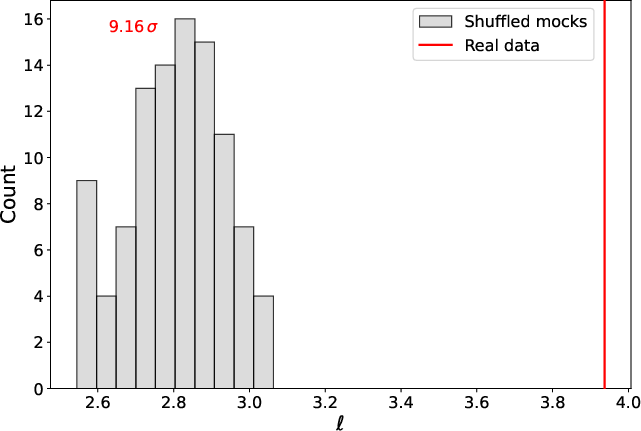
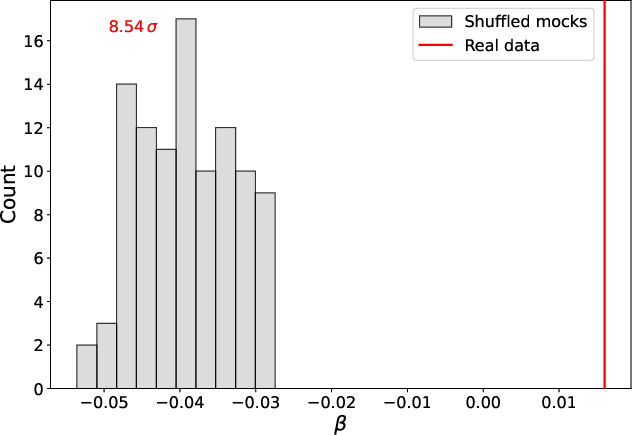
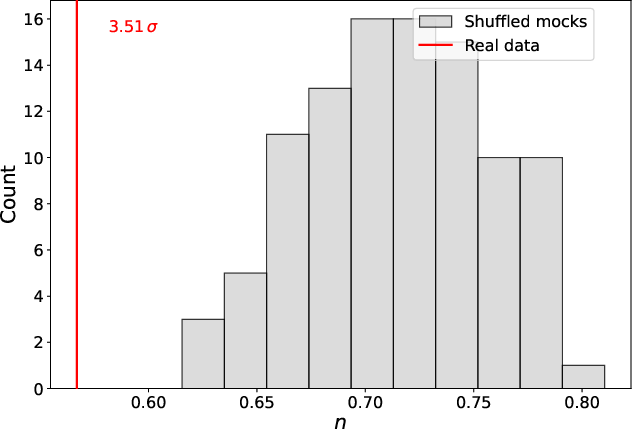
Figure 2: Null distributions of parameters ($8$1, $8$2, $8$3) inferred from 100 randomized catalogues; vertical red lines indicate values from real data, revealing high-significance detection of the physical correlations.
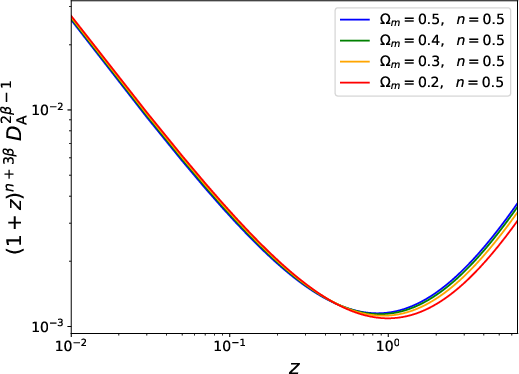
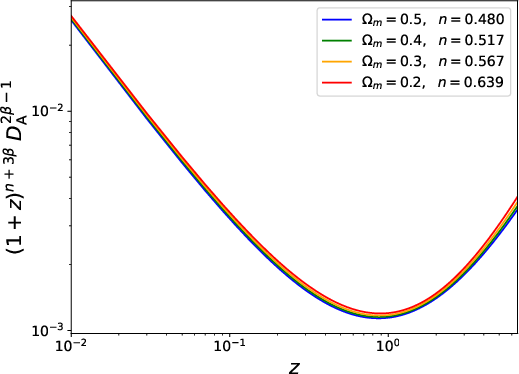
Figure 4: Variation of the redshift sensitivity in the analytic $8$4 relation under different cosmological (upper) and coupled astrophysical-cosmological (lower) parameterizations; strong degeneracy between $8$5 and $8$6 is evident.
Methodological and Practical Limitations
The study finds that simply inflating sample size does not fully overcome inherent limitations:
- Astrophysical–cosmological parameter degeneracy: The deformation parameter $8$7 can mask changes in $8$8, making simultaneous constraints on both essentially impossible for noisy, unlabeled samples.
- Sample size vs. per-source scatter: To achieve sub-percent precision on standard rod-based cosmological distances, between $8$9 and 7.6–8.70 sources with 7.6–8.71 measurement scatter are required.
- Homogeneity breakdown: The use of fixed observed frequency imprints a redshift-dependent rest-frame selection, violating the standard rod hypothesis for the full heterogeneous sample.
Breaking these degeneracies and enhancing cosmological sensitivity will necessitate high-precision, multi-frequency data and rigorous control of sample homogeneity (spectral index, luminosity, rest-frame size selection, further classification).
Implications and Future Prospects
The expanded VLBI AGN sample allows stringent validation of the robustness of the 7.6–8.72 test but highlights the fundamental challenge of astrophysical evolution in milliarcsecond-scale reference objects. The correlation between angular size and redshift is statistically significant, but inadequate constraints on the cosmological background are attainable without external calibration on 7.6–8.73, 7.6–8.74, or additional data dimensions.
In the near term, the practical use of AGN as standard rods will require:
- Application of spectral and luminosity-based sub-selection strategies to isolate subsamples with minimal intrinsic evolution;
- Cross-matching with independent multi-wavelength data (e.g., optical, X-ray, or Gaia astrometry) to empirically calibrate size–luminosity–redshift dependencies;
- Extension of the methodology to leverage improved completeness and higher-precision VLBI surveys, scaling up the sample size and facilitating the required standardization.
The published dataset (with all measurement infrastructure) will serve as a community resource for further targeted efforts in AGN cosmology.
Conclusion
This study supersedes previous AGN 7.6–8.75 cosmological tests in dataset scale, statistical rigor, and methodological transparency. While the use of compact AGN as cosmological standard rods is still presently compromised by strong astrophysical–cosmological degeneracies, the groundwork laid here provides the path for future improvements via homogenous, well-calibrated VLBI samples, and integration with next-generation observational resources. The availability of these data will enable the next phase of development for geometric cosmological probes beyond the current luminosity-based hierarchy (2604.12936).

