- The paper introduces an exact Hamiltonian transformation that cuts measurement evaluations nearly in half for energy-based operator selection.
- It details a method splitting the Hamiltonian into three analytically computable fragments to optimize the ADAPT-VQE ansatz construction.
- Numerical benchmarks on LiH, BeH₂, and H₂O demonstrate improved convergence and reduced cost, enhancing practical quantum simulation.
Resource-Efficient Energy-Based Operator Selection for Fermionic ADAPT-VQE
Introduction
The paper "Resource-efficient energy-based operator selection in fermionic ADAPT-VQE via exact Hamiltonian transformation" (2606.04786) presents a formalism to mitigate the computational bottleneck in energy-based operator selection within adaptive quantum variational algorithms, specifically the fermionic ADAPT-VQE (Adaptive Derivative-Assembled Pseudo-Trotter Variational Quantum Eigensolver). The principal advancement comes from an exact Hamiltonian transformation that enables efficient evaluation of the one-parameter energy landscapes associated with candidate operators, reducing the measurement cost nearly to the gradient-based approach level without compromising the algorithm's landscape-aware selection benefits.
Theoretical Framework
ADAPT-VQE systematically constructs compact and system-specific ansätze by interleaving operator selection and parameter optimization. The traditional energy-based selection (as in Rotoselect) provides superior operator ordering by directly minimizing the 1D energy landscape along each candidate generator, but at a cost: the trigonometric energy landscape for each operator requires multiple expectation value evaluations, each corresponding to a full Hamiltonian measurement. This is especially prohibitive in fermionic implementations due to the structure of the excitation pools.
The key theoretical contribution here is the deployment of an exact closed-form unitary transformation formalism for fermionic operators [Evangelista_Magoulas_2025]. The procedure leverages the special algebraic properties of excitation-type generators, which allow the energy landscape with respect to an appended excitation to be expressed as a sum of three analytically derived fragments, with trigonometric dependence parameterized by a generator-dependent closure relation (Figure 1).
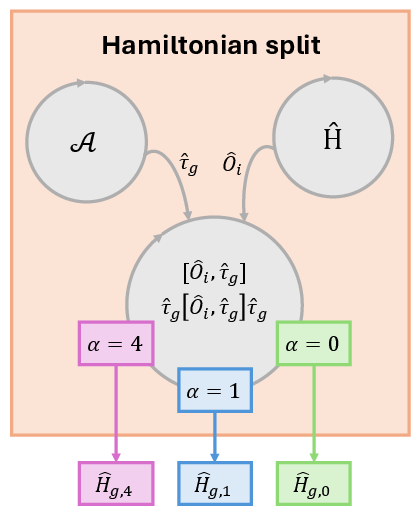
Figure 1: A schematic depiction of the Hamiltonian splitting procedure, fragmenting the Hamiltonian by the closure parameter α with respect to each pool generator.
The central Hamiltonian fragmentations, based on nested commutator closure relations, permit a per-generator Hamiltonian split into components with α=0,1,4. This allows the parameter-dependent expectation value to be reconstructed from the measurement of expectation values of these fragments at only a small number of parameter shifts. The overall process is schematically summarized in Figure 2.
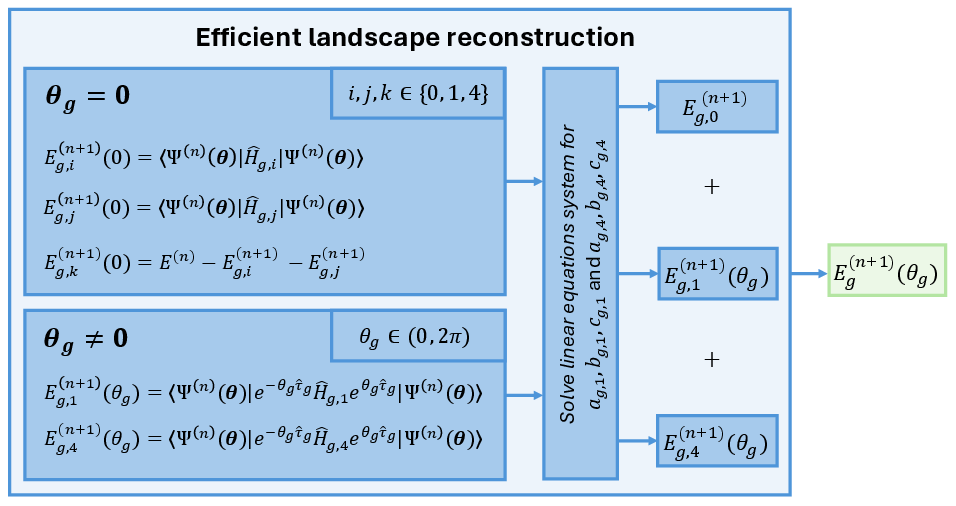
Figure 2: Efficient procedure for reconstructing the energy landscape associated to each generator via selective measurement of Hamiltonian fragments.
Algorithmic Implementation
Prior energy-based ADAPT-VQE strategies (e.g., Rotoselect) require four full Hamiltonian evaluations per candidate per iteration; the present work reduces this to approximately two, closely matching the cost of commutator-based gradient selection.
Specifically, the splitting procedure for a given generator τ^g proceeds by categorizing each Fermi string in the second-quantized electronic Hamiltonian into one of three commutation closure classes. This pre-processing yields for each generator a triple (H^g,0,H^g,1,H^g,4), such that the expectation value for any parameter shift can be reconstructed from just the trigonometric forms of these fragments and a minimal set of parameter-shift measurements. This Hamiltonian pre-fragmentation is conducted once per simulation, after which the ADAPT iteration proceeds as shown in Figure 3.
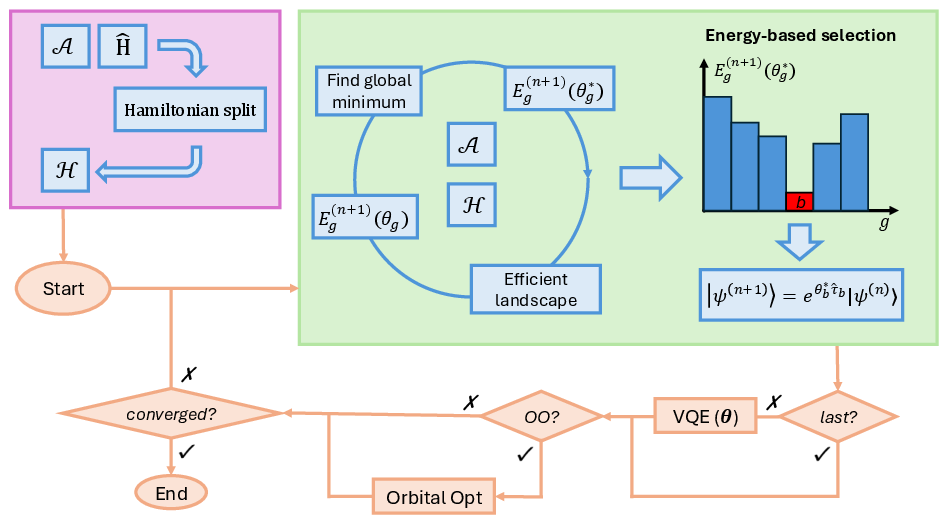
Figure 3: Flowchart of the adaptive protocol, indicating the stepwise splitting, measurement, selection, and ansatz extension process.
The landscape (energy) scoring for each operator is obtained efficiently, yielding both the operator choice and a high-quality initial parameter value. Selection is followed by either a local or a full re-optimization of ansatz parameters, optionally including orbital optimization.
Numerical Benchmarks
The methodology is benchmarked on LiH, BeH2, and H2O, at equilibrium and stretched geometries, across the low- and strong-correlation regimes. Notably, Table 1 in the manuscript demonstrates:
- Standard energy-based Rotoselect imposes a cost over twice that of gradient-based selection, measured in relative Pauli string-weighted evaluations.
- The resource-efficient Rotoselect (denoted RSe) closes this gap, with a cost ratio to gradient-based selection near unity (about 1.1--1.17).
The performance gains are reflected both in absolute measurement cost and convergence dynamics. At weak correlation, energy-based selection—especially in 'last' optimization (optimizing only the new parameter)—delivers faster and more cost-effective convergence, in some cases circumventing the need for variational optimization entirely. This property is especially advantageous for NISQ-era devices, where VQE convergence landscapes are plagued by roughness and barren plateaus.
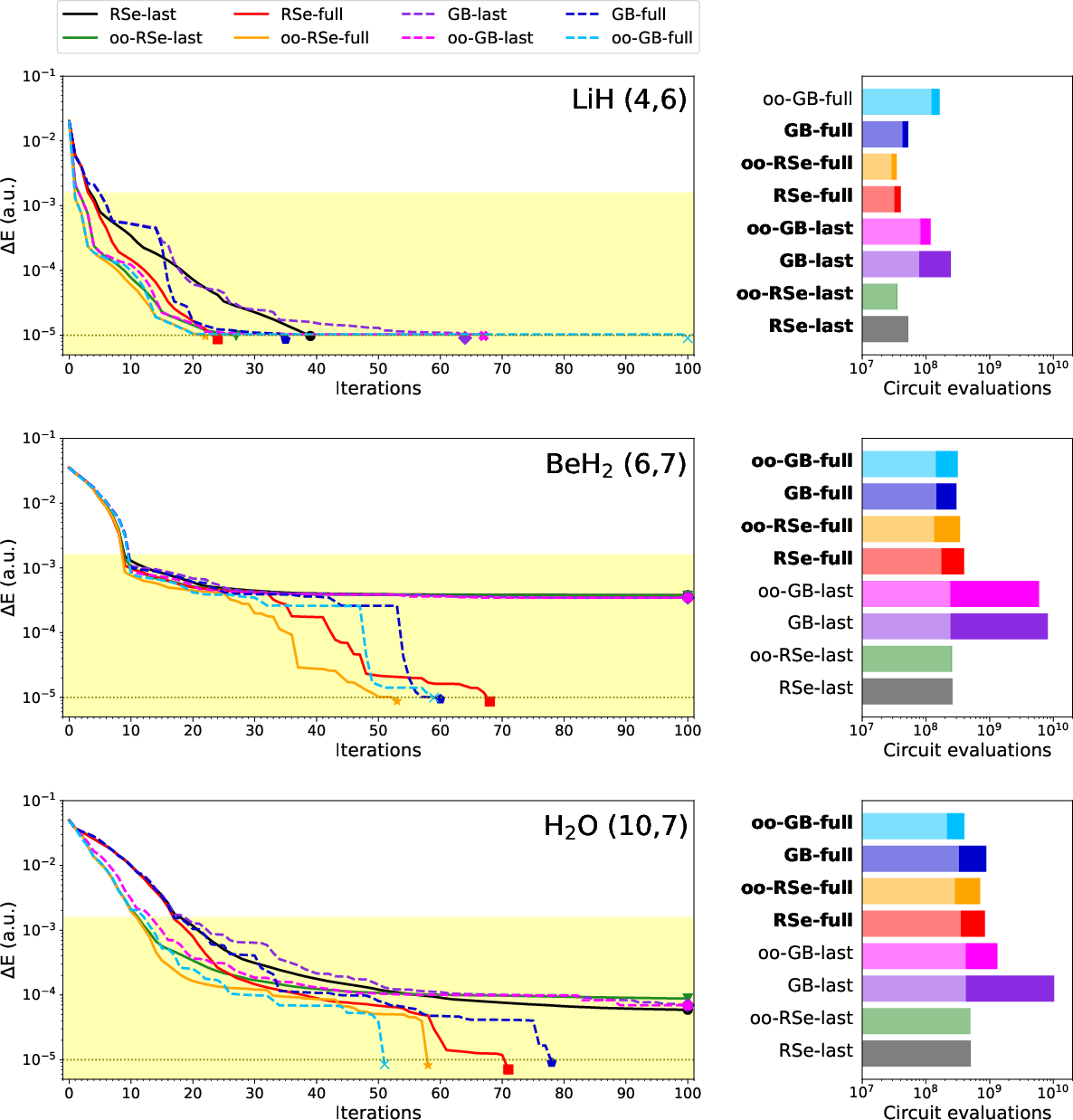
Figure 4: Comparison of selection and optimization strategies for LiH, BeH2, and H2O at their equilibrium geometries, indicating both energy convergence and relative circuit evaluation costs.
As correlation strength increases (e.g., at bond stretch), the influence of operator selection diminishes relative to the necessity for full ansatz re-optimization and orbital relaxation. In these regimes, full re-optimization strategies consistently outperform 'last'-type updates, and orbital optimization (where single excitations are integrated classically) accelerates convergence and lowers measurement costs.
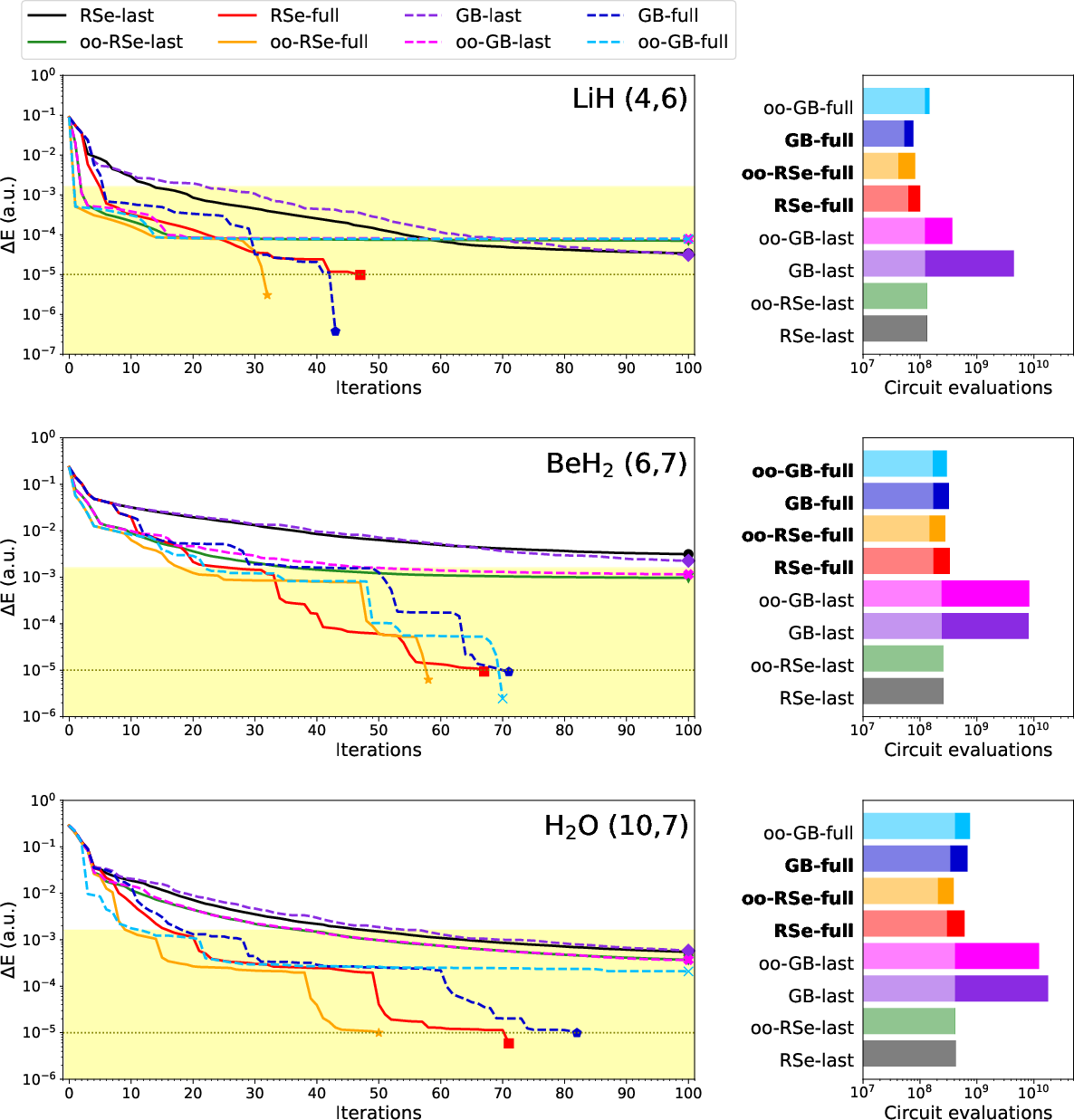
Figure 5: Comparison of selection-optimization strategies in stretched geometries, where full re-optimization and orbital optimization become dominant for robust convergence.
Practical and Theoretical Implications
By collapsing the measurement cost disparity between energy-based and gradient-based selection, this approach renders landscape-aware, parameter-sweeping selection strategies practical for larger problem instances and more challenging Hamiltonians. The warm-start initialization provided by direct minimization along each generator direction improves optimization trajectory and overall ansatz compactness, particularly in weakly correlated molecules.
In the high correlation regime, the limited effect of the selection strategy places emphasis on global parameter optimization (to avoid gradient troughs) and circuit design, pointing future work at symmetry enforcement and advanced global optimization routines. These improvements are critical for scaling ADAPT-VQE to active spaces relevant for chemistry beyond proof-of-principle demonstrations.
On practical hardware, where Pauli string grouping, shot noise, and device imperfections further complicate resource considerations, the ability to systematically reduce measurement overhead becomes a limiting factor for all VQE-family methods. Thus, the presented theoretical improvements directly translate to hardware relevance, decreasing wall-time and sample complexity.
Conclusion
The work delivers a formal, mathematically exact, and resource-efficient formulation of energy-based operator selection for fermionic ADAPT-VQE, enabled by a generator-dependent exact Hamiltonian transformation. For weakly correlated systems, the approach leads to ansätze that require no explicit VQE optimization. For more challenging molecules, convergence is dominated by full re-optimization and orbital adaptation, but landscape-aware selection remains beneficial.
The broader implication is that with this cost reduction, adaptive quantum algorithms can benefit from optimal operator ordering and parameter initialization without sacrificing measurement efficiency, bringing practical quantum simulation of correlated fermionic systems closer to feasibility on near- and intermediate-term devices. Future directions include addressing optimization stagnation, enforcing symmetries, and integrating global or stochastic parameter search strategies for robust ansatz construction.