- The paper introduces a minimal Hamming distance metric that reveals a universal power-law scaling (r ~ A·Nb^(-α)) with anomalously small exponents (0.1–0.35).
- The methodology systematically analyzes unique projective measurement bitstrings from diverse quantum states to diagnose structure, connectivity, and phase transitions.
- The findings suggest that minimal Hamming distances are scalable, device-agnostic descriptors for quantum state certification, benchmarking, and phase classification.
Extremely Slow Scaling of Minimal Hamming Distance in Quantum Sampling Data
Introduction
This work addresses the challenge of extracting structural information from quantum measurement data, typically represented as highly sparse bitstring samples in an exponentially large Hilbert space. By introducing the average minimal Hamming distance between observed bitstrings as a key diagnostic metric, the study identifies an emergent universal power-law relationship for a variety of quantum states. The parameters of this scaling (A and α) serve as compact descriptors, retaining information about the connectivity and complexity of quantum states without requiring complete wavefunction reconstruction or extensive observable measurements.
Methodology: Minimal Hamming Distance Framework
The approach involves generating a set of unique projective measurement bitstrings from a quantum source (device experiments, classical sampling, or neural network quantum states), followed by systematic subsampling at varying set sizes Nb. The minimal Hamming distance rˉ1(Nb) for each sample to its nearest neighbor is calculated, averaged, and then analyzed as a function of Nb. It is observed that for a wide array of quantum states, rˉ1(Nb) exhibits robust power-law scaling:
rˉ1(Nb)=ANb−α
with A and α encapsulating state-specific information. Notably, the scaling exponents are anomalously small (α∈[0.1,0.35]), signifying extremely slow convergence even at large α0, indicative of the vastness and structure of the underlying quantum configuration space.
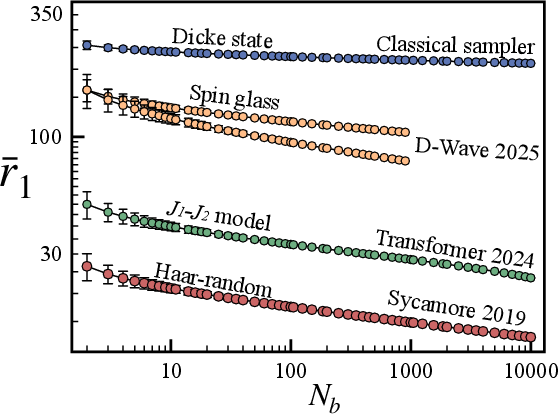
Figure 1: Minimal Hamming distance functions for various quantum states, including Dicke, D-Wave spin-glass, ViT-optimized α1–α2 ground state, and Haar-random Sycamore states.
Analysis of Dicke States
Dicke quantum states, exhibiting controlled complexity with excitation number α3, serve as a natural testbed. For moderate qubit counts (α4) and varied α5, the power-law form of α6 persists. States with the same α7 cluster around similar exponents α8, while α9 is sensitive to the excitation fraction, reflecting internal structure. When sample sizes approach Hilbert space saturation, rapid deviation from the power-law emerges, but for physically accessible scales, the power law is a robust diagnostic.
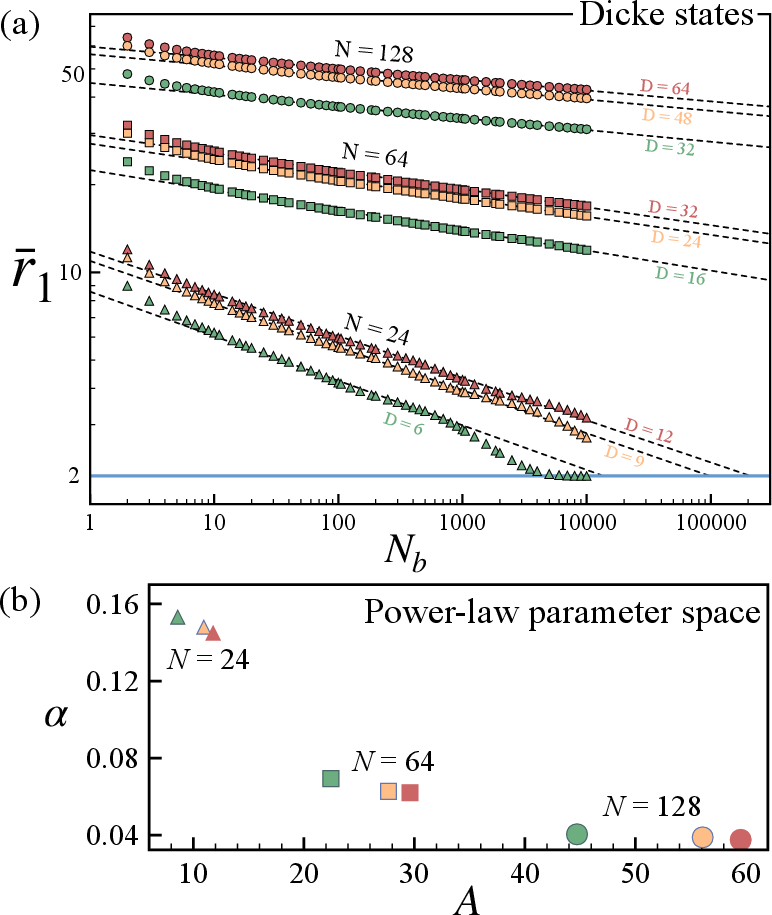
Figure 2: (a) Power-law behavior in minimal distances for Dicke states; (b) Distinguishability map via Nb0 and Nb1 across Dicke state families.
Quantum Phase Transitions in the Nb2–Nb3 Model
The minimal Hamming distance scaling method is applied to ground state samples from the two-dimensional Nb4–Nb5 antiferromagnetic spin model. Both exact diagonalization (ED) and variational neural quantum states based on Vision Transformers (ViT) are considered. The power-law exponent Nb6 shows clear sensitivity to phase structure: linear in the N\'eel and stripe regimes and sharply peaking in the intermediate frustrated region. The peak at Nb7 coincides with the debated quantum phase boundary, also reflected in the standard variational diagnostics (V-score), highlighting the potential of Hamming-based metrics for phase classification.
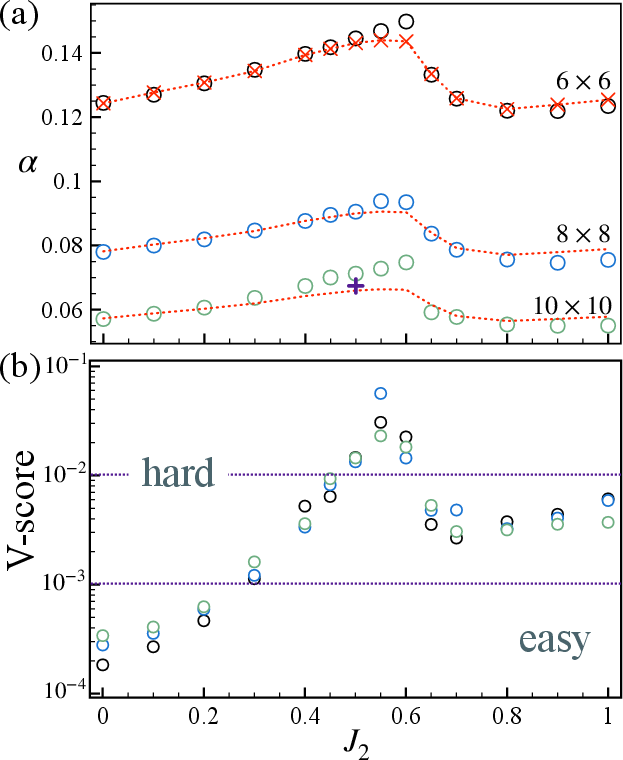
Figure 3: (a) Scaling exponent Nb8 across Nb9–rˉ1(Nb)0 phase space for ED and ViT; (b) Corresponding V-score as an energy/variance-based benchmark.
Supplementary analysis of the prefactor rˉ1(Nb)1 further corroborates the diagnostic power for both quantum phases and variational accuracy.
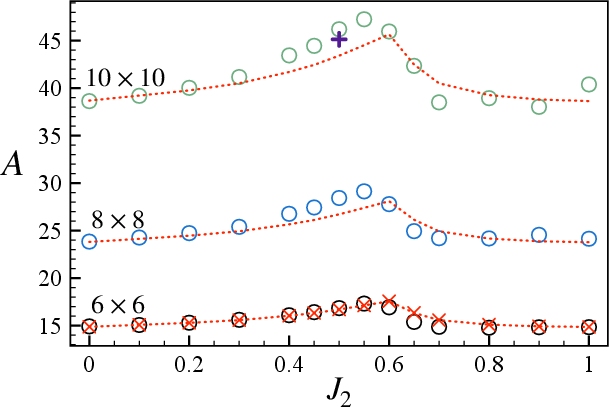
Figure 4: Power-law prefactor rˉ1(Nb)2 for rˉ1(Nb)3–rˉ1(Nb)4 model, showing sensitivity to frustration and phase boundaries.
Structure and Dimensionality of Quantum Annealing Data
Measurement bitstrings from D-Wave quantum processors are analyzed to characterize their sampling structure under varying annealing protocols. The exponent rˉ1(Nb)5 systematically increases with annealing time rˉ1(Nb)6, indicating increased locality and reduced wavefunction spread in the bitstring space. This behavior is observed consistently across system sizes.
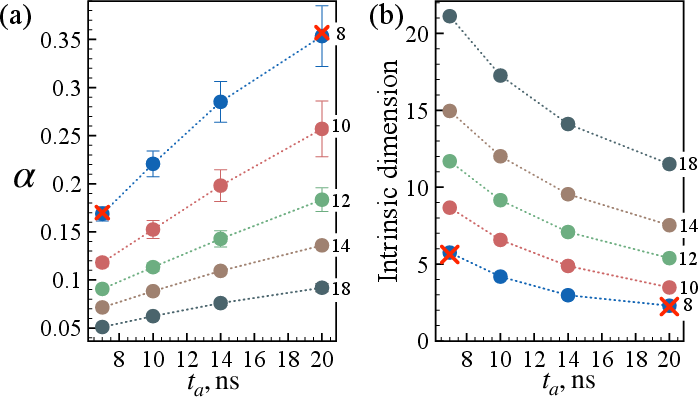
Figure 5: (a) Dependence of scaling exponent rˉ1(Nb)7 on D-Wave annealing time and system size; (b) Intrinsic dimension (ID) reduction with annealing, matching trends from MPS simulations (red crosses).
To quantify the effective sampling complexity, the study estimates the intrinsic dimension (ID) using the two-nearest-neighbor method. Quantum annealer samples lie on manifolds of substantially reduced dimension relative to the Hilbert space, with ID decreasing as rˉ1(Nb)8 increases (slower quench). This ID reduction reflects growing sample redundancy and localization as the wavefunction approaches classical ground-state structure.
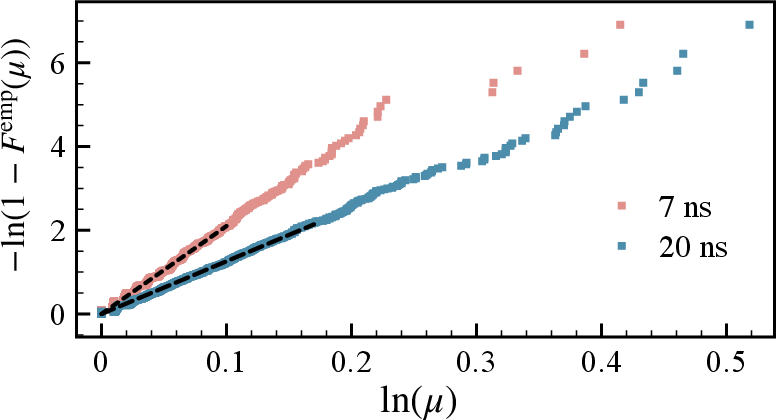
Figure 6: Empirical cumulative distributions for ID calculation from D-Wave data at different rˉ1(Nb)9, yielding dramatic reductions in effective dimension.
Practical and Theoretical Implications
This universal power-law scaling of minimal Hamming distances holds across quantum state origins (hardware, classical, neural), enabling the extraction of critical information about quantum state structure, connectivity, and phase transitions from limited data. For variational quantum eigensolvers, the approach diagnostically distinguishes easy and hard parameter regimes, allowing certification or invalidation of neural ansätze without ground-truth access.
In experimental platforms, the scaling exponents and IDs provide practical tools for rapid device characterization, system benchmarking, and validation of quantum sampling quality. The theoretically observed slow scaling suggests inherent challenges for brute-force state-space exploration and underpins the necessity of highly efficient sampling and learning protocols.
The observed trends in the Nb0–Nb1 model and D-Wave experiments imply that these data-science inspired metrics can serve as order-parameter surrogates, with utility for models where conventional observables are inaccessible due to sample sparsity. This methodology motivates targeted search for minimal sufficient representations and can inform the design of improved quantum and classical algorithms for state reconstruction.
Conclusion
The minimal Hamming distance scaling framework reveals a profound, universal, yet extremely slow power-law scaling in quantum measurement data across disparate platforms and algorithms. The exponents and prefactors of this scaling provide compact, discriminative descriptors of quantum state structure, informative of both computational complexity and phase behavior. These quantities furnish scalable, device-agnostic metrics, directly applicable to quantum state certification, algorithmic benchmarking, and condensed matter diagnostics, and highlight the deep connection between bit-level data analysis and the physics of many-body quantum systems.