- The paper introduces neural quantum states (NQS) using ResNet and dCNN architectures to simulate full Lindblad dynamics in many-body quantum systems, overcoming traditional simulation limits.
- Results demonstrate that NQS accurately reproduces local and nonlocal observables, revealing a universal power-law decay (exponent ≈1/3) in both 1D and 2D subradiant regimes.
- The approach enables scalable simulations of large atomic ensembles with implications for quantum memory, entanglement generation, and advanced quantum optical devices.
Neural Network Modeling of Many-Body Super- and Sub-Radiant Dynamics
Introduction
The study addresses a central challenge in quantum many-body optics: the efficient simulation of dissipative dynamics in large, interacting atomic ensembles. Specifically, it focuses on superradiance and subradiance—collective radiative phenomena fundamentally governed by coherent long-range interactions and structured dissipation—which are observable in ordered arrays of atoms coupled to electromagnetic fields. Traditional approaches to simulating such open quantum systems, including exact diagonalization or tensor network methods, rapidly become intractable as the system size increases. Semi-classical methods (e.g., mean-field, cumulant expansions, discrete truncated Wigner approximations) can qualitatively capture early time, high-excitation dynamics, but systematically fail to accurately describe late-time, strongly correlated subradiant regimes due to their inherent neglect of higher-order quantum correlations.
This work applies neural quantum states (NQS)—a class of variational artificial neural network models for quantum state representation—to the dissipative, many-body regime of open-system quantum optics, demonstrating simulation capabilities for system sizes beyond reach for exact or tensor-network calculations. The methodology leverages probabilistic neural networks within a time-dependent variational principle (TDVP) framework to simulate the full Lindblad dynamics, including the effects of both long-range coherent couplings and collective dissipation, in one- and two-dimensional atomic arrays.
Methodology
The physical model is a dense ensemble of atoms arranged in ordered 1D or 2D arrays, described by an effective spin model after integrating out the photon degrees of freedom. The master equation is a Lindblad equation characterized by long-range, position-dependent coherent couplings Jij and dissipative rates Γij determined by Green's tensor of the electromagnetic field. The collective nature of the dynamics entails both superradiant decay (enhanced, short-time photon emission) and subradiant relaxation (suppressed, long-lived excitation density), with the latter fundamentally inaccessible via mean-field or simple cumulant methods for large systems due to strong many-body correlations.
The major technical advancement is using a POVM-based NQS ansatz, parameterized either as a deep residual network (ResNet) or a dilated convolutional neural network (dCNN). The NQS directly encodes the probability distribution of an informationally complete set of measurement outcomes (tetrahedral POVM), providing a compressed, variational description of the system's density matrix. Time evolution of parameters is performed using TDVP, where gradients are computed via Monte Carlo sampling. The architectures are tailored to capture varying correlation lengths efficiently: ResNet grows receptive field linearly with depth, whereas dCNN achieves exponential growth via dilation, facilitating encoding of highly nonlocal correlations at minimal depth.
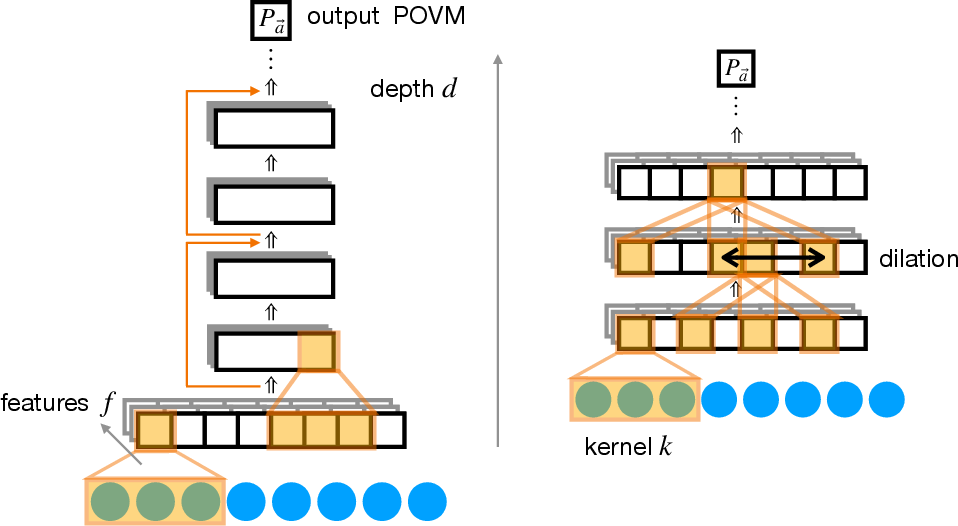
Figure 2: Schematic illustration of the ResNet (left) and dCNN (right) architectures, both used for the NQS ansatz.
Results: One-Dimensional Arrays
For benchmarking, the authors first compare the NQS (ResNet and dCNN) against quantum trajectories (QT)—the numerically exact approach—in systems up to 16 atoms. The time evolution of the excitation density ne and cumulative TDVP errors precisely match QT as network expressivity increases, with cumulant expansions diverging at late times, especially in the subradiant regime.
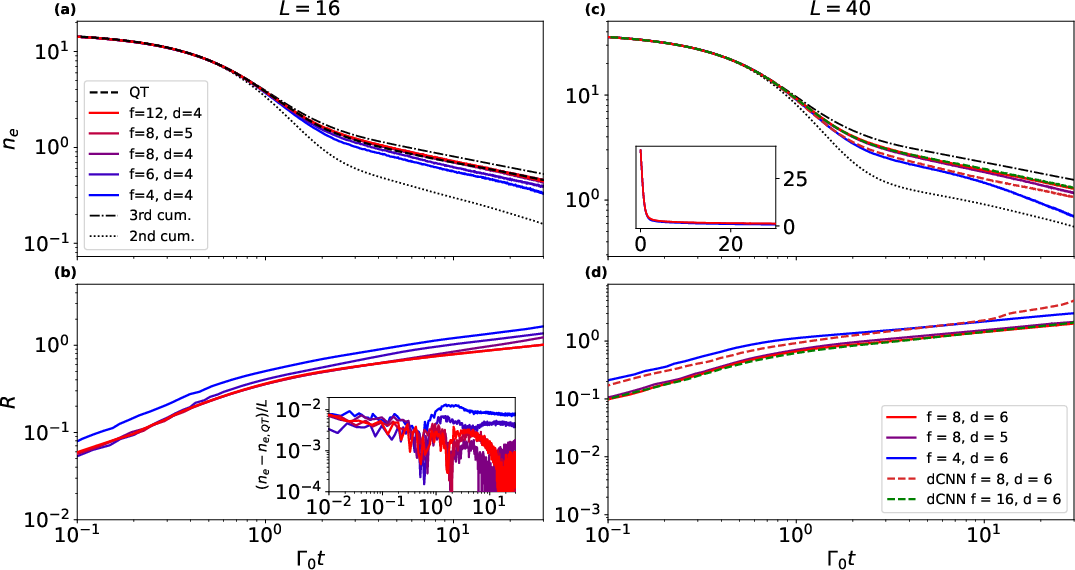
Figure 3: 1D NQS (ResNet) results vs. QT for L=16 and L=40; (a) excitation decay, (b) cumulative TDVP error; (c, d) system size scaling and network architecture convergence.
Extending to previously inaccessible system sizes (L=40), the NQS approach—unattainable by QT or tensor networks due to exponential Hilbert space growth—reveals qualitatively new behavior: the onset of subradiance occurs while the system still harbors multiple excitations, rigorously demonstrating the many-body character of subradiant dynamics. The ResNet and dCNN architectures converge efficiently (with dCNN requiring fewer parameters), and the learned NQS accurately reproduces both local observables and nonlocal two-point correlations.
Results: Two-Dimensional Arrays
The approach generalizes efficiently to 2D arrays, with simulations performed on 4×4 and 6×6 atom arrangements. For 4×4, direct benchmarks against QT again show that NQS maintains high fidelity, with cumulant expansion accuracy degrading more severely than in 1D, illustrating the growing importance of many-body correlations in higher dimensions.
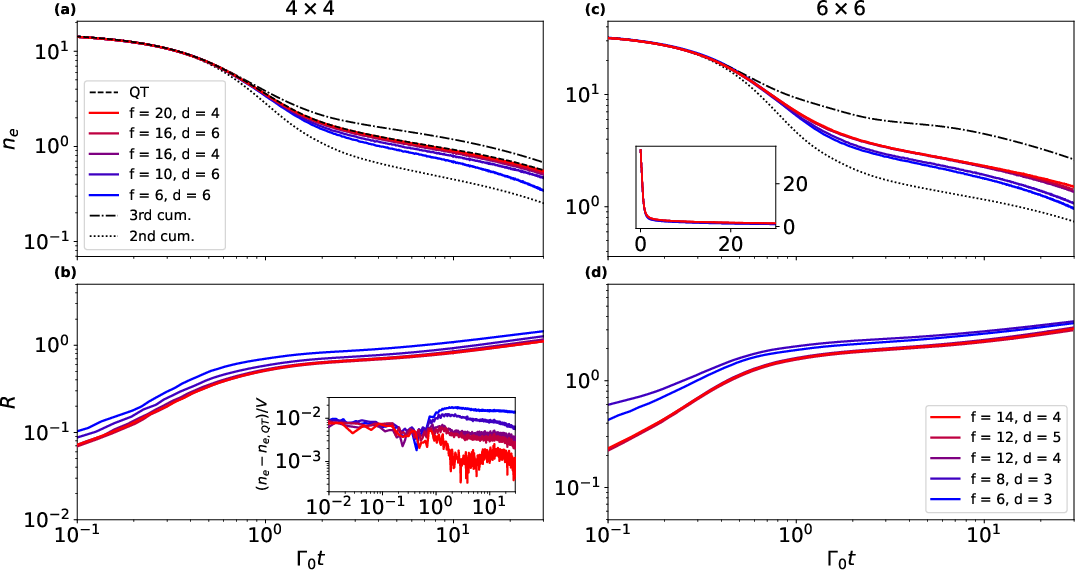
Figure 4: 2D NQS (ResNet) results benchmarked against QT for 4×4 atoms and simulation of Γij0 atom dynamics; TDVP error monitoring and parameter scaling are shown.
For Γij1, only the NQS approach supplies trustworthy dynamics due to the inaccessibility of QT. Compared with cumulant expansion, NQS predicts a smoother, consistent power-law decay at late times, whereas higher-order cumulants (third order) produce nonphysical features and deviate substantially.
Universal Features and Comparison Across Geometries
Collating results across geometries and sizes, the authors plot the excitation density dynamics, revealing a universal power-law decay in the late-time, subradiant regime with exponent near Γij2 for both 1D and 2D, robust over system size.
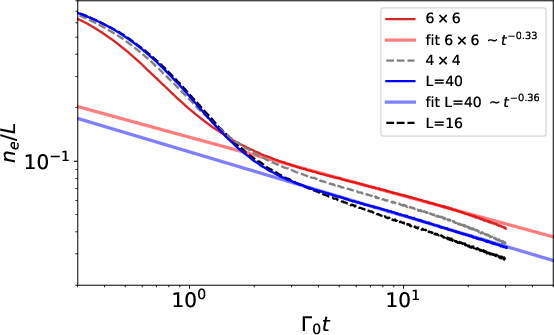
Figure 1: Excitation density dynamics across dimensionalities and array sizes; only NQS (or best exact) results are displayed, exhibiting universal power-law scaling at late times.
This late-time scaling, previously hypothesized but never demonstrated for large many-body arrays, implies the emergent universality of subradiant relaxation and underscores the need for direct many-body quantum treatment well beyond the regime of single or few excitations.
Implications and Outlook
The primary implication is that NQS enable simulation of open-system many-body quantum dynamics in experimentally relevant geometries and system sizes, directly capturing regimes where collective dissipation and interactions produce highly nonclassical phenomena. Subradiance, in particular, is shown to be a genuinely many-body effect persisting at finite excitation density in the thermodynamic limit, with potential relevance for long-lived quantum memory, entanglement generation, and quantum metrology protocols utilizing slow relaxation.
Practical applications include protocol design for cold-atom arrays, optimization of many-body dark states, and benchmarking of quantum devices in the subradiant regime. From a theoretical perspective, these results open avenues for studying nonequilibrium phase transitions, scaling in dissipative critical systems, and dynamics in novel geometries (e.g., driven-dissipative lattices, driven subradiant phases with engineered interactions).
The demonstrated flexibility of both ResNet and dCNN architectures in the NQS setting suggests that their usage can be adapted for efficient encoding of correlations in a wide variety of open quantum systems, and that future architectural developments (e.g., attention-based NQS, adaptive receptive fields) could further enhance expressive power and simulation efficiency.
Conclusion
The work establishes the first simulation of super- and sub-radiant many-body quantum dynamics in large atomic arrays using variational neural network states, surpassing the limitations of existing exact and semi-classical methods. The combination of POVM-based NQS and TDVP offers a scalable framework for capturing the interplay of structured dissipation, long-range interactions, and many-body quantum effects. It reveals that subradiance in ordered arrays should be considered an emergent, collective phenomenon with universal dynamical scaling and opens the path for systematic theoretical and experimental investigations of nonequilibrium quantum relaxation, entanglement dynamics, and dissipation engineering in large-scale quantum optical platforms.