- The paper presents the discovery of new quantum dynamics using NISQ simulators, revealing phenomena like quantum scars and resilient photon bound states.
- It employs programmable quantum processors to test and challenge conventional models, including empirical validations of KPZ universality in spin transport.
- The research highlights NISQ devices’ ability to measure key parameters in correlated electron systems, offering insights that surpass classical computational limits.
NISQ Simulators as Engines of Discovery in Quantum Many-Body Dynamics
Introduction
The structure and evolution of quantum many-body systems with significant interactions remain among the most demanding challenges in theoretical physics. Addressing these phenomena requires tools capable of probing dynamics fundamentally beyond the reach of perturbative methods or exact diagonalization. The paper "Discovering novel quantum dynamics with NISQ simulators" (2512.08293) advances the thesis that quantum simulators in the NISQ (Noisy Intermediate-Scale Quantum) era are not only validating established theoretical concepts but have already yielded instances of genuine scientific discovery. These "discoverinos"—phenomena first uncovered via quantum simulation before theoretical or numerical characterization—underscore the growing role of programmable quantum processors as both experimental and exploratory platforms for many-body quantum physics.

Figure 1: Instances of NISQ-enabled discoveries, spanning quantum scarring in Rydberg atoms, resilient photon bound states, anomalous correlation propagation, KPZ universality tests, and transport in Fermi-Hubbard models, highlighting how quantum simulators touch new regions of phase space before theory and numerics.
Theoretical Context and Motivation
Quantum simulation, as envisioned by Feynman, offers a path to efficiently emulate quantum systems whose full Hilbert space dimension grows exponentially with size, defying all classical computational resources. While fault-tolerant quantum computation remains a long-term objective, present-day NISQ processors—composed of tens to hundreds of qubits with tunable interactions—enable exploration within decoherence-limited timeframes and system sizes. The central question addressed is whether this intermediate regime can contribute meaningfully to the frontiers of quantum many-body physics, particularly in non-equilibrium settings where entanglement and complexity inhibit both analytic progress and classical numerics.
Categories of NISQ-Enabled Discovery
The paper identifies three principal categories for NISQ-enabled scientific advances: (i) challenging conventional wisdom, (ii) empirical tests of scientific conjectures, and (iii) direct calculation of parameters in strongly correlated systems.
Challenging Conventional Wisdom
One of the most visible examples is the observation of quantum many-body scars in a Rydberg atom chain [bernien2017probing]. Contrary to expectations from eigenstate thermalization, the system exhibits persistent oscillatory return to specific non-thermal states, not captured by standard thermalization paradigms. The periodic re-emergence of initial state structure, stabilized further under periodic driving [bluvstein2021controlling], constitutes a violation of conventional dynamical relaxation expectations. Despite extensive subsequent analysis, the structural origins and classification of quantum scars remain active areas of debate, suggesting the presence of new dynamical universality classes.
Another salient case concerns the observable resilience of photon bound states in superconducting qubit rings under integrability-breaking perturbations [morvan2022formation]. Contrary to the anticipation that bound states decay rapidly when integrability is broken, experiments reveal long-lived excitations, motivating new theoretical scrutiny [Surace_PRX_2024, Papic_PRX_2024] and challenging simple applications of the Fermi Golden Rule. Similar anomalies are noted in the propagation of quantum correlations in ion chains, where observed growth rates surpass linear light-cone bounds in short-range interaction regimes [Richerme, jurcevic2014quasiparticle].
Empirical Tests of Conjectures
NISQ simulators have provided critical data to adjudicate universal dynamical hypotheses such as the applicability of KPZ universality to spin transport in one-dimensional magnets [Ljubotina_PRL_2019]. Sequential experiments with both cold atoms [wei2022quantum] and superconducting circuits [Eliott2024] find that the lower moments of domain-wall relaxation statistics conform with KPZ exponents, but higher-order moments (skewness, kurtosis) deviate when initial states approach equilibrium. These discrepancies emphasize the limitations of current theoretical models, suggesting that the full structure of quantum transport in Heisenberg chains exhibits greater complexity than captured within the KPZ framework.
Experimental implementation of paradigmatic models such as Fermi-Hubbard in cold atom arrays enables direct measurement of transport coefficients—such as spin diffusion and resistivity—in parameter regimes where classical computation is infeasible [nichols2019spin, brown2019bad]. For example, the observed linear temperature dependence of resistivity in such systems echoes the "strange metal" phenomenology found in high-Tc superconductors, with quantum simulators accessing dynamical regimes that extend beyond the predictive reach of numerical approaches based on quantum Monte Carlo or DMRG.
Experimental and Technological Implications
These instances of discovery are contingent on recent progress in quantum control, decoherence mitigation, and measurement protocols—such as randomized entanglement measurement [ZollerScience2019] and advanced error mitigation strategies [Kandala_nature_2019]. The results indicate that NISQ hardware already accesses phase space beyond classical reach for certain dynamical observables, with the bottleneck shifting from qubit number to sustained coherence and reliable readout.
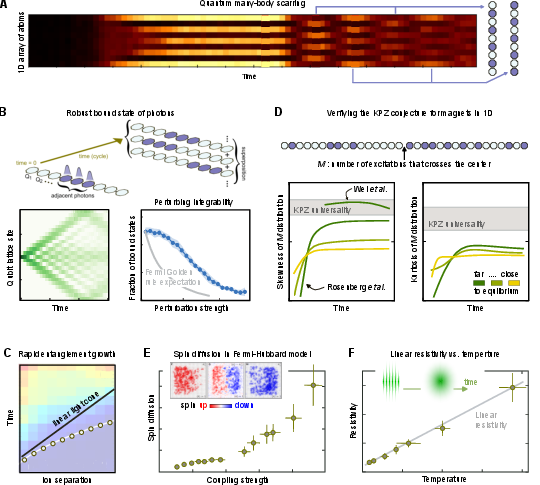
Figure 2: Selected examples of NISQ-enabled discoveries, including quantum scarring in Rydberg atom chains, photon bound states in superconducting circuits, and anomalous propagation of quantum correlations in trapped ions.
The gradual closing of the algorithm-hardware gap supports a future in which experiments can be conducted without direct theoretical precedent, focusing instead on reliably excluding decoherence artifacts and verifying emergent phenomena. Theoretical verification methods—currently a key concern in quantum computational complexity [Gheorghiu2019Verification]—will become essential to interpret experimental outcomes, particularly as programmable simulators exceed the capabilities of classical numerics and established theory.
Outlook and Speculation
As experimental capacity increases, the function of quantum simulators will transition from platform validation and hypothesis testing towards a generative, exploratory mode of discovery. This will catalyze the investigation of emergent dynamical phenomena, identification of new universality classes, and possibly the discovery of novel quantum phases. Theoretical advancements will be needed to interpret the high-dimensional datasets and raw observables produced by these larger-scale platforms. The reciprocal relationship between hardware progress and conceptual advances is expected to intensify, with experimental anomaly driving new theory, and vice versa.
Conclusion
The paper persuasively documents that NISQ quantum simulators have already contributed nontrivial insights into quantum many-body dynamics—often by revealing unexpected behaviors that subsequently motivate and challenge theoretical understanding. While decoherence and system size remain current limitations, the prospect of systematic discovery via quantum simulation is clear. As these platforms mature, they will offer critical data beyond the purview of existing computational or analytic tools, redefining both the process and substance of research in quantum statistical mechanics and correlated electron systems.