- The paper shows that neither the model nor the harness alone can secure epistemic integrity, advocating a joint hierarchical design.
- It introduces a four-level framework managing goal validity, archetype sequencing, tool selection, and diagnostic failure classification.
- Empirical evaluations highlight metrics like epistemic drift and resumption fidelity, underscoring the need for contract-first interface design.
Hierarchical Joint Design and Epistemic Integrity for Long-Running Agents
Introduction
The paper "Neither Layer Alone: Epistemic Integrity Requires Hierarchical Joint Design for Long-Running AI Agents" (2606.04017) advances the thesis that robust agentic operation, particularly in the long-running regime, cannot be secured by enhancements to the model layer or the harness layer in isolation. Instead, the preservation of epistemic integrity—defined as the coherence, inspectability, and correctability of the agent’s operational state—demands explicit architectural contracts at the model–harness interface. The work characterizes "interface volatility" as a critical, often overlooked failure modality whereby independently evolving models and harnesses diverge semantically, resulting in a loss of meaning for belief, tool, and goal states even under unchanged schemas.
Problem Analysis: Interface Volatility and Epistemic Integrity
Traditional agent architectures either privilege the model as the locus of knowledge and policy or treat the harness as a static substrate for tool execution and memory management. However, interface volatility emerges precisely when implicit interface assumptions—about the prioritization of memory, tool trust, or goal persistence—become invalid due to upgrades or changes in either layer. This indirection means that regression testing and output validation may pass, while the operational semantics that underpin safe and correct resumption, tool invocation, or goal fulfillment have actually shifted. The core claim is that epistemic integrity is not a property local to either the model or the harness but is realized (or lost) specifically at their interfacial contract.
The AEI Framework: Domains, Primitives, and Prospective Memory
The paper formalizes Agent Epistemic Integrity (AEI) as a system-level invariant. AEI is decomposed into the domains of Knowing (belief and memory management), Doing (capability/action management), and Deciding (goal management). Session-based agents typically assume belief freshness, tool idempotency, and goal validity, but these assumptions fail in the long-running regime—where harness and model evolution, external state aging, and session boundaries all manifest.
The key primitive unifying these domains is prospective memory: an explicit, queryable record of the agent’s intended future commitments, with metadata including validity conditions, provenance, uncertainty, and revision history. Prospective memory is not a passive store; it is the actionable interface surface for human intervention, computable revision, and cross-session continuity. This abstracts away concrete mechanisms (stable what) from instance-level implementations (volatile how), rendering the system more resilient to both infrastructure and model drift.
Hierarchical Operational Control: The Four-Level Design
To replace the limitations of flat act-loop architectures, the paper proposes a four-level operational hierarchy at the model–harness interface. This approach modularizes epistemic and control obligations, providing for more robust preservation and versioning across component upgrades.
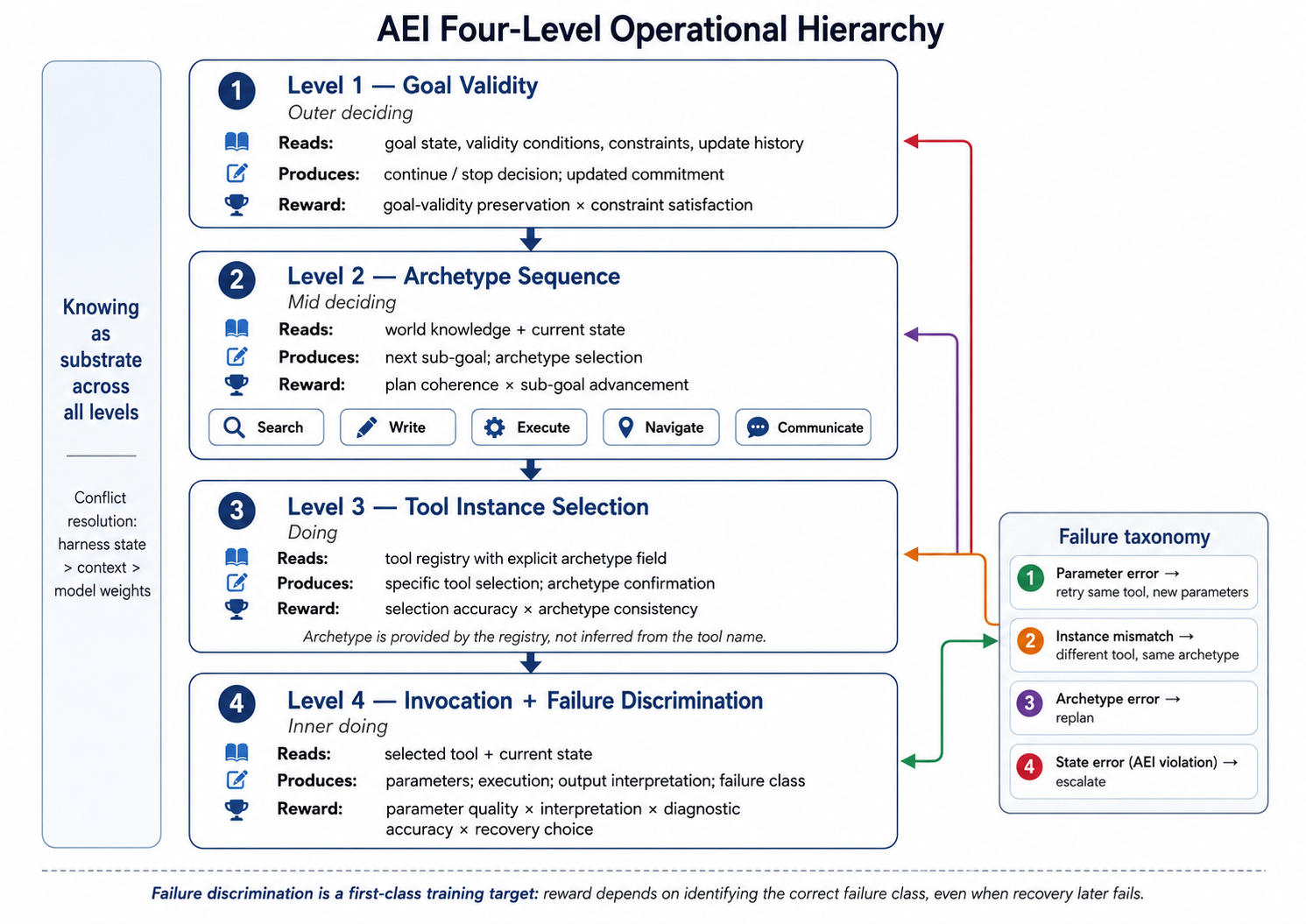
Figure 1: Four-level AEI operational hierarchy with explicit model and harness responsibilities at each control level: goal validity check, archetype selection, registered tool instance choice, and invocation/failure discrimination.
- Level 1: Goal Validity—The agent evaluates if the current goal, given its validity conditions and recent updates, remains actionable or requires revision/expiration.
- Level 2: Action-Archetype Sequencing—Instead of binding to a specific tool instance, the agent first selects an archetype (e.g., search, write, navigate) as a stable abstraction, decoupling high-level intent from changes to the tool registry.
- Level 3: Tool Instance Selection—Selection of a concrete tool is grounded in an explicit registry, enforcing consistency and traceability.
- Level 4: Invocation and Failure Discrimination—Invocation is augmented with diagnostics so that the agent does not merely retry, but differentiates between recoverable parameter errors, archetype mismatches, and state errors that require escalation or violate AEI.
This operational structure ensures that intermediate commitments, tool effects, and failure classes are all observable and auditable via structured interface outputs, further supporting downstream evaluation and correction.
Evaluation of Long-Running Epistemic Integrity
Current agent benchmarks do not adequately measure epistemic integrity; they focus on per-session trajectory correctness rather than the stability and continuity of epistemic commitments across sessions, model versions, or tool set changes. The paper defines evaluation surfaces including epistemic drift rate (divergence of model beliefs from ground truth across updates), resumption fidelity, replanning quality, goal drift detection, and handoff fidelity. The central evaluation criterion is whether the agent's epistemic state—including beliefs, tool histories, and goal commitments—remains interpretable and actionable upon state, configuration, or model evolution.
Interface Contracts and Reward Signals
Moving beyond classical schemas, AEI-driven contracts specify not only types and fields, but also authority order, validity, conflict resolution, and stable invariants. For example, beliefs must carry provenance, source, and supersession metadata; tool invocations are required to state semantic intent, selection rationale, and invocation effects; goal commitments must be explicitly versioned, with their validity and escalation criteria exposed.
A distinctive contribution is the explicit reward signal hierarchy deriving from the interface contract: Level 1 rewards goal-validity preservation; Level 2, archetype sequencing; Level 3, tool selection accuracy; Level 4, diagnostic correctness in failure classification. Notably, the requirement that models be rewarded for diagnosing—not just recovering from—failures is a differentiator from typical process- or environment-driven RL.
The contract’s Doing component stipulates that tool registration declare both idempotency and reversibility axes. Tool classes are thus partitioned into safety quadrants at registration, supporting rigorous runtime safeguards and simplifying the extension or refinement of tool portfolios without semantic drift. High intra-archetype variance signals contract drift requiring taxonomy correction, allowing architectural correctness to be audited structurally.
Implications and Prospective Directions
This paper prescribes that interface contracts must precede and constrain both training and evaluation for long-running agents. The practical implication is a new design and deployment discipline: models and harnesses must coordinate over versioned, auditable contracts, with reward design and persistent state organized accordingly. In contrast, flat session-based or black-box evaluation pipelines permit drift and silent semantic errors that will surface only under continued operation or in safety-critical settings.
Theoretically, the AEI framework suggests that agent reliability is a compositional property at the interface layer, not a linear function of component reliability. This moves the evaluation of agent architectures fundamentally into architectural and system-level domains, with substantial consequences for both model and harness design. The development of testbeds supporting persistent cross-session state, versioned interface contracts, and explicit failure labeling will be a necessary empirical step.
Conclusion
The work establishes that epistemic integrity in long-running agentic systems is achievable only through hierarchical, contract-based joint design of models and harnesses. Neither layer, nor their independent improvement, suffices to maintain epistemic coherence in the face of state aging, registry evolution, or model upgrades. By explicitly versioning knowledge, action, and decision interfaces—and by distributing reward and evaluation metrics accordingly—the discipline of agentic system design is refactored away from flat output- or schema-centric paradigms and toward modular, robust, and temporally persistent architectures. Subsequent advances in the empirical study of interface volatility, cross-session evaluation, and contract-first reward design will define the next phase of safe, reliable long-running agent research.

