Scalable On-Hardware Training of Quantum Neural Networks and Application to Clinical Data Imputation
Abstract: Training quantum neural networks (QNNs) on quantum hardware is currently bottlenecked by the cost of gradient estimation: standard parameter-shift methods require a number of circuit evaluations that grows quadratically with the number of trainable parameters, making hardware-based optimisation impractical beyond small system sizes. In this work, we introduce a training framework that reduces this cost to logarithmic in the number of qubits, making gradient-based QNN optimisation feasible on near-term hardware at increasing scales. Our framework combines three co-designed ingredients: (i) a structured, subspace-preserving Butterfly circuit architecture with $O(n \log n)$ parameters and logarithmic depth; (ii) a layer-wise training strategy that confines on-hardware optimisation to one small, well-structured layer at a time; and (iii) a parallelised parameter-shift rule that exploits the commuting structure within each Butterfly layer to extract all gradients in a constant number of circuit executions. Together these reduce the number of distinct circuit evaluations per optimisation step from $O(n2)$ to $O(\log n)$. We validate the framework on clinical data imputation using the MIMIC-III electronic health record dataset, a demanding benchmark sensitive to optimisation instability and model variance. Hybrid classical-quantum models are trained directly on IonQ Forte Enterprise trapped-ion hardware at 16 qubits without performance degradation relative to ideal or noisy simulation and via tensor-network simulation at 32 qubits, with 32-qubit inference executed on hardware. The resulting models match or exceed strong classical neural baselines in downstream patient survival prediction while exhibiting reduced variance across runs, demonstrating that the proposed framework enables practical, scalable QNN training under realistic hardware constraints.
Paper Prompts
Sign up for free to create and run prompts on this paper using GPT-5.
Top Community Prompts
Explain it Like I'm 14
Overview
This paper is about teaching quantum computers to learn like neural networks, but in a way that actually works on today’s small and noisy machines. The authors design a “shortcut” that makes training quantum neural networks (QNNs) much faster and more practical. Then they test this on a real-world task from medicine: filling in missing patient data (called “imputation”) and checking how well those filled-in values help predict whether patients survive.
What questions did the researchers ask?
- Can we train quantum neural networks directly on real quantum hardware without it taking forever?
- Can we design the quantum circuit and the training process so that the number of measurements we need stays small, even as the model grows?
- If we use this faster training, can a quantum-enhanced model do as well as strong classical methods on a tough, real task like medical data imputation?
How did they do it? (Simple explanation of the approach)
The problem: Training a QNN usually needs a lot of “gradient” calculations—the gradients tell you which way to tweak the model’s knobs to improve it, like figuring out the slope of a hill so you can climb to the top. On a quantum computer, getting each gradient normally means running many slightly different versions of the circuit. If a model has many knobs, this explodes in cost, often growing about as fast as the square of the number of qubits.
The solution is three ideas that fit together:
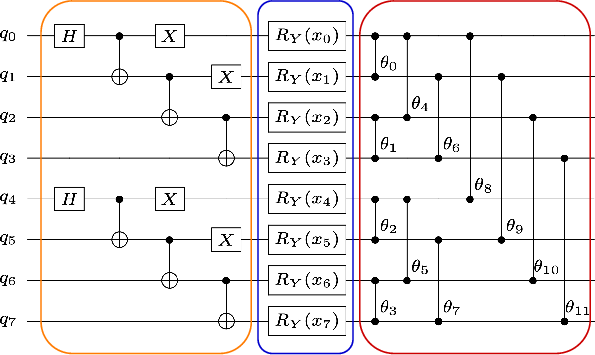
- A special circuit design (the “Butterfly” architecture): Think of your qubits as players in a tournament bracket. Each round (layer) pairs up players, mixes their information, and then moves on to new pairings. This “Butterfly” pattern uses only a few rounds—its depth grows like the logarithm of the number of qubits—so it’s shallow and efficient. It also uses “keep-the-number-of-lights-on” gates (Hamming-weight-preserving), meaning the circuit keeps the same number of 1s as it started with. This helps avoid getting stuck during training and keeps things stable.
- Layer-wise training (build one floor at a time): Instead of adjusting every knob at once, they train one small part (layer) of the circuit at a time, freeze it, then add the next layer. This makes each training step smaller and steadier, which is easier for today’s quantum hardware.
- Parallel gradient trick (shift many knobs at once): Usually, you must nudge each knob separately to see how it changes the output. Here, because the gates inside a layer act on disjoint pairs and don’t interfere with each other (they “commute”), you can nudge all the knobs in that layer at once and still recover each knob’s gradient. It’s like checking how all the dimmers in a room affect the brightness by flipping them in a coordinated way, then using some math to figure out each dimmer’s effect.
Why this matters for speed:
- Typical training might need a number of circuit runs that grows like the square of the system size (very fast).
- With this design and training strategy, the number grows only with the logarithm of the number of qubits (very slowly). That’s a huge reduction.
They also use a special starting quantum state (an entangled “non-Gaussian” state) that’s hard for classical computers to simulate, to keep the quantum part genuinely “quantum.”
What did they test this on?
They tackled medical data imputation using the MIMIC-III ICU dataset, which has patient measurements like vital signs. In real life, medical records often have missing values. The model’s job is to fill in the missing pieces in a sensible way so that a later prediction—like whether a patient survives—works well.
Their setup:
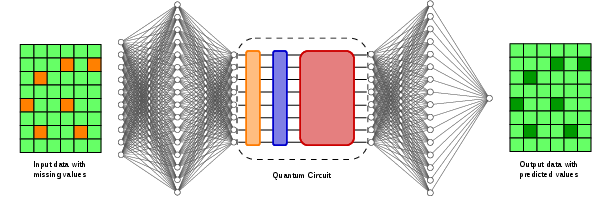
- They used a hybrid model: most of the system is a standard neural network, but the middle part is a QNN layer with 8, 16, or 32 qubits.
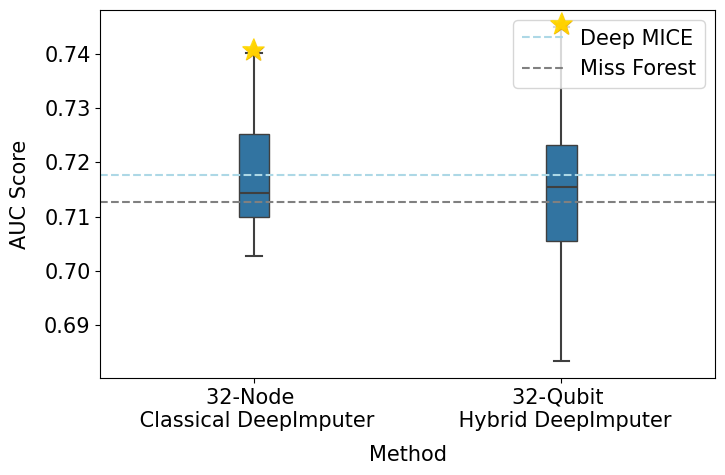
- To keep the test clean and realistic, they imputed one especially important feature using the quantum-enhanced model and imputed the rest with a strong classical method. Then they trained a downstream survival predictor and measured performance using AUC (a common scoring metric).
- They trained on real IonQ trapped-ion quantum hardware at 16 qubits, checked 32-qubit behavior in simulation (with 32-qubit inference also run on hardware), and compared against strong classical baselines.
Main results and why they matter
- Training became practical: By combining the Butterfly circuit, layer-wise training, and the parallel gradient trick, the number of different circuits needed per training step dropped from something that explodes with model size to something that grows very slowly (from roughly “square of qubits” to “log of qubits”). This is the key to making on-hardware training feasible today.
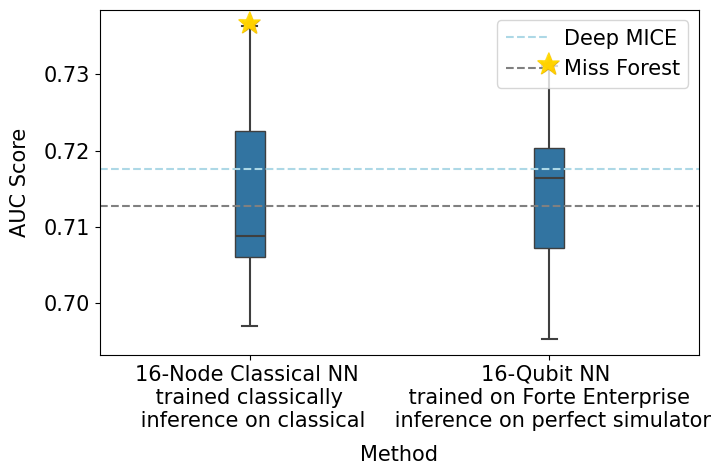
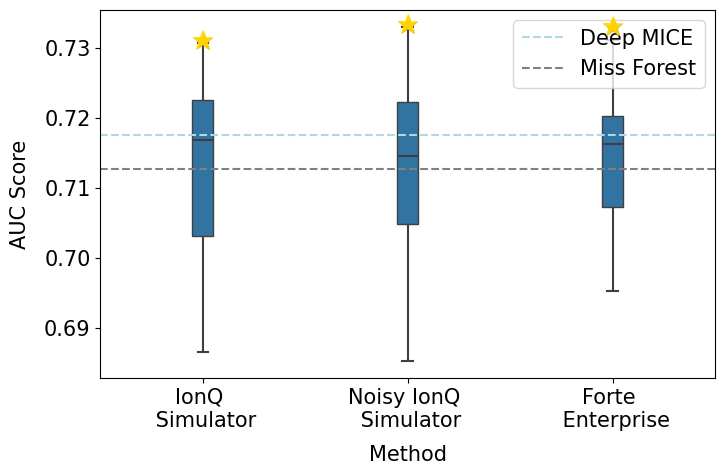
- It worked on real hardware: They trained QNNs directly on an IonQ trapped-ion device at 16 qubits and found performance was on par with simulations. That means the method is robust to real-world noise and measurement limits.
- Competitive imputation quality: The hybrid quantum–classical models were comparable to strong classical neural baselines on downstream survival prediction, and better than many standard classical imputers. They also tended to show lower run-to-run variability, which is valuable in medical settings where consistency matters.
- Scaling to more qubits: They explored 32-qubit models via simulation and did inference at 32 qubits on hardware. Results stayed in line with expectations, suggesting the approach can scale up as hardware improves.
Why this is important:
- Faster and steadier training is the main bottleneck for QNNs. This work shows a path around that bottleneck.
- Medical data imputation is a tough, practical task. Matching strong classical methods while maintaining stability is a meaningful achievement.
- The ideas here (architecture + training recipe) aren’t limited to imputation; they can be used in other learning tasks as quantum hardware grows.
What’s the bigger picture?
This research shows that smart design can make quantum machine learning more than a theory exercise. By carefully choosing:
- a shallow, structured circuit (Butterfly),
- a step-by-step training plan (layer-wise),
- and a clever way to measure gradients in parallel,
we can train quantum models directly on today’s devices and get competitive performance on real data. As quantum computers get larger and less noisy, this kind of efficient training could unlock quantum advantages in broader problems—like more accurate predictions, better generative models, or faster scientific data analysis—while keeping training time and hardware demands reasonable.
Knowledge Gaps
Knowledge gaps, limitations, and open questions
Below is a concise list of what remains missing, uncertain, or unexplored, framed to guide actionable future research:
- Quantify shot complexity and variance: provide theoretical and empirical scaling of gradient estimator variance and shot requirements under the proposed parallel parameter-shift, as a function of qubit count, layer index, and hardware noise.
- Constants behind O(log n) scaling: report the exact number of circuit executions, measurement bases, and shots per optimisation step (and per epoch), and how these constants scale with model depth and different loss observables.
- Measurement-basis overhead for parallel gradients: specify how individual gradients are extracted from commuting observables in practice (number of distinct measurement settings/basis changes required per layer, additional basis-rotation circuits, and their depth/noise impact).
- Generality beyond Z⊗n observable: assess whether the commuting-generator condition holds for commonly used loss functions/observables (single-qubit readouts, parity subsets, multi-output heads) and develop/benchmark extensions when generators do not commute with the measurement.
- Applicability to non-commuting blocks: design and evaluate gradient rules or measurement-grouping strategies when a layer’s generators partially commute (or neither commute nor anticommute) with the observable, and quantify the resulting circuit-evaluation cost.
- End-to-end fine-tuning vs greedy freezing: empirically compare the proposed layer-wise freezing with full end-to-end fine-tuning (and hybrid schemes), measuring convergence, final performance, stability, and hardware cost.
- Expressivity–trainability trade-offs: characterize the functional class of the Butterfly + FLO ansatz with non-Gaussian inputs (e.g., approximation properties, effective rank/correlation patterns) and its limits relative to dense non-preserving architectures.
- Necessity and overhead of non-Gaussian state preparation: ablate the magic-state loader (with/without non-Gaussian blocks), quantify its gate depth, fidelity, error sensitivity, and net contribution to performance and classical hardness.
- Classical hardness evidence: provide complexity-theoretic or empirical hardness arguments specific to the exact architecture, initialization, encoding, and measurement used (beyond generic FLO-with-non-Gaussian statements), including classical tensor-network baselines at larger n.
- Hardware platform generality: assess portability to limited-connectivity platforms (e.g., superconducting qubits), quantifying SWAP overhead, depth increases, and the impact on gradient parallelisation and noise.
- Robustness to hardware noise and drift: report cross-day/cross-calibration stability, error-mitigation effects (if any), and sensitivity to state-preparation and measurement (SPAM) errors during training and inference.
- Missingness mechanisms beyond MCAR: evaluate performance under MAR and MNAR missingness, including realistic EHR missingness patterns, and study robustness to mechanism misspecification.
- From one-feature to full multivariate imputation: extend from single-column (diagnostic) imputation to full chained-equations/multivariate iterative imputation, measuring compounding error, convergence, and runtime on hardware.
- Dataset and task generalisation: validate on multiple clinical datasets and non-clinical tabular benchmarks; report metrics beyond downstream AUC (e.g., RMSE/MAE on reconstructed entries, calibration, fairness).
- Capacity matching and fairness of comparisons: match parameter counts/compute budgets between hybrid and classical baselines; study how performance scales with qubit count n versus classical hidden width under equalised capacity.
- Role of classical–quantum interface: detail and ablate the 128→n and n→128 classical projections (architectures, nonlinearities, bottleneck effects), and test alternative embeddings/heads that better utilise quantum features.
- Data encoding choices: compare RY angle encoding with alternatives (e.g., ZZ-feature maps, data re-uploading, multi-qubit encodings), including their impact on commuting conditions, expressivity, and trainability.
- Output mapping and loss formulation: precisely define how quantum measurements feed into the hybrid model (scalar vs vector outputs, multi-observable heads), and explore designs that preserve commuting structure without constraining the hypothesis class.
- Optimisation protocol details: disclose and study learning-rate schedules, optimiser choices, batch sizes, shot allocation strategies, and their influence on stability and wall-clock efficiency on hardware.
- Full resource accounting: report wall-clock training time, number of optimisation steps, total circuits executed, total shots, and energy/cost metrics for 8/16/32 qubits, enabling reproducible cost–performance comparisons.
- Scaling beyond 32 qubits: demonstrate on-hardware training (not only inference) at ≥32 qubits; characterise where shot noise, SPAM errors, or depth become limiting, and whether O(log n) circuit-count scaling translates to practical speedups at scale.
- Interaction with barren plateaus: empirically probe gradient norms versus depth, qubit count, and initialisation (Gaussian vs non-Gaussian), validating claims of favourable scaling for Hamming-weight-preserving ansätze.
- Safety of feature-importance selection: ensure target-feature selection (via Gini importance) avoids test leakage; compare against training-only importance and alternative selection criteria, and test sensitivity to the chosen target column.
- Comparative training-efficiency baselines: benchmark against alternative gradient-reduction strategies (e.g., WSBD, stochastic parameter-shift, SPSA, simultaneous perturbation methods), comparing accuracy, stability, and hardware cost.
- Error-mitigation and readout strategies: evaluate whether measurement-error mitigation, zero-noise extrapolation, or dynamical decoupling materially improves gradient estimation and downstream performance in this setting.
- Theoretical convergence guarantees: investigate block-coordinate/layer-wise convergence properties for commuting-block QNNs under noise and finite shots, including conditions guaranteeing descent and bounds on suboptimality.
Practical Applications
Immediate Applications
Below are practical uses that can be deployed now, leveraging the paper’s training framework (Butterfly architecture + layer-wise training + parallel parameter-shift) and the demonstrated hybrid imputation workflow.
- Healthcare industry — Hybrid quantum imputation module for EHR pipelines
- Use case: Add a QNN-based conditional estimator to existing clinical imputation workflows (e.g., a one-feature or top-k features step within MICE/chained equations) to improve robustness and reduce variance in downstream risk prediction.
- Sectors/tools/workflows: Healthcare analytics, hospital data science teams; integrate as a scikit-learn/PyTorch-compatible “QuantumImputer” component that calls IonQ cloud APIs for on-hardware gradient steps; batch inference using 16–32 qubits; fits into ETL → imputation → model training workflows.
- Assumptions/dependencies: Access to trapped-ion hardware (e.g., IonQ Forte Enterprise) or high-fidelity simulators; de-identified data and secure cloud connectivity; features normalized for angle encoding; current evidence strongest under MCAR missingness; regulatory use limited to research/secondary analyses at this stage.
- Cross-industry data engineering — Quantum-aided imputation for tabular data with gaps
- Use case: Fill missing entries in finance (credit risk, KYC), manufacturing (predictive maintenance logs), energy (SCADA/PMU telemetry gaps), and telco (network telemetry) where robustness under limited data is valued.
- Sectors/tools/workflows: Finance, manufacturing, energy, telco; provide a drop-in imputer within Python data pipelines; schedule training using layer-wise on-hardware steps with parallel parameter-shift to minimize circuit calls; export imputed datasets back to data lakes.
- Assumptions/dependencies: Cloud QPU access; willingness to pilot hybrid models; numerical ranges mapped to RY encoding; performance parity with strong classical baselines will vary by domain/dataset.
- Software/ML platforms — QNN feature-transform layer for hybrid models
- Use case: Replace 1–2 dense hidden layers in an existing neural network with a Butterfly QNN layer to test robustness and variance reduction in tabular or small-structured data tasks.
- Sectors/tools/workflows: Software, AutoML platforms; package as
torch.nn.Moduleor scikit-learn transformer; prebuilt “ButterflyQNN” layer with O(n log n) params and log depth; gradient server that batches the 4–6 parallel-shift circuits per layer. - Assumptions/dependencies: Commuting-block structure preserved (RBS gates on disjoint pairs); measurement observable chosen to commute/anticommute as required (e.g., global Z); shot budgets and latency acceptable for training cadence.
- Quantum cloud providers — Training-time accelerator via parallel parameter-shift scheduling
- Use case: Offer a managed service that auto-detects commuting blocks and executes layer-wise, parallel-shift gradients in a constant number of circuit executions per layer.
- Sectors/tools/workflows: Quantum cloud (PaaS/SaaS); compiler pass to identify commuting generators; API endpoints like
parallel_shift_grad(block_id); dashboards estimating O(log n) evaluation cost per step. - Assumptions/dependencies: Compilation support to validate commutation relations; stable gate calibration for RBS-like excitation-preserving gates; users expose or export block structure.
- Academia — Scalable on-hardware QNN training experiments
- Use case: Reproduce/improve training studies at 8–32 qubits; benchmark barren-plateau mitigation using Hamming-weight-preserving ansätze; study robustness/variance across seeds and missingness patterns.
- Sectors/tools/workflows: Academic labs, teaching; open-source reference implementations (Butterfly ansatz, magic-state loader, layer-wise trainer, parallel-shift gradient engine); MIMIC-III-style EHR benchmarks or public tabular datasets.
- Assumptions/dependencies: Institutional access to quantum hardware or simulators; IRB/data governance for clinical datasets; compute for tensor-network simulations at 32+ qubits.
- Clinical research policy pilots — Secondary analysis with quantum imputers
- Use case: Include a quantum-enhanced imputer arm in observational studies to assess impact on calibration and AUC for survival or readmission models.
- Sectors/tools/workflows: Health systems, policy labs; research-only deployments; pre-registered protocols comparing classical vs. hybrid imputers under MCAR-like masks.
- Assumptions/dependencies: Research ethics approval; no direct clinical deployment/claims; results treated as exploratory evidence.
- Daily life (near-term) — Robust gap filling in consumer health and IoT data
- Use case: Cloud-based imputation of missing wearable vitals or smart-home sensor readings to stabilize trend analyses in wellness apps.
- Sectors/tools/workflows: Consumer health, smart devices; backend service calls to QPU during model training; inference via classical layers + quantum-informed parameters.
- Assumptions/dependencies: Data must be de-identified; latency tolerant training loops; small-to-medium data dimensionality compatible with 16–32 qubits.
- Tooling and education — Minimal examples and curriculum modules
- Use case: Short labs showing O(log n) scaling of circuit evaluations, commuting-block gradients, and layer-wise training on public quantum backends.
- Sectors/tools/workflows: Education, developer relations; Jupyter notebooks; integration with Qiskit/PennyLane/Cirq backends.
- Assumptions/dependencies: Backend supports needed gates or compilation to native gates; free-tier hardware access may be queue-limited.
Long-Term Applications
The following require more research, scaling to larger qubit counts/fidelities, and/or broader validation beyond MCAR settings.
- Production-grade chained-equations quantum imputation (MAR/MNAR)
- Use case: Replace multiple conditional models in iterative imputation with QNN blocks, learning under MAR/MNAR mechanisms and uncertainty quantification.
- Sectors/tools/workflows: Healthcare, finance, energy; end-to-end hybrid imputation stacks with uncertainty estimates; integration with MLOps (data drift, monitoring).
- Assumptions/dependencies: Larger, more reliable QPUs (64–256+ qubits), strong error mitigation; causal/missingness modeling advances; regulatory evidence packages.
- Quantum-enhanced clinical decision support
- Use case: Certified pipelines where quantum-imputed EHR feeds risk models for ICU triage or chronic disease management, demonstrating improved calibration and fairness.
- Sectors/tools/workflows: Healthcare; validation in multi-site studies; model risk management artifacts; audit trails for quantum components.
- Assumptions/dependencies: Regulatory clearance (FDA/CE); rigorous real-world evidence; privacy and data-residency controls for quantum cloud.
- High-dimensional tabular learning with quantum feature transforms
- Use case: Replace multiple mid-depth classical layers with stacked Butterfly QNN blocks in risk scoring, fraud detection, and anomaly detection at scale.
- Sectors/tools/workflows: Finance, cybersecurity, industrial IoT; compilers that map arbitrary networks into commuting-block structures to retain parallel-shift benefits.
- Assumptions/dependencies: Compiler and hardware support for deeper/larger circuits; proven accuracy/latency trade-offs vs. classical SOTA.
- Generative modeling and synthetic data for regulated domains
- Use case: QNN-based generative models to produce privacy-preserving synthetic EHR/financial/tabular data sets, aiding data sharing and augmentation.
- Sectors/tools/workflows: Healthcare, finance, public sector; hybrid VAEs/flows with quantum layers; differential privacy wrappers.
- Assumptions/dependencies: Scalable training stability; privacy guarantees; benchmarks showing utility and reduced disclosure risk.
- Automated quantum training compilers
- Use case: Toolchains that detect commuting blocks, insert layer-wise schedules, allocate shots, and pick compatible observables automatically; cross-hardware portability.
- Sectors/tools/workflows: Quantum software and compilers; “parallel parameter-shift” passes; cost models for O(log n) training budgets.
- Assumptions/dependencies: Mature IRs (intermediate representations) across platforms; hardware-native support for excitation-preserving gates or efficient decompositions.
- Privacy-preserving/federated QML
- Use case: Multi-institution model training where only gradients/statistics are shared; quantum layers trained across sites without centralizing sensitive data.
- Sectors/tools/workflows: Healthcare networks, banks; federated orchestration for quantum-classical hybrids; secure aggregation.
- Assumptions/dependencies: Communication-efficient quantum gradient protocols; organizational buy-in; harmonized data schemas.
- Real-time or near-real-time inference for operations
- Use case: Imputation and anomaly detection in grid operations, manufacturing lines, or trading systems with stringent latency and uptime requirements.
- Sectors/tools/workflows: Energy, manufacturing, finance; pre-trained quantum layers distilled or compiled into fast inference paths.
- Assumptions/dependencies: Either much faster QPU access or effective knowledge distillation from quantum to classical surrogates; robust service-level guarantees.
- Extended theory and algorithmic generalization
- Use case: Generalizing parallel parameter-shift to broader gate families and partially commuting/approximately commuting blocks; error-resilient gradient methods.
- Sectors/tools/workflows: Academia, quantum algorithms; theoretical guarantees for variance and convergence; hybrid second-order methods with block structure.
- Assumptions/dependencies: Advances in analytic gradient theory and noise-aware training; experimental validation on multiple hardware modalities (superconducting, photonic, Rydberg).
- Integrated hospital/HPC–QPU deployments
- Use case: On-premise or sovereign-cloud QPU access with hospital/HPC integration to address data residency and latency; standardized connectors to EHR vendors.
- Sectors/tools/workflows: Healthcare IT; Kubernetes-native QPU jobs; observability for quantum stages in MLOps.
- Assumptions/dependencies: Vendor ecosystem maturity; secure enclaves; cost-effectiveness vs. classical scaling.
Notes on feasibility and dependencies common across applications
- Hardware: Current results are strongest at 16–32 qubits with trapped-ion devices and shallow, excitation-preserving circuits; scaling needs higher qubit counts, fidelities, and error mitigation/correction.
- Architecture: The O(log n) training benefit relies on commuting-block layers (disjoint RBS pairs) and compatible measurement operators; portability to other ansätze requires preserving or engineering commutation.
- Data characteristics: Demonstrations used MCAR; performance under MAR/MNAR and in time series requires further research and likely workflow changes (e.g., causal modeling, temporal encodings).
- Integration: Practical deployment needs secure data pipelines, normalization for angle encoding, and MLOps support (monitoring, drift, governance); regulated sectors require rigorous validation and auditability.
- Cost/latency: While training evaluations reduce from O(n2) to O(log n) distinct circuits, wall-clock viability depends on queue times, shot budgets, and smart batching/scheduling.
Glossary
- AUC: Area under the ROC curve; a scalar metric summarizing binary classifier performance across thresholds. "measured by the area under the ROC curve (AUC)."
- Angle-encoding scheme: A method to embed classical data into a quantum state via parameterized rotations. "using an angle-encoding scheme based on single-qubit rotations."
- Anticommute: A relation between operators A and B where {A,B}=0, implying they flip each other’s eigenstates’ signs. "commute or anticommute with "
- Ansatz: A parameterized circuit template chosen to define the model’s hypothesis space. "our trainable ansatz uses a Butterfly layout"
- Bayesian ridge regression: A probabilistic linear regression with L2 regularization treated in a Bayesian framework. "using Bayesian ridge regression as the default conditional model"
- Block-coordinate optimisation: An optimization strategy that updates subsets (blocks) of parameters sequentially. "block-coordinate optimisation"
- Butterfly architecture: A logarithmic-depth, excitation-preserving circuit pattern enabling global mixing with O(n log n) parameters. "The Butterfly architecture is especially attractive for hardware execution"
- Chained-equations imputation: An iterative method that imputes each feature using models trained on the others in a loop. "chained-equations imputation"
- Commuting-block QNNs: Parameterized circuits organized in blocks whose generators commute, enabling parallel gradient extraction. "Commuting-block QNNs are parametrised circuits"
- Cooley--Tukey fast Fourier transform: A divide-and-conquer algorithmic pattern inspiring the circuit’s mixing structure. "such as the Cooley--Tukey fast Fourier transform."
- Deep MICE: A neural-network-based variant of MICE that models nonlinear conditional relationships for imputation. "Deep MICE, an IterativeImputer-style procedure"
- Excitation-preserving: A constraint where gates conserve total excitation (Hamming weight), confining dynamics to fixed subspaces. "excitation-preserving QNN framework"
- Fermionic linear optics (FLO): A class of circuits representable by quadratic fermionic Hamiltonians, classically simulable for Gaussian inputs. "fermionic linear optics (FLO) circuits"
- Gini importance: A feature-importance measure derived from impurity reductions in tree ensembles. "Gini importance metric"
- Gaussian states: Quantum states fully characterized by first and second moments; efficiently simulable under FLO. "Gaussian states"
- Gradient pruning: A technique that selectively ignores small or noisy gradients to stabilize training. "probabilistic gradient pruning"
- Hamming weight: The number of 1s in a computational basis bitstring; conserved by certain gates. "preserve the total Hamming weight"
- Hamming-weight-preserving: A property of circuits/gates that keep the number of excitations constant. "Hamming-weight-preserving circuits"
- Hilbert space: The high-dimensional vector space in which quantum states reside. "high-dimensional Hilbert space"
- IonQ Forte Enterprise: A trapped-ion quantum hardware platform used for on-device training and inference. "IonQ Forte Enterprise trapped-ion hardware"
- KNN imputation: A distance-based imputation method using nearest neighbors to fill missing entries. "KNN imputation (KNNImputer,~scikit-learn)"
- Magic-state loader: A protocol that prepares non-Gaussian resource states to go beyond FLO simulability. "magic-state loader"
- MAR (Missing At Random): A missingness mechanism where the probability of missingness depends only on observed data. "MAR or MNAR patterns"
- MCAR (Missing Completely At Random): A mechanism where missingness is independent of observed and unobserved data. "Missing Completely At Random (MCAR) mechanism"
- MICE (Multiple Imputation by Chained Equations): An iterative framework imputing each variable by modeling it conditional on others. "MICE (linear) (IterativeImputer,~scikit-learn)"
- MissForest: An iterative imputation algorithm using random forests as conditional models. "MissForest, iterative imputation using random forests"
- MNAR (Missing Not At Random): A missingness mechanism where the probability of missingness depends on unobserved data. "MAR or MNAR patterns"
- NISQ devices: Noisy Intermediate-Scale Quantum processors with limited qubits and fidelity. "NISQ devices"
- Non-Gaussian state: A quantum state not fully described by Gaussian statistics, enabling non-FLO correlations. "non-Gaussian initial state"
- Parameter-shift rule: A hardware-compatible method to compute exact gradients by evaluating shifted circuits. "parameter-shift rule"
- Parallelised parameter-shift rule: A gradient method exploiting commuting structure to extract all layer gradients with few circuit evaluations. "parallelised parameter-shift rule"
- Quantum machine learning (QML): The study of applying quantum computing to learning and data-driven tasks. "Quantum machine learning (QML) aims"
- Quantum neural network (QNN): A parameterized quantum circuit optimized with classical feedback to model data. "quantum neural network (QNN)"
- QOC: An early on-hardware QNN training experiment using parameter-shift gradients. "QOC~\cite{Wang2022}"
- Reconfigurable Beam Splitter (RBS) gate: A two-qubit, excitation-preserving gate enabling controllable mixing. "Reconfigurable Beam Splitter (RBS) gates"
- ROC curve: Receiver Operating Characteristic curve plotting true positive vs. false positive rates across thresholds. "area under the ROC curve (AUC)"
- RY loader: An angle-encoding data-loading layer using Y-axis rotations for each feature. "we employ the RY loader"
- Subspace-preserving: Architectural constraint that restricts evolution to a fixed excitation subspace. "subspace-preserving"
- Tensor-network simulation: Classical simulation technique exploiting low entanglement/structure to scale to larger qubits. "tensor-network simulation at 32 qubits"
- Trapped-ion processors: Quantum hardware using trapped ions as qubits with long-range connectivity. "trapped-ion processors"
- Weighted stochastic block descent (WSBD): A training method that freezes low-importance parameters to reduce circuit evaluations per step. "weighted stochastic block descent (WSBD)"
Collections
Sign up for free to add this paper to one or more collections.

