- The paper demonstrates that compact gate-based photonic QNNs yield a measurable algorithmic advantage by achieving near-perfect XOR classification with fewer parameters compared to classical ANNs.
- It employs linear-optical circuits based on the KLM model with dual-rail encoding and a single entangling gate to optimize variational quantum classifiers.
- Extensive experiments reveal that higher shot rates and lower hardware noise in photonic platforms lead to more stable convergence and improved training performance.
Algorithmic Advantage in Gate-Based Photonic Quantum Neural Networks
Introduction
The paper "Algorithmic Advantage on a Gate-Based Photonic Quantum Neural Network" (2605.10801) provides an experimental and simulation-based assessment of gate-based photonic QNNs (PQNNs) as variational quantum classifiers. By leveraging single-photon platforms with probabilistic entangling gates, the study demonstrates that such QNNs can achieve higher expressive capacity and superior classification accuracy compared to size-matched classical ANNs, with a specific focus on quantum algorithmic advantage in minimal-parameter regimes.
The proposed QNNs are implemented using linear-optical quantum circuits via the Knill-Laflamme-Milburn (KLM) model, realized with Quandela's Ascella photonic processor. In this architecture, dual-rail encoding for qubits (with ∣0⟩ and ∣1⟩ mapped to different photon waveguides) is combined with single-qubit rotations and a single CNOT entangling gate per circuit. Circuits of up to six qubits can be built, adhering to the standard variational QNN framework where real-valued parameters are optimized classically to tune quantum gate angles in supervised learning tasks.
Superconducting qubit QNNs (SQNNs) are also evaluated for cross-platform benchmarking, but hardware constraints and context-specific advantages (notably, measurement rate, photon loss, and gate fidelity) are highlighted as primary determinants in system-level behavior.
Benchmark Datasets and Decision Boundaries
The experiments focus on two canonical binary classification scenarios:
- Linearly Separable Iris Subset: Extracted from the classic Iris dataset with features (x0,x1), facilitating direct comparison with shallow ANNs (single-layer perceptrons).
- Nonlinearly Separable XOR Dataset: A four-point, two-class XOR problem where classic perceptron architectures are provably insufficient, serving as a minimal testbed for assessing expressive power.
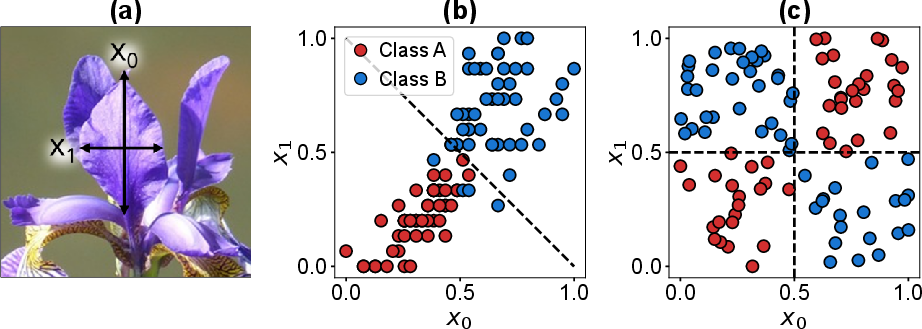
Figure 1: Visualization of Iris and XOR datasets, with the complexity of decision boundaries reflected in separability structure.
Model Architectures and Effective Dimension
Each model class in the study is parameter-matched: both QNNs and ANNs are instantiated with two ("minimal") or six ("deeper") trainable parameters, respectively. The quantum circuits leverage angle encoding for classical features, single-qubit rotations (Rx,Ry,Rz), and a fixed entangling gate. Classical baselines are constructed as feedforward ANNs with corresponding input and hidden layers.
Expressive capacity is quantitatively assessed via the model's effective dimension (ED) computed from the Fisher information matrix, following the generalization bound analysis introduced by Abbas et al. The QNNs—particularly the two-parameter variant—demonstrate substantially higher ED compared to ANNs, reflecting a broader and more powerful functional hypothesis space.
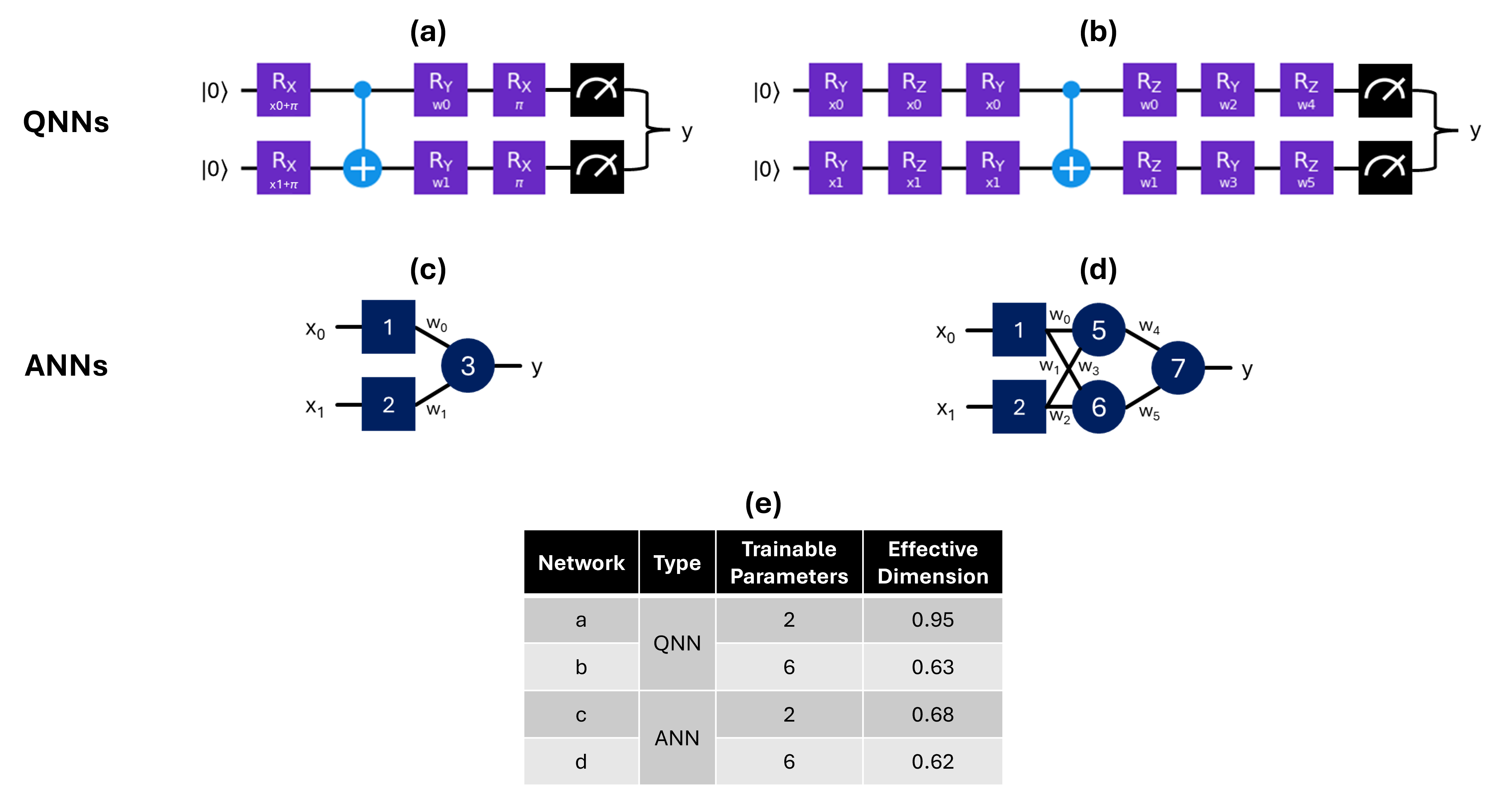
Figure 2: Architecture diagrams for QNN and ANN variants, annotated with parameter counts and normalized effective dimension values.
Hybrid Quantum–Classical Training Protocol
The hybrid training routine follows standard variational hybrid learning: classical input features are normalized and angle-encoded, variational quantum circuits are executed (locally in simulation or remotely on hardware, with shot-based projective measurements), observed outputs are post-processed, and classical optimizers (Adam for simulation, COBYLA for hardware) are used to update circuit parameters until convergence.
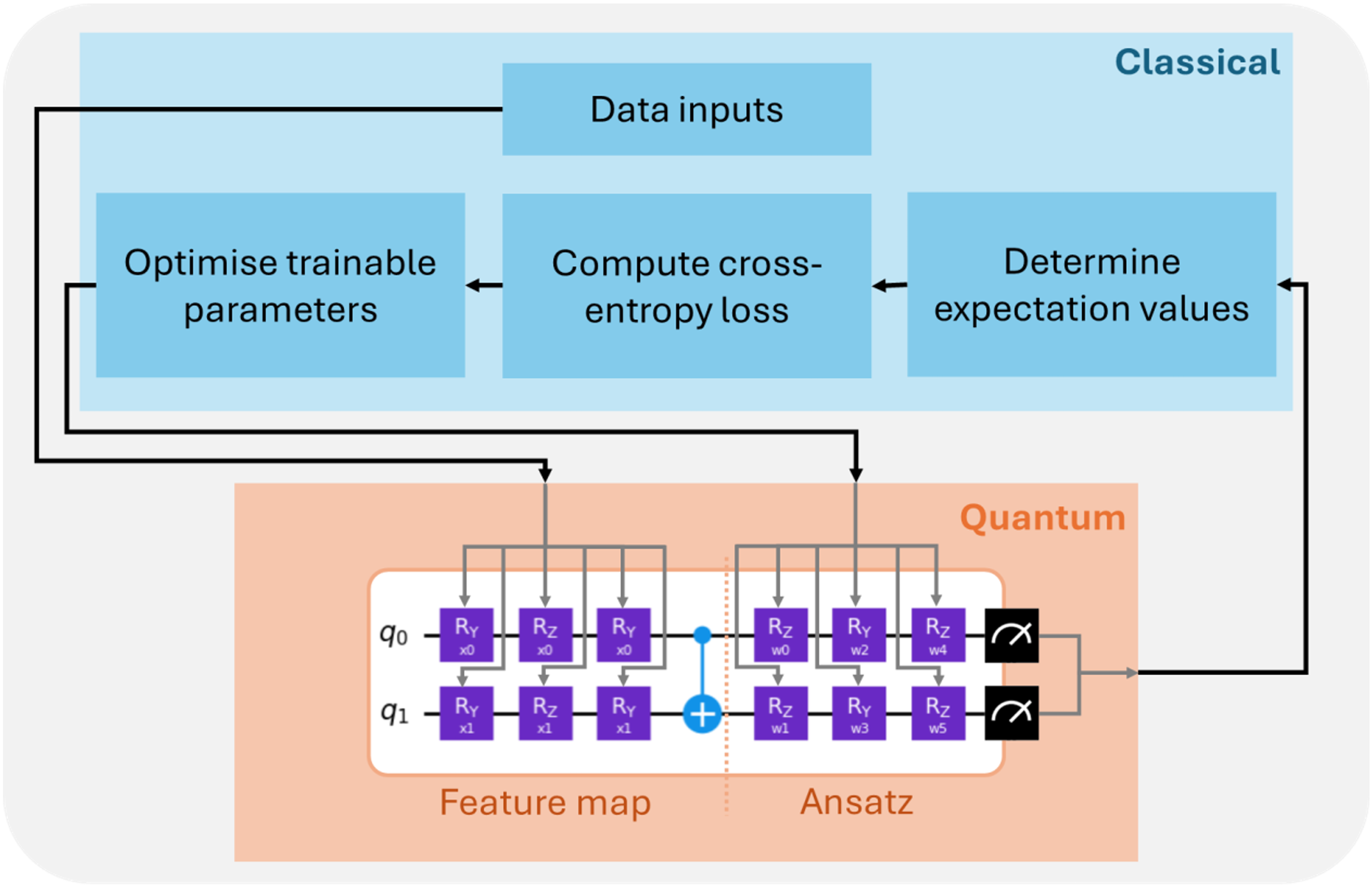
Figure 3: High-level hybrid training pipeline, illustrating data encoding, quantum circuit execution, measurement, and classical feedback.
Empirical Results and Numerical Analysis
Nonlinear Expressivity and Algorithmic Advantage
On the XOR dataset, the two-parameter QNN reliably converges to perfect classification accuracy and negligible cross-entropy loss (≈0.04), whereas the equivalently sized ANN fails to learn the decision boundary, saturating at random-guessing loss (≈ln2) and 50% accuracy. Importantly, while an ANN with more parameters can solve XOR, the quantum circuit achieves this with one quarter the parameter count (two versus at least eight for ANN), demonstrating a tangible algorithmic advantage in terms of model compactness and representational power.
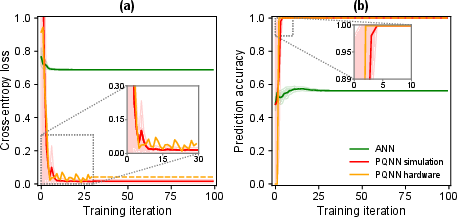
Figure 4: Training dynamics on XOR for two-parameter QNN and ANN—with QNN achieving full accuracy and superior convergence.
Robustness to Sampling Noise
Simulations of hardware effects highlight the impact of finite shot counts and photonic imperfections on training dynamics. Increasing the shot number beyond a few hundred per iteration sharply improves both final mean loss and accuracy, with diminishing returns as variance asymptotes at high shot counts. This motivates the operational choice of 105 shots per training step to ensure reliability in downstream experiments.
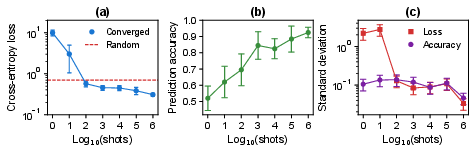
Figure 5: Dependence of final loss, accuracy, and run-to-run variability on measurement shot count for QNN under realistic hardware noise.
Online vs. Mini-Batch Training
The online (sample-wise) update protocol substantially outperforms mini-batch updates (batch size 4) for small datasets and shallow circuits. Online updates exploit stochastic gradient approximations to enable more aggressive exploration of the parameter landscape, a strategy validated in both quantum and classical optimization literature.
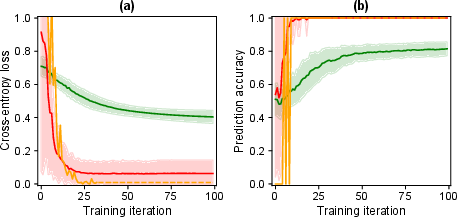
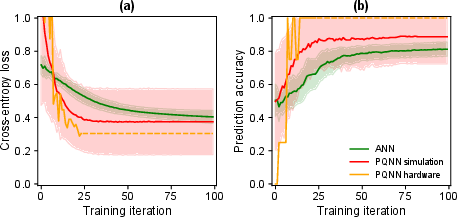
Figure 6: Convergence comparison between online and mini-batch training for the six-parameter circuits, favoring online updates.
Hardware Deployment: Photonic vs. Superconducting
Deployments on both photonic and superconducting hardware confirm simulative trends: PQNNs (on Ascella) exhibit more stable convergence, lower variance, and ultimately outperform both ANNs and SQNNs in both final accuracy and cross-entropy loss. The photonic advantage stems from lower gate decoherence, higher gate fidelity, and much higher feasible shot rates (up to ∼200 kHz in present setups)—translating to enhanced training stability and reduced elapsed wall-time per optimization epoch.
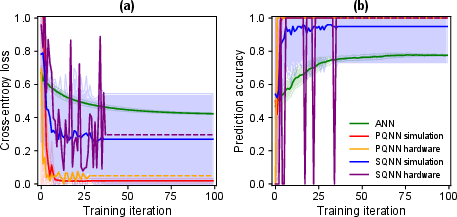
Figure 7: Hardware-measured training loss and accuracy for QNNs and ANNs, highlighting stronger and more stable PQNN performance.
Implications and Outlook
Theoretical and Algorithmic Consequences
These results empirically confirm that photonic QNNs, even at small parameter counts and in non-fault-tolerant regimes, can implement hypothesis classes that are inaccessible to parameter-matched ANNs. This provides an explicit illustration of algorithmic—not just model—advantage, as predicted by effective dimension theory. Such demonstrations underline the need for refined expressivity analyses in QML and constrain the design of classical baselines for future quantum benchmarking.
The observed advantage is algorithmic rather than computational: for these problem sizes, all quantum circuits remain classically simulable, and classical models with increased parameter counts can always close the gap. However, as photonic hardware scales to more qubits and higher circuit depth, the scaling behavior of the QNN's expressivity could potentially enable practical quantum advantage in classification tasks.
Practical Considerations and Future Directions
The demonstrated photonic QNNs are enabled by recent advances in single-photon source brightness, indistinguishability, and linear-optical gate fidelity. Expected short-term hardware improvements (faster source repetition, reduced loss) will likely further increase shot rates and circuit complexity, driving the exploration of higher-dimensional datasets and more complex boundaries.
A major direction is extending gate-based QNN implementations to measurement-based quantum computation (MBQC) platforms, which offer scalable entanglement and more natural error correction for photonic qubits. Successful replication of these algorithmic trends in MBQC will provide a robust foundation for photonic quantum advantage in machine learning.
Conclusion
The study establishes that compact gate-based photonic QNNs, even with severe hardware constraints (a single entangling gate, 2–6 trainable parameters), show measurable and reproducible algorithmic advantages in classical data classification—outperforming parameter-matched ANNs in both expressivity and empirical accuracy. While not demonstrating full quantum advantage due to classical simulability at this scale, the work provides critical experimental validation that the effective-dimension benefits predicted in prior theory [qnnAbbas2021] do transfer to realizable hardware and practically meaningful tasks.
Advances in photonic processor scale and speed, coupled with progress in variational circuit design, portend increased model complexity and dataset coverage. As photonic QNNs transition to non-simulable sizes, and MBQC becomes experimentally viable, these algorithmic advantages may mature into operational quantum advantages in hybrid AI pipelines.

