- The paper introduces a novel Cost-aware Fusion-based Decomposition (CFD) framework that minimizes fusion steps by exploiting LC equivalence for optimal graph state representation.
- It decomposes target photonic graph states into ring, star, and linear motifs, aligning with hardware capabilities for enhanced synthesis efficiency.
- Numerical results demonstrate up to 84.6% resource reduction and orders-of-magnitude improvements in photonic generation rates for larger qubit configurations.
Efficient Synthesis of Quantum Graph States by Motif Fusion
Background and Motivation
Photonic graph states are foundational in MBQC, distributed quantum sensing, and quantum networking, owing to their natural compatibility with photon-based platforms. Photonic implementations avoid direct two-qubit gates, leveraging instead prepared graph states and single-qubit measurements. This approach circumvents significant hardware obstacles but imposes severe synthesis bottlenecks due to the probabilistic character of fusion operations. Specifically, in Type-I fusion, each operation succeeds with probability $1/2$, driving an exponential decline in generation rates with increased fusion steps and concomitant physical resource overhead. As quantum applications increasingly demand complex graph-state topologies with large photon numbers, synthesis efficiency becomes critical.
The paper introduces a cost-aware framework for graph state synthesis, leveraging LC equivalence to search for synthesis-friendly state representations and decomposing them into hardware-realizable motifs—rings, stars, and linear clusters. By exploiting motif structure and LC flexibility, the proposed Cost-aware Fusion-based Decomposition (CFD) dramatically reduces fusion count and physical-qubit consumption.
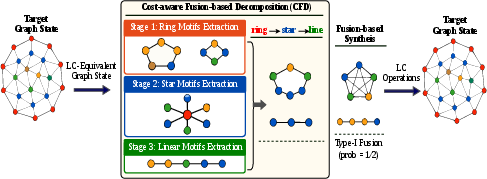
Figure 1: The CFD workflow: starting with a target graph state, the minimum-edge LC-equivalent representative is found, motifs are extracted in three stages, fused, and then LC operations reverse-mapped to recover the original.
Photonic Graph State Synthesis: Foundations
Each photonic graph state is defined by a graph G=(V,E): vertices encode qubits, edges mark CZ entanglements. Synthesis proceeds by fusing experimentally accessible resource states (motifs):
- Star motif: Central node linked to N−1 leaves, naturally corresponds to GHZ-type states.
- Linear motif: Chain-like connectivity, directly generated via emitter-based sequential protocols.
- Ring motif: Closed cyclic states, extracted by fusing the ends of a linear motif.
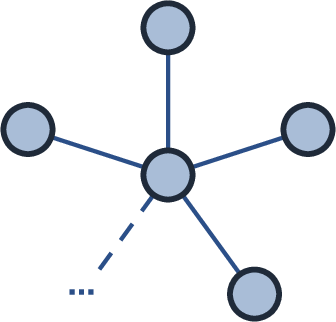

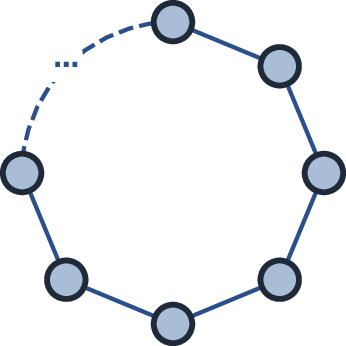
Figure 2: Star motif—a GHZ-type primitive directly accessible in photonic hardware.
Direct photonic generation of these motifs is compatible with quantum dot/cavity platforms and deterministic single-photon emitters, but construction of arbitrary graph states demands a systematic motif fusion strategy.
LC transformations (single-qubit Clifford operations, primarily local complementation) generate a class of LC-equivalent graphs, all representing the same entanglement substrate up to local operations. Two identical quantum resources may have distinct graph topologies with vastly different synthesis complexity.
Fusion operations, particularly Type-I fusions, stitch motifs by photon interference and measurement, merging nodes while redirecting connections. Each fusion is probabilistic, introducing significant overhead, both in photon loss and preparation cost.
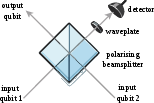
Figure 3: Type-I fusion schematic linking two motifs, with success probability $1/2$, central to resource-efficient graph state assembly.
Cost-aware Fusion-based Decomposition (CFD) Framework
CFD reframes synthesis as an edge-disjoint cover problem over the LC equivalence class. The key workflow:
- LC Minimization: Enumerate all LC-equivalent graphs; select one with minimum edge count, heuristically linked to minimal fusion requirement.
- Motif Extraction: Three-stage process—first extract ring motifs, then star motifs, finally cover residual edges with linear motifs. The ring-star-linear order yields the lowest mean resource overhead empirically.
- Fusion Assembly: Motifs are synthesized independently and assembled using Type-I fusion, reconstructing the LC-minimized graph. LC operations recover the original target state with negligible additional cost.
CFD is computationally efficient owing to fast polynomial-time algorithms for star and linear motif extraction; ring motif extraction employs VF2 for subgraph isomorphism (NP-complete, but tractable for small motifs).
CFD is evaluated using exhaustive LC orbit data for n=4 to $9$ qubits and lattice instances up to 8×8 and cubic graphs. The main synthesis metric is the photonic generation rate, which decays exponentially with the number of fusion steps k.
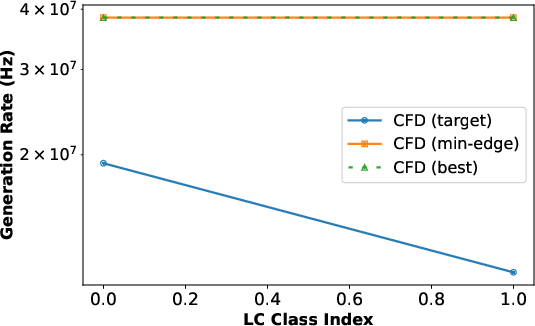
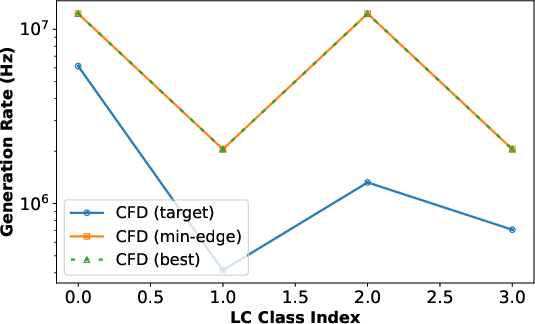
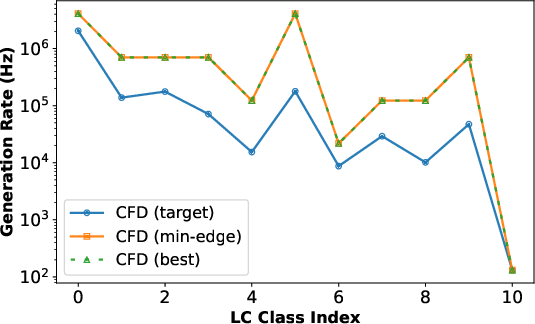
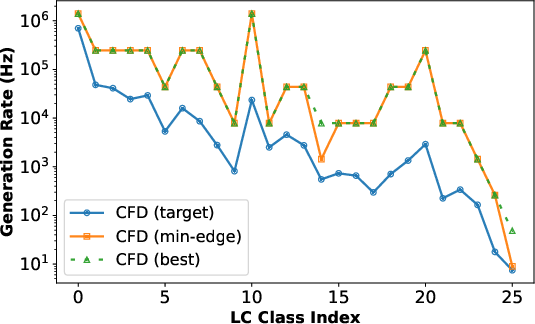
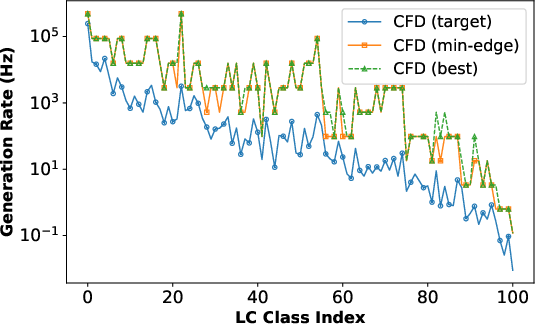
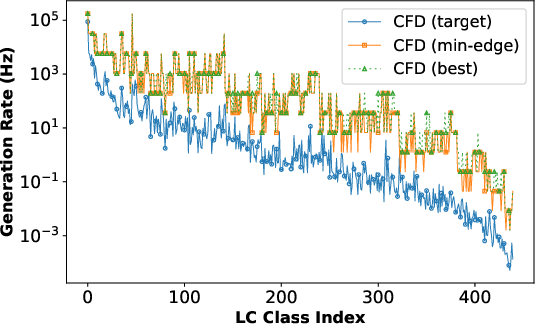
Figure 4: Generation rate comparisons for n=4 graph states across LC equivalence classes; CFD (min-edge) outperforms direct CFD (target) and closely tracks CFD (best).
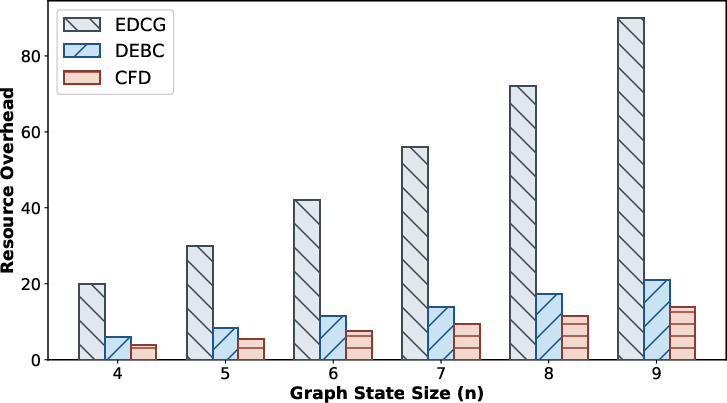
Figure 5: Resource overhead comparison—CFD achieves up to 84.6% reduction relative to EDCG baseline, and G=(V,E)0 relative to DEBC.
Strong numerical evidence supports two claims:
- Selecting the minimum-edge LC-equivalent form almost always coincides with the globally optimal (best) synthesis rate within the LC class.
- CFD achieves exponential improvements in photonic generation rate, scaling from constant-factor gains at small G=(V,E)1 to orders-of-magnitude at G=(V,E)2.
For regular lattices (2D and 3D clusters), motif extraction policies impact resource overhead. For large grid states, linear motif extraction alone is optimal, exploiting regularity; for smaller or irregular structures, ring and star extraction contribute more savings.
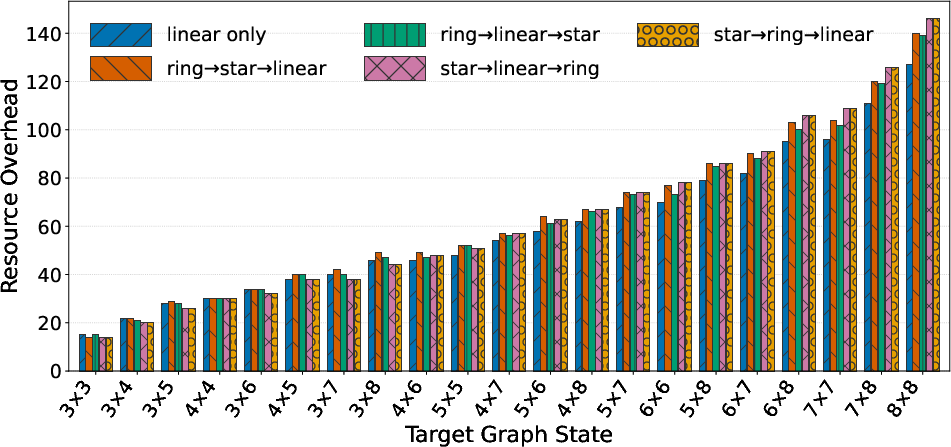
Figure 6: Policy comparison for 2D lattice states; linear-only motif extraction minimizes overhead for large grids.
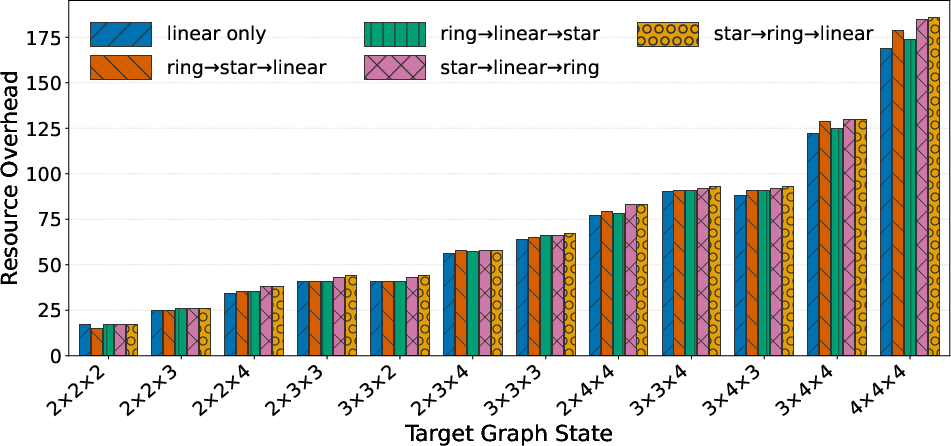
Figure 7: Policy comparison for 3D cubic states, again showing superiority of linear motif extraction for regularity.
Practical and Theoretical Implications
CFD demonstrates that structure-aware decomposition, combined with LC equivalence exploitation, is a scalable, hardware-adaptive strategy for photonic graph state synthesis. The dramatic overhead reductions unlock high-generation-rate photonic substrates, critical for MBQC, quantum networking, and distributed quantum sensing. The motif extraction ordering, and LC class minimization, introduce new algorithmic levers for resource-aware quantum architecture design.
On the theoretical side, the connection between minimum-edge LC representation and synthesis cost invites further exploration of graph invariants and isomorphism strategies. The motif fusion paradigm, while developed for photonic platforms, may transfer to other quantum systems with motif-based resource synthesis constraints.
Conclusion
The CFD framework offers a principled, computationally efficient scheme for synthesizing arbitrary photonic graph states from experimentally available ring, star, and linear motifs, minimizing physical resource overhead by leveraging LC equivalence. Numerical experiments confirm up to G=(V,E)3 reduction in overhead and substantial generation-rate improvements. The motif-based decomposition strategy, anchored in structural graph theory and hardware constraints, has significant implications for scalable quantum computing and networking architectures, suggesting fertile future directions in synthesis algorithm design and quantum hardware co-optimization.