- The paper introduces a symmetry-driven protocol that reduces emitter and CNOT gate counts for fusion-based quantum computing resource states.
- It leverages stabilizer formalism and symmetry reduction to optimize circuit generation for both unencoded and Shor-encoded ring states.
- Optimization results show that a 24-qubit Shor-encoded state can be generated with only 3 emitters and 11 CNOTs, significantly lowering resource overhead.
Efficient Generation of FBQC Resource States from Quantum Emitters
Introduction and Motivation
Fusion-based quantum computing (FBQC) relies on constructing small, highly-entangled photonic resource states that are subsequently fused through Bell state measurements to achieve universal quantum computation. The central limitation in FBQC, particularly for fault-tolerant implementations, is the rate at which these photonic resource states can be generated. Traditional approaches relying on probabilistic linear optics face exponentially decreasing success probabilities with increasing photon number due to fusion gate failures, especially when logical encoding is employed to counter photon loss. This work addresses this bottleneck by exploiting deterministic generation with a minimal number of quantum emitters, introducing symmetry-based optimization protocols that reduce emitter overhead and CNOT gate count during resource-state generation (2605.09325).
Circuit Generation Algorithm and Symmetry Exploitation
The underlying circuit generation is based on the stabilizer formalism and the tableau method, specifically the algorithm by Li et al. which operates in time-reversed order to construct minimal-emitter generation circuits for arbitrary graph states. The emitter count and CNOT requirements are highly sensitive to photon emission ordering. Exhaustive search over all possible orderings is infeasible for large encoded states due to factorial complexity.
However, FBQC resource states (notably ring graph states and their encoded variants) possess considerable symmetry (dihedral rotations and reflections), which significantly reduces the effective search space for emission orderings. For example, the search space for an n-qubit ring reduces to (n−1)!/2 unique orderings by accounting for dihedral symmetry.
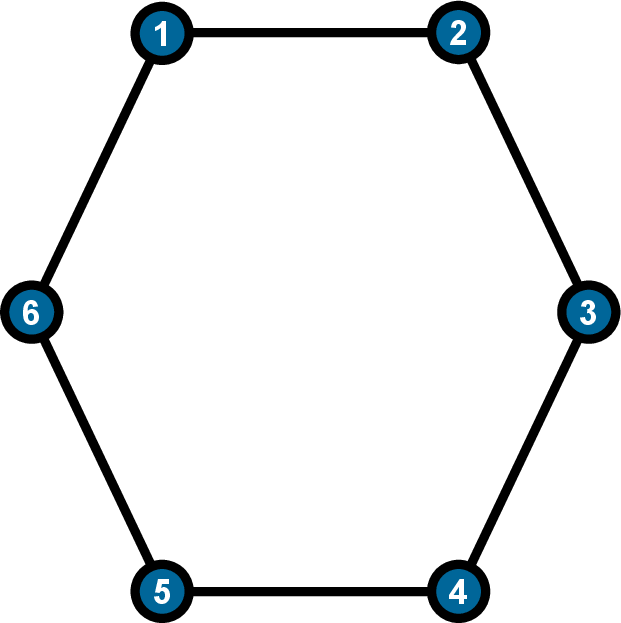
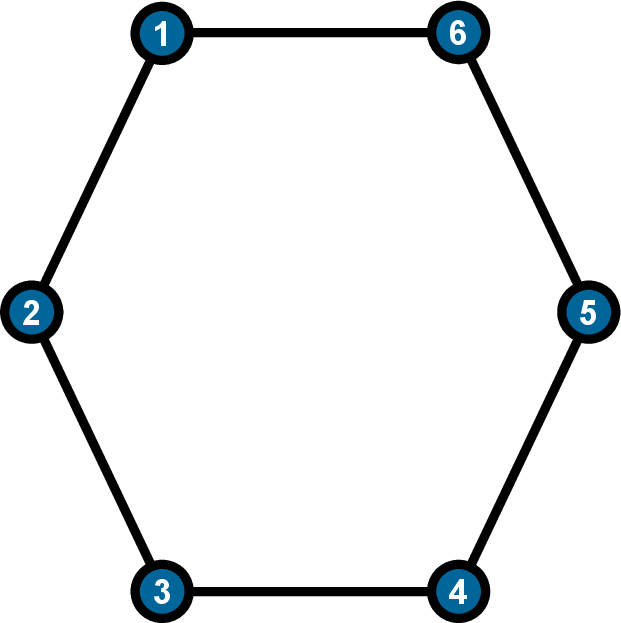
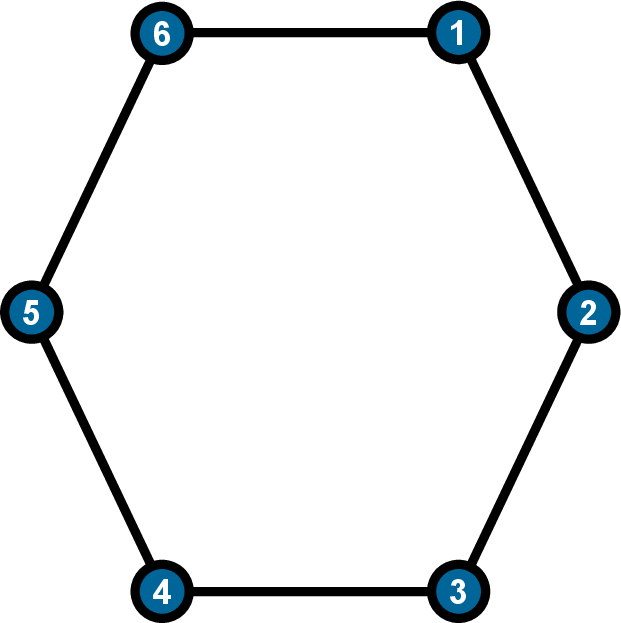
Figure 1: 6-qubit ring with original emission ordering.
Optimization Results: Unencoded and Encoded Graph States
Unencoded 6-Qubit Ring
A brute-force search across symmetry-reduced orderings reveals that the unencoded 6-qubit ring state can be deterministically generated using as few as 2 emitters and 2 emitter-emitter CNOT gates; multiple optimal circuits are identified, demonstrating flexibility in emission sequencing.
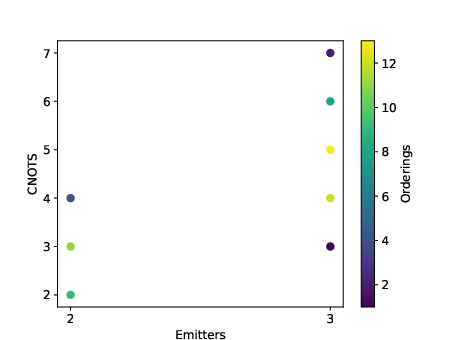
Figure 2: Emitter vs CNOT count for the 6-qubit ring state across emission orderings.
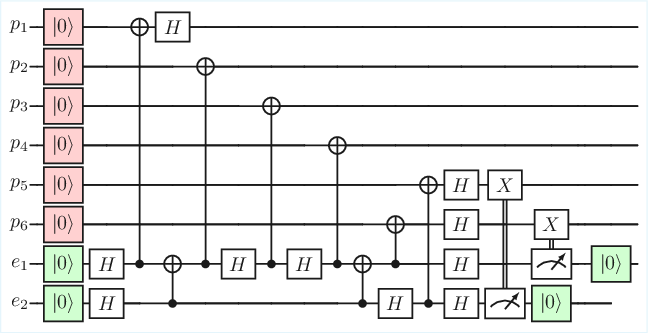
Figure 3: Optimized circuit for the 6-qubit ring with emissive ordering [1, 2, 3, 6, 5, 4].
Shor-Encoded 24-Qubit Ring
For loss-tolerant FBQC, logical encoding is essential. The (2,2) Shor code is used to encode each logical qubit of the 6-ring, resulting in 24 physical qubits. A naive search for optimal emission ordering is rendered intractable by the enormous search space, even after symmetry reduction.
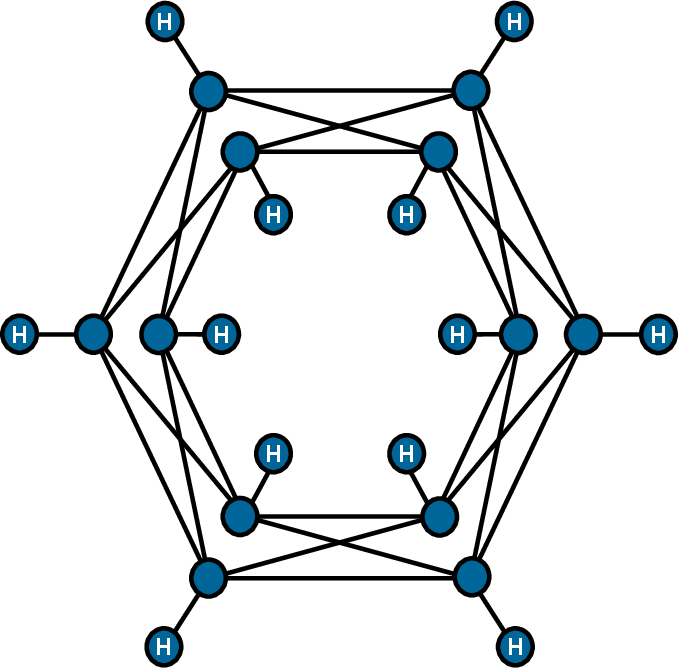
Figure 4: 24-qubit (2,2) Shor-encoded 6-ring resource state, with Hadamards applied to leaf qubits for FBQC.
Randomized search over millions of orderings yields circuits requiring 4 emitters and 22 CNOTs at best. However, further structure-based heuristics—truncation of leaf qubits from the encoding and optimized attachment of leaves—enable a compact ansatz for circuit construction. This two-stage method reduces the search space dramatically.
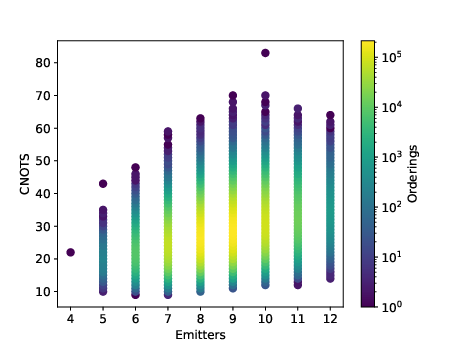
Figure 5: Emitter count vs CNOT count for randomized orderings in the encoded 6-qubit ring.
By brute-force optimization of the truncated graph (interlocked core rings) and systematic leaf reattachment, the authors demonstrate that the encoded 24-qubit ring can be generated using 3 emitters and only 11 emitter-emitter CNOTs, which is substantially lower than previously estimates.
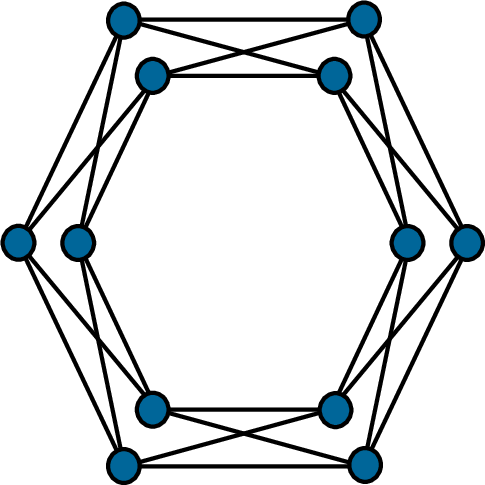
Figure 6: 12-qubit interlocked core graph, basis for emission-order optimization.
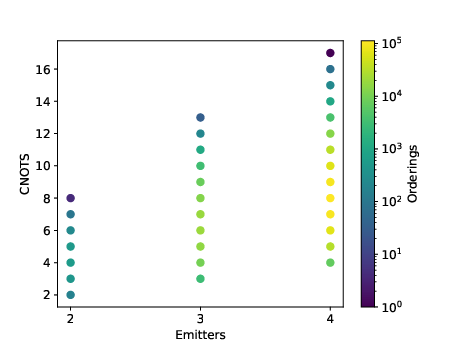
Figure 7: Emitter vs CNOT count for the encoded ring without leaves, highlighting orderings with minimal resources.
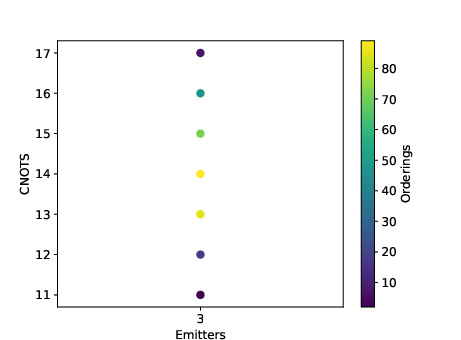
Figure 8: Emitter count vs CNOT count after reduced search on the full encoded ring.
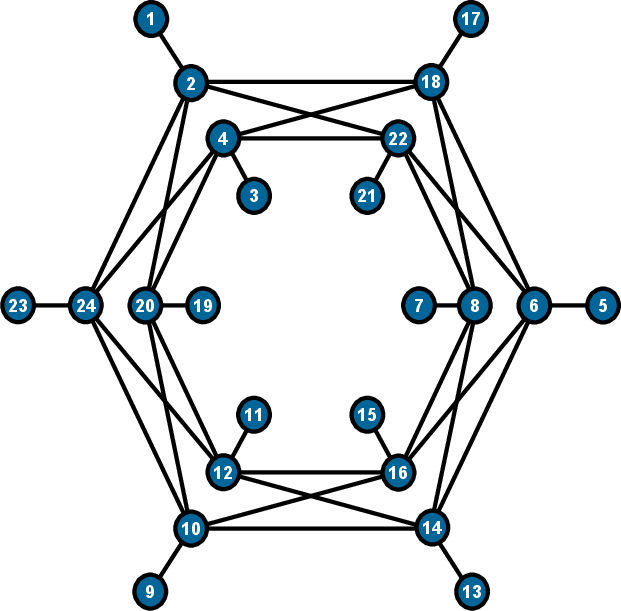
Figure 9: (2,2) Shor-encoded 6-ring resource state with optimized emission ordering.
Theoretical Upper Bounds on CNOT Count
Complementing empirical optimization, the work provides analytical upper bounds on emitter-emitter CNOT count, leveraging stabilizer code structure and RREF gauge properties. For a state with np photons and ne emitters, the total CNOT count is bounded above by ⌊npne/2⌋+np⌊ne/2⌋+[(ne(ne+1)/2)−⌊(ne+1)2/4⌋]. For the encoded 6-ring, this yields an upper bound of 62 CNOTs, which is loose for compact states but informative for larger or more complex target graph states.
Implications and Future Directions
Practical Impact
The identification of circuits requiring only 3 emitters and 11 CNOTs for generating a Shor-encoded FBQC resource state marks a significant reduction in both physical and temporal overhead. With fewer emitters, the requirement for emitter homogeneity, spectral matching, and networked stability is greatly eased. The shorter entanglement storage time lowers susceptibility to decoherence and error.
These optimizations have direct relevance as emitter platforms (quantum dots, neutral atoms, NV centers) improve in entangling gate fidelity, optical efficiency, and integration. Compact circuit constructions are poised to amplify the advantages of deterministic approaches over probabilistic linear optics, particularly in loss-tolerant and scalable photonic architectures.
Theoretical Significance
The work unveils a richer circuit optimization landscape for emitter-based resource-state generation than previously recognized. Hybrid architectures combining deterministic emitter generation and boosted fusion operations stand to benefit, allowing architecturally tunable trade-offs between emitter number, gate count, fabric homogeneity, and resilience to loss. Applications outside quantum computing, including quantum networking and sensing, where highly symmetric graph states are used, can leverage these symmetry-based optimizations for emitter economy.
Systematic studies leveraging this protocol could guide architecture-level choices, inform scheduling, and establish hardware-agnostic benchmarks for emitter-based photonic state generation.
Conclusion
This study presents a symmetry-driven protocol for the efficient generation of FBQC resource states from quantum emitters, achieving strong numerical reductions in emitter and CNOT requirements for both unencoded and Shor-encoded ring graph states. The algorithmic framework and heuristic reductions introduced here recharacterize the resource landscape for photonic state generation, laying foundations for future hardware-independent optimizations in emitter-based quantum information applications. The significance is amplified as platforms mature, and as deterministic, hybrid, and loss-tolerant requirements converge in photonic quantum technologies.