- The paper introduces a QASST-based framework that leverages LC orbit optimization and split-fuse protocols to efficiently prepare graph states.
- It demonstrates linear resource scaling for distance-hereditary graphs by minimizing entangling gate count and circuit depth through modular state synthesis.
- The approach generalizes to non-DH graphs by combining heuristic minimization with QASST decomposition, thereby reducing overhead in complex quantum architectures.
Efficient Preparation of Graph States Using QASST Decomposition and Split-Fuse Techniques
Introduction
The efficient preparation of graph states is a critical challenge in scalable quantum information processing, affecting both measurement-based quantum computation (MBQC) and photonic quantum networking. Preparation resource metrics—including the count of entangling gates (primarily CZ gates) and the associated circuit depth—are bottlenecks in realistic architectures. The use of local complementation (LC) to traverse the orbit of LC-equivalent graph states enables reductions in preparation costs by targeting optimal representatives. However, the combinatorial explosion of LC orbits (with #P-complete counting complexity) renders brute-force approaches computationally infeasible for large systems.
This work introduces an approach grounded in the split decomposition of graphs, formalized as the quotient-augmented strong split tree (QASST), providing a scalable framework for both LC orbit classification and practical state preparation. For distance-hereditary (DH) graphs, which are closed under LC and admit tractable split decompositions into star and complete quotient graphs, the authors demonstrate analytic LC orbit characterizations and optimal representative selection. Major contributions include the split-fuse preparation method, which achieves linear scaling in both entanglement operations and depth for DH graph states and is amenable to a generalized strategy for non-DH graphs.
Graph States, Local Complementation, and QASST Structure
Graph states are defined as ∣G⟩=(u,w)∈E(G)∏CZu,wv∈V(G)⨂∣+⟩v, constructing entanglement based on the underlying graph topology. The LC operation, implemented via single-qubit Clifford gates (notably Hadamard and phase gates), modifies connectivity without altering entanglement characteristics and forms an equivalence relation partitioning state space into LC orbits.
The intractability of explicit LC orbit enumeration for large graphs necessitates structure-aware techniques. The split decomposition, and its encoding as the QASST, provides such a structure by recursively collapsing strong splits into quotient graphs, which are classified as prime, star, or complete. This approach leverages the invariance of strong splits under LC, allowing the LC-equivalence class of a graph to be captured as combinations of LC-equivalent quotient graphs connected according to the split tree. For DH graphs—all of whose quotient graphs are star or complete—this property is especially powerful.

Figure 2: An example of a Type-II fusion between qubits q1 and q2 from two different graph states ∣G1⟩ and ∣G2⟩.
The QASST also underpins operational strategies, as it naturally decomposes large state preparation into the assembly of smaller, independently preparable components, which are merged by fusion-type operations.
Classification and Optimization of LC Orbits
DH graphs (including bipartite, multipartite, clique-star, and repeater families) permit analytic LC orbit classifications informed by the QASST. For instance, the LC orbit size of Kn,m is nm+n+m+3, with symmetry classes determined by the local qubit roles in the split tree. Optimal representatives minimizing either ∣E(G)∣ (CZ count) or Δ(G) (circuit depth bound) are obtained by explicit mapping of QASST symmetries to graph parameters.
This explicit orbit structure allows the identification of minimal-complexity preparation sequences without exhaustive search. For example, the optimal representative of O(Kn,m) is a binary-star with q10 edges and q11 maximum degree, substantially reducing both depth and gate count relative to the naive approach.
The Split-Fuse Preparation Method
The split-fuse protocol replaces direct graph state construction with a modular strategy: intermediate graph states—corresponding to the quotient graphs from the QASST—are prepared in parallel (preferably as minimal-edge representatives by exploiting their LC orbits), augmented by auxiliary qubits for the split-nodes. These modules are then combined using Type-II fusion operations, which efficiently generate the required entanglement by connecting the neighborhoods associated with fused split-nodes.
Resource scaling for a DH graph with q12 physical qubits and q13 quotient graphs is as follows:
- Total CZ gates: q14
- Total time steps: q15, where q16 and q17 are, respectively, the leaf and split-node count in quotient q18
- Physical qubits: q19
Notably, all resources scale linearly in q20, providing an asymptotic advantage for large classes of resource states.
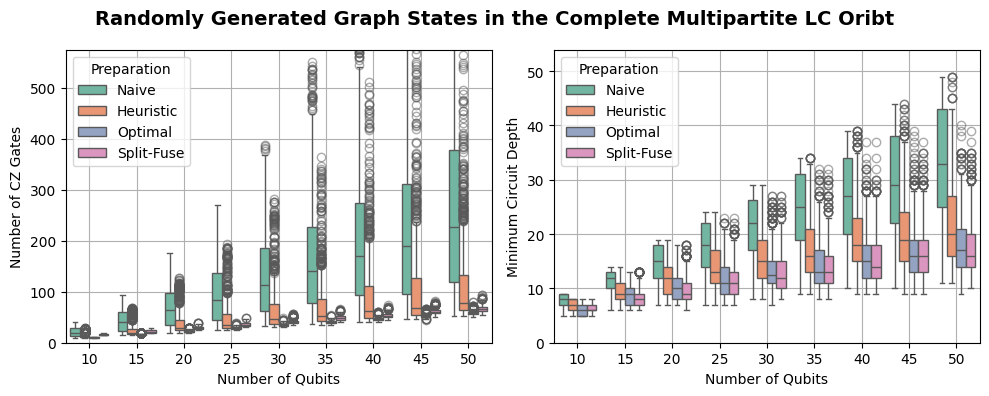
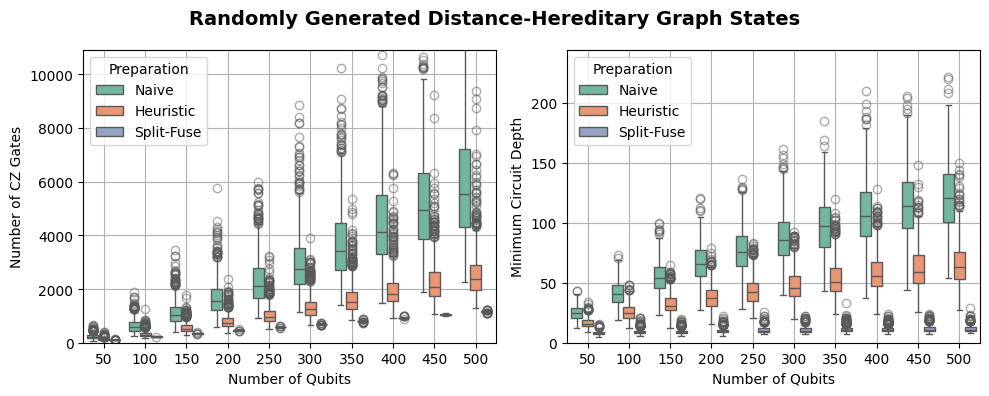
Figure 4: Comparison of the resource requirements (CZ gates on the left and circuit depth on the right) for graph state preparation protocols using QASST-based techniques and orbit-based optimizations for samples of LC-equivalent multipartite/DH graphs.
Numerical results demonstrate that for small instances, orbit-based optimization remains slightly superior due to the overhead of auxiliary qubits, but the split-fuse method's resource scaling becomes advantageous as q21 increases or the graph structure becomes more complex.
Generalization and Heuristic Enhancement
The split-fuse methodology extends to generic (non-DH) graphs, where the split decomposition contains prime quotient graphs. In such scenarios, the quotient-wise preparation can still exploit LC minimization for all star/complete quotients, while prime subgraphs are handled either directly or via heuristics targeting edge count reduction, such as triangle enumeration-based greedy strategies. This hybrid approach offers scalable optimization for arbitrary input graphs and is especially impactful for dense connectivity regimes.
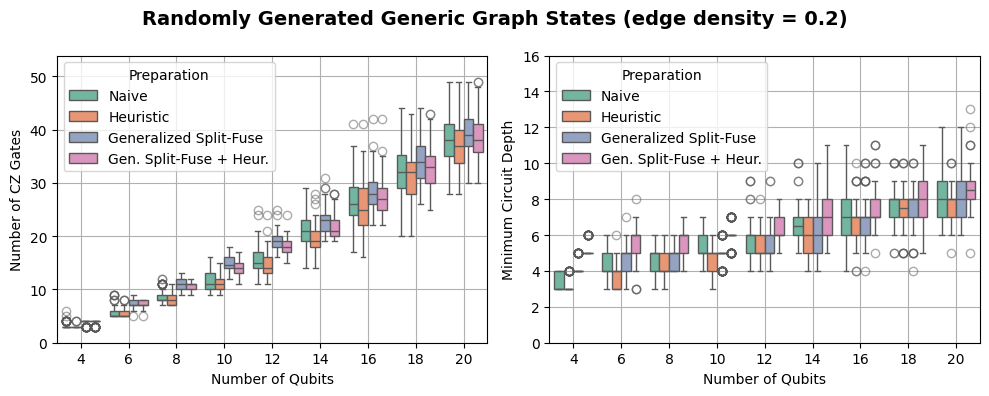
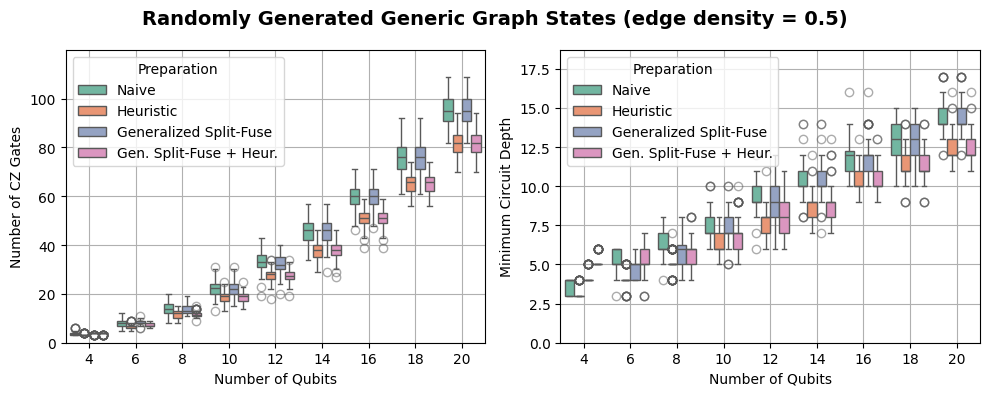
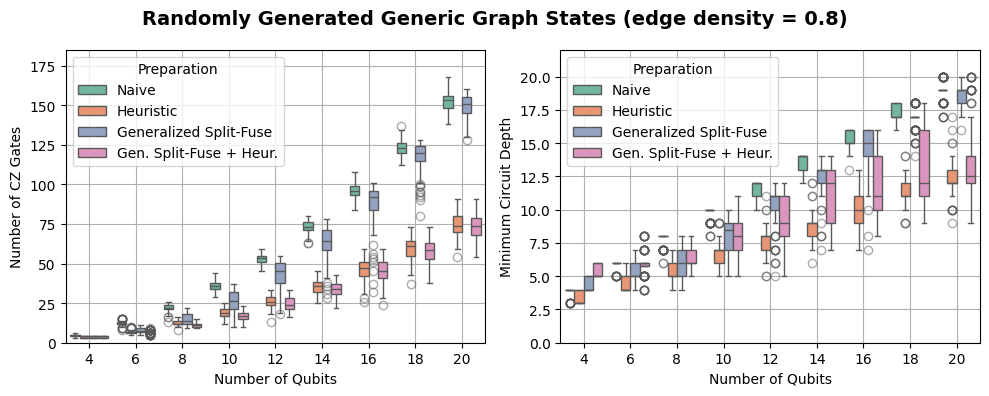
Figure 6: Resource comparison for various preparation methods (naive, heuristic, split-fuse, and combinations) applied to generic Erdős–Rényi random graphs with varying edge density.
Results indicate that for highly connected graphs, the combined use of heuristic minimization at the prime quotient level and QASST-guided split-fusion leads to substantial reductions in both entangling gate count and circuit depth.
Practical and Theoretical Implications
The linear resource scaling of the split-fuse method is a critical feature for scalable quantum hardware architectures, particularly those supporting efficient fusion operations (photonics, modular ion traps, etc.). The approach is generalizable and robust to graph size and structure, providing a methodology for operational resource minimization unavailable to orbit-based search methods.
While auxiliary qubit overhead and the probabilistic/technical details of fusion operations must be considered for hardware realization, the presented method forms a baseline against which realistic implementations can be benchmarked. The analytic LC orbit characterization for DH graphs further suggests that graph-theoretic structure can be fruitfully leveraged for quantum circuit design, and invites the systematic study of optimal prime quotient state preparation as a future research direction.
Conclusion
The QASST-based analytic characterization of LC orbits and the split-fuse assembly protocol enable efficient, scalable preparation of graph states for quantum information tasks. By combining graph-structural insights (distance-hereditary closures, tractable split decompositions) with practical assembly mechanisms (fusion operations and heuristic minimization), the presented work provides both tight resource reductions within key graph families and a generalizable framework for larger, denser, and more complex quantum network topologies. These methods are expected to have broad relevance in the practical implementation of MBQC, quantum networking, and related large-scale entanglement applications.

