- The paper introduces a smooth velocity shuttling method that uses a Tukey window approach to suppress non-adiabatic valley excitations in Si/SiGe quantum dots.
- The protocol leverages frequency-modulated voltage waveforms to shape the shuttling velocity profile, thereby reducing high-frequency spectral sidelobes and mitigating spin dephasing.
- The paper shows that the method effectively enhances qubit fidelity in devices with large deterministic valley splitting, even under moderate disorder conditions.
Smooth Velocity Shuttling to Suppress Valley Excitations in Disordered Si/SiGe Quantum Dots
Introduction
Coherent electron shuttling constitutes a foundational element for the scalability of silicon-based quantum information processing architectures. A pervasive challenge in this domain is the presence of nearly degenerate conduction-band valleys intrinsic to silicon, resulting in a strong susceptibility of spin qubits to non-adiabatic transitions during shuttling. These valley excitations induce spin dephasing via spin-valley coupling, ultimately degrading the fidelity of quantum operations. Traditional shuttling protocols typically employ abrupt control steps, further amplifying non-adiabaticity. This work introduces an analytically motivated control strategy—smooth velocity shuttling—to suppress valley excitations, aligning the design of the shuttling velocity profile with the suppression of high-frequency spectral sidelobes, as performed in window function design in classical signal processing.
Silicon quantum dots exhibit valley degrees of freedom, with the conduction band hosting two nearly degenerate valleys. The valley splitting energy Ev is typically on the order of GHz, so non-adiabatic shuttling pulses lead to real transitions between the valley eigenstates. Considering time-dependent transport, the effective Hamiltonian includes off-diagonal elements proportional to the time derivative of the valley phase ϕ˙v, itself directly linked to the shuttling velocity v(t) through the chain rule.
Importantly, the probability of a transition to an excited valley state after shuttling can be expressed, to leading order, as the squared modulus of the component of the velocity waveform’s spectrum at the valley splitting frequency:
pv∝∣v~(ωv)∣2
This formal result identifies the design problem: suppress ∣v~(ωv)∣ for relevant ωv.
Smooth Velocity Shuttling Protocol
Motivated by the analogy to window function design, the proposed protocol eliminates sharp steps in the velocity profile by replacing standard rectangular windows with Tukey windows parametrized by a smoothing parameter β. For β=0, the protocol reproduces the conventional rectangular window (abrupt on/off), while at β=1 it corresponds to a Hann window (fully smoothed ramp). As β increases, the temporal velocity profile and its spectrum both exhibit progressively greater suppression of high-frequency sidelobes.
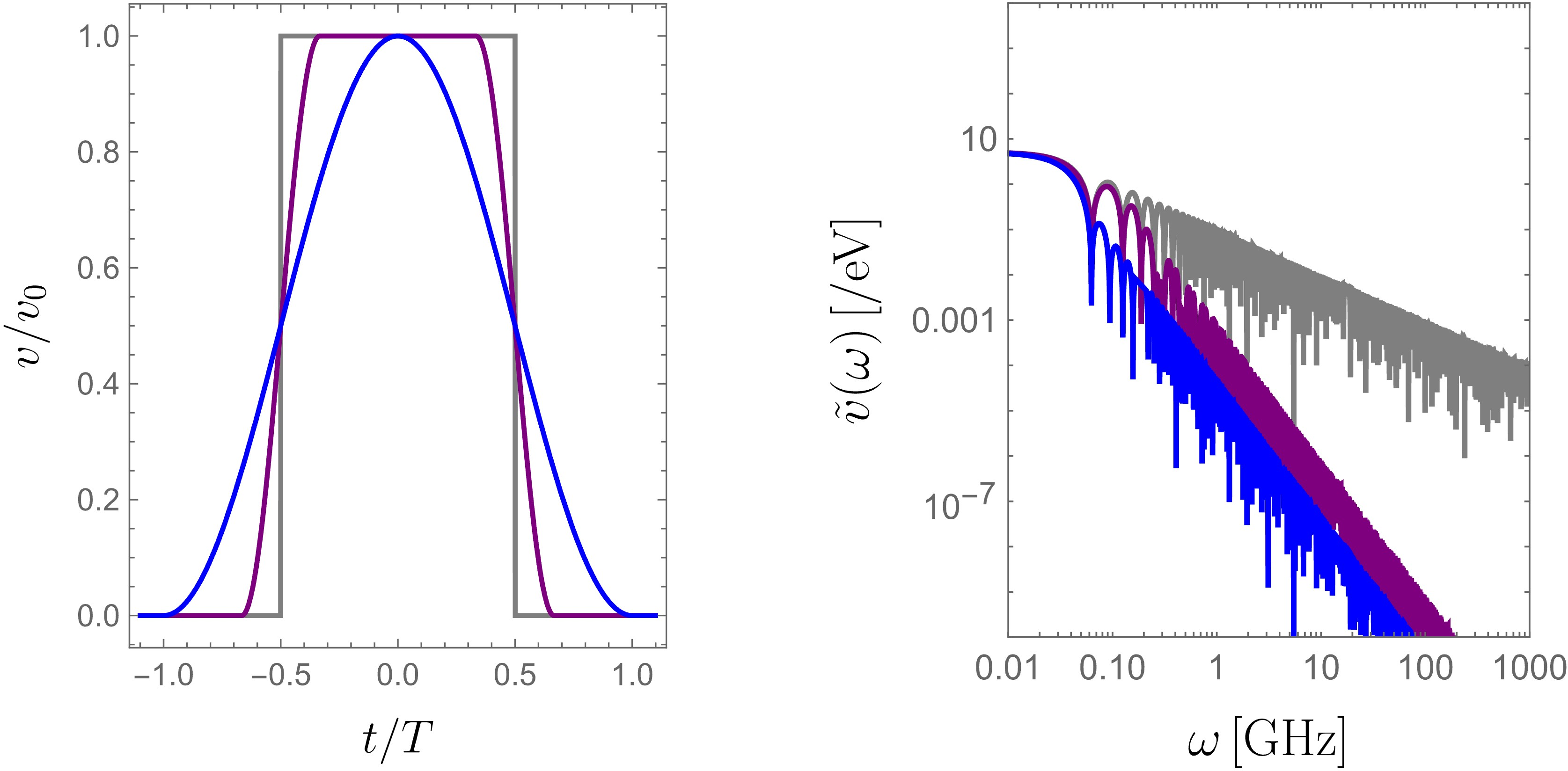
Figure 1: Shuttling velocity profiles for different smoothing parameters (left) and their corresponding spectral characteristics (right), revealing high-frequency sidelobe suppression with increasing ϕ˙v0.
Gate electrode controls are then engineered using frequency-modulated (FM) voltage waveforms, with ϕ˙v1 encoding the deviation from the nominal (constant) shuttling velocity. These FM voltages can be constructed from carrier signals typical in conveyor-belt shuttling, which are modulated in direct accordance with the desired velocity waveform.
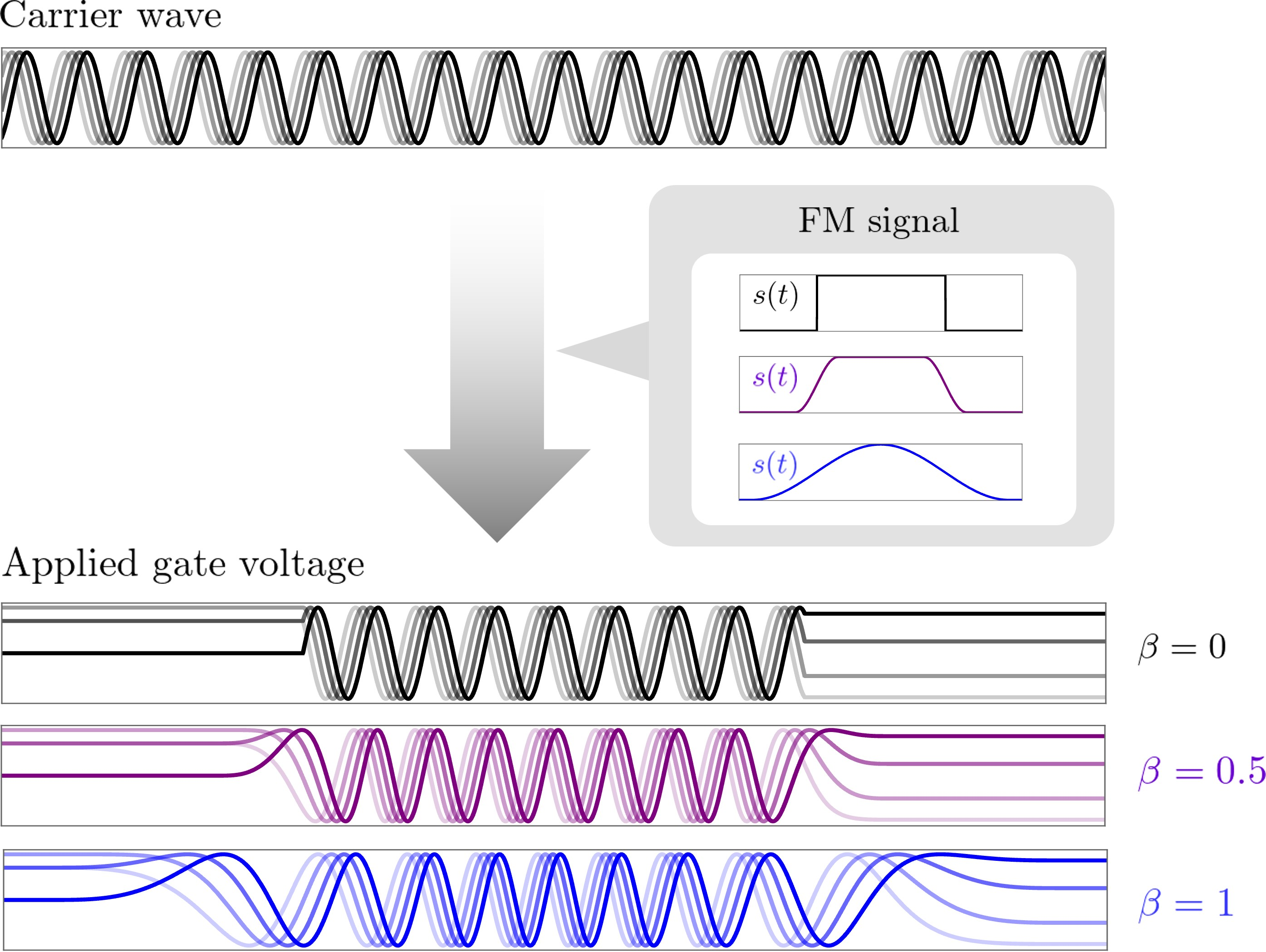
Figure 2: Gate-voltage waveforms illustrating the implementation of smooth velocity shuttling by modulating the gate drive frequencies according to the smoothing parameter.
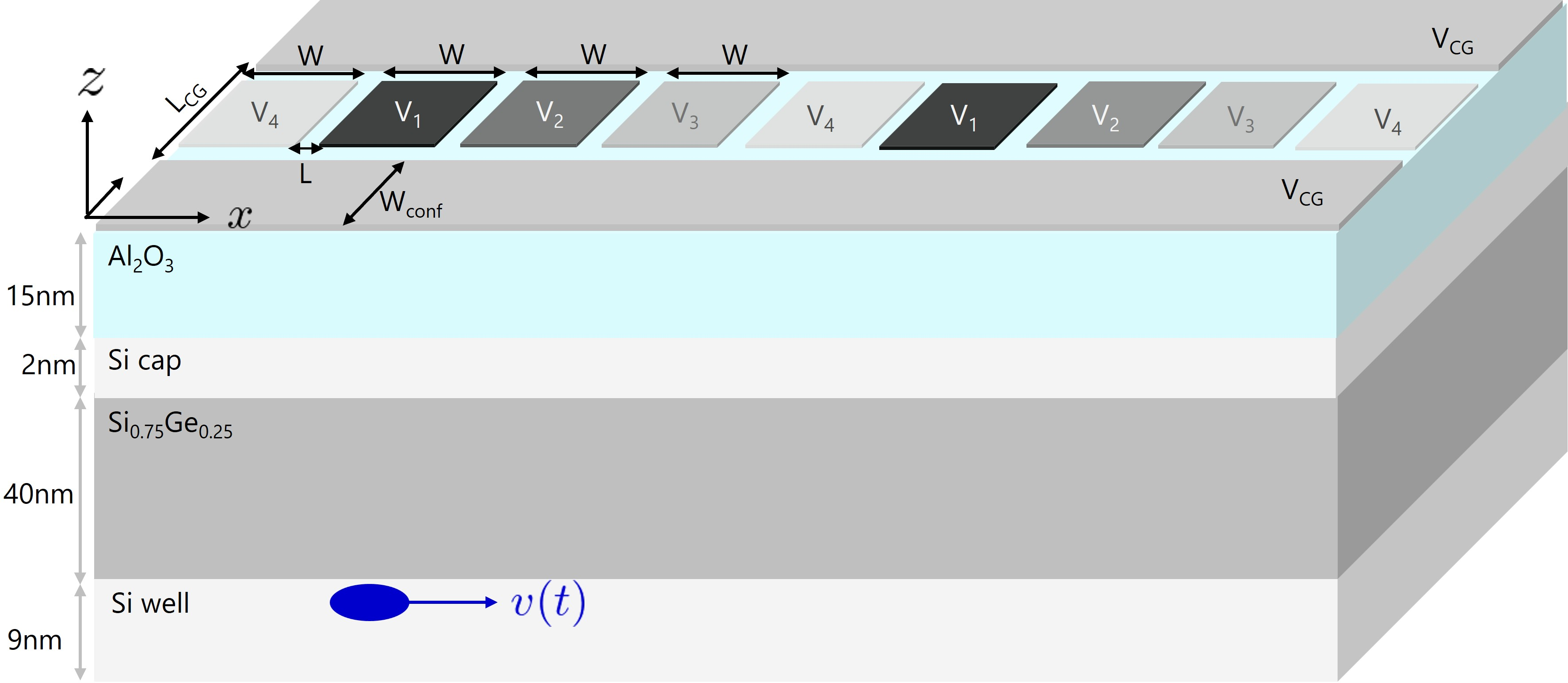
Figure 3: Schematic of the SiGe/Si/SiGe quantum dot shuttling device, exhibiting gate arrangements and FM architecture used in simulations.
Implementation and Electrostatic Modeling
Full device-level electrostatic simulations were performed for a representative SiGe/Si/SiGe heterostructure with quantum dots formed beneath nanofabricated gates. By analytically solving the Laplace equation for realistic device geometries and boundary conditions, the protocol demonstrates robust control of both quantum dot position and size throughout the shuttling process, with minimal deformation as the velocity profile is smoothed.
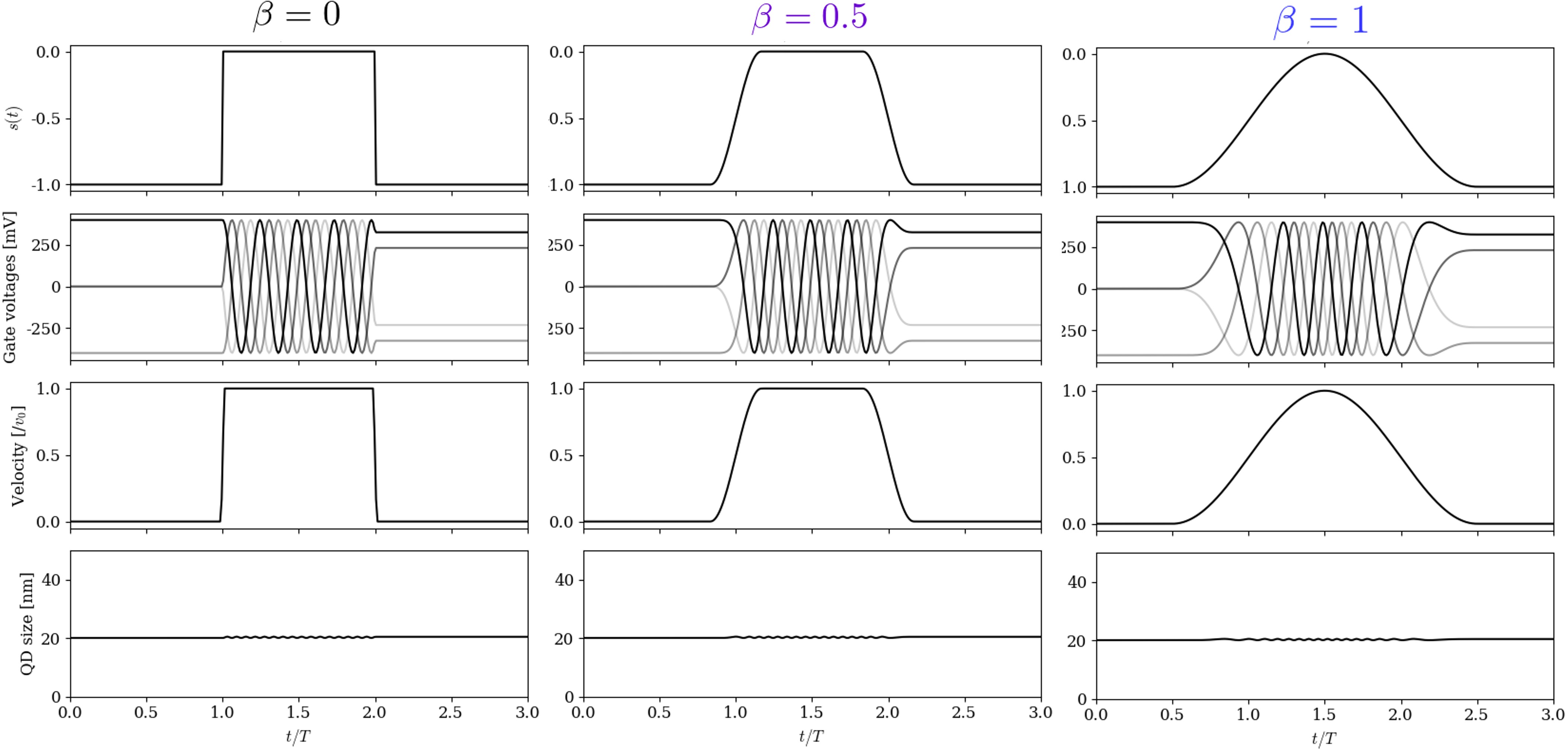
Figure 4: Numerical simulation results of the velocity shaping protocol, showing the time evolution of signal wave, gate voltage, actual velocity, and quantum dot size as a function of time and smoothing parameter ϕ˙v2.
This validates both the physical plausibility and practical utility of the FM-based smooth velocity shuttling protocol, as the quantum dot wavefunction remains well-controlled.
Fidelity Analysis in Disordered Valley Landscapes
A critical aspect for realistic devices is the presence of spatial disorder in the valley coupling, which arises from atomic-scale interface roughness and alloy fluctuations. The statistical impact of disorder is modeled by a random component ϕ˙v3 superimposed on the deterministic valley coupling ϕ˙v4, with the relative disorder strength quantified by ϕ˙v5.
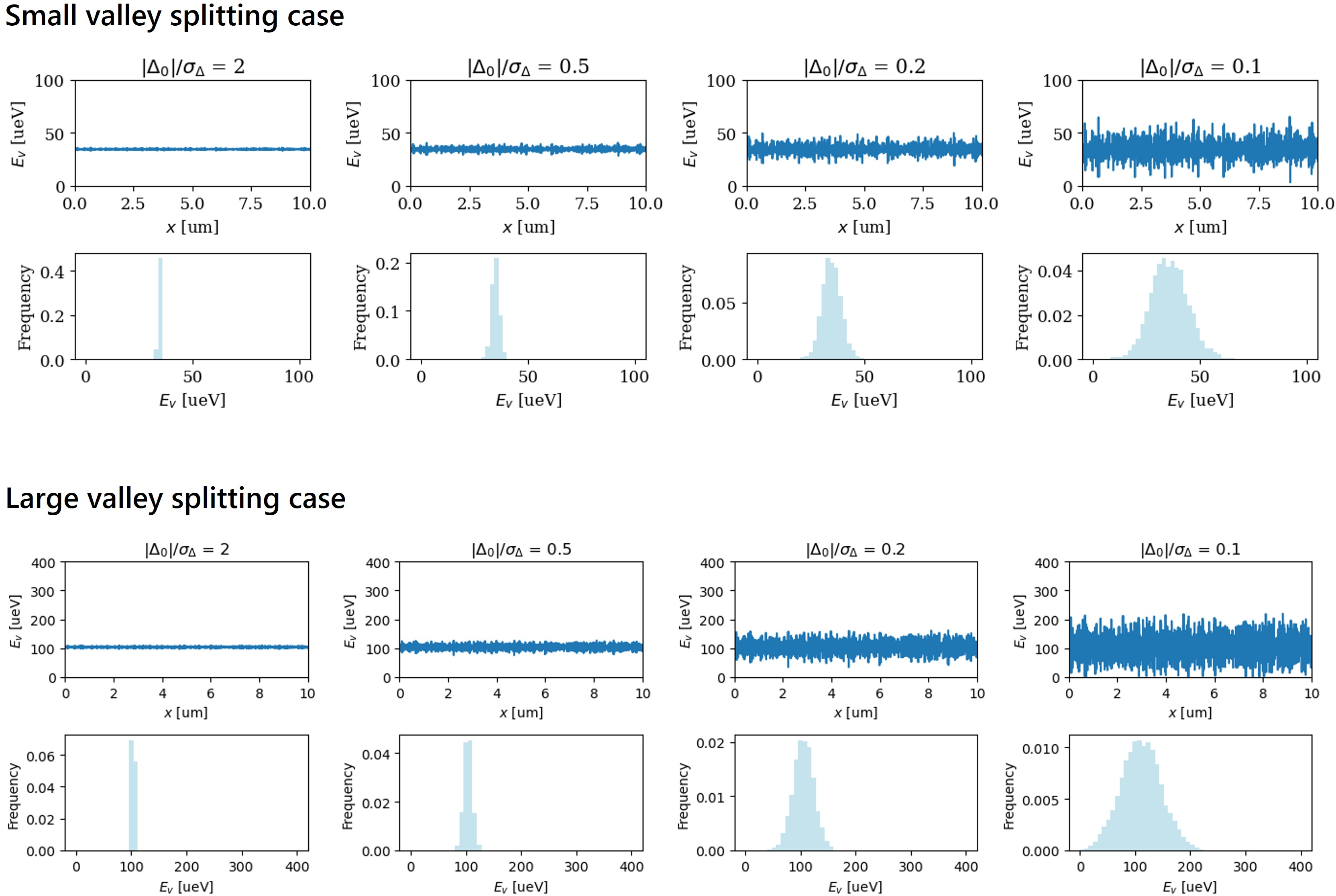
Figure 5: Typical valley coupling landscapes along the shuttling path for various disorder strengths, with larger disorder reducing the dominance of deterministic splitting.
The simulation incorporates not only the valley subspace but also spin dynamics and spin-valley mixing, calculating both spin purity and fidelity as metrics for qubit quality. The time evolution is computed via direct solution of the time-dependent Schrödinger equation.
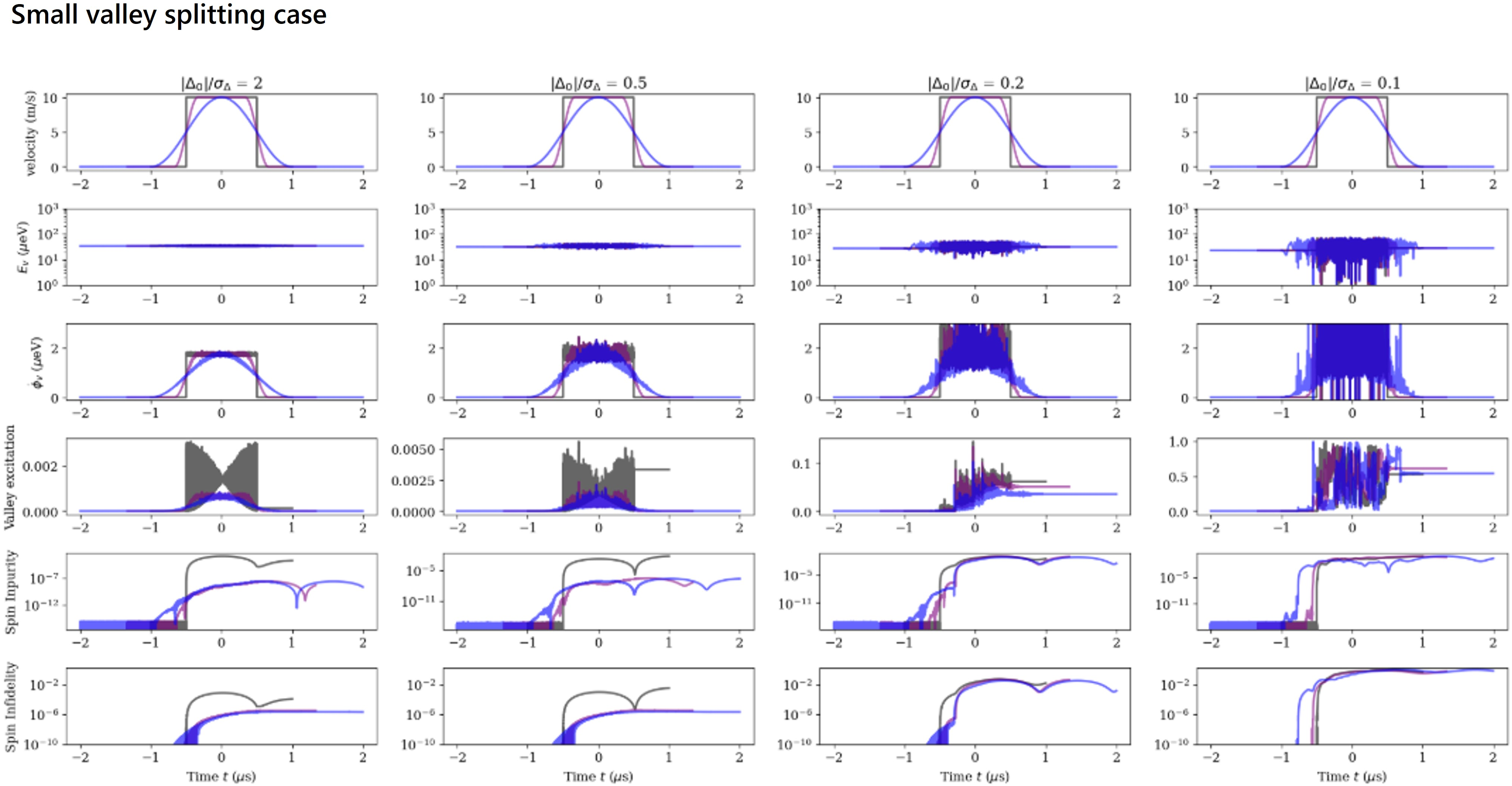
Figure 6: Time evolution of spin impurity (ϕ˙v6) and spin infidelity (ϕ˙v7) during shuttling for different disorder strengths and for several velocity shaping parameters. Smooth profiles suppress degradation except when disorder dominates.
The results demonstrate that, for moderate-to-low valley disorder (ϕ˙v8), increasing ϕ˙v9 provides a substantial reduction in spin infidelity, as non-adiabatic valley excitations are suppressed. In the regime of strong disorder (v(t)0), fidelity improvements by velocity shaping are marginal since interface-induced rapid variations dominate transition dynamics.
Robustness in High-Valley-Splitting Devices
An essential finding is that the efficacy of the velocity smoothing approach increases in devices engineered for large deterministic valley splitting (e.g., through interface quality or heterostructure design enhancements). In devices with v(t)1, high-fidelity shuttling is recovered by the smooth velocity protocol even for disorder strengths (v(t)2) where conventional methods fail to protect the qubit.
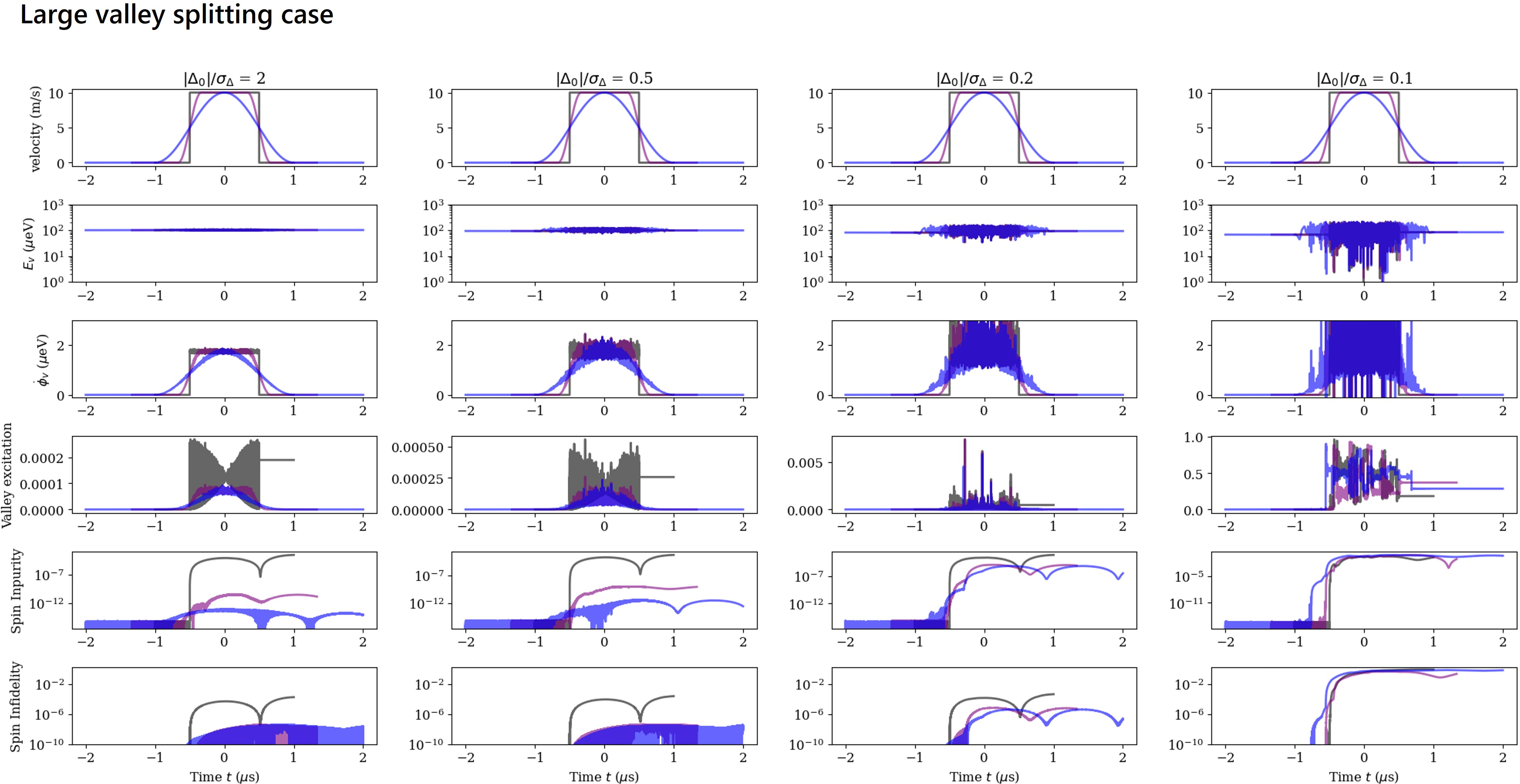
Figure 7: Fidelity and impurity dynamics with large deterministic v(t)3, showing improved robustness and extended regime in which velocity shaping protects quantum coherence.
Implications and Future Directions
This study establishes and validates an analytical design principle for high-fidelity spin shuttling via control-level velocity shaping, synergistically complementing ongoing efforts in material purification and deterministic valley engineering. By reframing the quantum control problem as one of spectral sidelobe suppression, the framework enables fast construction of physically implementable voltage sequences—contrasting with numerically intensive, device-specific, black-box optimization in the literature (Romero et al., 22 Apr 2026, David et al., 2024, Oda et al., 2024).
From a practical perspective, the outlined protocol is immediately compatible with scalable quantum dot arrays, where coherent spin shuttling on fault-tolerant timescales is mandatory. The approach is device-agnostic, and the insight can generalize beyond one-dimensional shuttling to more complex geometries required for advanced quantum error correction layouts.
Looking forward, incorporating additional decoherence channels—such as charge noise or spin-orbit disorder—into both the model and experimental protocols will be crucial for further enhancing transport fidelities. Furthermore, as device miniaturization and integration enable larger arrays, the generalization to two-dimensional transport protocols (e.g., through T-junctions, crossbars) using this spectral-design philosophy represents a pertinent research direction. Experimental work will also be required to validate the predicted synergy between material-level and control-level suppression of valley excitations in next-generation silicon quantum processors.
Conclusion
Smooth velocity shuttling, as presented, analytically links classical signal processing concepts with the suppression of non-adiabatic errors in quantum dot electron transport. The direct construction of frequency-modulated, physically feasible voltage sequences provides a robust and scalable means of maintaining high spin qubit fidelity in the presence of realistic valley disorder. Strategic combination of this control-level approach with deterministic valley engineering offers a clear pathway toward scalable, fault-tolerant silicon quantum computing (2606.01541).

