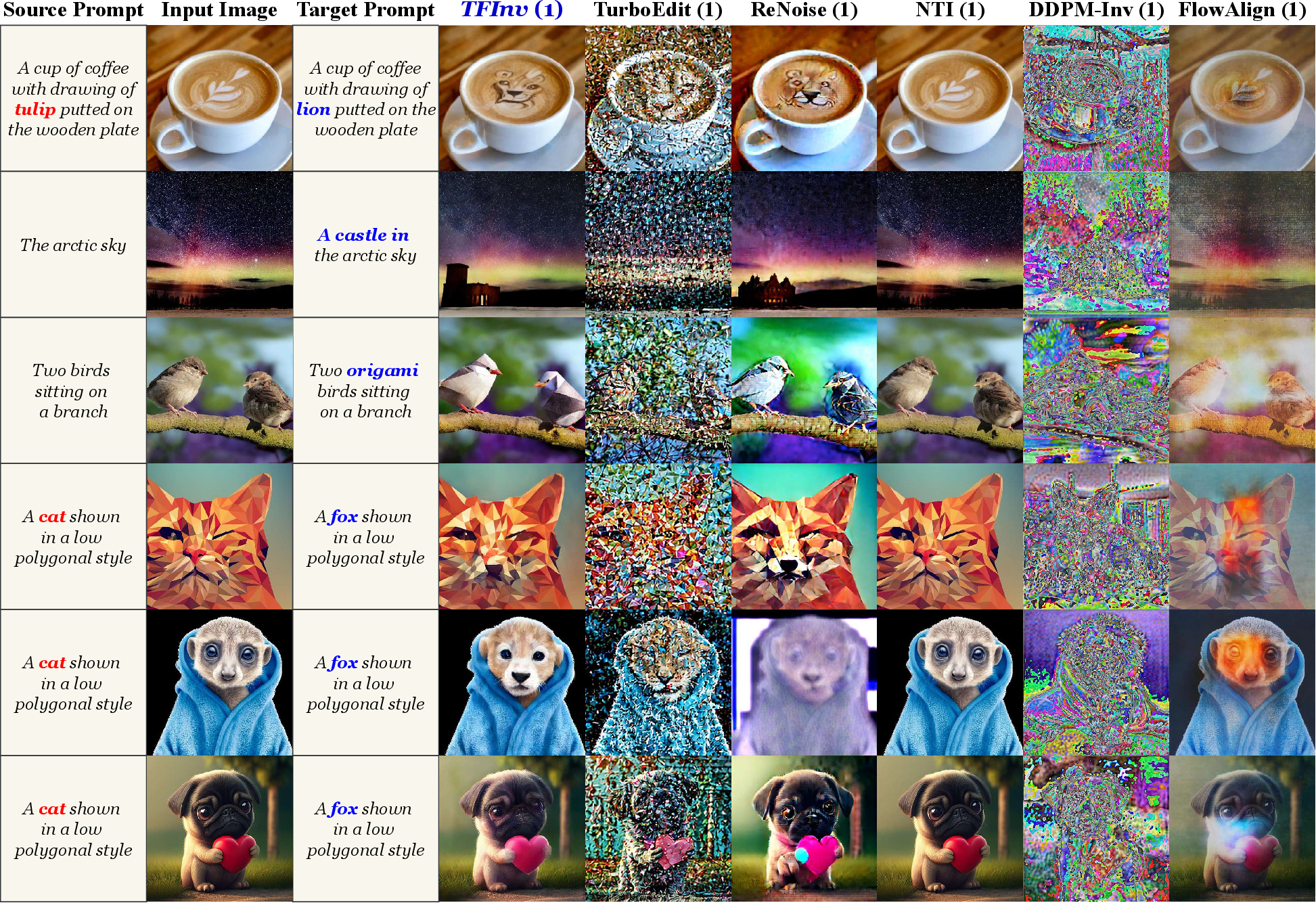
- The paper proposes a training-free inversion pipeline that employs iterative noise alignment and suffix token learning to overcome key challenges in one-step diffusion models.
- It identifies the caption gap and initial latent editability as critical factors, balancing reconstruction fidelity with prompt-based editability.
- Experimental results demonstrate superior performance over existing baselines on metrics like CLIP similarity, SSIM, and perceptual distance with minimal overhead.
Training-Free Inversion for One-Step Diffusion Models: Technical Overview
Introduction and Motivation
Text-to-image (T2I) diffusion models have catalyzed substantial progress in controllable semantic image generation and editing. The field has increasingly migrated from iterative, multistep denoising approaches toward highly efficient few-step or even one-step models, motivated by distillation, consistency regularization, and architectural innovations. These advances are transformative for user experience in interactive editing and on-device deployment, but pose acute challenges for real image inversion and subsequent semantic editing in the one-step regime.
"Training-free image inversion for one-step diffusion models" (2606.01380) addresses this bottleneck by dissecting the inherent difficulties in inverting one-step diffusion models for real images. The work identifies two critical factors—Initial Latent Editability and the Caption Gap—as the primary obstacles for faithful inversion and effective text-based editing. It then proposes a two-stage, training-free inversion pipeline: Iterative Noise Alignment and Suffix Token Learning, circumventing the need for dataset-specific model training. The method achieves not only precise reconstruction, but also robust prompt-based editing in the challenging one-step context, and demonstrates superiority over both existing training-free and training-based baselines.
Analysis of Inversion Pathologies
The paper begins with a rigorous empirical analysis of the inversion process. Two pathological phenomena are highlighted:
- Caption Gap: Divergence between the image semantics and textual captions impedes faithful inversion, as evidenced by systematic experiments varying caption conditioning. Inaccurate or misaligned captions bias the initial noise and degrade reconstruction/editability trade-offs.
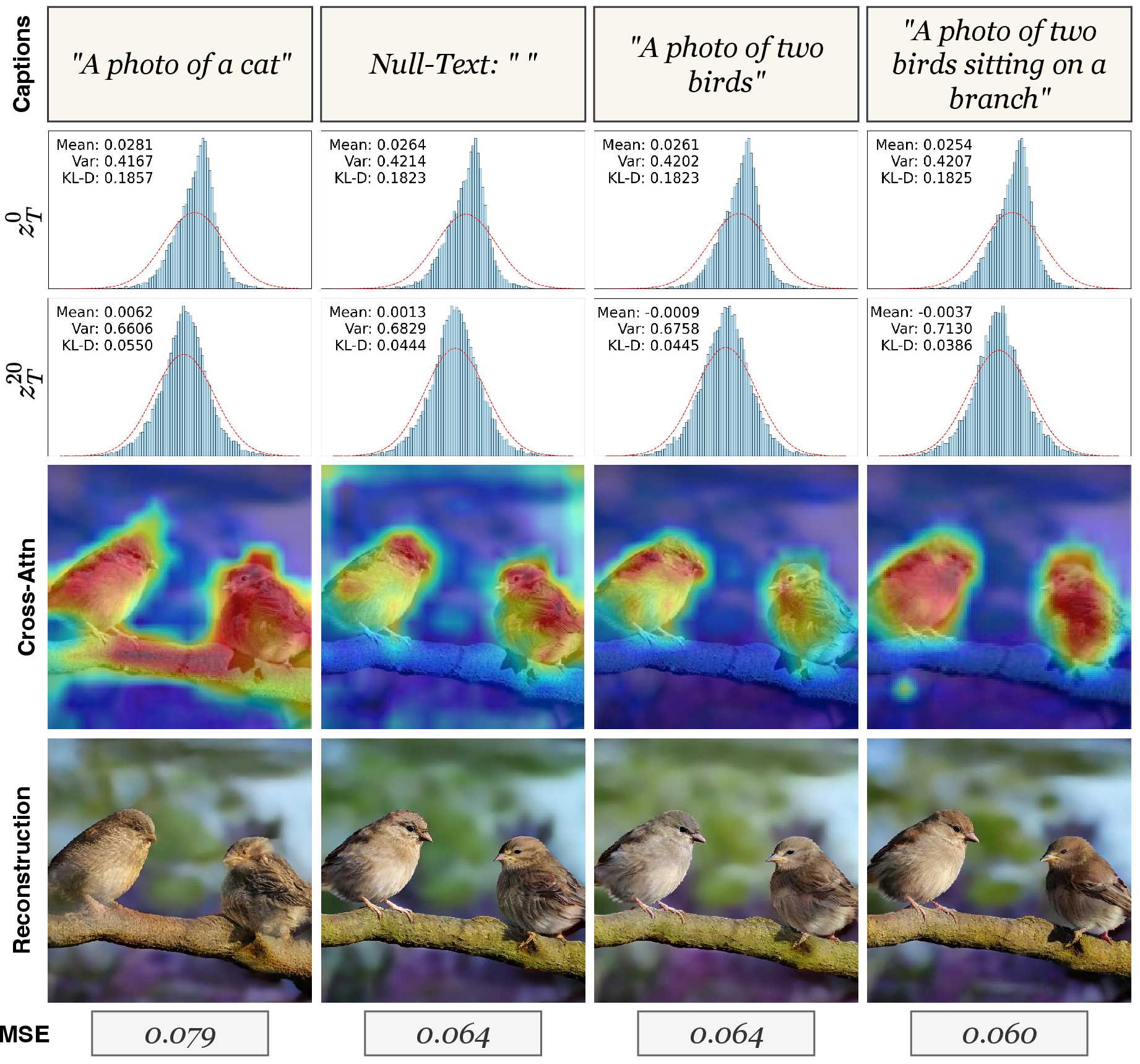
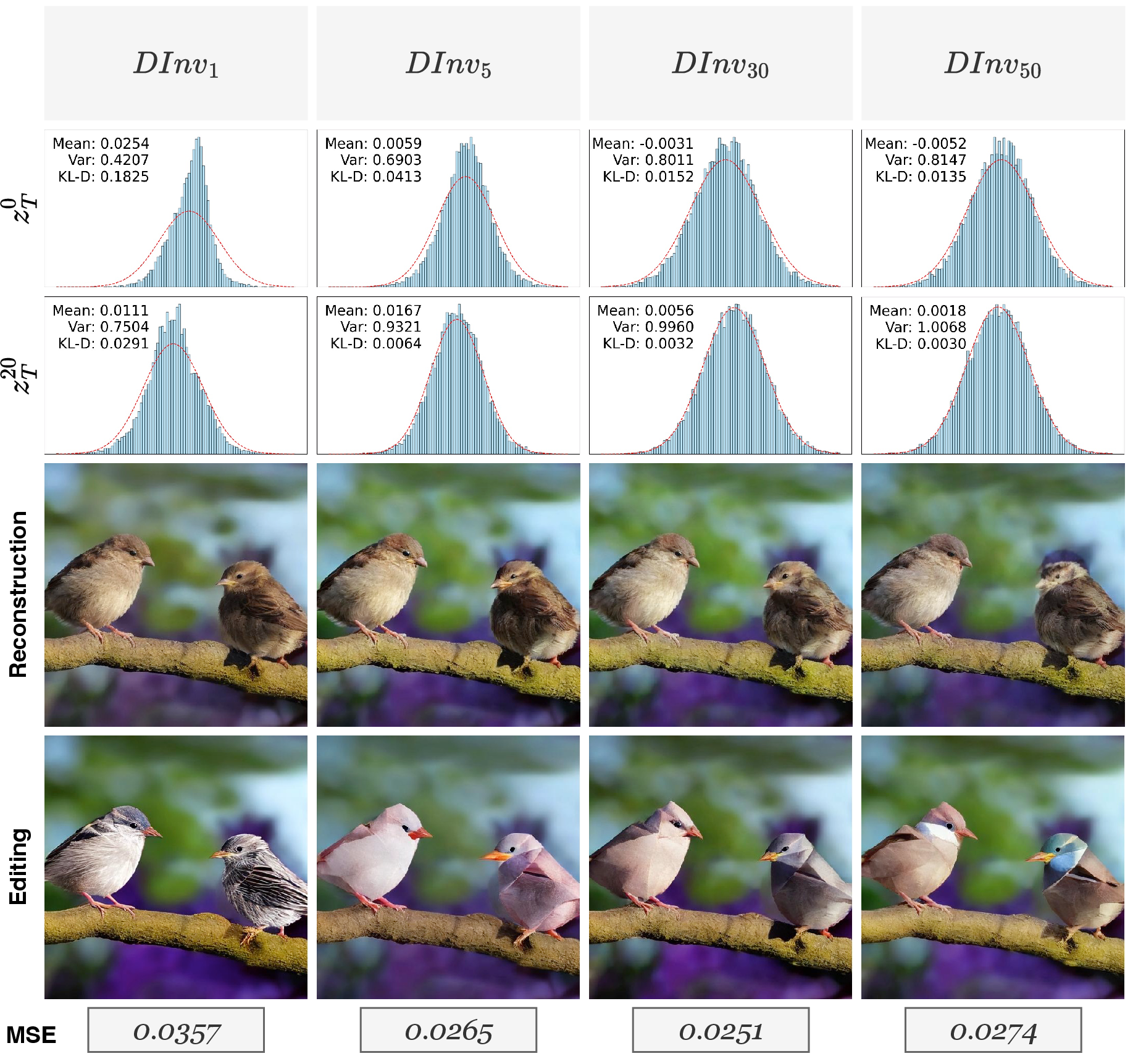
Figure 1: Caption gap influence on one-step inversion and editing under distinct caption sources or misalignment regimes.
- Initial Latent Editability: When fewer DDIM inversion steps are used, the resulting noisy latent retains excessive image-specific structure, yielding low-editability latents poorly aligned with the Gaussian prior. Conversely, more inversion steps improve editability but complicate accurate reconstruction due to distribution mismatch.
These findings point to a non-trivial trade-off between reconstructive fidelity and flexible editability, particularly severe in the one-step setting where classical iterative inversion is impossible.
Methodology: Training-Free Inversion Pipeline
The proposed pipeline consists of two synergistic, training-free optimization procedures:
Iterative Noise Alignment
Given an input image I, encoded into latent z0, initialize a noisy latent z~T via multi-step DDIM inversion. Then, iteratively refine z~T to minimize a composite objective:
L1=∥z0−z~0∥22+λDKL(z~T∣N(0,I))
where z~0 is the reconstruction via the (frozen) one-step generator. This procedure ensures that the refined z~T both lies close to the Gaussian prior (supporting future editability) and enables high-fidelity inversion.
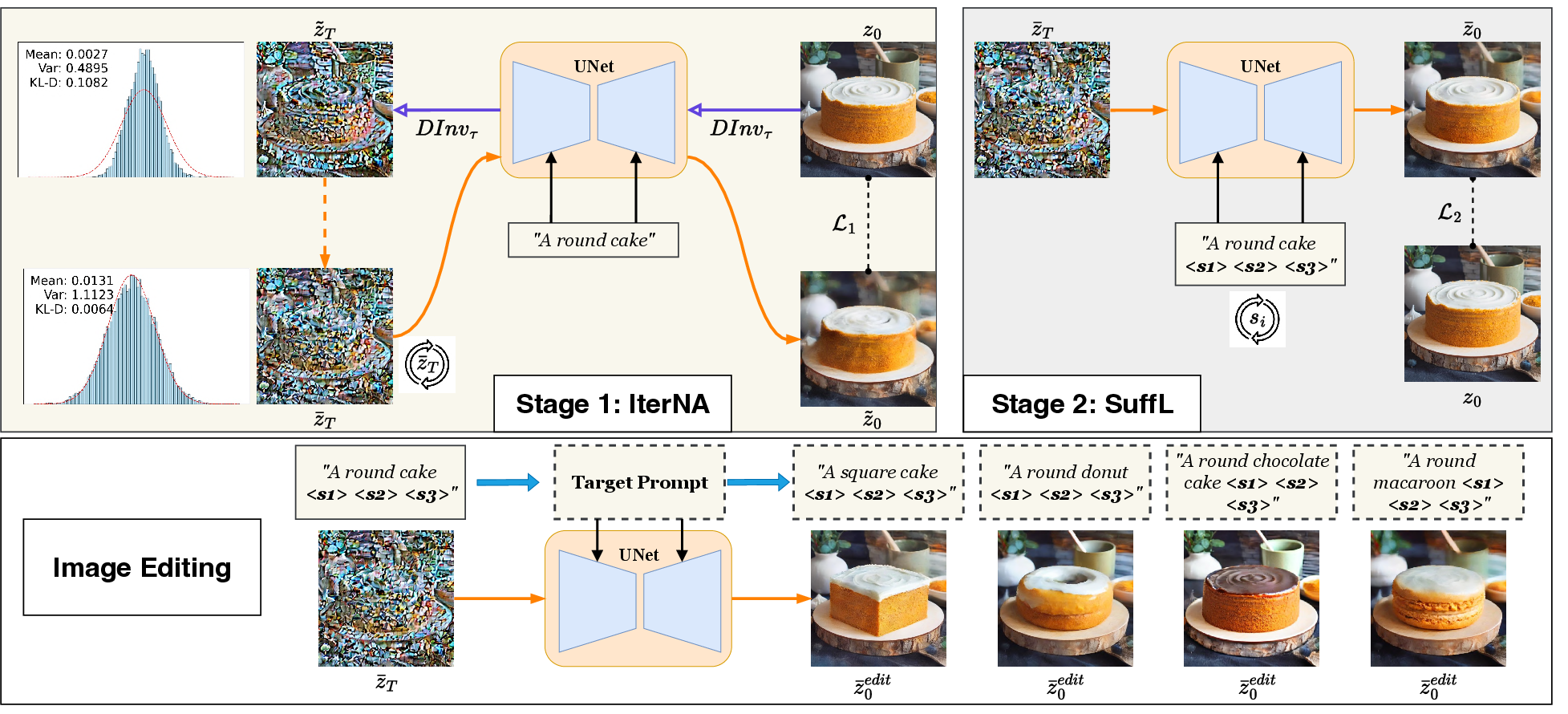
Figure 2: Two-stage training-free inversion pipeline: iterative noise alignment to match Gaussian prior while maintaining reconstructability, followed by prompt suffix token learning.
Suffix Token Learning
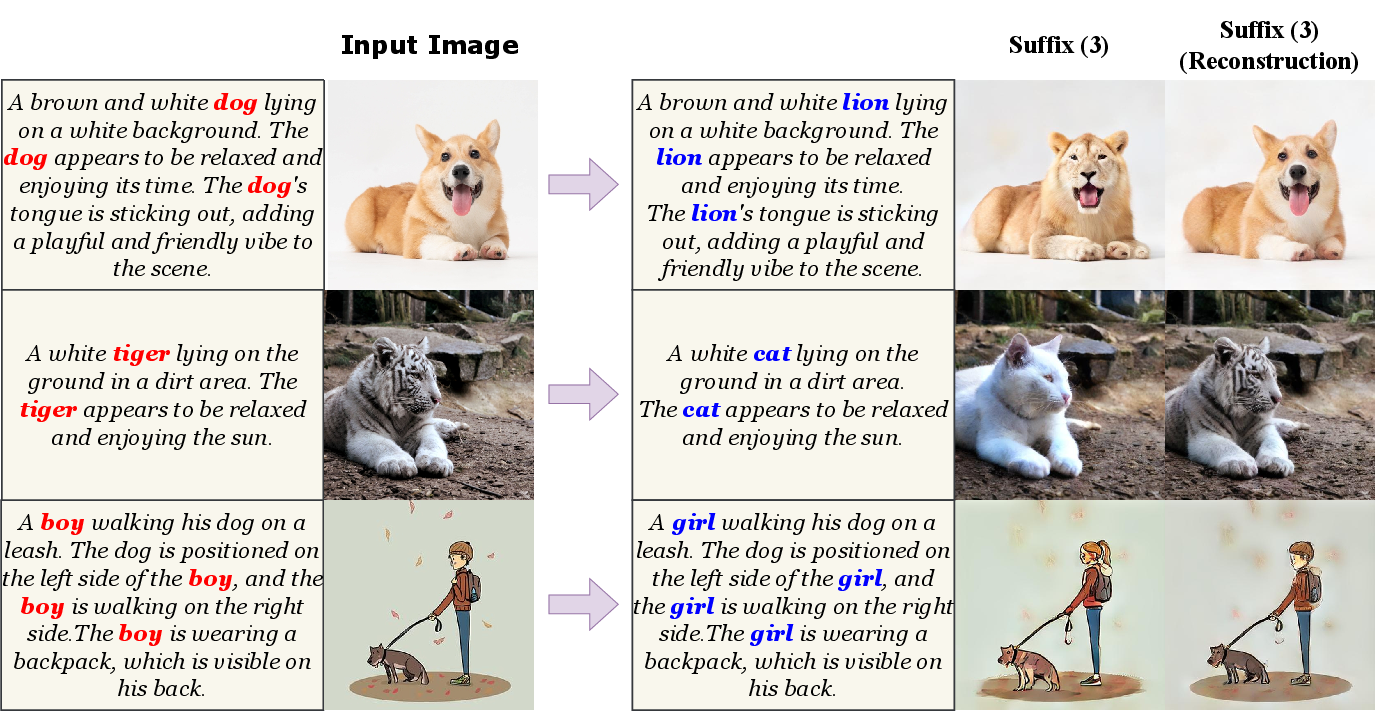
Directly optimizing the entire prompt embedding can overfit and destroy editing flexibility. The method instead appends a small set of learnable, non-semantic suffix tokens to each prompt. These tokens are optimized (via MSE loss on the reconstructed image) solely for improving inversion fidelity. Their decoupling from core prompt semantics preserves editability. Experiments indicate that as few as three suffix tokens provide a Pareto-optimal balance.
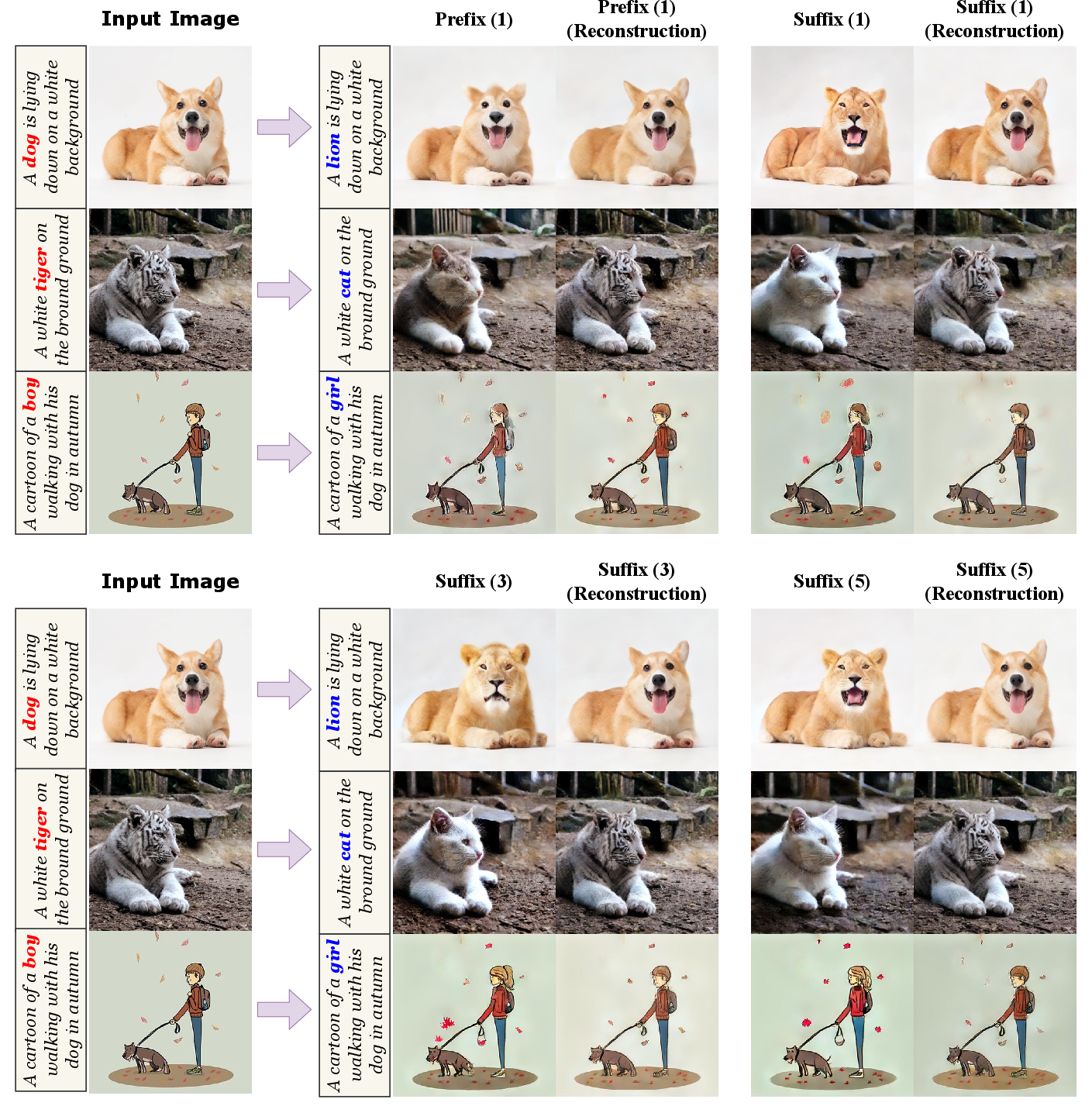
Figure 3: Prefix vs. suffix token learning: prefix tokens distort embeddings and harm editability, while suffix tokens (esp. 3) preserve edibility/reconstruction balance.
Editing and Masking Strategies
Prompt-based editing is performed by substituting the source prompt (plus the learned suffix) with the desired target prompt, reusing the fixed inverted noise. For locality, a mask is derived from the cross-attention maps accumulated during inversion, allowing for region-specific modification while preserving background fidelity. This cross-attention-driven mask mechanism introduces nuanced, spatially-aware composition without auxiliary models or annotation.
Experimental Results and Ablations
The method is comprehensively validated on the PIE-Bench dataset, utilizing diverse edit types and structural/semantic metrics. Key findings include:
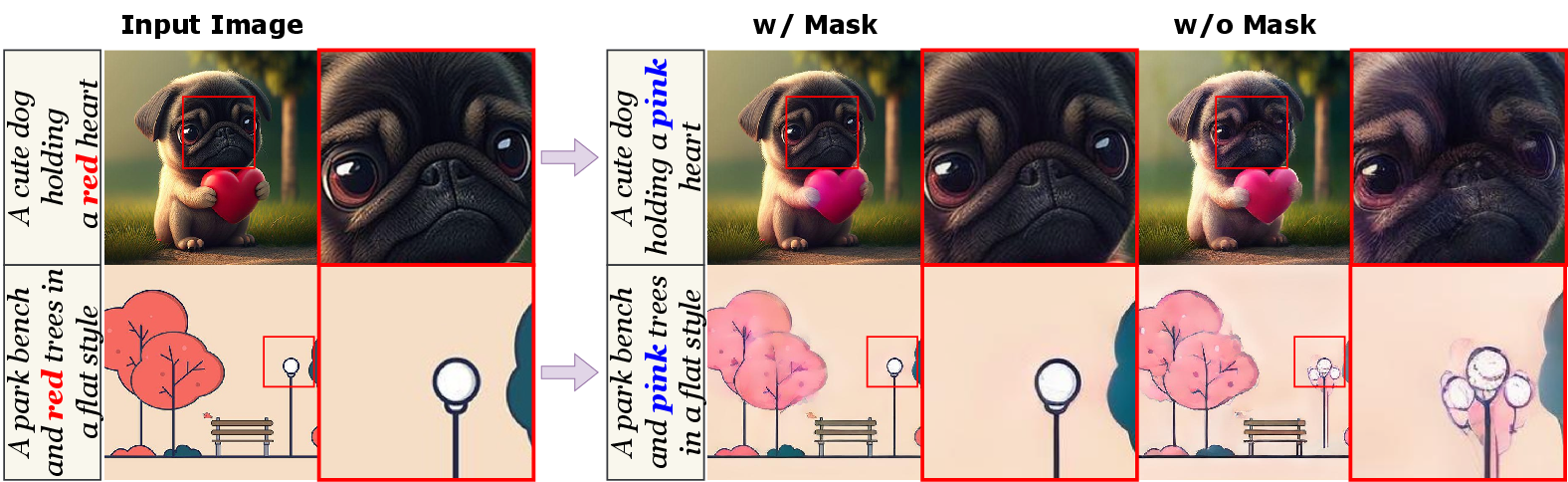
Figure 5: Robustness to complex and repetitive captions: effective editing and strong reconstruction with semantically entangled prompts.
Generalization is evidenced by application to alternative one-step architectures such as LCM, confirming architectural orthogonality.
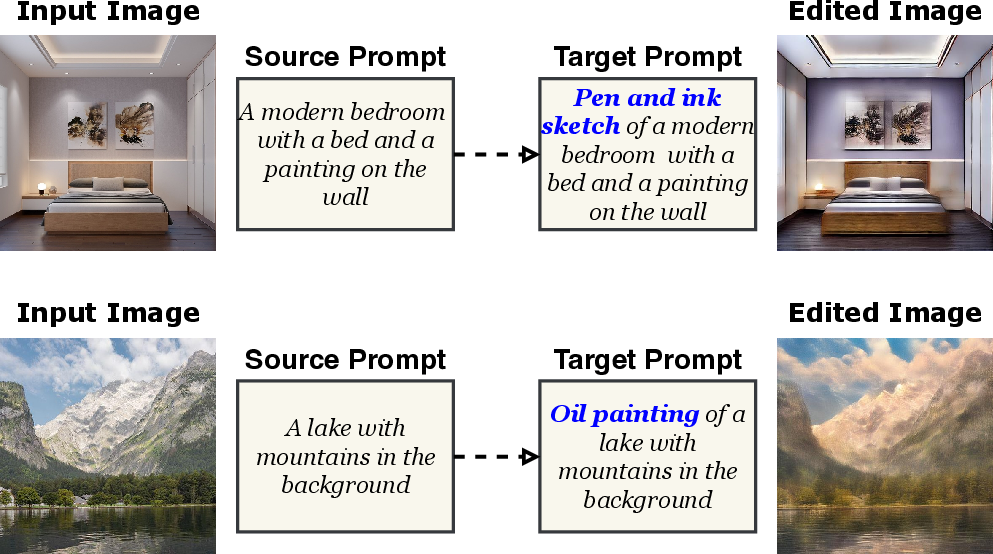
Figure 6: Generalization of the method across SD-Turbo and LCM backbones.
Implications and Future Directions
This work demonstrates that training-free inversion and editing for one-step diffusion models is achievable with proper objective design and conditioning regularization. The critical innovations—noise alignment and suffix tokens—translate to improved computational efficiency during editing phases (single forward pass post-inversion) and minimal memory overhead. However, the (once-per-image) inversion optimization remains moderately expensive.
Practically, the approach enables scalable, rapid semantic editing suitable for interactive and resource-constrained applications, notably avoiding the impracticalities of dataset-level retraining. Theoretically, the identification and mitigation of the caption gap and latent editability illuminate core limitations of text-conditioned diffusion inversion, especially in the distilled regime.
Future work may focus on:
- Reducing computational cost of the inversion phase (e.g., better initialization, gradient-free optimization).
- Extending the approach to non-U-Net/Transformer diffusion backbones.
- Improving suffix token interpretability and generalization for multi-modal semantic editing tasks.
Conclusion
This study establishes a robust, training-free methodology for real image inversion and text-driven semantic editing in one-step diffusion models. The combined iterative noise alignment and suffix token learning confront the unique trade-offs at the heart of one-step inversion, yielding strong empirical performance and laying the foundation for further acceleration and generalizability in diffusion-based image editing systems.