- The paper proposes the MPVI framework that interleaves classical motion planning with VLA models to mitigate navigation failures and execution order confusion.
- It leverages an LLM-based subtask planner and proprioceptive completion checks to manage subtask progress and reduce error-prone transitions.
- Experimental results reveal a 113% mean Q-score improvement on BEHAVIOR-1K, demonstrating enhanced robustness without additional data.
Interleaving Classical Motion Planning with Vision-Language-Action Models for Robust Long-Horizon Mobile Manipulation
Introduction and Motivation
The paper "Make Your VLA More Robust Without More Data By Interleaving Motion Planning" (2606.00985) proposes a hybrid framework — MPVI (Motion Planner / VLA Interleaving) — that integrates classical motion planning (MP) with Vision-Language-Action (VLA) models to robustify performance in long-horizon mobile manipulation tasks, particularly without requiring additional data or retraining. Empirical performance of VLAs, even those finetuned on large expert-collected datasets, remains limited on benchmarks like BEHAVIOR-1K, especially for extended, spatially distributed tasks. Major failure modes include navigation failures, execution order confusion, and compounding task errors. These are largely architectural issues that data augmentation cannot resolve, as demonstrated by persistent poor performance on BEHAVIOR-1K (≤12.4% success rate even at the competition state-of-the-art).
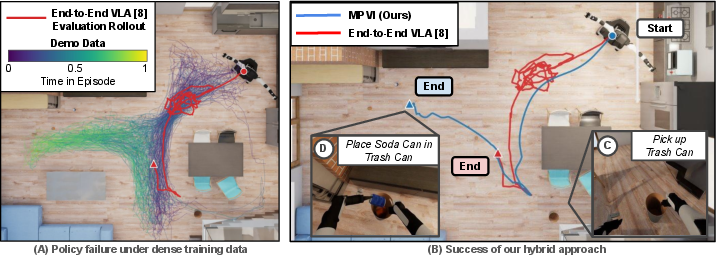
Figure 1: End-to-end VLA models (red) fail on evaluation tasks even when the training data distribution is dense, due to structural limitations. MPVI (blue) integrates classical planning for navigation to resolve such failures and reliably complete complex tasks (C, D).
Motivated by the complementary capabilities of model-based planning (reliable navigation, spatial task decomposition) and learning-based VLAs (dexterous manipulation, vision-language grounding), the authors formalize an integration framework to explicitly route control between these modules, leveraging learned strengths where they are most effective.
MPVI Framework
The MPVI architecture consists of five modules: (1) LLM-based Subtask Planner, (2) Orchestrator, (3) Navigation Policy (classical MP), (4) Manipulation Policy (VLA), and (5) Completion Checker (VLM). This modular design allows seamless task-centric delegation and switching of responsibilities depending on subtask semantics and system state. The overall data/control flow is shown in Figure 2.
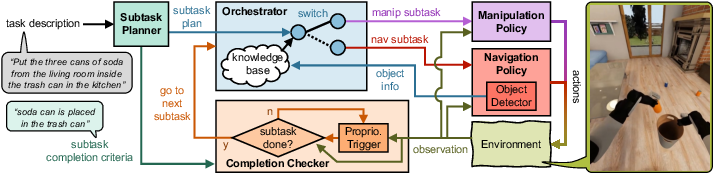
Figure 2: MPVI control structure, where an Orchestrator switches between Manipulation and Navigation modules based on the subtask plan from an LLM. The Completion Checker, triggered by proprioception, queries a VLM to assess subtask completion.
Subtask Planning and Orchestration
Long-horizon tasks are decomposed into a sequence of navigation and manipulation subtasks via LLM prompting, with explicit completion criteria (world-state predicates). The Orchestrator maintains a knowledge base of environment semantics and routes each subtask: navigation subtasks are delegated to the classical motion planner, while manipulation subtasks are batched and passed to the VLA. Progress tracking and failure handling are managed centrally in the Orchestrator to ensure reliable transitions and enable memory over subtasks and discovered object locations.
Navigation and Object Localization
For navigation, classical A* planning is employed, using a semantic traversability map and localization. In scenarios where object locations are not pre-known — a realistic household robotics assumption — open-vocabulary object detection (GroundingDINO) and frontier-based exploration strategies are utilized for robust search and localization. Once the robot is within a predefined proximity to the target, control is handed off to the VLA for manipulation primitives.
Manipulation Execution
Manipulation is handled by a VLA (openpi-comet, based on π0.5, finetuned for BEHAVIOR-1K), which receives localized subtask instructions and sensory inputs. MPVI's contribution is not in developing a new VLA, but in optimally integrating VLAs with planning machinery by specifying when and how control transitions should occur.
Completion Checking
A persistent challenge in prior VLA systems is unreliable detection of subtask completion, leading to premature terminations or failure cascades (see Figure 3). The paper introduces a proprioception-triggered VLM Completion Checker. Instead of frequent, error-prone VLM polling, checks are triggered when robot states (e.g., gripper closes) indicate potential completion, reducing queries and hallucination risks.
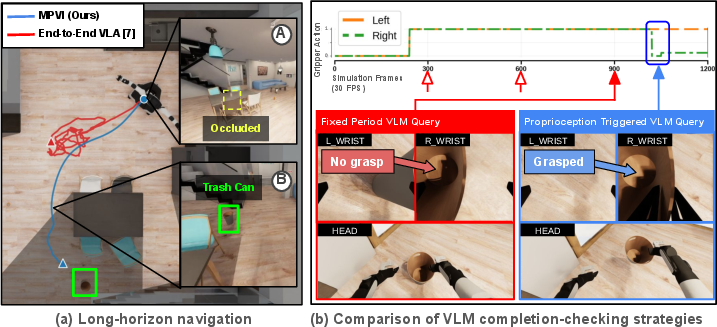
Figure 3: Baseline VLA (red) fails to locate occluded objects and produces false-positive completions; MPVI (blue), with proprioceptive VLM querying and frontier exploration, achieves reliable subtask progress.
Experimental Results
BEHAVIOR-1K Evaluation
MPVI is evaluated on the full BEHAVIOR-1K NeurIPS 2025 Challenge set (50 long-horizon tasks, 10 randomizations each) using standard metrics: Q-score (fraction of goal predicates satisfied), normalized simulation time, base/effector distance. The primary baseline is openpi-comet (whole-body VLA), which achieves 11.4% task success in the official evaluation setting.
MPVI achieves a mean Q-score improvement of 113% over the openpi-comet baseline, with progress gains on 31 tasks, parity on 16, and regression on only 3. Detailed per-task statistics reveal concentration of gains in tasks with spatially distributed multiple subgoals, aligning with failure analyses identifying navigation and sequencing as the chief bottlenecks.
Efficiency metrics indicate that, when controlling for task progress, motion-planner-based navigation is only marginally more efficient than learned navigation (4.5% less base distance, 9.8% less time). The main benefit of MPVI manifests as robust long-horizon compositionality rather than mere efficiency at subtasks.
Ablation Studies
Ablations isolate contributions of (1) task decomposition only, (2) object search and detection methods, and (3) completion checking strategy. Results Figure 4 indicate:
- Subtask prediction alone (without classical MP) yields a 31% Q-score drop compared to MPVI, though still outperforms end-to-end VLA.
- Oracle object localization provides marginal additional gains, indicating that current detection modules are not a major bottleneck except in large, open scenes.
- Removing proprioceptive completion triggers reduces Q-score by 47%, validating the importance of semantically precise completion checking for reliable control switching.
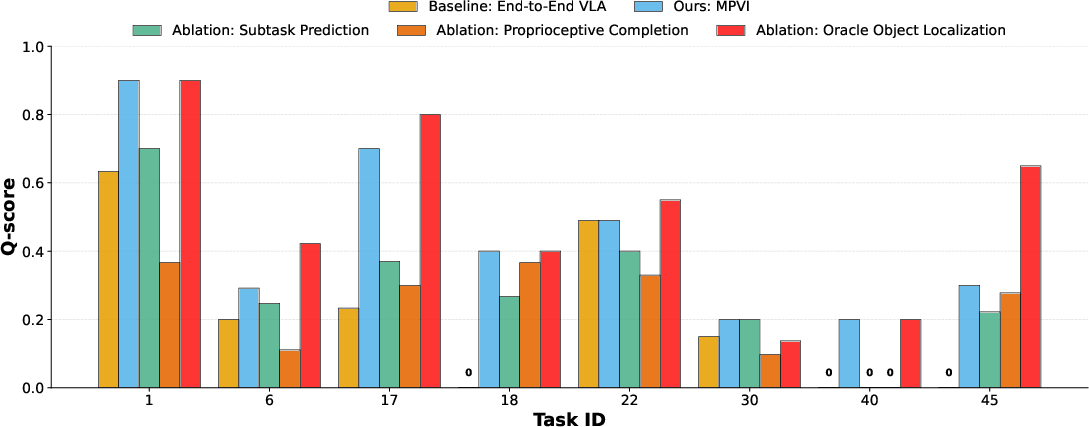
Figure 4: Q-score improvements from full MPVI and ablations. Performance drops precipitously when removing classical planning (Subtask Pred.), proprioceptive triggers (No Prop. Trigger), or with poor object localization.
Qualitative Analysis of Failure Modes
The authors document and visualize Figure 5 the principal failure modes of end-to-end VLAs: (i) search failures for occluded/non-visible targets, (ii) premature task terminations from hallucinated completion, and (iii) execution-order confusion (e.g., objects picked before containers are open). All such errors are resolved in MPVI via robust sequentialized routing and principled state checks between modules.
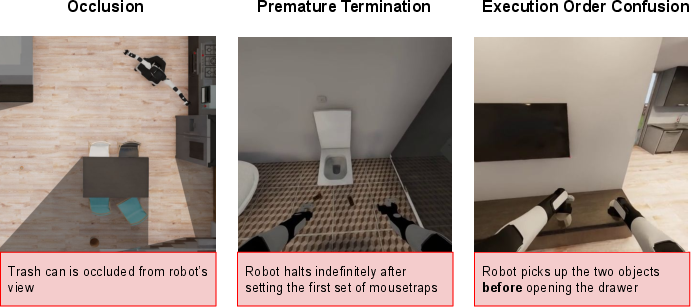
Figure 5: Three classes of end-to-end VLA failures (occlusion, preemptive stop, order confusion) are systematically addressed by MPVI mechanisms: frontier exploration, completion-triggered routing, and explicit subtask ordering.
Implications and Future Directions
Theoretical Significance
MPVI's results demonstrate that the primary limitations in current long-horizon robotic control derive from architectural segmentation of skills and structural error propagation, not necessarily from insufficient data or the need for more extensive pretraining. The hybridization of classical planning and learned policies, with explicit task-aware switching, yields substantial robustness improvements even when using existing VLA policies.
Practical Impact
From a deployment perspective, MPVI reduces cumulative error, enhances interpretability, and improves progress rates in realistic embodied settings without requiring further data collection or retraining. It points towards a principled hybrid architecture for embodied AI, with the orchestration logic acting as a meta-policy over hierarchical skills. This segmentation could ease troubleshooting, benchmarking, and explainability in fielded robotic systems.
Open Challenges and Future Work
Key limitations are noted: the requirement for an a priori traversability map (restricting online application to environments lacking robust mapping) and the lack of model-based intervention for non-navigation manipulation failures (e.g., dexterous assembly tasks). Future progress could focus on:
- Online semantic mapping and room discovery to relax environmental assumptions
- Adaptive intervention strategies to trigger classical/planning modules not just at static boundaries, but in response to dynamic signals (e.g., learned failure detection, deviation from demonstration manifold)
- Expanding the integration to model-based manipulation planning, e.g., for intricate pre-grasp or assembly subtasks
Theory-driven research may also formalize the conditions and triggers for reliable, learnable handoff mechanisms between model-based and model-free skill components.
Conclusion
MPVI provides compelling evidence that principled interleaving of classical motion planning and VLA-based policies, anchored by LLM-driven subtask planning and proprioceptive VLM completion checks, dramatically improves robustness on long-horizon mobile manipulation benchmarks. The performance improvements are achieved without additional data, underscoring that key architectural innovations can surpass brute-force scaling in embodied AI. As VLA models and embodied agents continue to scale, the development of hybrid, orchestrated frameworks with explicit failure recovery and skill partitioning will likely define the next wave of advancements in robust, general-purpose robot autonomy.

