Macro-aware time series forecasting via hierarchical mixed-frequency attention models
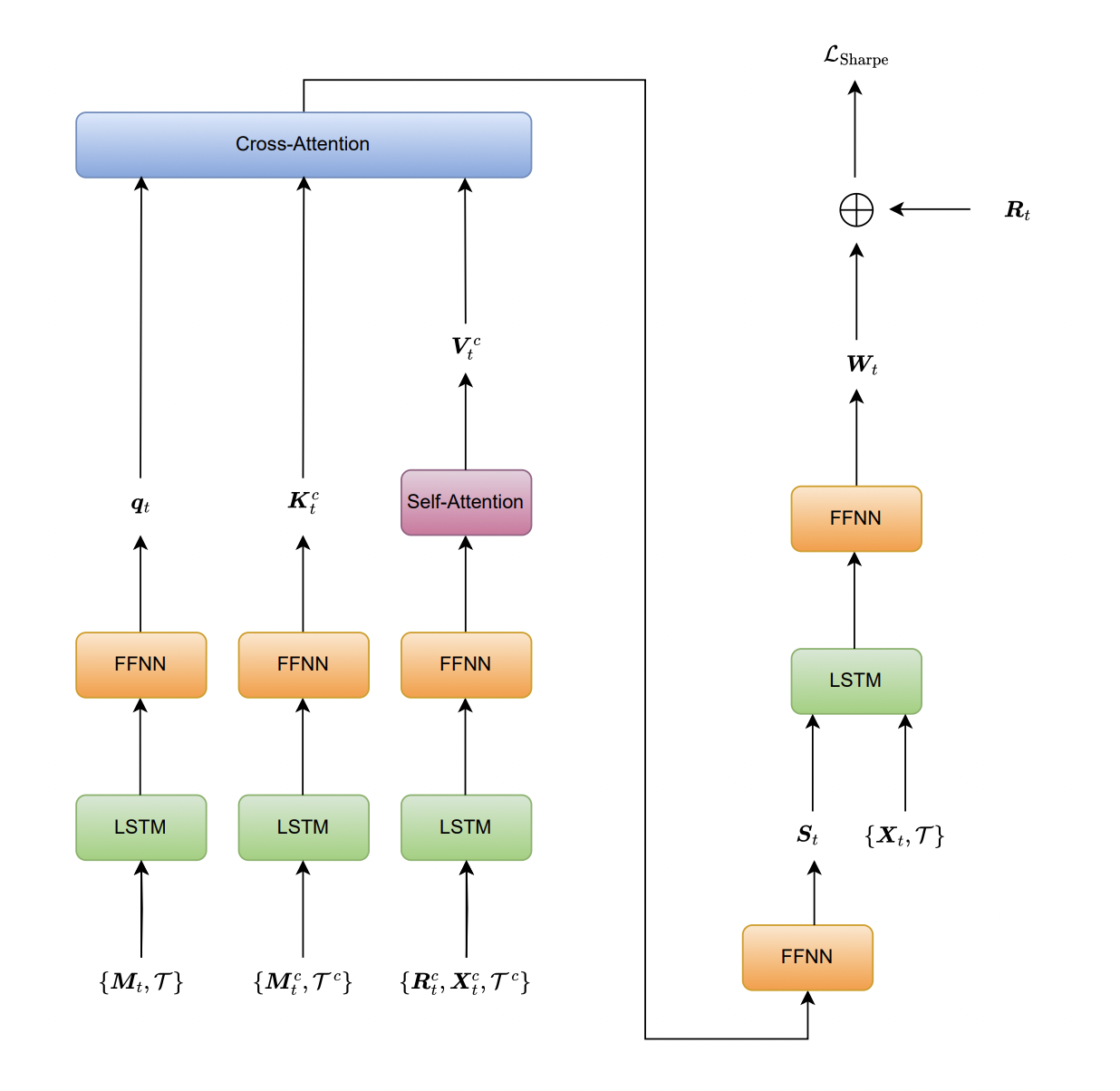
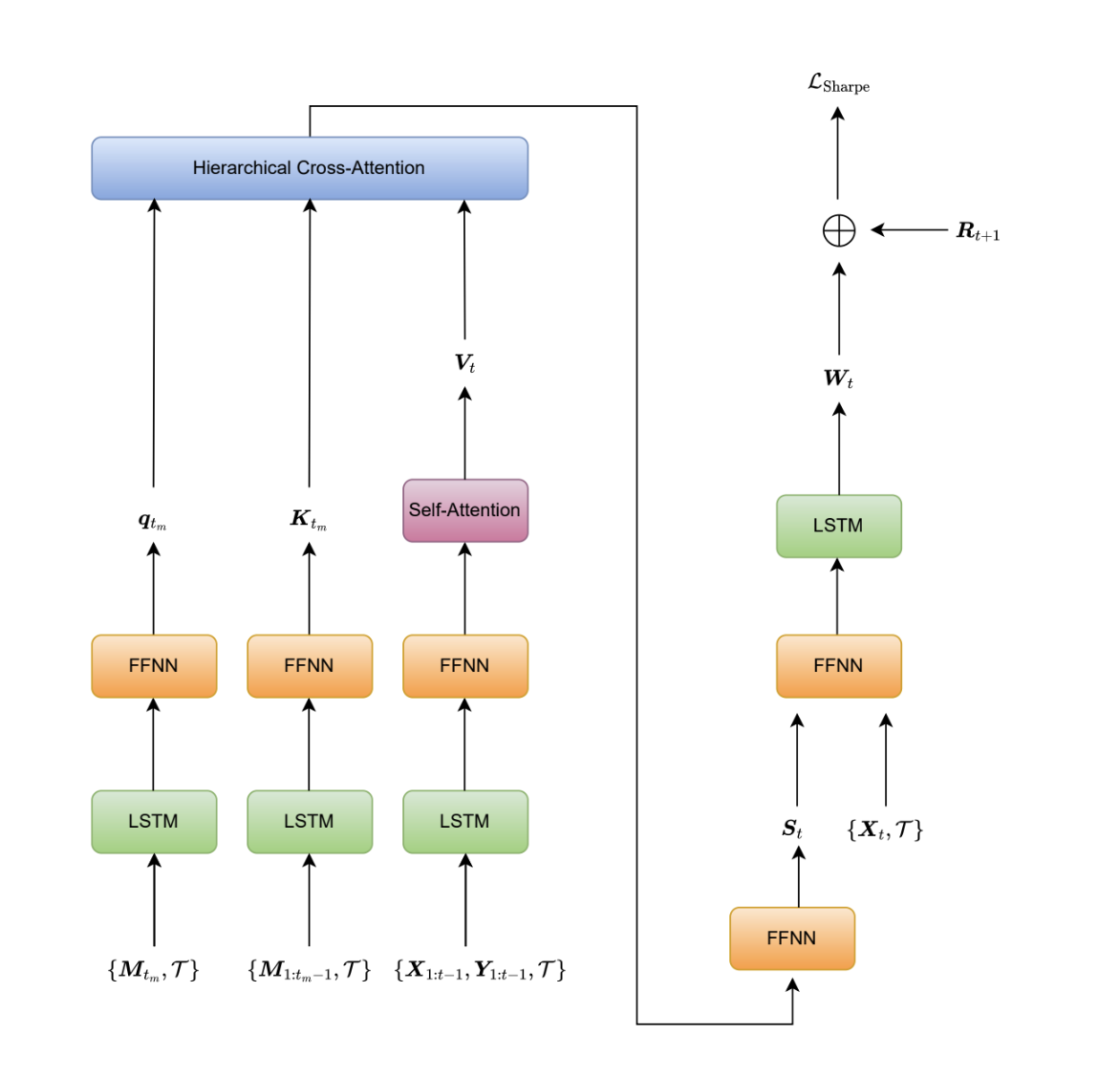
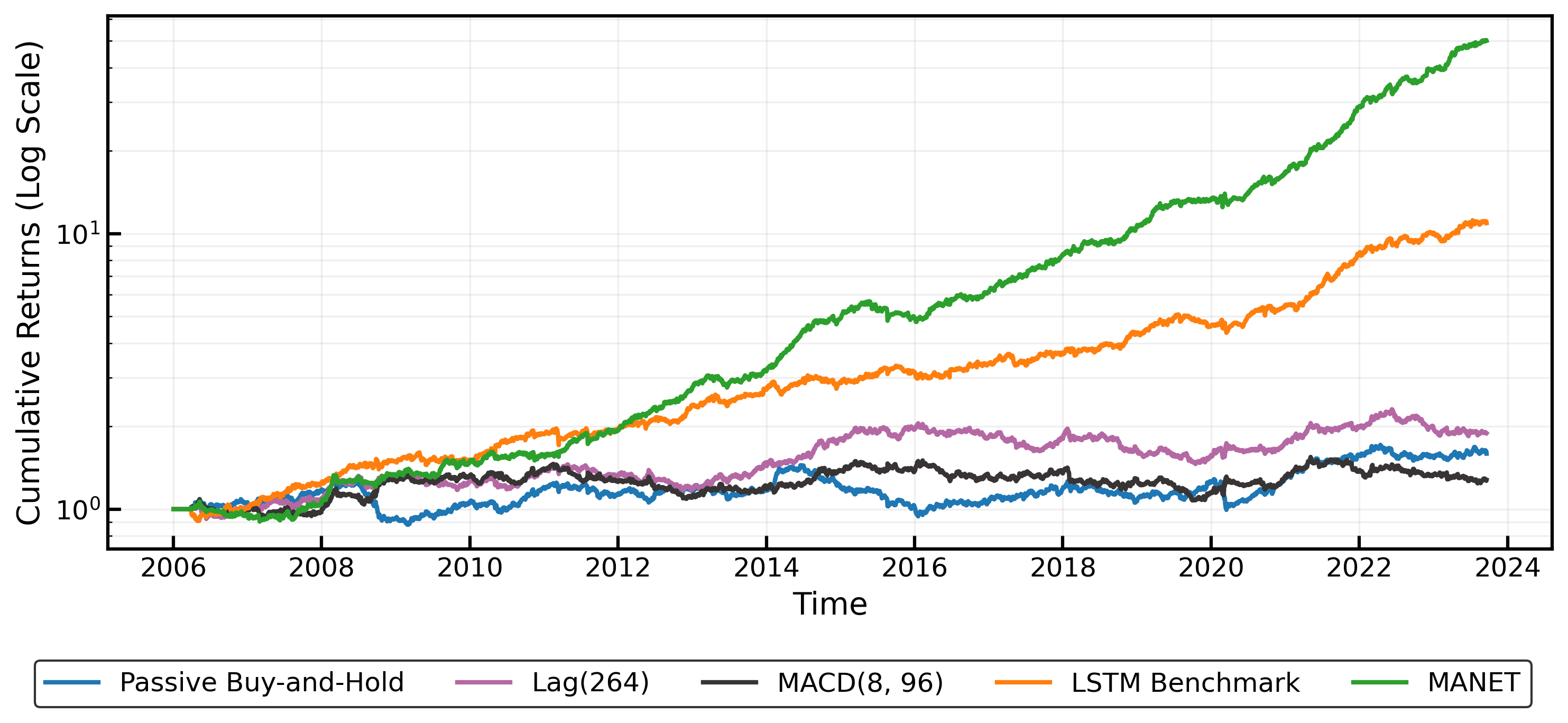
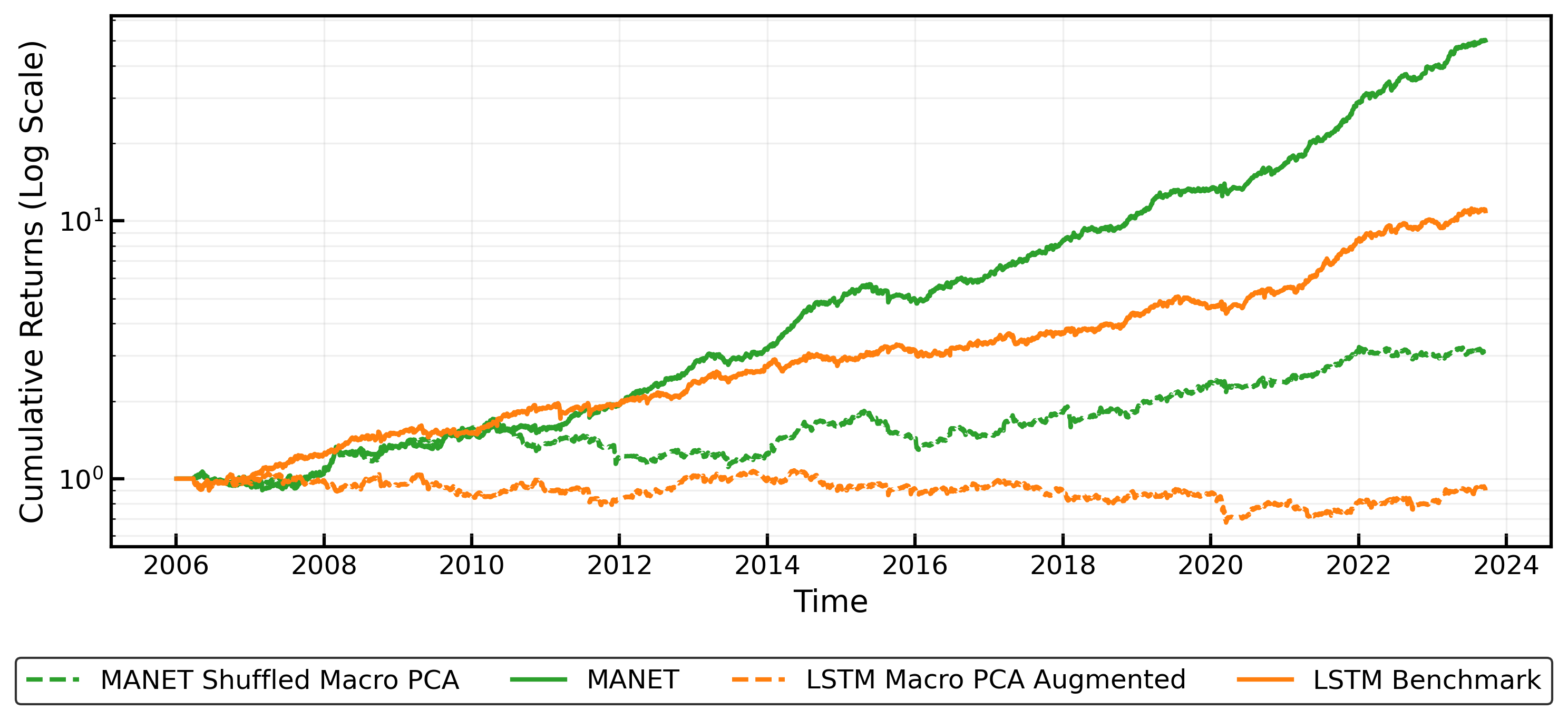
Abstract: Deep learning models show promise in financial forecasting, yet their generalization is often undermined by small datasets, noisy signals, and non-stationarity. While meta-learning and related techniques mitigate some of these issues, they typically do not account for a core limitation in macro-financial prediction: the scarcity of distinct macroeconomic regimes that drive asset returns. We introduce HANET (Hierarchical Attention Network), a hybrid LSTM-based architecture that integrates macroeconomic domain knowledge through attention over long-run macro contexts while preserving high-frequency market dynamics. HANET organizes information in a hierarchical mixed-frequency structure, with daily asset-return signals nested within monthly macroeconomic windows, and introduces a Hierarchical Cross-Attention mechanism that reconciles low-frequency macro signals with high-frequency returns without discarding granular daily information. By framing regime selection as attention over macroeconomic contexts, the model adapts to scarce and shifting regimes. Empirically, across 55 liquid futures spanning multiple asset classes, HANET consistently outperforms neural forecasters that ignore macroeconomic information, particularly during turbulent periods, improving risk-adjusted returns and mitigating losses. Ablation studies show that these gains rely on structured macro conditioning rather than naive feature augmentation: an LSTM with the same macro representation performs poorly, and shuffling macro contexts substantially degrades performance. Finally, HANET provides interpretability through attention weights, highlighting which historical regimes are most influential for each forecast and linking macro conditions to portfolio outcomes. These results establish HANET as a systematic approach to integrating macroeconomic information into attention-based deep learning for financial forecasting.
Paper Prompts
Sign up for free to create and run prompts on this paper.
Top Community Prompts
Explain it Like I'm 14
What is this paper about?
This paper is about building a smarter way to predict how different financial markets (like commodities, currencies, bonds, and stock indexes) will move day by day. The key idea is to mix two kinds of information:
- fast-changing daily price moves, and
- slow-changing monthly economic conditions (like inflation and jobs data).
The authors design a model called HANET that “looks up” past economic situations similar to today’s, and then uses that context to guide its daily trading decisions.
What questions are the authors trying to answer?
In simple terms:
- Can a deep learning model do better at daily market forecasting by paying attention to the big-picture economy?
- How can we combine slow, monthly economic data with fast, daily market data without losing important details?
- Does this kind of “macro-aware” approach actually improve performance, especially in tough times like crises?
- Can the model explain which past economic periods influenced its decisions?
How does the model work? (Explained simply)
Think of forecasting like planning a trip:
- Daily market prices are like the weather right now—changing quickly.
- The broader economy is like the season—changing slowly but shaping the weather patterns.
The challenge: You want to use both. If you only look at daily prices, you miss the season. If you only look at the season, you miss today’s cloud cover.
The model (HANET) solves this by using a few key ideas:
- Hierarchical, mixed-frequency design:
- Monthly “macro” snapshots (economy) form a long-term context.
- Daily market signals (prices, trends) carry the fine details needed to trade.
- Attention mechanism:
- Attention is like a spotlight that searches history for months when the economy looked similar to now.
- The model assigns higher weights to those past months and uses what happened then to help decide what to do today.
- It computes this “spotlight” on the monthly timeline and then spreads those weights over the daily data in the same months, so we keep all the daily detail.
- LSTM “memory”:
- An LSTM is a kind of neural network that remembers what happened recently. Here, it processes daily market data to capture patterns like momentum (trends) and carry (benefits implied by futures prices).
- Another LSTM processes the monthly macro data to represent the broader economic state.
- Putting it together:
- Monthly attention figures out which past economic regimes matter most right now.
- Those monthly weights are projected onto the daily market data from those months.
- The model then blends that weighted daily information to make a daily trading decision.
Key terms in everyday language:
- Regime: A kind of “season” in the economy (e.g., high inflation, recession, recovery).
- Momentum: A trend-following idea—if an asset has been going up, it may keep going up for a while (and vice versa).
- Carry: A built-in return you can infer from futures prices (like earning interest in currencies or from the slope of commodity futures curves).
- Attention: A way for the model to focus on the most relevant pieces of information, like highlighting the most similar past situations.
- Mixed frequency: Combining slow data (monthly macro) with fast data (daily prices).
What did they test and how?
- Data:
- 55 highly traded futures across several asset classes (commodities, currencies, equity index futures; bonds included for trends but excluded from carry because of missing inputs).
- Daily prices and signals to capture momentum and carry.
- Monthly U.S. macroeconomic data (FRED-MD), cleaned to avoid “peeking into the future” and reduced with PCA into a few main factors.
- Tasks:
- Predict time-series strategies for each asset (treat each asset on its own), focusing on momentum and carry.
- Turn model predictions into positions (long/short) with risk controls, so no single market dominates the portfolio.
- Comparisons:
- Standard neural models that only use daily prices/signals.
- The same kind of model but with macro simply “glued on” as extra features (no special structure).
- Variants of HANET with pieces removed or shuffled (ablation studies) to see what really matters.
What did they find and why is it important?
Main findings:
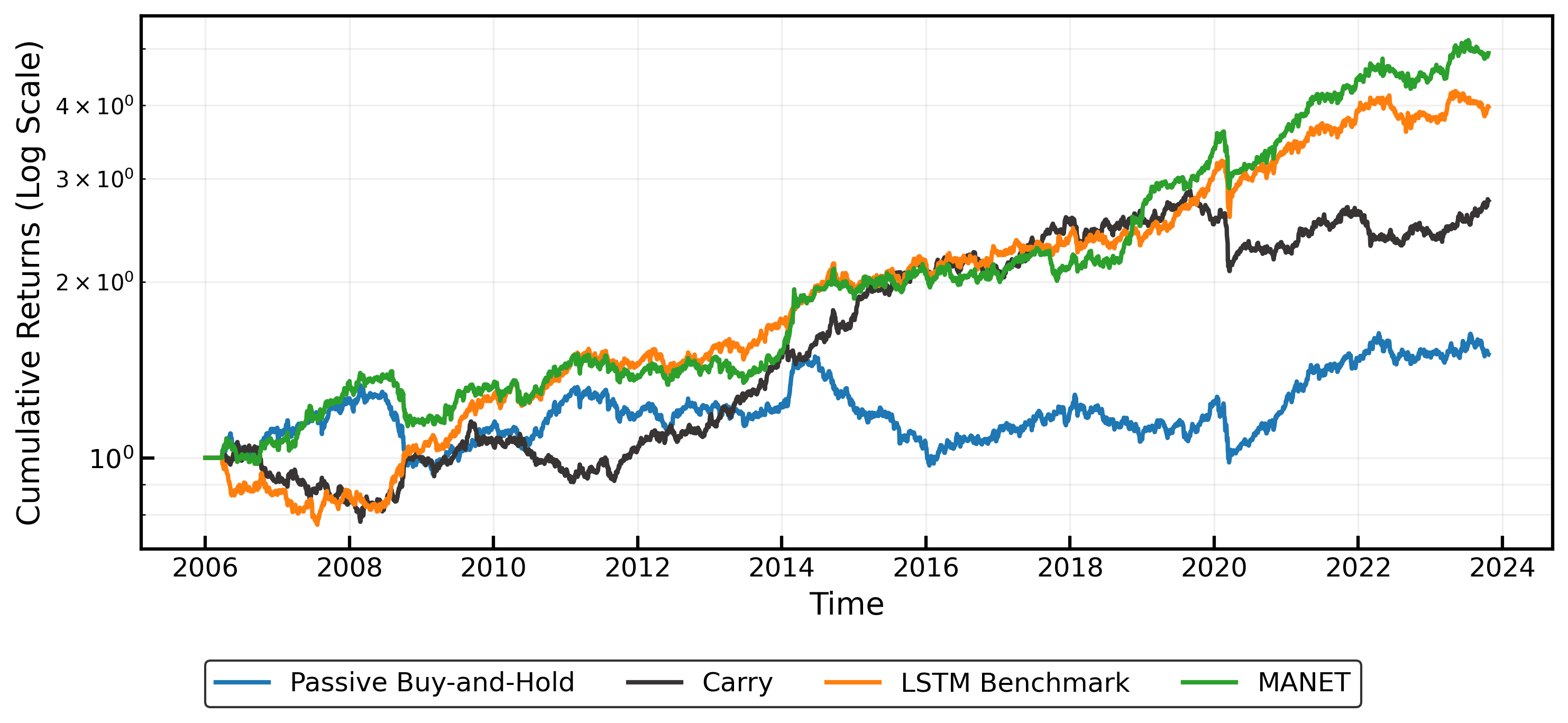
- HANET outperforms models that ignore macro information, especially during turbulent times when markets behave differently than usual.
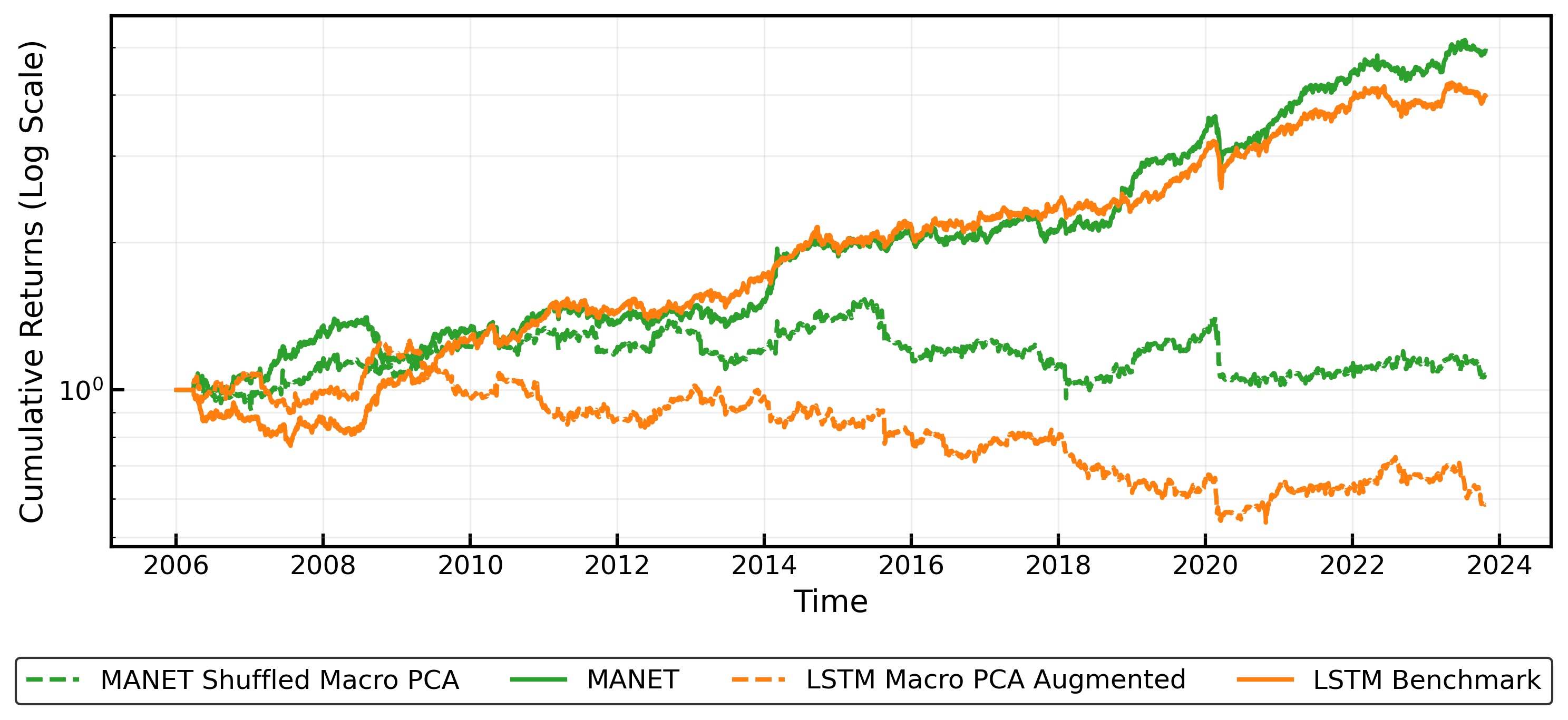
- Just adding macro data as extra inputs to a regular model doesn’t work well; in fact, it can hurt performance. The structure—doing attention over monthly macro and then guiding daily decisions—is what makes the difference.
- When they shuffle the macro history (breaking the link between current conditions and the correct past contexts), performance drops a lot. This shows the attention over true macro context is crucial.
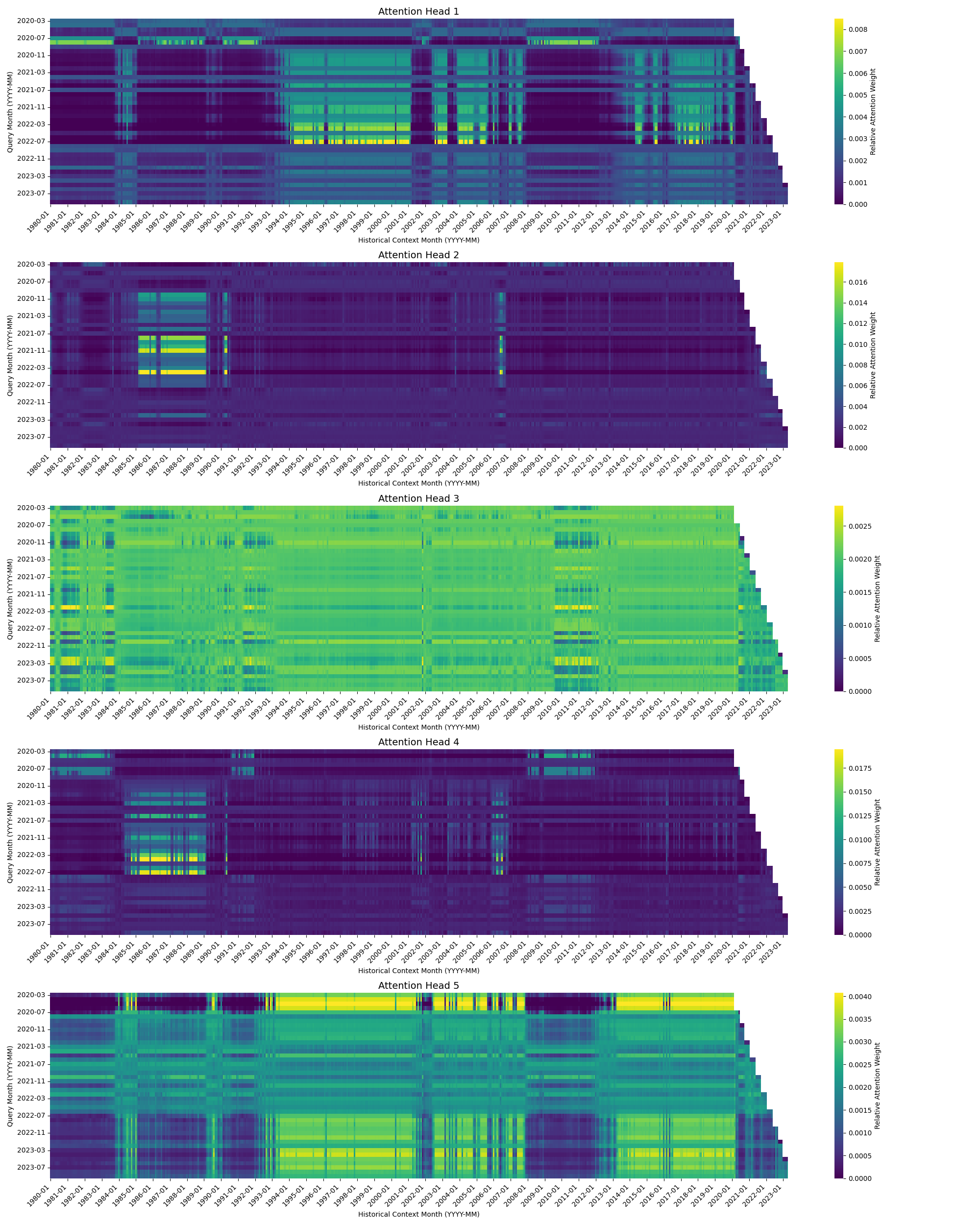
- The model is interpretable: the attention weights show which past economic periods the model relied on for today’s decision. This helps connect macro conditions to portfolio outcomes in a transparent way.
Why this matters:
- Financial markets don’t behave the same all the time. There are relatively few distinct economic “seasons,” but they matter a lot. A model that can detect and adapt to these seasons is more robust.
- During crises or transitions (like inflation spikes or recessions), many models that rely only on recent price patterns can fail. Conditioning on macro regimes can reduce big losses and improve risk-adjusted returns.
What could this change in practice?
- Better risk management: Traders and asset managers can navigate difficult periods more safely by adapting strategies to the economic backdrop.
- More general tools: The mixed-frequency attention idea can apply beyond finance wherever you want to combine slow-moving context with fast-moving signals.
- Transparency: Because attention highlights the most influential past regimes, it’s easier to explain why the model took certain positions.
- Broader strategies: The approach works for both trend-following (momentum) and carry, suggesting it can generalize across different return drivers.
Short recap
- Problem: Daily market moves are noisy and change with economic regimes. We need a way to use both daily signals and monthly macro context.
- Solution: HANET, a hierarchical attention model that finds past economic periods similar to today and uses them to guide daily trading.
- Result: Better, more robust performance than models that ignore macro or add it naively—especially in rough markets—with clear explanations via attention weights.
- Impact: A practical, interpretable step forward in making deep learning “macro-aware” for financial forecasting.
Knowledge Gaps
Knowledge gaps, limitations, and open questions
Below is a focused list of concrete gaps and unresolved questions that future work could address.
Data and macro alignment
- Precise release-lag alignment: The architecture uses the “current-month” macro vector for daily decisions, but the paper does not detail how publication lags and intra-month availability are handled day-by-day (e.g., pre-/post-release within a month). Specify an event-time mapping from individual macro releases to trading days to eliminate any residual look-ahead.
- Intra-month heterogeneity: Monthly attention weights are expanded uniformly to all days in a month, ignoring mid-month macro updates or surprises. Investigate event-driven gating (e.g., reweighting around release days) or nowcasting to reflect within-month information flow.
- US-only macro conditioning: Macro contexts are exclusively US (FRED-MD) while the asset universe is global. Test whether country-specific or global composite macro (e.g., weighted by asset domicile/exposure) improves performance.
- Exclusion of interest rate and FX variables: Key state variables (rates, yield curve, FX) are omitted to avoid redundancy, yet they are central to both carry and macro regimes. Quantify performance/robustness impact of including these variables (with careful leakage controls).
- PCA choices and stability: The number of retained components, loadings stability across rolling windows, and sensitivity to PCA preprocessing are not examined. Provide a sensitivity analysis and compare with alternative dimension reductions (dynamic factor models, autoencoders).
- Real-time/vintage fidelity across daily backtests: The real-time macro vintages are monthly, but the daily trading simulation may still face alignment ambiguities (e.g., which vintage applies between release and revision). Formalize and test a daily-vintage selection protocol.
Methodological design and modeling choices
- Asset-agnostic macro attention weights: Attention weights are computed purely from macro queries/keys and applied identically across all assets. Explore asset-conditional queries/keys or joint query construction with asset embeddings to allow asset-specific macro sensitivities.
- Static attention temperature: A single learned temperature controls attention sharpness across all periods/assets. Evaluate time-varying or asset-specific temperatures, or uncertainty-aware retrieval (e.g., entropy regularization).
- Coarse month-to-day projection: The month-level attention is mapped to daily values via a simple index mapping. Compare against richer cross-frequency operators (e.g., learned MIDAS-style kernels, Kalman smoothing, or cross-attention with day-level macro proxies/nowcasts).
- Alternative macro encoders: Macro encoders use LSTMs + PCA inputs. Assess whether transformers with relative position encodings, temporal convolution, or graph-based macro networks yield better regime embeddings.
- Supervised vs. unsupervised macro embeddings: The current macro factors are unsupervised (PCA). Explore supervised embeddings learned end-to-end for predictive objectives, including contrastive or metric-learning losses that explicitly separate regimes relevant for returns.
- OOD/regime novelty handling: The model retrieves from the historical macro set but does not explicitly detect or adapt to unseen regimes (e.g., 2020 or 2022-type shocks). Add OOD detection/calibration and test-time adaptation mechanisms.
- Carry formulation coverage: Bond carry is excluded due to data constraints; FX carry relies on a proxy forward. Extend the framework to full fixed-income carry (with funding curves) and validate FX forward proxies against transaction-level forward data.
Evaluation, baselines, and robustness
- Missing transaction costs, turnover, and capacity: Backtests omit realistic trading frictions, margin/leverage, and capacity constraints. Re-estimate performance net of costs and with turnover penalties during training.
- Robustness to hyperparameters and seeds: No evidence on multiple seeds, confidence intervals, or nested cross-validation. Provide statistical tests, bootstrap/clustered inference, and variance across seeds and splits.
- Baseline breadth: Ablations compare mainly to an LSTM with concatenated macro features. Add stronger mixed-frequency baselines (e.g., MIDAS, U-MIDAS, TFT/temporal fusion with exogenous inputs, cross-attention Transformers) and simple econometric regime-switching models.
- Period dependence and stability: Claims of outperformance “especially in turbulent periods” need time-segmentation tests (pre/post-2010, 2015–2020, 2020–2023), drawdown analyses, and rolling window stability plots.
- Universe and scale: Results are for 55 futures. Test scalability to larger universes (including single stocks) and different frequencies (e.g., weekly/intraday) to assess computational and performance robustness.
- Data survivorship and start-date heterogeneity: Instruments have different inceptions; ratio-adjusted series can mask delisting/roll effects. Document survivorship handling, missingness imputation, and sensitivity to instrument onboarding/offboarding rules.
Interpretability and causal claims
- Attention-weight validity as explanations: The paper treats attention as interpretability, but attention weights can be unstable and non-causal. Validate attention via perturbation tests, counterfactuals, and alignment with known regimes (e.g., NBER recessions, inflationary episodes).
- Attribution across modalities: It is unclear how much of a decision is driven by macro retrieval vs. daily value streams. Provide modality attribution (e.g., ablate macro/value streams per forecast) and SHAP/IG-style analyses at the hierarchy level.
- Regime labeling reconciliation: Compare learned soft regime weights with standard discrete regime labels (HMM, Markov switching) to assess interpretability consistency and detect splitting/merging of economic phases.
Portfolio construction and objectives
- Objective function design: Training uses a Sharpe-based loss; turnover and tail-risk are not directly optimized. Study multi-objective training (e.g., Sharpe + turnover + drawdown/CRRA or CVaR penalties) and evaluate distributional risk metrics.
- Risk budgeting and constraints: Positions are tanh-bounded and volatility-scaled equally across assets. Investigate dynamic risk budgets, exposure caps, and correlation-aware allocation (e.g., risk-parity or conditional risk parity integrated into training).
- Execution and roll mechanics: Ratio-adjusted returns abstract from real roll/execution impacts. Incorporate explicit roll schedules, contract selection, and execution cost models to close the sim-to-live gap.
- Position update frequency and latency: Daily rebalancing is assumed but not stress-tested. Evaluate lower/higher frequency updates and latency sensitivity to macro release timestamps and data provider delays.
Practical Applications
Immediate Applications
Below are concrete, deployable use cases enabled by the paper’s findings and methods, organized by sector and noting feasibility considerations.
- Macro-aware signal generator for trend and carry (Sector: Finance/Asset Management)
- What: Use HANET as a production forecaster to generate daily positions in liquid futures, conditioning on monthly macro factors (e.g., FRED‑MD PCA) while preserving high-frequency signals (momentum/carry).
- Tools/Workflow: Python pipeline integrating point-in-time macro ingestion, ratio-adjusted futures, hierarchical mixed-frequency attention module, volatility targeting, and Sharpe-based training; plug into existing OMS/EMS and risk systems.
- Dependencies/Assumptions: Access to point-in-time macro vintages (to avoid look-ahead), reliable futures and curve data, robust transaction-cost and slippage modeling, compliance approvals, and sufficient compute for LSTM/attention training (modest vs Transformers).
- Regime-aware risk overlay for existing strategies (Sector: Finance/Risk Management)
- What: Apply HANET’s monthly macro-attention weights as a gating mechanism to modulate exposure of legacy momentum/carry strategies (e.g., de-risk during regimes historically associated with crashes).
- Tools/Workflow: Compute attention weights daily; create overlay rules (e.g., cap gross exposure, tilt long/short asymmetrically, adjust stop-losses/vol targets) conditioned on retrieved regime similarity.
- Dependencies/Assumptions: Clear mapping from attention scores to risk rules; guardrails against pro-cyclicality; stress tests across past crises; acknowledgment that attention ≠ causality.
- Interpretable macro-regime diagnostics for PMs (Sector: Finance/Research & PM Support)
- What: Use attention heatmaps to visualize which historical macro months inform today’s forecast; link macro conditions to expected factor performance.
- Tools/Workflow: Dashboards displaying attention over macro history (e.g., inflation upswings, recessions) with PnL attribution; integrate into research notebooks and IC memos.
- Dependencies/Assumptions: Accurate macro release calendars and lag handling; proper calibration of attention temperature to avoid overly diffuse or spiky explanations.
- Multi-asset backtesting with mixed-frequency inputs (Sector: Finance/Quant Research)
- What: Adopt the mixed-frequency architecture to fairly backtest macro-conditioned TS signals with point-in-time macro data and daily trading.
- Tools/Workflow: Backtest harness supporting monthly-to-daily projection of weights, walk-forward PCA on training-only samples, and realistic portfolio aggregation/risk budgeting.
- Dependencies/Assumptions: Data engineering discipline (vintages, roll calendars); reproducibility and auditability for model governance.
- Commodity and FX carry enhancement (Sector: Commodities/FX Trading)
- What: Augment existing carry strategies by conditioning sizing on macro-attention to past environments (e.g., funding stress episodes, inventory cycles).
- Tools/Workflow: Integrate term-structure carry inputs with HANET’s value stream; apply attention-modulated weights.
- Dependencies/Assumptions: Quality of curve data (front/second, 1Y-out contracts) and liquidity; careful treatment of seasonality (as in the paper’s conventions).
- Corporate hedging policy support (Sector: Corporate Treasury)
- What: Inform hedge ratios by referencing historical macro months similar to current conditions to adjust hedge aggressiveness.
- Tools/Workflow: Lightweight deployment of attention scores as a decision aid layered over existing hedge programs for FX/commodities.
- Dependencies/Assumptions: Policy and accounting constraints; conservative governance; emphasis on advisory signal rather than automated execution.
- Teaching and methodology transfer (Sector: Academia/ML Education)
- What: Use HANET as a teaching module for mixed-frequency attention, macro conditioning, and interpretability in time-series.
- Tools/Workflow: Open-source notebooks replicating PCA-vintage handling, hierarchical attention, ablations, and interpretability analyses.
- Dependencies/Assumptions: Access to public FRED‑MD vintages and open futures proxies for didactic purposes.
- Research prototypes for policy labs (Sector: Policy Research/Think Tanks)
- What: Prototype regime-retrieval tools linking current macro states to past episodes and associated asset-price responses for scenario discussion.
- Tools/Workflow: Offline analysis to support briefings; no live policy decisioning.
- Dependencies/Assumptions: Research-only use; careful communication that this is not a structural policy model.
Long-Term Applications
These applications require further research, scaling, data, or validation before broad deployment.
- Macro-aware multi-asset ETF/SMA products (Sector: Finance/Wealth/Asset Management)
- What: Launch investable products that dynamically allocate across futures or ETFs using HANET signals and interpretable macro attribution.
- Potential Products: Macro-tilted trend/carry ETF; active risk-parity overlay with regime gating; transparency features for client reporting.
- Dependencies/Assumptions: Persistent out-of-sample edge net of fees/TC, capacity and liquidity assessment, KIID/prospectus disclosures, robust model governance and explainability requirements.
- Regulator/Central bank stress-testing augmentation (Sector: Policy/Regulation)
- What: Use attention-based retrieval to map current macro states to historical episodes and infer distributions of market risk factors for stress tests.
- Tools/Workflow: Combine with macro-financial scenario generators; use as a complementary empirical lens to design or calibrate scenarios.
- Dependencies/Assumptions: Extensive validation, transparency, and audit trails; attention’s non-causal nature requires cautious interpretation; integration with supervisory data environments.
- Cross-country and cross-asset macro conditioning (Sector: Global Macro/EM Investing)
- What: Extend HANET to multi-country macro panels and global assets, managing asynchronous data releases and different macro regimes.
- Tools/Workflow: Country-specific PCA factors, calendar-aware attention, translation of macro release lags across jurisdictions.
- Dependencies/Assumptions: Availability of reliable, point-in-time global macro datasets; heterogeneity in data quality and timeliness.
- Enterprise demand and inventory forecasting with mixed-frequency drivers (Sectors: Retail/Supply Chain)
- What: Apply the hierarchical mixed-frequency attention primitive to combine monthly/quarterly drivers (e.g., CPI, consumer confidence, promotions calendars) with daily POS data.
- Tools/Workflow: Forecasting service that attends over long-run low-frequency contexts (macro/seasonality) while preserving daily seasonality/holidays in values.
- Dependencies/Assumptions: Access to clean, historical enterprise data; careful handling of reporting lags and calendar effects; domain-specific evaluation metrics.
- Power/load and commodity consumption forecasting (Sector: Energy/Utilities)
- What: Incorporate monthly climate indices, regulatory changes, and fuel cost regimes as low-frequency contexts with daily/hourly load as values.
- Tools/Workflow: Forecasting and dispatch planning with regime-aware uncertainty estimates; scenario retrieval for extreme weather/policy shifts.
- Dependencies/Assumptions: High-quality meteorological and policy datasets; adaptation to hourly sub-daily grids (extend projection scheme).
- Hospital operations and epidemiology planning (Sector: Healthcare)
- What: Use monthly/weekly public-health indicators (e.g., CDC ILI, vaccination rates) as low-frequency contexts with daily admissions and staffing as high-frequency series.
- Tools/Workflow: Regime-aware staffing and capacity planning; attention-based retrieval of analogous past waves/outbreaks.
- Dependencies/Assumptions: Data sharing/privacy constraints; robustness under structural changes (e.g., new variants, policy responses).
- Hybrid cross-sectional + time-series attention (Sector: Quant Research/Software)
- What: Combine HANET’s macro hierarchy with cross-sectional retrieval (e.g., X-Trend) to allocate not only over time but also across assets/countries conditional on macro regimes.
- Tools/Workflow: Two-level attention (macro monthly for queries/keys; cross-sectional values for allocation); libraries implementing the attention primitive.
- Dependencies/Assumptions: Complexity increases; risk of overfitting; need for strong regularization and ablation testing.
- Standardization as an ML primitive in time-series libraries (Sector: Software/ML Tooling)
- What: Package “hierarchical mixed-frequency attention” as a reusable layer (monthly queries/keys, daily/hourly values + projection) for general forecasting tasks.
- Tools/Workflow: Open-source modules with lag calendars, projection utilities, and interpretable temperature control.
- Dependencies/Assumptions: Community validation across domains; clear API for custom calendar mappings and lag structures.
- Narrative/alternative data conditioning (Sector: Finance/Data Science)
- What: Enrich low-frequency context with news, policy text summaries, or survey factors embedded monthly, enabling attention over historical narrative regimes.
- Tools/Workflow: Combine NLP embeddings at monthly cadence with daily price values; use attention to retrieve narrative-analog episodes.
- Dependencies/Assumptions: Stable text embeddings over long horizons, mitigating topic drift; rigorous PI/PD controls and compliance for alt data.
- Causal and stability extensions (Sector: Academia/Methodology)
- What: Investigate causal regularization or invariant risk minimization around the macro-attention mechanism to improve robustness across regime changes.
- Tools/Workflow: Joint training with stability penalties; benchmarking on multi-decade datasets.
- Dependencies/Assumptions: Theoretical development and large-scale experiments; careful distinction between predictive retrieval and causal attribution.
Glossary
- Ablation studies: Systematic removal or alteration of components in a model to assess their impact on performance. "Ablation studies show that these gains rely on structured macro conditioning rather than naive feature augmentation"
- Attention weights: The learned similarity scores that determine how much influence each context element has during attention-based retrieval. "Finally, HANET provides interpretability through attention weights, highlighting which historical regimes are most influential for each forecast and linking macro conditions to portfolio outcomes."
- Carry: A strategy or signal derived from the slope of the futures/forwards term structure, reflecting implied forward returns from holding an asset. "carry is derived from the slope of the term structure of forwards and futures"
- Carry crashes: Episodes when carry strategies experience abrupt and severe drawdowns, often during funding stress. "carry crashes \cite{brunnermeier-nagel-2008}"
- Correlation breaks: Sudden changes in correlation relationships between assets, undermining historical dependencies. "correlation breaks \cite{molenaar2024stockbond}"
- Cross-sectional strategies: Investment approaches that rank assets relative to each other to form long–short portfolios exploiting cross-asset dispersion. "Cross-sectional strategies are relative-value in nature"
- Dynamic factor models: Statistical models that extract latent factors driving co-movements in many time series, extended here to mixed-frequency settings. "dynamic factor models with mixed-frequency extensions \citep{banbura-etal-2013}"
- End-to-end: Training a model from inputs to final objective without intermediate hand-engineered steps. "trained end-to-end under a Sharpe-based objective."
- Ex-ante volatility estimate: A forward-looking volatility measure computed from past data to standardize risk before returns are realized. "let be an ex-ante volatility estimate for asset formed at time "
- Exponential moving average (EMA): A moving average that applies exponentially decreasing weights to older observations, giving more weight to recent data. "denotes the exponential moving average of the price series"
- Few-shot learning: Learning to generalize from a very small number of examples by leveraging similarity or prior structure. "A complementary perspective is one-shot or few-shot learning"
- FRED-MD: A widely used monthly U.S. macroeconomic database curated by the Federal Reserve Bank of St. Louis. "The raw dataset is constructed from FRED-MD"
- FX carry: The return from holding a high-yielding currency funded by a low-yielding currency, proxied via the forward–spot differential. "FX carry (3-month forward)."
- Hard example mining: Emphasizing difficult or misclassified samples during training to improve model robustness. "hard example mining \cite{freund1997boosting, lin2017focal}"
- Hidden Markov models: Probabilistic models with latent (hidden) states governing observed sequences, often used for regime identification. "hidden Markov models"
- Hierarchical Cross-Attention mechanism: An attention module that computes attention at a low frequency (e.g., monthly) and applies it to high-frequency representations (e.g., daily). "Hierarchical Cross-Attention mechanism"
- Hierarchical Mixed-Frequency Attention Primitive: An attention design that bridges different sampling rates by aligning low-frequency context with high-frequency decisions. "A Hierarchical Mixed-Frequency Attention Primitive."
- Importance weighting: Reweighting training samples to correct for distribution shifts or imbalance. "importance weighting \cite{kahn1953importance}"
- Lagged Cumulative Returns (TSMOM): A momentum signal based on the sign of cumulative returns over a lookback window. "Lagged Cumulative Returns (TSMOM)."
- Limit order book: The market’s record of outstanding buy and sell orders at various price levels. "limit order book modeling \citep{zhang2019deeplob}"
- Long Short-Term Memory (LSTM): A recurrent neural network architecture with gating mechanisms to capture long-range dependencies in sequences. "a standard Long Short-Term Memory (LSTM) cell"
- MACD (Moving Average Convergence Divergence): A momentum indicator based on the difference between short- and long-term EMAs. "Moving Average Convergence Divergence (MACD)."
- Markov-switching models: Time-series models allowing parameters or regimes to switch according to a Markov process. "Markov-switching models"
- Matching Networks: A few-shot learning approach that makes predictions by attending over a labeled support set. "Matching Networks \citep{vinyals-etal-2016}"
- Meta-learning: Methods that learn how to learn, adapting rapidly to new tasks or distributions. "meta-learning and related techniques"
- MIDAS regressions: Econometric models that relate variables sampled at different frequencies via constrained lag polynomials. "MIDAS regressions \citep{ghysels-etal-2007}"
- Mixed-frequency: A setting where variables are sampled at different intervals (e.g., monthly macro vs. daily returns). "creating a mixed-frequency challenge"
- Momentum crashes: Sharp drawdowns in momentum strategies, often following market rebounds. "momentum crashes \cite{daniel2016momentum}"
- Neural Processes: Models combining neural networks with stochastic processes to enable fast adaptation to new tasks via context conditioning. "Neural Processes \citep{kim-mnih-schwarz-2019}"
- Non-stationarity: When the statistical properties of a process (e.g., mean, variance) change over time. "small datasets, noisy signals, and non-stationarity."
- Nowcasting: Real-time estimation of current or near-term economic variables using available data. "nowcasting macro aggregates from high-frequency indicators"
- PCA (Principal Component Analysis): A dimensionality-reduction technique extracting orthogonal components that explain most variance. "principal component analysis (PCA)"
- Point-in-time macroeconomic vintages: Historical snapshots of macro data as they were known at the time, reflecting publication lags and revisions. "point-in-time macroeconomic vintages"
- Query embedding: The learned representation of the current state used to retrieve relevant contexts via attention. "We form a query embedding"
- Ratio-adjusted linked series (".RAD"): A continuous futures series constructed by multiplicatively adjusting past contracts to remove roll gaps while preserving returns. "ratio-adjusted linked series (``.RAD'')"
- Regime (macroeconomic regime): A distinct macroeconomic state (e.g., recession, inflationary period) influencing asset returns. "the scarcity of distinct macroeconomic regimes that drive asset returns"
- Risk premia: Expected excess returns associated with bearing certain risks or exposures. "risk premia across asset classes."
- Rolldown-only proxy: A carry approximation that captures only the curve’s mechanical roll yield, excluding financing components. "rolldown-only proxy rather than the full carry concept."
- Scaled dot-product attention: An attention mechanism that computes similarities via scaled inner products between queries and keys. "scaled dot-product attention weights"
- Self-attention: An operation that relates different positions within a sequence to compute contextualized representations. "a self-attention block"
- Sharpe-based objective: A training loss aligned with maximizing the Sharpe ratio (risk-adjusted return). "Sharpe-based objective."
- SMOTE: A synthetic oversampling technique for imbalanced datasets that creates new minority class samples. "SMOTE \cite{chawla2002smote}"
- Support set: The labeled context examples over which attention is computed in few-shot learning. "a labeled support set"
- Temperature parameter (attention): A scaling factor controlling the sharpness or diffuseness of attention distributions. "learnable positive temperature parameter"
- Term structure: The schedule of prices/yields across maturities (e.g., futures curve), often summarized by its slope. "the slope of the term structure of forwards and futures"
- Time-series carry: A carry strategy defined and applied per asset over time rather than across assets; here formulated as a forecasting task. "the time-series carry task"
- Time-series momentum (TSMOM): A strategy that goes long (short) an asset whose past returns were positive (negative). "established time-series momentum as a pervasive phenomenon"
- Volatility scaling: Adjusting positions so each asset contributes equally to risk by scaling with an ex-ante volatility estimate. "we volatility-scale each asset's exposure"
- Volatility targeting: Controlling portfolio risk to a desired level by adjusting exposure based on volatility estimates. "we apply volatility targeting."

