- The paper demonstrates that PROBE substantially improves joint optimization of binding affinity and druggability through a probing-guided, multi-agent iterative system.
- It employs a three-stage workflow—site map construction, controlled probing, and a co-optimization loop—yielding superior multi-objective outcomes compared to conventional methods.
- Diagnostic metrics reveal that PROBE minimizes objective interference and enhances efficiency, offering a robust blueprint for AI-driven drug design in SBDD.
Probing-Guided Multi-Objective Molecular Optimization with LLM Agents
Introduction and Motivation
Structure-based drug design (SBDD) aims to generate ligand candidates that optimally fit a protein binding pocket, balancing two competing objectives: maximizing binding affinity and ensuring suitable drug-like properties (druggability). Most recent deep learning approaches to SBDD, including 3D generative models and LLM-based methods, have adopted a one-shot candidate generation paradigm, with little capacity for iterative post-generation refinement. In contrast, expert medicinal chemists employ iterative design-make-test-analyze (DMTA) cycles to improve leads based on specific feedback. Translating this iterative workflow for LLM agents has been hindered by a core difficulty: typical local edits seldom lead to simultaneous improvements in both binding affinity (often measured by the AutoDock Vina score) and druggability (measured by Quantitative Estimate of Drug-likeness, QED, and Synthetic Accessibility, SA).
The paper "Probe Before You Edit: Probing-Guided Molecular Optimization for LLM Agents in Structure-Based Drug Design" (2606.00555) addresses this issue by introducing PROBE, a pipeline that explicitly probes the response of a protein–ligand complex to controlled local edits before guiding iterative, multi-agent optimization. This approach leverages new diagnostic metrics to quantify the frequency and interplay of per-edit improvements for each objective, exposing a persistent bottleneck in prior LLM-agent schemes: most local edits either benefit only one objective or worsen the other.
PROBE Framework
The PROBE methodology introduces a three-stage workflow for molecular optimization:
- Site Map Construction: The system decomposes a ligand into fragments, synthesizing geometric, property, and interaction signals at each site using tools like BRICS decomposition and PLIP for interaction annotation. A pocket-specific site map is constructed, categorizing fragments as SYNERGY (sites permitting joint improvement), TENSION (where objectives are in conflict), or LIABILITY (problematic motifs).
- Probing and EditManual Induction: Prior to actual optimization, PROBE performs controlled edits at the mapped sites—systematically perturbing substructures under three strategies (affinity-first, druggability-first, and co-optimization) and observing the resulting changes in affinity and druggability. Outcomes are distilled into a compact, actionable EditManual guiding permissible edit directions, semantic constraints, and cross-site dependencies.
- Multi-Agent Co-Optimization Loop: With site map and EditManual in hand, the system deploys three LLM-driven agent roles—affinity, druggability, and co-optimization agents. Each proposes edits according to their objective-driven priorities, cross-reviews designs to avoid violations or objective harm, and reconciles conflicting edits. Iterative rounds are evaluated and the most jointly improved candidates are promoted for further refinement.
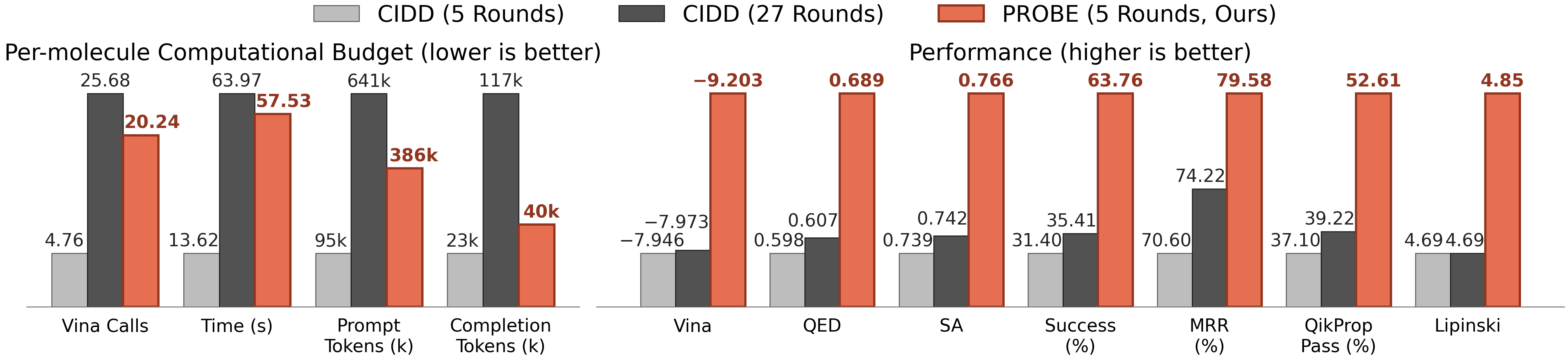
Figure 1: Computational budget and performance comparison. CIDD (27 Rounds) is the baseline extended to match PROBE's theoretical Vina budget.
Diagnostic Metrics and Baseline Limitations
Two diagnostic metrics are proposed to rigorously assess per-edit optimization trajectories:
- Joint Improvement Rate: The fraction of edits that improve affinity and druggability simultaneously.
- Objective Interference Rate: The frequency with which a gain in one objective is accompanied by a loss in the other.
Applied to several SBDD LLM-agent pipelines—MOLLM, CIDD, CIDD+MOO, LIDDIA—these metrics reveal that, in current paradigms, fewer than a third of edits succeed in joint improvement. Intent–outcome consistency is poor when attempting joint optimization, and single-objective improvements are commonly offset by regressions in the other axis. Increasing computational budgets by simply running more rounds yields diminishing returns, as evidenced by the negligible gain in baseline CIDD when extended to 27 rounds (Figure 1).
Quantitative Results
On the CrossDocked2020 benchmark, PROBE achieves state-of-the-art performance on binding, druggability, and overall success criteria. Key findings from the comparative study include:
- Largest Mass in Joint Improvement: PROBE is unique among evaluated methods in making joint progress the dominant per-edit outcome, with a joint improvement rate substantially exceeding those of baselines.
- Dramatically Reduced Objective Interference: Edits engineered via EditManuals derived from probing evidence sharply lower the probability of harming a non-targeted objective, enabling effective multi-objective control.
Ablation studies confirm the critical role of both the site map (which ensures edits are contextually targeted) and the probing-derived EditManual (which constrains allowable modifications to those supported by empirical signal). Purely leveraging LLM priors, or naïvely organizing edits by flat fragments without site context, is insufficient to achieve similar gains.
Computational Efficiency
Despite an expanded computational budget due to the initial probing stage, PROBE demonstrates superior efficiency. Matching baselines for total docking calls, PROBE delivers much higher multi-objective yield. The guidance supplied by probing evidence focuses high-value edits and sharply limits wasted optimization steps, counter to the cost–inefficiency pattern seen in extended baseline runs.
Practical and Theoretical Implications
Practically, PROBE's probe-before-edit paradigm presents an actionable blueprint for scalable, evidence-grounded molecular optimization with LLMs. This results in more robust, targeted, and controllable molecular refinement, mitigating well-documented trade-offs between binding affinity and molecule quality. Theoretically, the explicit separation of exploration (probing responses) from exploitation (guided optimization) represents a modular, interpretable, and flexible approach that can generalize to other multi-objective design domains beyond SBDD—including materials discovery and protein engineering.
Moreover, the system's design allows for continual integration of additional agent roles, more sophisticated diagnostic metrics, or richer probing protocols. The explicit EditManual offers interpretable, pocket-specific constraints, enabling both better agent performance and human-in-the-loop review.
Future Directions
- Expansion to New Target Classes: Extending PROBE to broader target spaces, such as membrane proteins or protein–protein interaction interfaces, remains an open avenue.
- LLM Backbone Agnosticism: Comparative results indicate the pipeline's efficacy is robust across multiple LLM backbones, ensuring practical portability.
- Experimental Validation: While performance is assessed with in silico proxies, prospective synthesis and bioassays are required to confirm in vitro/vivo translation.
- Generalization to Other Design Tasks: The probe-before-edit framework is not limited to molecular optimization and may underpin LLM-driven multi-objective design strategies in other domains.
Conclusion
The PROBE framework introduces a principled, evidence-driven approach for multi-objective molecular optimization with LLM agents in SBDD. By explicitly diagnosing site-specific edit responses before optimization, it enables robust agent-driven DMTA cycles that yield candidate molecules substantially superior on both binding and druggability axes. The methodology’s clear quantitative advantage, interpretability, and extensibility mark a significant advance toward practical AI-assisted drug design under real-world constraints.

