- The paper demonstrates that perfect-pairing states emerge as a systematic limit of Richardson-Gaudin states to capture strong electron correlation.
- It develops an EN2 perturbative approach with a detailed classification of low-lying excitations and near-polynomial computational scaling.
- Extensive numerical benchmarks on systems like H8, H50, N2, and H2O confirm that PP-based EN2 corrections rival traditional methods while addressing intruder states.
Perfect-Pairing Limit of Richardson-Gaudin States: A Systematic Framework for Strong Electron Correlation
Introduction and Theoretical Setting
The paper delivers a formal development of the perfect-pairing (PP) limit within the Richardson-Gaudin (RG) state methodology, aimed at tractably capturing strong electronic correlations in quantum chemistry. Building on the preceding work in the RG seniority-based hierarchy, the author demonstrates that PP states not only emerge naturally as the limiting case of RG states but also provide a systematic, efficient reference for post-mean-field treatments. The manuscript contextualizes PP against established strong-correlation frameworks such as CASSCF and DMRG, but emphasizes the superior computational scaling and interpretability through seniority partitioning, particularly in large active spaces.
Central to the discussion is the division of the orbital space into core, valence, and virtual sectors, and the explicit construction of the PP wavefunction as strongly orthogonal products of geminal pairs localized within two-orbital blocks (valence-bond subsystems, VBS). This construction both simplifies the algebraic structure and provides an analytically tractable solution to the variational problem, bypassing the need for iterative solution of the non-linear Richardson equations that typify more general RG states. The author details the role of the VBS energy gaps, their relation to orbital occupations, and their use as fundamental parameters both for orbital optimization and for the computation of excitation spectra.
Perturbative Corrections and Excitation Structure
Upon establishing the PP reference, the paper conducts an exhaustive enumeration and classification of low-lying excited states up to seniority four, constructing all single and double excitations relevant for an Epstein-Nesbet (EN2) perturbative treatment. The taxonomy captures three major classes: local swaps (bond-antibond transitions within a VBS), splits (seniority-changing single-particle excitations leaving blocked singly occupied orbitals), and correlated pair transfers (doubles not reducible to simple electron transfers). The EN2 correction is constructed by systematically evaluating the off-diagonal Hamiltonian couplings among these excitations and the PP reference, making extensive use of the PP-specific structure of the reduced density matrices and pair amplitudes.
A salient finding is that, contrary to prior expectations, the EN2 correction formulated in the PP excitation manifold not only matches but frequently outperforms the corresponding RG-based EN2 correction, at substantially lower computational cost. The author attributes this to a richer excitation manifold in the PP case and more physical choices for the seniority-four excitations.
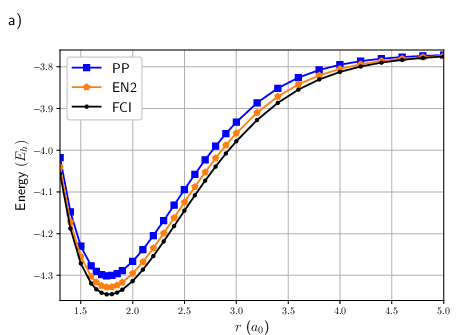
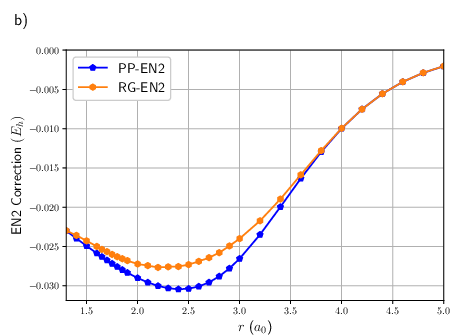
Figure 1: Comparative dissociation profiles for linear H8 using EN2 corrections built on PP and RG references, demonstrating close agreement and negligible distinguishability at the reference and correction levels.
Numerical Analysis: Model Dissociation Profiles and Excitation Channel Decomposition
The manuscript presents a suite of high-fidelity dissociation calculations for paradigmatic strongly correlated systems: linear hydrogen chains (H8, H50), N2, and H2O, in both minimal and extended basis sets. These benchmarks interrogate the accuracy of PP and EN2-augmented PP (PP-EN2) across bond-breaking regimes notorious for failing single-reference methods.
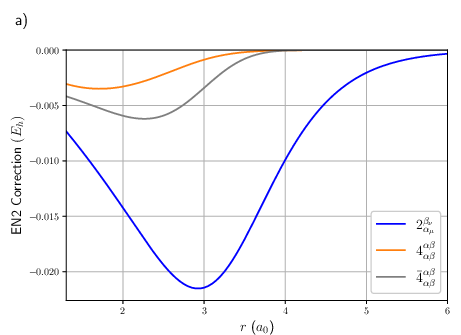
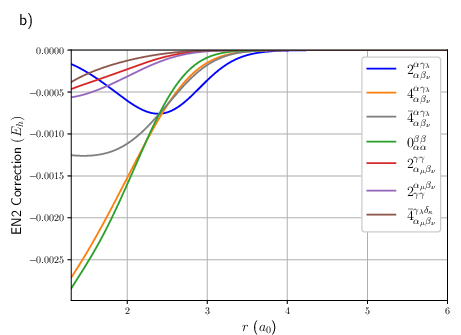
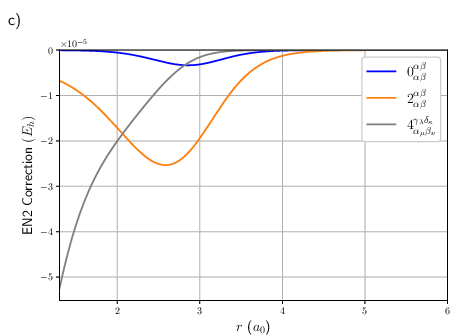
Figure 2: EN2 channel-resolved analysis in H8, distinguishing dominant, moderate, and negligible excitation pathways contributing to the total correction.
The analysis succinctly identifies that the dominant contributors to the total EN2 correction are single electron transfers, double-splits, and complementary double-splits within the valence subspace. Other channels (e.g., double swaps, pair transfers of seniority four) yield marginal contributions or are strictly zero, justifying highly aggressive truncation strategies for future scalable implementations.
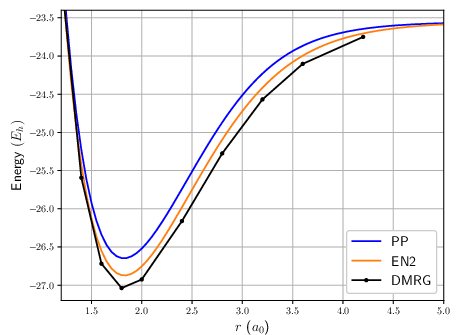
Figure 3: Extension to H50, demonstrating that the PP and EN2 approaches successfully recapitulate DMRG dissociation benchmarks, preserving size-consistency and correct asymptotic behavior.
Notably, the computational scaling is rendered near-competitive with MP2 owing to the polynomial scaling with system size and the restriction of the dominant contributions to O(N2) excitations.
Intruder States and Size-Consistency
In the context of multiple bond dissociations sharing atomic centers (N2, H2O), the study uncovers the emergence of low-lying complementary double-split "intruder" states, which can artificially lower the EN2 correction and even drive it below FCI or CASSCF references at dissociation. This artifact is shown to be remediable by diagonalizing a small reference-intruder Hamiltonian, restoring size consistency and correct dissociation limits.
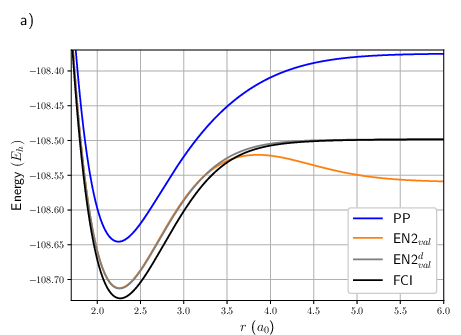
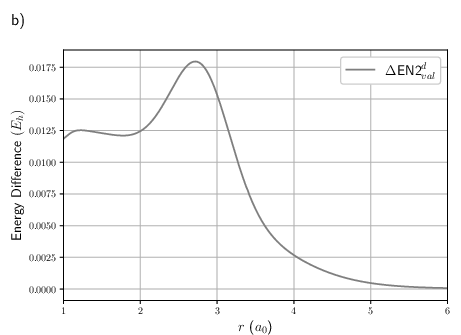
Figure 4: Dissociation curve for N80 highlighting the discrepancy introduced by intruder states in the EN2 correction, contrasted with both FCI and the reference.
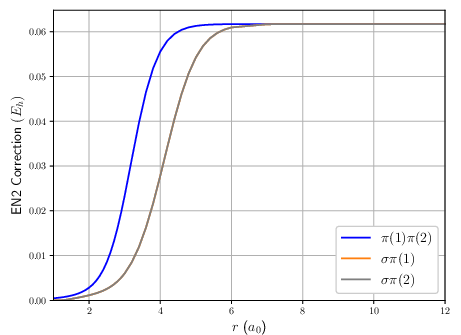
Figure 5: EN2 correction breakdown for N81, with explicit tracking of the contributions from intruding complementary double-split channels.
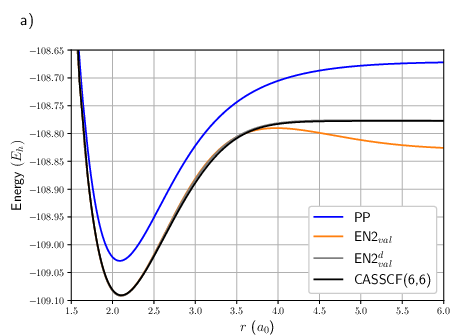
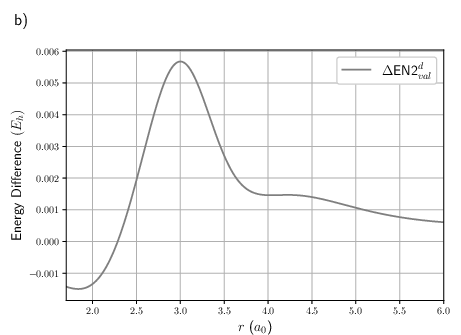
Figure 6: Dissociation of N82 in a larger basis, showing the stability and accuracy of EN283 (intruder-corrected) relative to CASSCF.
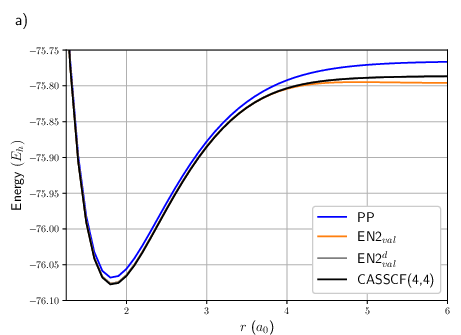
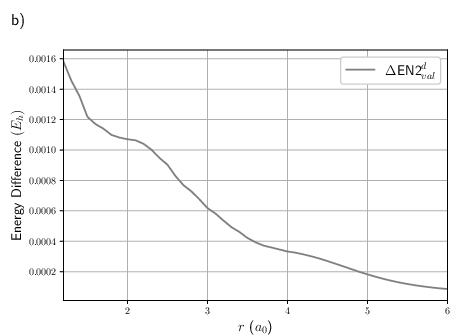
Figure 7: H84O symmetric bond dissociation, highlighting the same intruder effect as in N85 but with diminished magnitude.
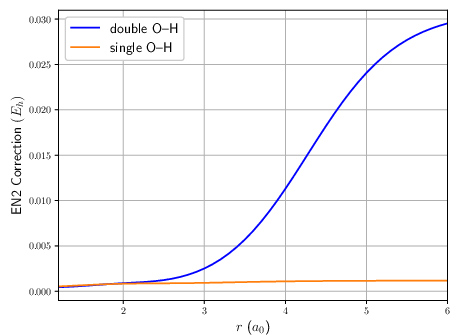
Figure 8: Quantification of the intruder state effect in H86O for both simultaneous and single-bond dissociation trajectories.
The systematic scaling analysis demonstrates that the occurrence and number of such intruder states increases only linearly with the number of atomic centers for main-group saturated systems, thus this corrective diagonalization step is computationally tractable even for extended systems.
Implications and Connections to Broader Strong-Correlation Methodologies
The paper situates the PP reference and its EN2 correction within a web of recent and classical treatments of strong correlation, including CASSCF, pCCD, block-correlated coupled cluster, and APSG frameworks. It claims that, for static correlation in large active spaces, compact EN2-augmented PP is competitive with CASSCF and DMRG in both minimal and extended basis sets—a significant assertion considering the exponential cost of conventional multireference approaches.
The discussion further highlights the rigorous relationship between the PP formalism and various coupled cluster and valence bond constructions, clarifying that the natural generalization to CI or coupled cluster expansions in the PP orthonormal basis is both possible and expected to yield further improvements.
The manuscript directly addresses concerns about size-extensivity of the EN2 correction and, by virtue of the localized nature of the PP orbitals, demonstrates numerically that spurious size-inconsistencies are minimal or fully correctable in chemically relevant regimes.
Future Directions and Theoretical Outlook
Several prospects for future development are articulated:
- Exploiting the analytic solvability of the PP algebraic structure for even lower-cost orbital optimization and integral transformation, potentially by importing recent techniques for rapid orbital updates.
- Constructing size-consistent, orbital-invariant perturbative corrections or coupled-cluster expansions atop the PP reference.
- Extending the CI expansion to higher seniority sectors systematically, leveraging the detailed enumeration and efficient matrix element computation furnished in this work.
The author postulates that, given the rigorous algebraic foundation and the practical success in benchmark cases, PP-based reference strategies augmented with systematically controlled excitation manifolds are poised to enable scalable, accurate treatment of strong correlation across molecular systems beyond the capacity of CASSCF, especially when canonical active-space selection becomes unmanageable.
Conclusion
This contribution establishes a comprehensive, tractable framework for the treatment of strong electron correlation via the perfect-pairing limit of Richardson-Gaudin states. By providing a complete classification and analytic evaluation of the low-seniority excitation spectrum and demonstrating robust numerical results for both model and chemically relevant systems, the author demonstrates both the theoretical soundness and computational efficacy of the approach. The aggressive claim that EN2 corrections in the PP manifold can match or exceed the accuracy of RG-based and CASSCF treatments at reduced cost is well-supported numerically, and the theoretical infrastructure facilitates further extension to more sophisticated post-PP methods. The framework opens promising avenues for scalable, physically-motivated electronic structure theory in the regime of strong static correlation.
Reference: "Richardson-Gaudin states of non-zero seniority III: The Perfect-Pairing limit" (2605.31582)

