- The paper introduces the SECI method that partitions the Hilbert space by fixing local seniority, capturing strong electron correlations.
- It employs an effective Hamiltonian using so(4) and su(2) algebraic structures to improve energy accuracy in models like the Hubbard and molecular dissociation.
- The study demonstrates that mean-field decoupling approximations can achieve near-FCI accuracy, significantly reducing computational cost.
Seniority Eigenstate Configuration Interaction: A Technical Analysis
Introduction and Theoretical Framework
Seniority number, defined as the count of unpaired electrons in a Slater determinant, has become a salient organizing principle for many-body wavefunction design in strongly correlated systems. While the seniority-zero (fully paired) sector underpins doubly occupied configuration interaction (DOCI) and pair coupled cluster doubles (pCCD), little has been done to exploit higher seniority sectors systematically. "Seniority Eigenstate Configuration Interaction" (2604.19063) advances this situation by introducing a configuration interaction (CI) scheme (SECI) that fixes the local seniority per paired orbital, partitioning the Hilbert space into a pairing set (seniority zero) and a spin set (seniority one in each orbital).
The methodology rests on the construction of an effective so(4) Hamiltonian that conserves local seniority. Remarkably, the maximal seniority sector admits the same su(2) algebraic structure as seniority zero—an observation substantiated by invoking the Nambu transformation, which establishes an isomorphism between the algebraic structures and allows for direct analysis of the maximal seniority states. The SECI ansatz is thus a generalization: it encompasses both standard DOCI and the spin analog (all singly occupied).
The SECI wave function is parametrized as a tensor product of zero- and one-seniority determinants:
∣Ψ⟩=ΓΛ∑CΓΛ∣ΞΓ⟩⊗∣ΦΛ⟩,
where ∣ΞΓ⟩ are product states in the singly occupied sector and ∣ΦΛ⟩ span the paired sector. The effective Hamiltonian, HδΩ=0eff, decomposes naturally into pairing, spin, and their coupling:
HδΩ=0eff=Hpairing+Hspin+Hcoupling,
with all parameters derived from the one- and two-electron integrals, fully accommodating spin-unrestricted orbitals as necessitated by the underlying physics of strongly correlated systems.
A crucial theoretical point, underscored both algebraically and by explicit calculation, is that restricted orbitals fail for maximal seniority—leading to, for example, the prediction of interaction-independent ground state energy for the two-site Hubbard model. Thus, maximal seniority sectors require a spin-unrestricted treatment in orbital optimization.
Numerical Results: Energy Accuracy and Seniority Effects
Application of SECI to prototypical strongly-correlated Hamiltonians, such as the Hubbard model with periodic boundary conditions and the dissociation of N₂, substantiates several claims:
- High seniority (maximal) results often match or surpass the accuracy of traditional seniority-zero (DOCI) approaches, especially in strong correlation regimes.
- As system size increases, increasing the local seniority monotonically improves the energy with respect to FCI.
In the 6-site half-filled Hubbard model, energy errors versus FCI decrease consistently with higher imposed seniority, and maximal seniority yields the best agreement regardless of U/t.
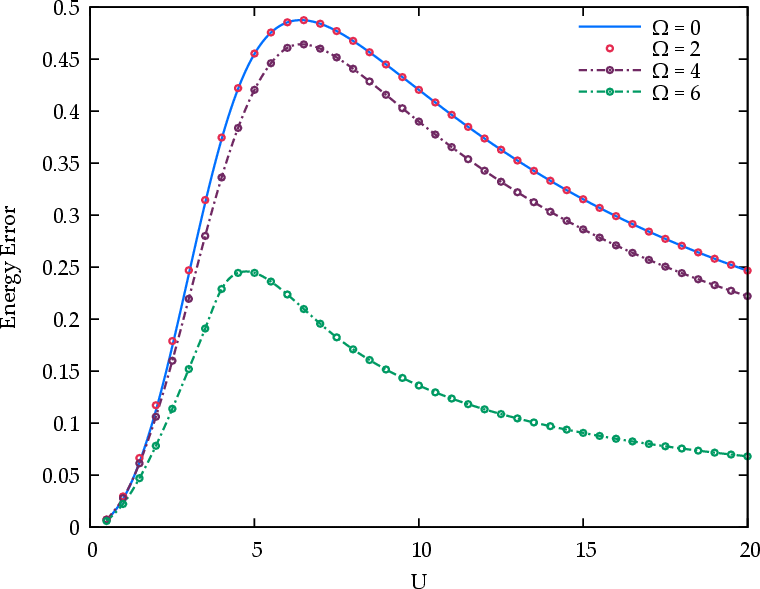
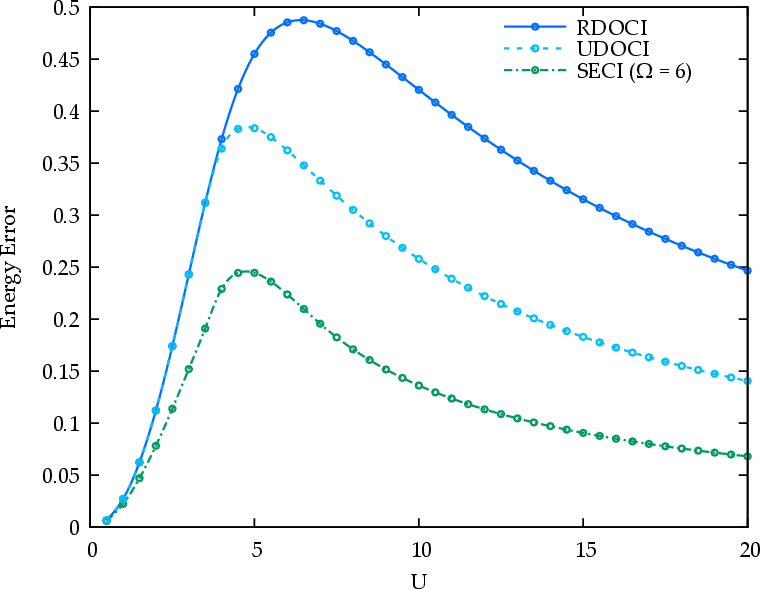
Figure 1: Energy errors vs FCI in the 6-site Hubbard model for SECI with various seniorities. Maximal seniority consistently achieves the lowest error; SECI outperforms both RDOCI and UDOCI in most regimes.
Analogous trends are evident in the 10-site half-filled Hubbard model.
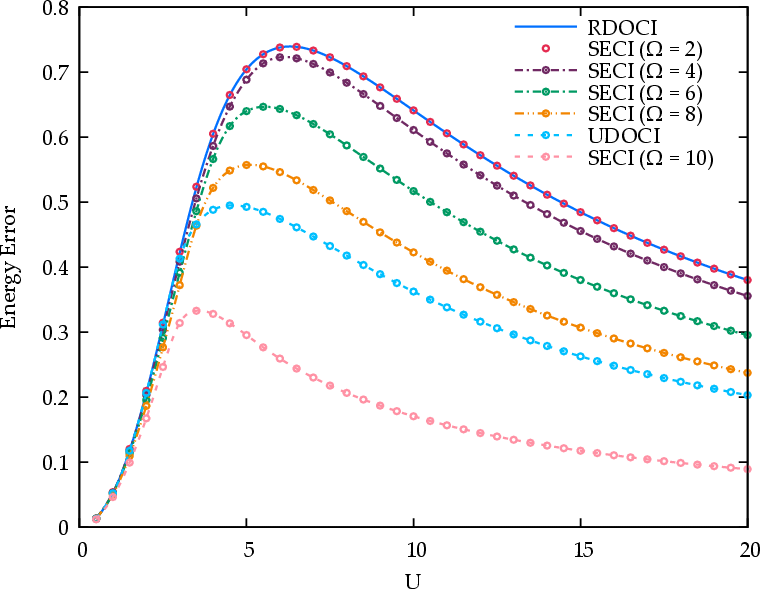
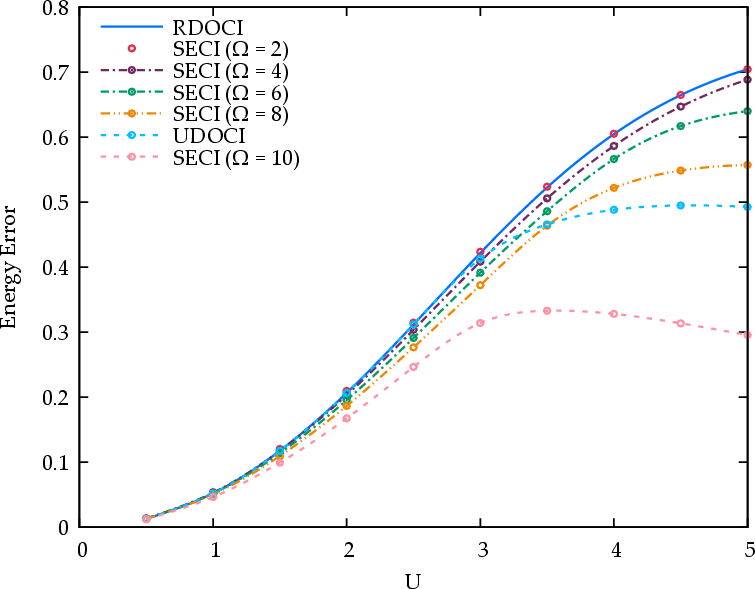
Figure 2: Energy errors for the 10-site Hubbard model, showing the superiority of maximal seniority over RDOCI and UDOCI, including at small U/t.
In the N₂ dissociation curve (minimal STO-3G basis), choosing a SECI sector with six singly occupied $2p$ orbitals yields variationally superior performance at large bond lengths—directly relevant to the physical dissociation limit—while near equilibrium, seniority-zero maintains a modest advantage.
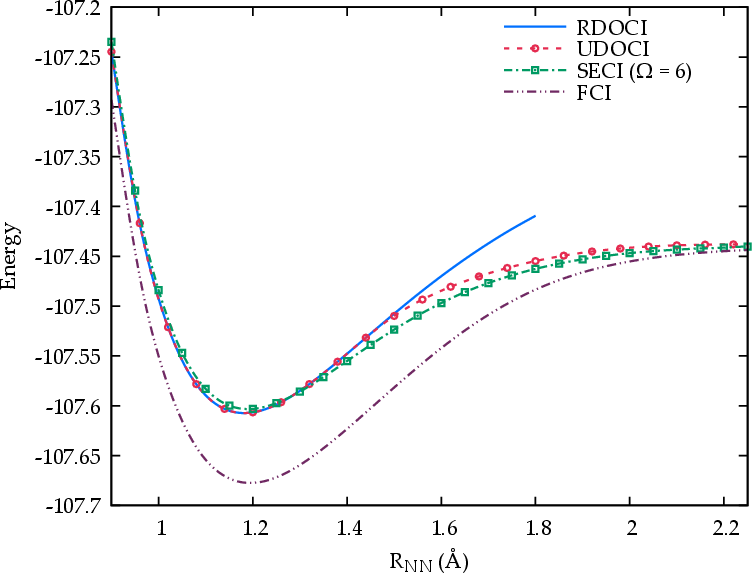
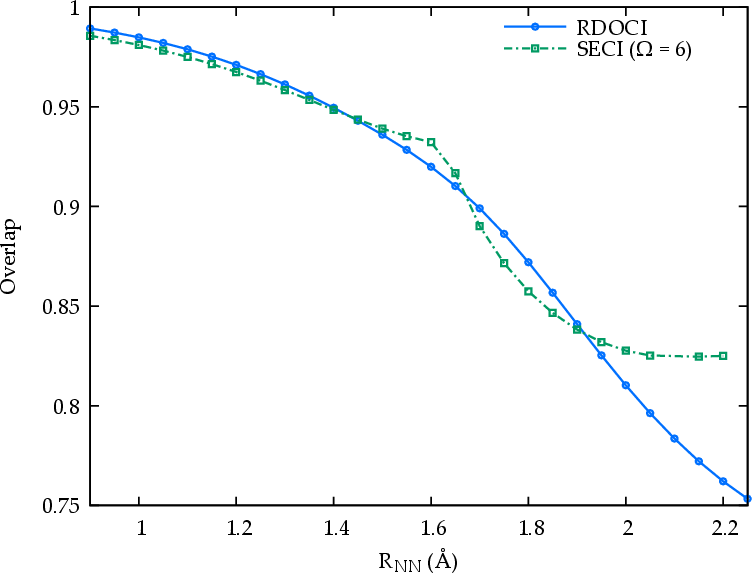
Figure 3: (Left) Total energies for N₂ dissociation in STO-3G. (Right) Overlap with FCI wave function; SECI achieves large overlap in stretched regime.
For doped Hubbard models, a crossover is observed: for strong su(2)0, maximal seniority remains optimal, while for weak-to-moderate correlation, UDOCI (unrestricted DOCI) is generally more accurate.
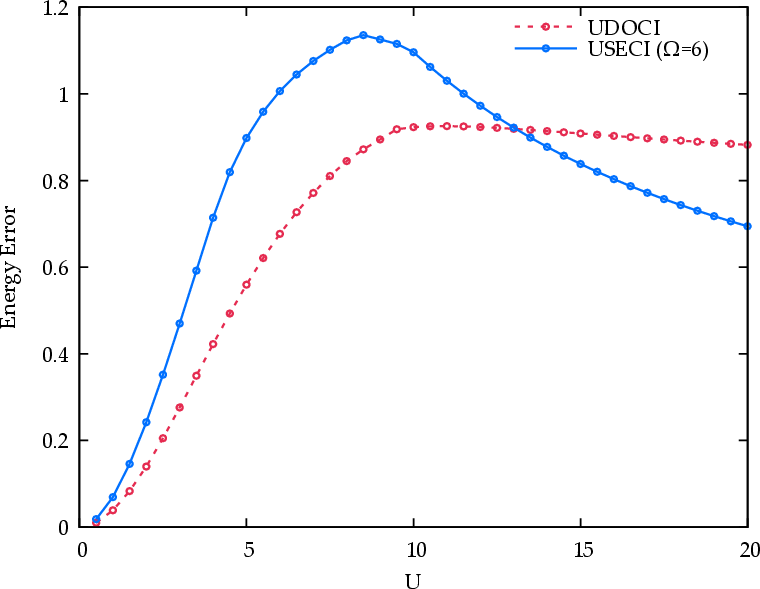
Figure 4: Energy error in the 6-electron, 10-site Hubbard ring, illustrating the regime dependence of optimal seniority sector.
Mean-Field Treatment and Computational Scaling
A key practical concern is the combinatorial scaling of SECI with system size and imposed seniority. The authors address this by exploring mean-field (MF) factorizations of the SECI wave function, benchmarking the impact of such approximations by singular value decomposition of the CI coefficient tensor. In the 8-site, 6-electron Hubbard model at intermediate seniority, the mean-field ansatz delivers negligible error compared to full SECI, supporting the feasibility of MF-based, polynomial-scaling solvers such as Jordan-Wigner Hartree-Fock for both pairing and spin sectors.
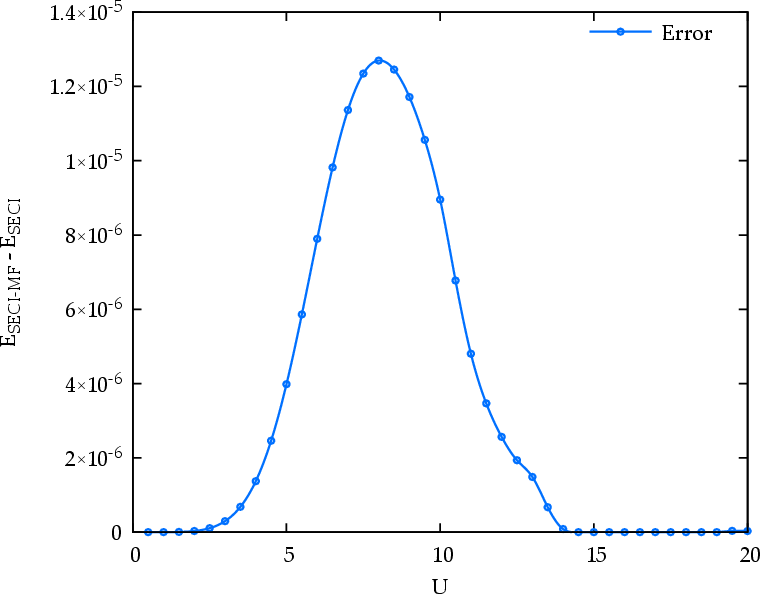
Figure 5: Difference between SECI and mean-field approximation in the 8-site, 6-electron Hubbard model at seniority four; mean-field recovers essentially all correlation captured by SECI.
Theoretical and Practical Implications
This work underlines the algebraic equivalence of paired and spin sectors at the extrema of seniority and extends the local-seniority organizing principle to arbitrary partitionings—opening the door to more flexible active space selections in strongly correlated simulations. The practical upshot is that SECI, when efficiently implemented (potentially with mean-field reductions), can address both the Hubbard Hamiltonian and molecular dissociation problems with much of the accuracy of FCI at greatly reduced cost. Notably, the necessity of spin-unrestricted treatment for high-seniority sectors suggests parallels to symmetry breaking/restoration techniques in both quantum chemistry and lattice physics.
Remaining challenges include optimal orbital assignments and the extension from local to global seniority constraints, the latter offering much greater variational freedom at a significant computational price.
Conclusion
Seniority Eigenstate Configuration Interaction provides a theoretically grounded and computationally efficient framework for incorporating strong correlation physics beyond the seniority-zero paradigm. By exploiting the symmetry between maximal and minimal seniority and judiciously constraining local seniority, SECI achieves energy accuracy competitive with FCI for prototypical models of strong correlation, at a reduced computational burden. The demonstrated utility of mean-field decoupling further enhances its practical relevance. The algebraic and variational insights herein set the stage for broader applications—particularly as developments in mean-field and tensor network methods facilitate scalable treatments of seniority-structured wave functions.

