Crafter: A Multi-Agent Harness for Editable Scientific Figure Generation from Diverse Inputs
Abstract: Scientific figures are among the most effective means of communicating complex research ideas, yet producing publication-quality illustrations remains one of the most labor-intensive parts of paper preparation. Existing automated systems each target a single figure type under text-only input, leaving the diversity of types and conditions researchers actually use unaddressed; their raster outputs further cannot be locally revised. Because scientific figures are structured compositions of discrete semantic components, the localized errors generators produce on such layouts demand not a stronger backbone but a harness. We instantiate this harness in two complementary systems: Crafter, a multi-agent harness for figure generation that generalizes across figure types and input conditions without architectural changes, and CraftEditor, which applies the same pattern to convert raster outputs into editable SVGs. Moreover, we introduce CraftBench, a benchmark spanning three figure types and four input conditions with human quality annotation. Experiments show that Crafter substantially outperforms both standalone generators and the agentic baseline on PaperBanana-Bench and CraftBench, with ablations confirming each component's independent contribution; CraftEditor faithfully converts outputs into editable SVGs that surpass all baselines. Our code and benchmark are available at https://github.com/HaozheZhao/Crafter.
Paper Prompts
Sign up for free to create and run prompts on this paper using GPT-5.
Top Community Prompts
Explain it Like I'm 14
What this paper is about
This paper shows a new way to help researchers make clear, good‑looking scientific figures (like diagrams, posters, and infographics) faster—and make them easy to edit afterward. The authors build two tools:
- Crafter: a “team” of AI helpers that plans, draws, checks, and fixes figures from different kinds of inputs (not just text).
- CraftEditor: a tool that turns a regular image (pixels) into an editable drawing (shapes and text) so you can tweak parts without redrawing everything.
They also create CraftBench, a new test set to fairly check if these tools work well across many figure types and input situations.
What questions the paper asks
In simple terms, the paper asks:
- Can we build one flexible system that makes many kinds of scientific figures, starting from text, sketches, partial layouts, or references?
- Can we keep improving a figure by finding and fixing small mistakes step by step, instead of just retrying from scratch?
- Can we turn non-editable pictures into editable diagrams that keep the original layout?
- Does this approach actually beat existing methods on a wide range of tasks?
How the approach works (in everyday language)
A “harness”: like a coach and checklist around a drawing engine
The core idea is a “harness,” which you can think of as a coach plus a shared checklist wrapped around an image generator. Instead of hoping one big model gets everything right in one go, the harness:
- Plans what to draw,
- Generates images,
- Checks for specific problems,
- Updates a structured checklist (not just messy notes),
- Tries again with targeted fixes.
This is different from just “prompting harder.” It’s more like organizing a team with roles and a plan.
Crafter: a team of AI helpers with clear jobs
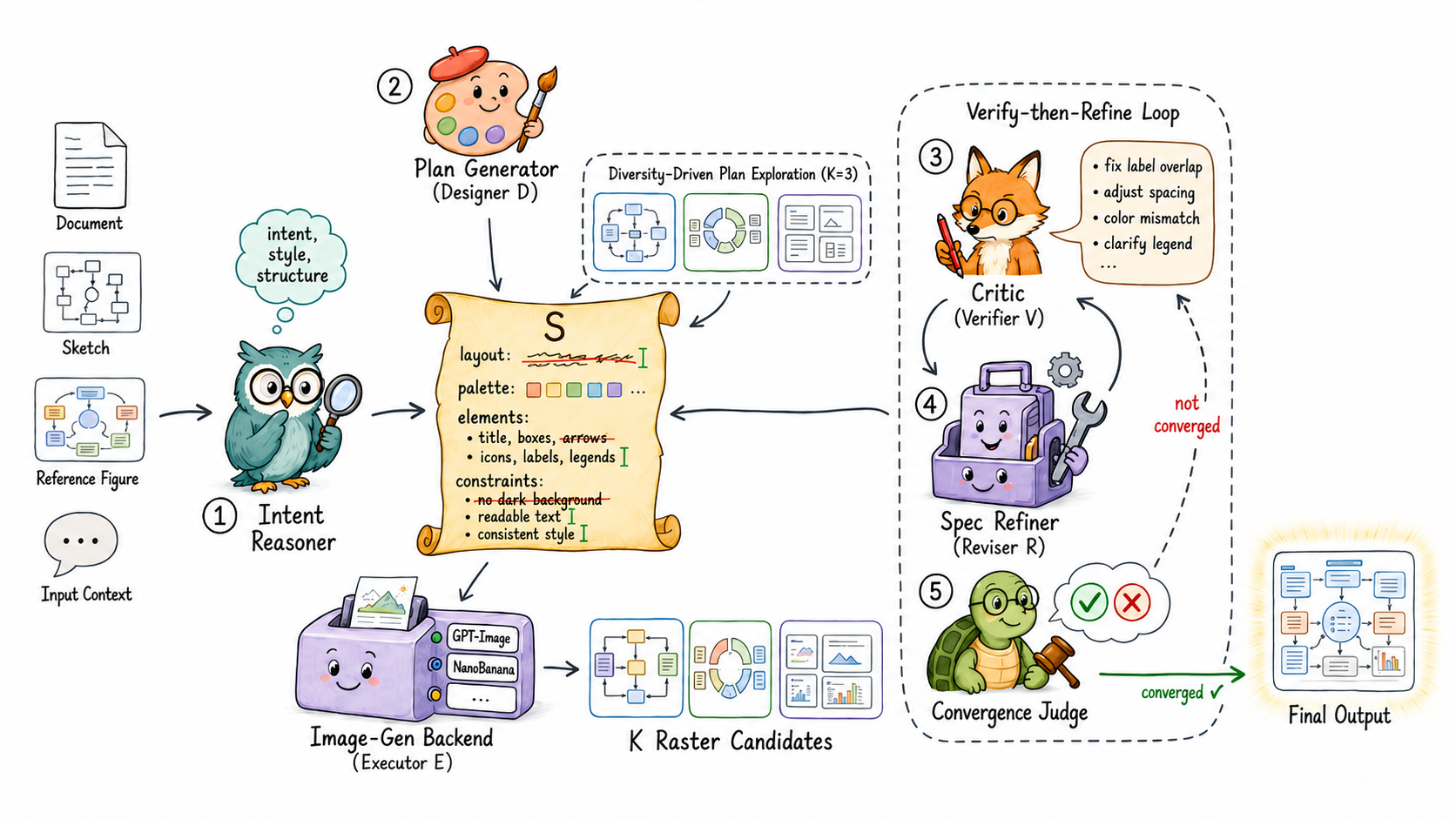
Crafter uses several specialized “agents,” like teammates:
- Intent reasoner: understands what the figure should communicate and drafts the first checklist.
- Plan generator: proposes several different layout ideas at once (like different poster layouts).
- Image generator: produces pictures for those plans.
- Critic: reviews the result and points out specific issues (e.g., a label is unreadable, an arrow points wrong).
- Specification refiner: updates a structured “spec” with precise edits (e.g., “increase title font size,” “align the two boxes”).
- Convergence judge: decides if the figure is good enough or if they should refine more.
Three simple but powerful ideas make this work:
- Explore multiple plans first: Try a few layout ideas up front so you don’t waste time fixing a bad layout.
- Structured fixes, not messy notes: Keep one clean, evolving checklist rather than piling on confusing instructions.
- Verify, then refine: Use a critic that gives detailed feedback and recheck after each fix.
CraftEditor: make images truly editable
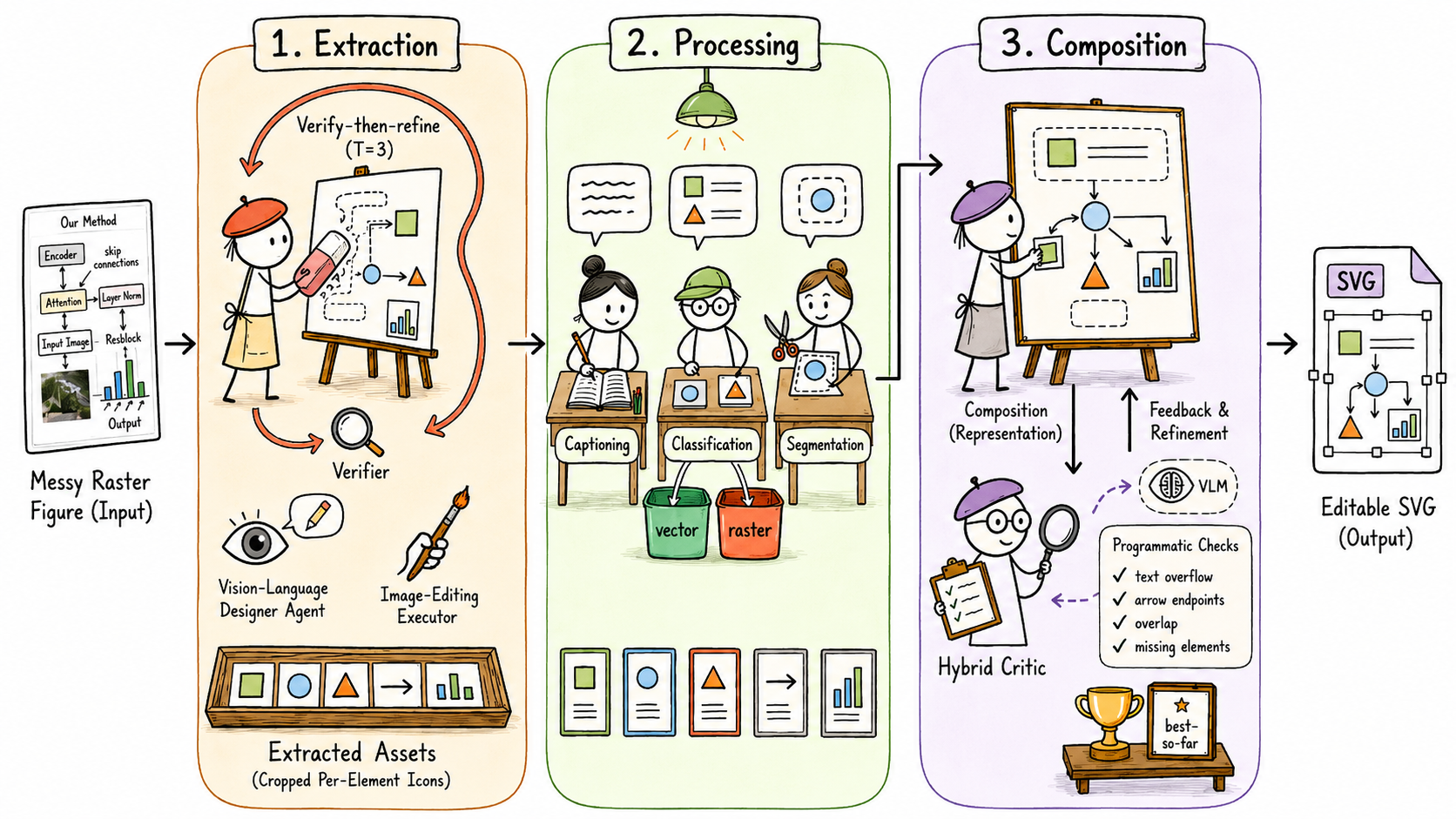
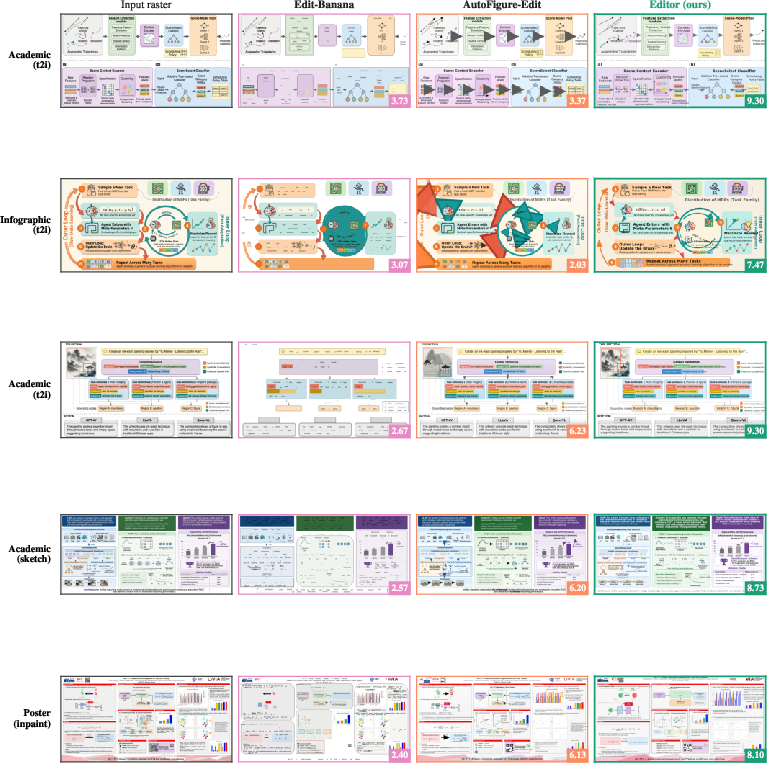
Most AI image tools give you pixel images (like photos), which are hard to edit piece by piece. CraftEditor converts these into SVGs (vector graphics), which are made of shapes and text you can move, recolor, or relabel easily.
It does this in three phases:
- Extraction: cleans the image and separates pieces (icons, arrows, boxes) without relying only on fragile segmentation.
- Processing: captions and classifies elements to understand what they are.
- Composition: assembles everything into an SVG, then iteratively checks and fixes layout problems (like overlapping elements or wrong arrow endpoints).
Quick glossary
- Raster image: a pixel picture (like a smartphone photo). Hard to edit details precisely.
- Vector image (SVG): shapes and text (like a diagram in a slide). Easy to move, resize, and edit.
- Benchmark: a standardized test set to compare methods fairly.
What they built to test it: CraftBench
CraftBench contains 279 real examples across:
- Three figure styles: academic diagrams, posters, and infographics.
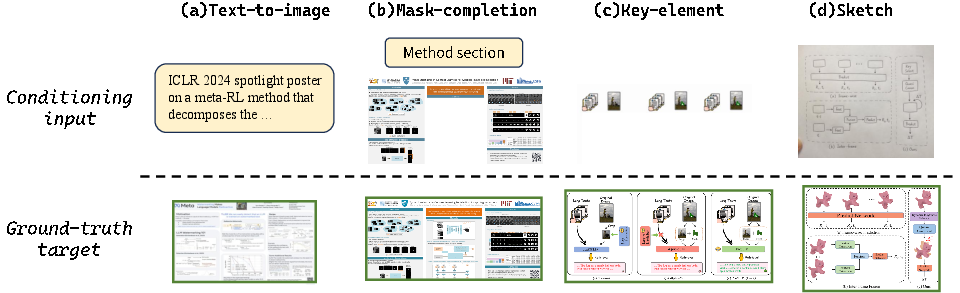
- Four input conditions: text-only, sketch-conditioned, key-element composition (you provide key parts to include), and mask-completion (fill in a specified area).
It includes quality checks by humans and uses an AI judge in a careful way to score results on things like faithfulness, readability, and how well the input instructions were followed.
What they found and why it matters
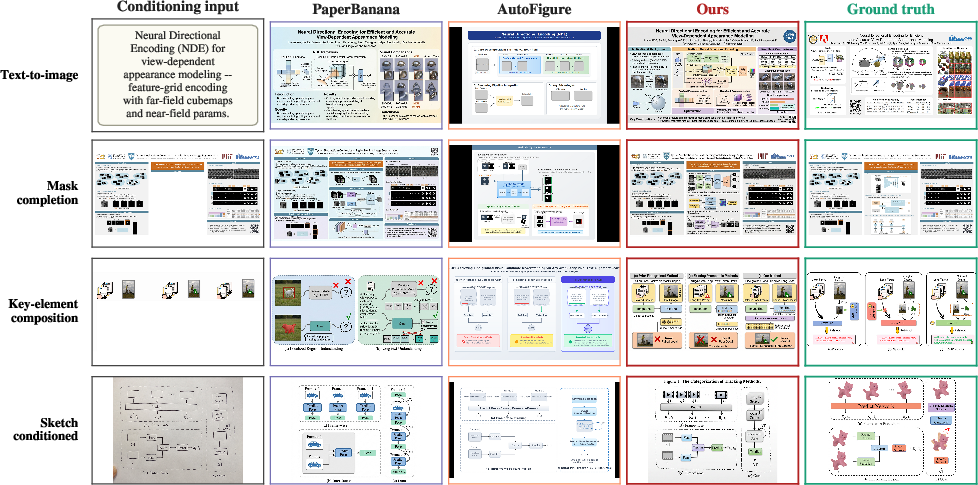
- Crafter consistently beat both standalone image generators and other “agent” systems on two benchmarks (including their new CraftBench). It worked across all figure types and input conditions, not just one niche.
- When they removed any one of Crafter’s three key ideas (plan exploration, structured fixes, or the verify‑then‑refine loop), performance dropped noticeably. This shows each part is important.
- CraftEditor produced higher‑quality editable SVGs than baseline methods, especially on tricky structural details like text alignment and arrow connections. That means it’s better at turning pictures into properly editable diagrams.
Why this matters:
- Researchers often need to tweak small parts of figures: fix a label, swap an icon, move a box. Crafter plus CraftEditor makes this far easier.
- The harness is “plug‑and‑play”: as better image generators arrive, you can swap them in without changing the overall system.
- The idea of a harness—plan, check, fix, repeat—could help in other tasks that need structured, precise results, not just pretty images.
Simple takeaway
Making scientific figures is hard and time‑consuming. This paper shows a practical way to organize AI helpers so they can draft, check, and refine figures more reliably—and then turn those figures into easy‑to‑edit diagrams. The result saves time, reduces frustration, and gives researchers more control over their work.
Knowledge Gaps
Knowledge gaps, limitations, and open questions
The following concrete gaps identify what remains uncertain, untested, or unexplored, and where future work can act.
- Benchmark scope is narrow relative to real research needs: CraftBench covers only three figure types and four input conditions; it excludes charts/plots, data-driven visualizations, math-heavy figures, CAD/circuit/molecular diagrams, 3D/interactive/animated figures, and very large posters with 100+ elements.
- Sample size and sampling bias: 279 curated samples may be too small to stress-test generalization; curation from arXiv/award posters/blogs may bias styles and domains.
- Language and script diversity are untested: no evaluation on non-Latin scripts, bilingual figures, right-to-left layouts, or mathematical typesetting fidelity.
- Accessibility and publishing compliance are unaddressed: no evaluation of color-blind palettes, font embedding, alt-text generation, reading order, or publisher style-guide conformance.
- Real-world constraint handling is not evaluated: support for strict aspect ratios, page/grid systems, margins/bleeds, corporate branding, color palettes, and typographic hierarchies is unspecified.
- No measurement of user impact: there is no user study on author time saved, number of manual edits avoided, or perceived usefulness in real paper-writing workflows.
- VLM-as-judge reliability is under-validated: limited analysis of inter-judge agreement, sensitivity to judge choice/prompts/tie-band calibration, or correlation with expert human ratings across figure types.
- Lack of standardized structural metrics for generation: beyond referenced VLM scoring, there are no objective geometric/layout metrics (e.g., IoU for bounding regions, arrow endpoint error, label placement/overflow rates).
- Editable-output fidelity is insufficiently quantified: CraftEditor’s “coordinate-faithful” claim lacks precise metrics (e.g., per-element alignment deviation, overlap violations, text overflow counts) reported against ground truth.
- Evaluation data for CraftEditor is not independent: SVG conversion is assessed on 80 Crafter outputs rather than diverse in-the-wild rasters with ground-truth vectors, risking pipeline-overfitting.
- Icons remain raster in the SVG: the method injects raster assets into a vector skeleton; true vectorization of icons, font glyphs, and shape boundaries (with acceptable simplification) is not addressed.
- Text handling is under-specified: no OCR accuracy, font mapping, ligatures, math notation, non-English scripts, or fallback strategies are reported for SVG composition.
- Layering, grouping, and semantics in SVG are not evaluated: object grouping, z-order consistency, reusable symbols, anchors, and semantic tags (for downstream edits or accessibility) are unmeasured.
- Arrow routing and connector logic are heuristic: the programmatic checkers audit endpoints, but path routing algorithms, avoidance of occlusions, and connector reflow under edits are not described or benchmarked.
- Harness convergence is empirical only: no analysis of convergence guarantees, regression frequency, or conditions under which verify-then-refine oscillates or collapses.
- Sensitivity to hyperparameters is unclear: the adaptive selection rules for number of plans K, rounds T, and decoding temperatures are not specified or validated; robustness to these settings is unknown.
- Compute and latency costs are opaque: per-sample wall-clock time, GPU-hours, token usage, and cost vs. quality trade-offs for K, T, and critic complexity are not reported.
- Reproducibility risks from proprietary components: dependence on closed models (e.g., Gemini judges/backbones) and instability/safety refusals (e.g., GPT-Image-2) threatens replicability across environments.
- Breadth of executor-agnostic claim is untested: only two backbones are used; compatibility with diffusion-based open models, layout-aware renderers, or code-generation executors for rendering is not demonstrated.
- Prompt robustness is unexamined: sensitivity to prompt phrasing, prompt injection from user-provided context/docs, and cross-LLM portability of agent prompts are not studied.
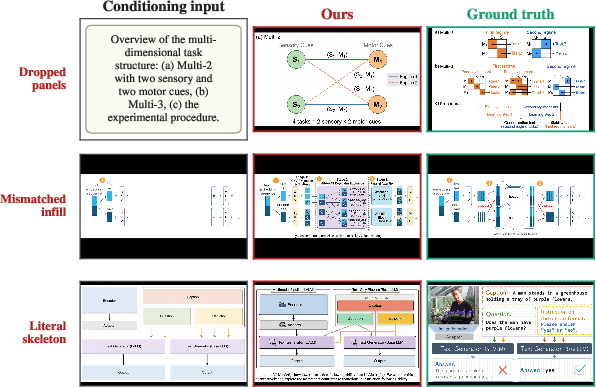
- Failure mode taxonomy is missing: while examples exist, there is no systematic categorization/quantification of failure types (e.g., label garbling, misaligned connectors, missed key elements) and their root causes.
- Safety, copyright, and privacy are not discussed: handling of copyrighted icons/logos, extraction of sensitive text from figures, and compliance with dataset licensing are unspecified.
- Input-constraint fidelity beyond included tasks is untested: e.g., strict layout preservation from sketches, color-palette locking, element “do-not-move” constraints, and brand assets with legal must-haves.
- Post-editing interoperability is unverified: performance and stability when opening/editing generated SVGs in common tools (Illustrator, Inkscape, Figma, draw.io) are not evaluated.
- Human-in-the-loop workflows are absent: no protocol for integrating user corrections into the structured specification S, conflict resolution for competing constraints, or guarantees that local edits remain local.
- Generalization beyond scientific figures is unknown: applicability to UI mockups, technical schematics, or instructional diagrams with different conventions is not established.
- Statistical significance is not reported: no uncertainty estimates or significance tests for headline improvements across benchmarks/tasks.
- Robustness to adversarial or contradictory inputs is untested: how the harness behaves when the conditioning input conflicts with instructions or contains misleading elements remains open.
- Long-horizon editing stability is unclear: cumulative degradation across many refinement rounds or large edit sequences is not measured.
- Data-binding and chart generation are out of scope: converting data tables to plots or ensuring numerical fidelity within charts is not addressed, yet common in scientific figures.
Practical Applications
Immediate Applications
The paper’s harness-based systems (Crafter for generation and CraftEditor for raster-to-SVG conversion) are deployable with today’s image/VLM backends and can be integrated into existing authoring and design workflows. Below are concrete, sector-linked use cases.
- Academia and Education
- Scientific figure and poster authoring assistants (Overleaf/LaTeX, MS PowerPoint, Google Slides, Keynote)
- Tools/workflows: “Crafter Assistant” plugin to generate figures from section text, sketches, or partial layouts; “CraftEditor” button to turn final rasters into editable SVGs for last‑minute label fixes, color changes, or panel rearrangements.
- Assumptions/dependencies: Access to an image-generation backend (e.g., Nano Banana, GPT-Image); VLM availability for the critic; compute budget for multi-plan exploration and iterative refinement; privacy controls for manuscript content.
- Rapid classroom material creation (lesson diagrams, lab workflows, assessment infographics)
- Tools/workflows: Sketch-to-diagram via tablet; library of curriculum-aligned icons; export to Slides/Canva/Figma as SVG.
- Assumptions/dependencies: Teacher-provided scaffolds; domain-specific vocabularies; human review for accuracy.
- Software/IT and Enterprise Documentation
- Architecture/API/DevOps diagrams and runbooks
- Tools/workflows: Generate drafts from README/specs; key-element composition using company icon packs; SVG handoff to draw.io, Figma, or Mermaid editors; iterative fix loop to enforce arrow endpoints, grid alignment, readable labels.
- Assumptions/dependencies: Icon libraries and naming conventions; style-guide prompts; on-prem/intra‑net deployment for source confidentiality.
- Knowledge base and SOP visualization (Confluence/Notion integrations)
- Tools/workflows: Text-to-figure and sketch-conditioned refinements; CraftEditor to convert legacy rasters for ongoing maintenance.
- Assumptions/dependencies: Authentication and content-safety filters; governance for edits.
- Marketing and Communications (Cross-industry)
- Research blog infographics and explainer visuals
- Tools/workflows: Draft multiple layouts with diversity-driven plan exploration; choose the best framing; localize colors/labels via SVG edits.
- Assumptions/dependencies: Brand color/style prompts; legal check for iconography licensing.
- Healthcare and Life Sciences
- Patient education leaflets and SOP flowcharts
- Tools/workflows: Sketch-conditioned or key-element composition from clinical guidelines; CraftEditor for standardized icons and unambiguous arrows/text.
- Assumptions/dependencies: Clinical review; controlled vocabulary and safety symbols; strict PHI handling.
- Finance and Regulated Industries
- Compliance workflows (KYC/AML), risk process diagrams
- Tools/workflows: Encode house rules as typed edits (e.g., mandatory disclaimers, label size minima); SVG edits for audit trails.
- Assumptions/dependencies: Human-in-the-loop signoff; policy rule packs; reproducibility logs.
- Conferences and Events
- Poster layout drafting and revision
- Tools/workflows: Generate multi-column/poster layouts from abstracts; mask-completion to update a section without full re‑render; SVG export for printer-ready tweaks.
- Assumptions/dependencies: High-resolution rendering; printer specs; time budget for iterative verification.
- Accessibility and Localization
- Readability improvements and language swaps
- Tools/workflows: Use CraftEditor to replace rasterized text with real vector text; enlarge fonts; adjust color palettes for contrast; swap labels to another language while preserving layout.
- Assumptions/dependencies: Translation resources; accessibility guidelines (e.g., WCAG) encoded as checks; font availability.
- Research and QA of Generative Systems
- Benchmarking and regression testing with CraftBench
- Tools/workflows: Evaluate new figure generators or agentic pipelines across types and input conditions using the provided VLM-based protocol.
- Assumptions/dependencies: Consistent VLM judge; calibration to reduce bias; dataset license compliance.
- Design Tool Extensions
- Figma/Illustrator/Draw.io plugins for raster-to-editable conversion
- Tools/workflows: One-click “Make Editable (SVG)” powered by CraftEditor; hybrid critic ensures arrow endpoints, text bounding, and non-overlap.
- Assumptions/dependencies: Plugin APIs; local processing or secure cloud execution; possible content-safety refusals by backends.
- Team-wide Consistency for Figure Families
- Cohesive multi-figure sets within a paper/report
- Tools/workflows: Carry a shared specification (colors, fonts, grid, iconography) across figures; typed edits enforce global constraints.
- Assumptions/dependencies: Project-level style guide captured in prompts/spec memory; versioning of specifications.
Long-Term Applications
These require further research, scaling, domain checkers, or tighter systems integration but follow directly from the paper’s harness pattern (executor-agnostic, structured spec as memory, directive critics, iterative refinement).
- Generalized Harness for Structured Visual Outputs
- UI wireframes, dashboard layouts, slide decks, and presentations
- Potential products: “SlideCrafter” for deck auto-layout; “DashCrafter” for BI dashboards with chart/legend/label checks.
- Dependencies: Domain-specific critics (e.g., chart semantics, responsive layouts); integrations with PowerPoint, Google Slides, or BI tools.
- CAD/Engineering and Safety-Critical Diagramming
- P&ID, electrical schematics, robotics cell layouts
- Potential products: “EngCraftEditor” with programmatic checkers for standards (ISO/IEEE symbols, line types, clearances).
- Dependencies: High-precision vector extraction; strict rule engines; certification and traceability; domain iconography libraries.
- Automated Policy/Standards Compliance for Diagrams
- Enforcing style guides and regulatory rules at authoring time
- Potential products: Rule packs for ACM/IEEE formatting; enterprise branding rule modules; compliance dashboards.
- Dependencies: Formalized rule sets; explainable failure reports; org-wide deployment and governance.
- Accessibility-by-Design and Audited Explainability
- Auto-generation of alt text, reading order, and colorblind-safe palettes
- Potential products: Accessibility critic modules; auto-contrast fixers; export with embedded accessibility metadata.
- Dependencies: Reliable text extraction and semantics; WCAG rule codification; multilingual alt-text generation and validation.
- Cross-lingual and Cultural Localization with Reflow
- Automatic re-layout for text expansion/contraction across languages
- Potential products: “Localize & Reflow” services integrated with TMS (translation management systems).
- Dependencies: Text measurement and reflow constraints; locale-specific typographic rules; QA workflows.
- Knowledge-Graph–to–Diagram and Diagram–to–Spec Loops
- Bidirectional mappings between structured specs and visuals
- Potential products: Import/export to JSON/YAML diagram specs; automated consistency checks between docs and figures.
- Dependencies: Robust inverse parsing; schema agreements; doc mining.
- Co-creative Design Agents (“AI Pair Designer”)
- Real-time, mixed-initiative editing: humans sketch; agent proposes, critiques, and applies typed edits with live previews
- Potential products: IDE-like design environment with critic linting for visuals.
- Dependencies: Low-latency VLMs; streaming diff/preview pipelines; stronger non-monotonicity guards.
- Synthetic Data Generation for Training
- Large corpora of high-diversity, high-fidelity structured figures with annotations
- Potential products: Data services for training diagram code generators or OCR/layout models.
- Dependencies: Quality control at scale; licensing/attribution; diversity coverage across domains.
- End-to-End Publication Automation
- From manuscript sections to numbered, cross-referenced figures with consistent styles and auto-updated captions
- Potential products: “PaperOps” pipelines integrated with Overleaf/CI; proofing bots for figures.
- Dependencies: Reliable section summarization; citation and cross-ref syncing; editorial acceptance.
- Interactive and Data-Linked Figures
- Generate SVGs that bind to underlying datasets for live updates
- Potential products: Data-bound figures in Jupyter/RMarkdown with auto-propagated layout constraints.
- Dependencies: Stable data bindings; separation of content vs. presentation; critics for data semantics.
- Policy Dashboards and Public Engagement
- From long-form policy text to explainer visuals and interactive summaries
- Potential products: Civic-tech hubs producing standardized, editable visuals for public portals.
- Dependencies: Fact-checking critics; misinformation safeguards; human oversight in sensitive domains.
Notes on feasibility across applications:
- All harness capabilities depend on the availability and stability of image/VLM backends and instructable image editors; content-safety filters may block certain inputs.
- Iterative loops and plan exploration incur latency and cost; on-device or on-prem deployments may be needed for privacy or speed.
- CraftEditor’s quality hinges on clean extraction and robust hybrid critics; highly cluttered or photorealistic imagery remains challenging.
- Legal/IP for icon libraries and brand assets must be addressed; human review is essential in regulated sectors.
- Encoding domain rules into directive critics and programmatic checkers is the main development effort when transferring to new verticals.
Glossary
- Ablations: Controlled experiments where components of a system are removed or altered to assess their contribution. "Ablations validate each mechanism"
- Acceptance thresholds: Predefined minimum scores on evaluation criteria that determine whether to stop refinement. "already satisfies acceptance thresholds on critical dimensions."
- Agentic baseline: A comparative system that uses agent-based orchestration to perform the task, serving as a benchmark. "outperforms both standalone generators and the agentic baseline on PaperBanana-Bench and CraftBench"
- Agentic pipelines: Multi-agent workflows that coordinate planning and generation to produce outputs. "agentic pipelines that pair planning agents with powerful image generators to produce visually polished figures from text"
- Backbone: The primary underlying model used for generation; stronger backbones are often sought to improve quality. "demand not a stronger backbone but a harness."
- Best-so-far checkpoint: A saved version of the highest-scoring output so far, used to revert if later iterations degrade. "with a best-so-far checkpoint that reverts to whenever the current round regresses"
- Calibrated tie band: A predefined score margin within which outcomes are considered ties to reduce noise in comparative evaluation. "under a calibrated tie band."
- Closed-loop verification: A feedback process where outputs are checked against the original intent and iteratively corrected. "enabling targeted correction of individual failure points and closed-loop verification against the original intent."
- Code-generation methods: Approaches that produce editable figure code (e.g., diagram code) rather than pixels. "code-generation methods that synthesize editable diagrams in TikZ or similar formats"
- Conditioning input: Additional input (e.g., sketches, masks, elements) that constrains or guides generation. "whether a system generalizes across figure types or preserves a user's conditioning input."
- Convergence judge: An agent that decides whether to accept, refine, or revert during iterative generation. "the convergence judge routes each round to accept, refine, or revert to Final output."
- Coordinate-faithful: Preserving precise spatial positions and relationships when converting or reproducing graphics. "into a coordinate-faithful editable SVG "
- Directive critic: An evaluator that provides actionable, targeted corrections rather than only scalar scores. "a verify-then-refine loop in which a directive critic issues targeted corrections rather than scalar scores."
- Diversity-driven plan exploration: Generating multiple candidate plans upfront to explore different compositions before refinement. "diversity-driven plan exploration generates multiple candidate framings in parallel"
- Early-exit gate: A mechanism to stop the iterative loop as soon as quality thresholds are met. "An early-exit gate bypasses the loop when the first-round output already satisfies acceptance thresholds on critical dimensions."
- Executor-agnostic: Designed to work with different underlying generators or executors without architectural changes. "Because the harness is executor-agnostic"
- Free-text revision: Unstructured natural-language instructions appended across iterations, which can lead to contradictions. "Iterative repair via free-text revision instructions degrades rapidly"
- Hallucination filter: A safeguard that discards spurious or irrelevant extractions produced during processing. "with a hallucination filter discarding blank, mismatched, or text-only extractions"
- Harness: An orchestration layer around a generator that plans, verifies, and revises outputs using structured memory. "What is needed in both settings is not a better generator but a harness"
- Hybrid critic: A combined evaluator using both model-based judgments and programmatic checks. "via a hybrid critic that combines two complementary channels"
- Intent reasoner: An agent that infers goals and required elements from inputs to seed the initial specification. "An intent reasoner analyzes and infers the figure's communicative role"
- Inverse parsing: Recovering a structured representation from generated diagrams to evaluate structural fidelity. "inverse-parses generated diagrams into structured graphs"
- Keep/delete plan: A plan specifying which elements to retain or remove during extraction. "authors a per-figure keep/delete plan specifying which elements to preserve and which to remove."
- Mask-completion: A task where generation fills in or completes specified masked regions conditioned on a mask. "mask-completion ($30$)"
- Non-monotonic: Performance that does not consistently improve across iterations and may regress. "language-model-driven iterative editing is empirically non-monotonic"
- OCR: Optical Character Recognition; extracting text from images for downstream processing. "converts segmentation and OCR outputs into DrawIO cells."
- Pluggable: Replaceable without changing the surrounding system, enabling modular swap-in of components. " is pluggable, so all task-specific behavior resides in the prompts"
- Position bias: A bias arising from the placement of items in pairwise comparisons, which can skew judgments. "which removes the position bias of pairwise comparison."
- Programmatic checkers: Automated rules or scripts that validate structural properties of an output. "programmatic checkers auditing structural properties (text overflow, arrow-endpoint accuracy, element overlap, missing components)"
- Raster-to-vector conversion: Transforming pixel-based images into vector graphics for editability. "recent raster-to-vector attempts remain limited by unreliable element extraction and fragile composition."
- Reference-conditioned tasks: Generation tasks that use auxiliary inputs like sketches or elements as constraints. "the three reference-conditioned tasks"
- Segmentation: Partitioning an image into regions or elements, often used to isolate components. "off-the-shelf segmentation"
- Specification refiner: An agent that writes structured edits to the evolving specification based on critiques. "the specification refiner writes typed edits into "
- Structured corrective layer: A mechanism that accumulates typed, structured edits instead of free text to avoid contradictions. "The structured corrective layer replaces free-text accumulation with typed edits on "
- Structured memory: A persistent, structured record (specification) shared across agents to track plans and revisions. "share an evolving figure specification as the pipeline's structured memory"
- SVG skeleton: A scaffold SVG structure with placeholders used to assemble final vector graphics. "an SVG skeleton and iteratively refines the result"
- TikZ: A LaTeX-based language for programmatically creating diagrams and graphics. "in TikZ or similar formats"
- Typed edits: Structured, typed operations applied to the specification to guide revisions coherently. "writes typed edits into "
- VLM-as-judge: Using Vision-LLMs as evaluators for generated images. "Our evaluation keeps the referenced VLM-as-judge philosophy"
- Weighted mean: An average where different aspects are combined with specified weights to compute a total score. "A weighted mean turns the per-aspect scores into one total per image"
- Verify-then-refine loop: An iterative process that evaluates outputs, issues directives, and revises until criteria are met. "verify-then-refine loop"
Collections
Sign up for free to add this paper to one or more collections.