- The paper introduces PokerSkill, a novel framework combining deterministic context extraction and human-crafted rule libraries to solve the decision-binding problem in LLMs.
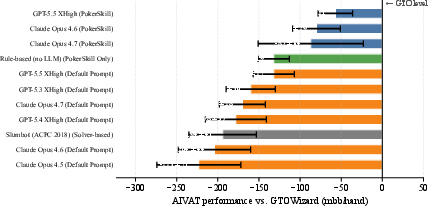
- It employs a multi-layer skill retrieval system with a budget mechanism to constrain decisions and achieve up to 61% performance improvement over default prompt LLMs.
- Empirical results show PokerSkill outperforms traditional agents and solver-based methods, offering a scalable, interpretable approach for sequential decision-making in poker.
Expert-Level Poker from LLMs Without Training or Solvers: An Essay on PokerSkill
Historical Perspective and Paradigm Distinctions
The paper "PokerSkill: LLMs Can Play Expert-Level Poker without Training or Solvers" (2605.30094) analyzes the development trajectory of poker AI, categorizing progress within four major paradigms: interpretable rule-based systems, computationally intensive CFR/solver-based approaches, LLM-based agents, and systems combining human-crafted skills with LLMs for decision-making. Rule-based agents historically offered interpretability but lacked strategic depth, whereas equilibrium solvers—enabled by CFR and abstraction—achieved near-optimal play at the expense of formidable computational requirements. Direct application of LLMs, even with extensive poker-relevant knowledge, has been ineffectual due to poor context-binding and strategy execution.
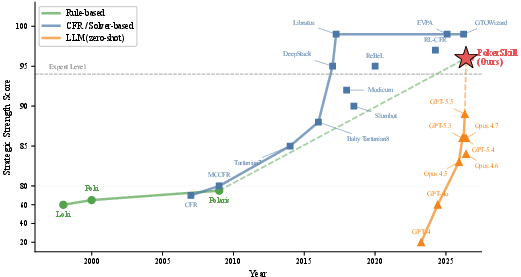
Figure 1: Evolution of poker AI systems, showing PokerSkill’s distinctive role in bridging LLM capabilities and strategic action via rule-based skills.
PokerSkill occupies a novel point, requiring no training or solver access, yet demonstrating competitive performance through structured scaffolding: human expert-crafted skills serve as the action-grounding interface for LLMs, activating latent domain knowledge under deterministic context retrieval.
Technical Architecture of PokerSkill
PokerSkill resolves the recurrent failure of default-prompt LLMs—the "decision-binding" problem—wherein models possess relevant strategic concepts but apply them incorrectly in context. The architecture consists of:
- Context Engine: Deterministically extracts game features (board texture, hand class, action line, SPR, position).
- Skill Retrieval: Context activates prompt fragments from a layered skill library (five layers: game rules, preflop ranges, general principles, context-specific guidance, river blockers), designed entirely by high-stakes poker experts.
- Budget Mechanism: Attack/defense budgets constrain the action space based on hand strength, board status, and line pressure.
- Bounded LLM Decision: LLM selects among context-compatible, legal actions; a validator enforces action legality.
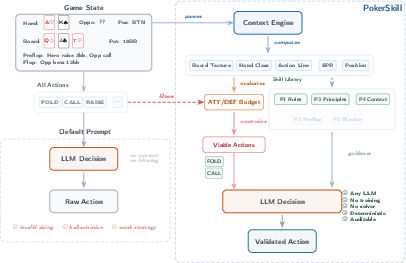
Figure 2: PokerSkill’s context engine and skill library, strictly bounding LLM outputs and preventing common action, sizing, and hallucination failures.
This deterministic scaffolding enables PokerSkill to externalize expert reasoning for every node, with fine-grained action line classification, board texture analysis, and per-hand strategic budgets, preventing both vague prompt drift and combinatorial overloading. The budget system formalizes multi-street coherence—per decision, the remaining budget quantifies available aggression or defense, algorithmically enforcing optimal geometric pressure distribution, positional adjustments, and draw-defense logic.
Evaluation utilized GTOWizard—a state-of-the-art GTO HUNL benchmark offering AIVAT variance reduction—to compare PokerSkill-enhanced LLMs, default-prompt LLMs, rule-based-only agents, and the Slumbot solver bot. Major empirical findings include:
Importantly, the rule-based skill library alone achieves only moderate improvement, while the combination with LLM reasoning yields robustly competitive results—indicating synergistic action, not mere prompt engineering. All PokerSkill LLMs outperform Slumbot, a champion-level solver, without any game-tree traversal or offline learning. The framework’s generality is corroborated by consistent improvements across divergent LLM families, with scaling improvement tied to model quality.
Implications for AI and Sequential Decision-Making
PokerSkill’s core insight is not just domain-specific: structured scaffolding fundamentally transforms LLM situated decision-making, activating expert knowledge through deterministic context classification and strategic retrieval. The results contradict the paradigm that either extensive solver computation or RL fine-tuning is a pre-requisite for strong imperfect-information sequential play. Instead, the evidence demonstrates that context-grounded rule retrieval and bounded output interfaces allow general LLMs to compete nearly at GTO-level, evincing that rule-based systems are not inherently weak but rather limited by the executor’s reasoning capacity.
Externalizing expert knowledge as actionable scaffolds suggests the emergence of a modular architecture: deterministic context engines, expert libraries, bounded LLM decision, and rigorous validator loops. As LLMs advance, PokerSkill’s performance is expected to scale without additional engineering. This pattern generalizes to domains where latent expert knowledge exists but situated selection among competing heuristics is error-prone (medical, legal, negotiation).
The architectural separation in PokerSkill (distilling expert intuition into context-activated retrieval) enables rapid replication, easy auditability, and cross-model generalization—contrasting sharply with opaque, computationally-intensive solver systems. Future work may extend to multiplayer poker, real-money settings, automated budget calibration, and generalize to sequential games requiring robust context-dependent strategic application.
Conclusion
PokerSkill establishes that LLMs, when paired with structured, expert-driven skill libraries and deterministic context engines, can attain competitive play in complex imperfect-information games without training or solver access. The empirical results show substantial improvements—up to 61% reduction in loss rates and outperforming solver-based agents—simply by resolving the decision-binding bottleneck. Theoretical implications point to a new direction in agent architecture: modular scaffolding, actionable rule retrieval, and bounded generation harnessing general LLM capabilities. Practically, this enables reproducible, interpretable, scalable agents whose strength grows together with foundational model advancements. The paradigm demonstrates the viability of training-free, skill-activated LLM agents for complex strategic domains, with broader applicability in AI for sequential decision processes.