- The paper introduces a hierarchical transformer that leverages cross-hand context to exploit systematic opponent flaws in poker.
- It demonstrates significant EV improvements over baseline NE strategies, with gains up to +1.0 BB/hand on Leduc Hold’em.
- The study maintains robustness against Nash equilibrium play while effectively adapting to both in-distribution and out-of-distribution opponent strategies.
Introduction and Motivation
AlphaExploitem addresses a central dichotomy in imperfect information games such as poker: while Nash equilibrium (NE) strategies guarantee safety by preventing exploitation, they often forgo substantial expected value (EV) available against suboptimal opponents who deviate from equilibrium. Unlike prevailing NE-seeking RL agents—DeepStack, Libratus, Pluribus, and AlphaHoldem—which treat each hand as independent, AlphaExploitem introduces the ability to adaptively exploit repeated interactions by leveraging previously observed hands with the same opponent. Accordingly, AlphaExploitem extends the AlphaHoldem architecture by incorporating a hierarchical transformer encoder, conditioned on the tokenized history of past hands, to recognize and capitalize on systematic opponent flaws. The approach is empirically demonstrated on Kuhn and Leduc Hold’em.
Architectural Design and Training Paradigm
AlphaExploitem’s architecture remains faithful to the efficient card and action encoders pioneered in AlphaHoldem but introduces a dedicated transformer stack for processing the cross-hand context. The three input streams consist of (i) card observations, (ii) intra-hand action history, and (iii) a session-level history of prior hands—where the latter is encoded as a sequence of typed tokens (distinguishing hero/opponent actions, private/community cards, etc.) for maximal informativeness. The transformer is hierarchically structured: a within-hand encoder computes per-hand embeddings, which are aggregated by an across-hand encoder, yielding a session representation fused with the active hand’s features for downstream policy and value estimation.
In training, AlphaExploitem adopts PPO with experience generation from a tripartite pool: (i) a K-best league of previous high-performing agent checkpoints, (ii) a curated set of hand-crafted, exploitable toy opponents spanning canonical archetypes (maniac, nit, LAG, calling station, etc.), and (iii) a long-tail buffer of earlier agent versions to increase policy diversity and prevent overfitting either to the NE or toy distributions. The policy is evaluated both in exploiter mode (history stream unmasked) and a non-exploiter ablation (history masked).
A primary empirical claim is that AlphaExploitem’s transformer-driven context utilization confers a distinct advantage in extracting EV from both in-distribution (training) and out-of-distribution (OOD) toy opponents.
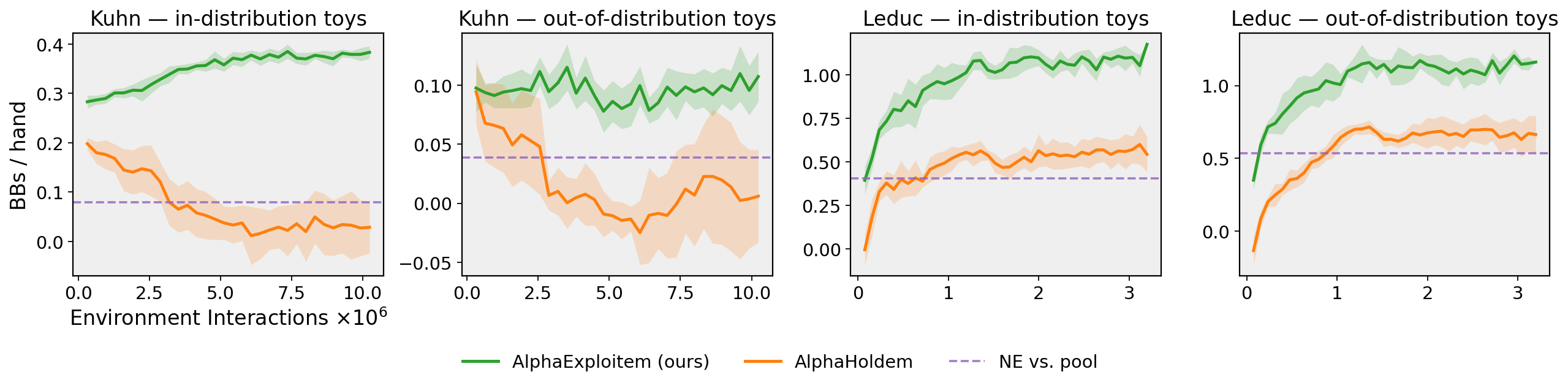
Figure 2: AlphaExploitem outperforms no-history baselines in both Kuhn and Leduc by accruing higher rewards per hand against both in-distribution and out-of-distribution opponent pools.
This improvement is substantial: on Leduc, AlphaExploitem achieves approximately +1.0 BBs/hand on ID toys versus +0.5 for AlphaHoldem, and this performance generalizes robustly to OOD opponents. In Kuhn, the agent reaches +0.38 BBs/hand (ID), a strong improvement over baseline (≈+0.03), with consistent OOD normalized gains. These results demonstrate that the hierarchical context encoder learns opponent class-level features rather than overfitting to specific policies.
Crucially, the performance against true NE policies remains unimpaired, as shown by reward curves converging near the NE-vs-NE expectation:
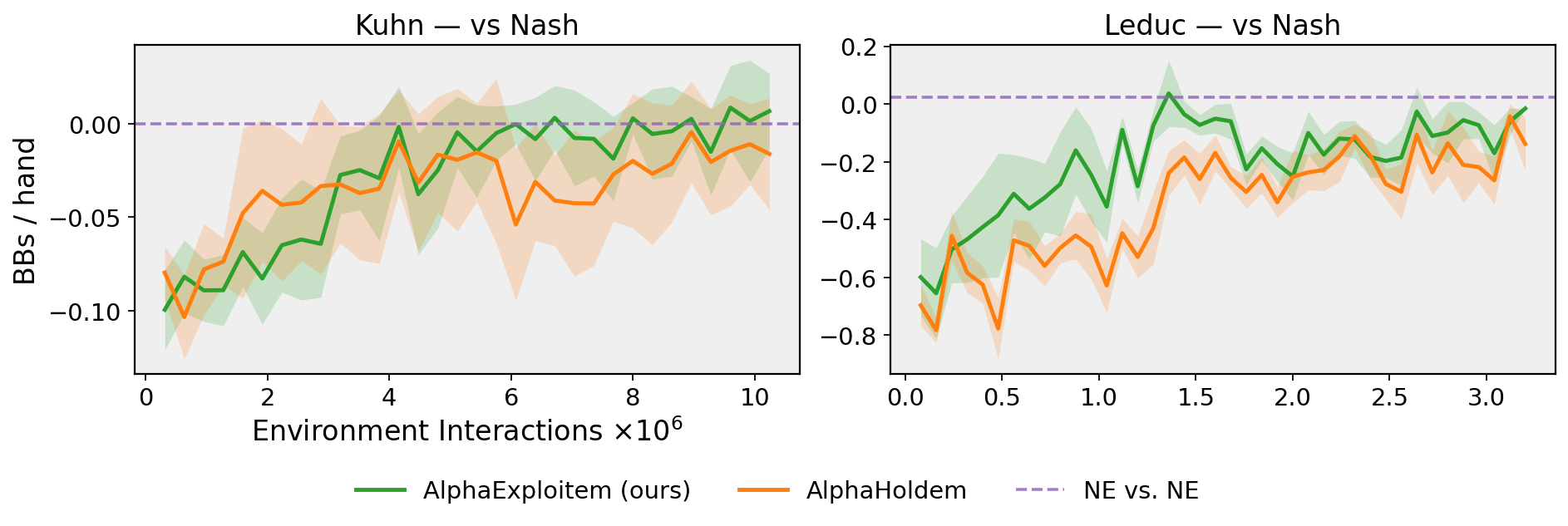
Figure 1: AlphaExploitem preserves strong robustness versus the Nash equilibrium policy in both game variants.
Thus, the exploitation capability does not render the policy susceptible to NE exploitation, affirming the agent’s strategic soundness.
Per-Opponent Analysis
Analysis by individual toy archetype reveals broad, not localized, benefit of the cross-hand encoder. AlphaExploitem delivers higher reward against every toy, with the most marked absolute gains against highly exploitable archetypes (maniac, LAG, extreme bluffers), and little difference for strong or near-NE opponents.
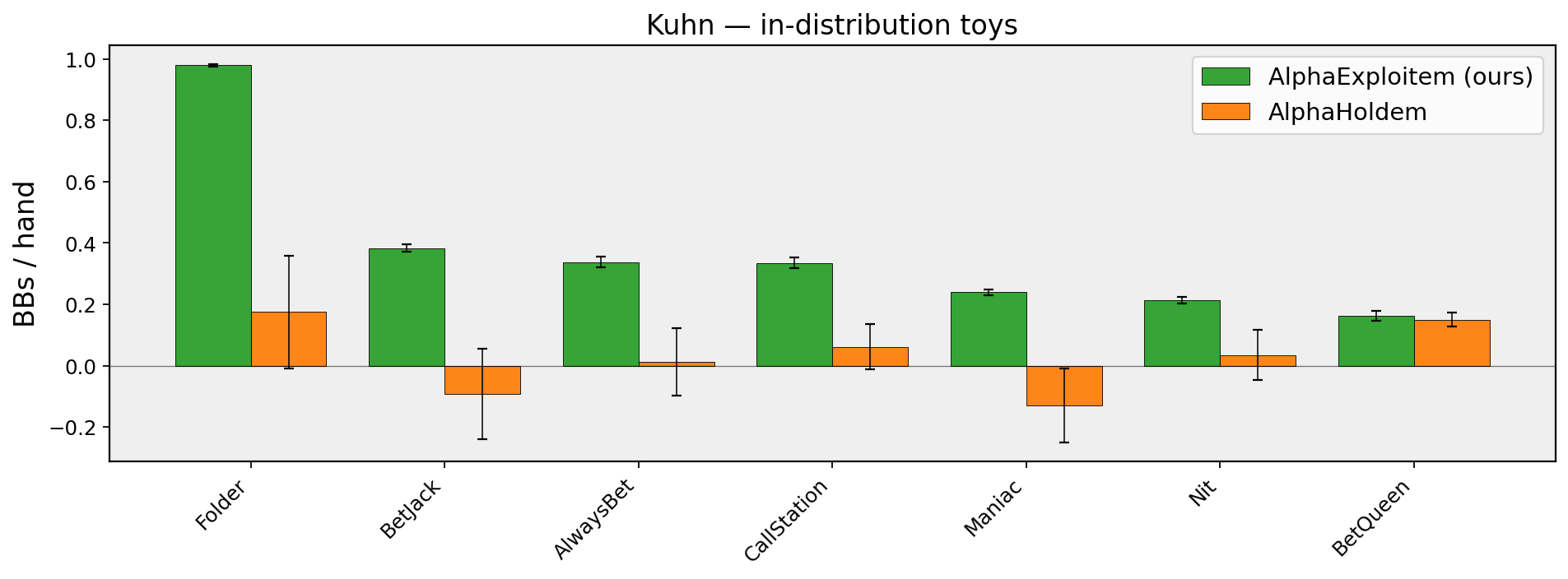
Figure 3: Distribution of per-opponent final rewards on in-distribution Kuhn toys shows consistent exploitation improvement.
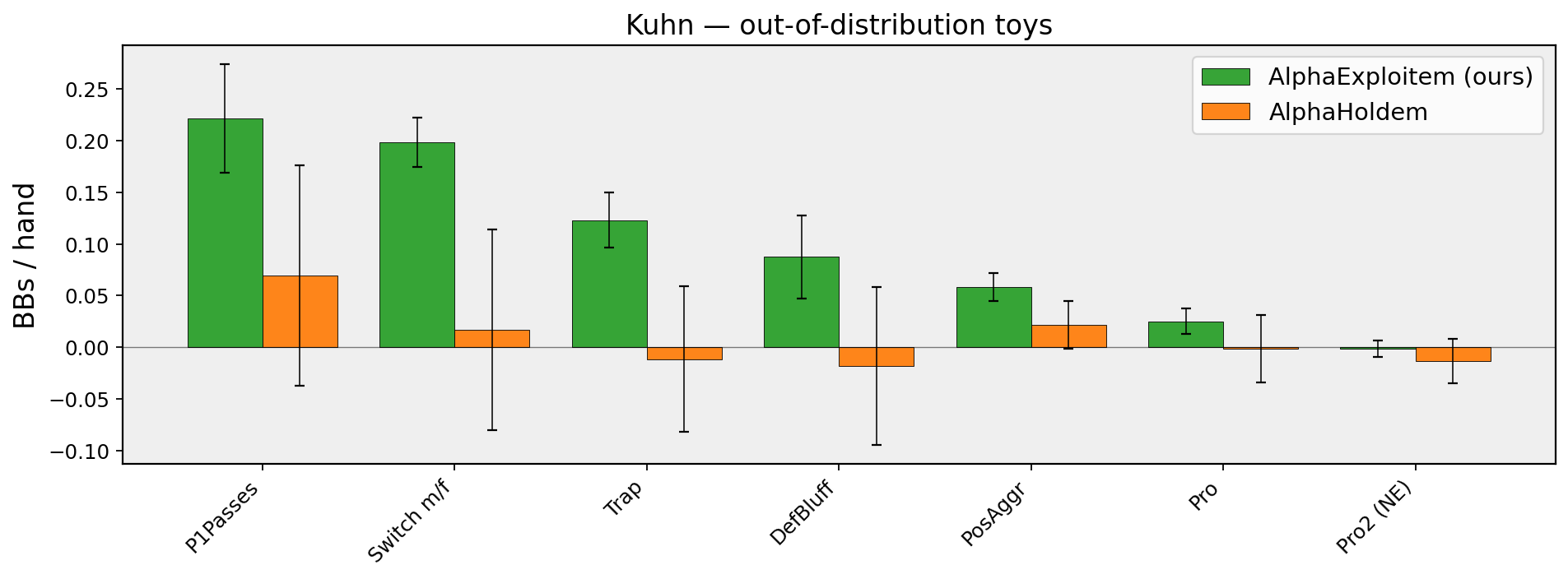
Figure 4: On OOD Kuhn toys, the exploitation benefit generalizes, though absolute values decline as expected from lower BR ceilings.
Analogous patterns are observed on Leduc for both ID and OOD pools (Figures 6 and 7, not shown here for brevity).
Context Ablation: Causality of Cross-Hand Reasoning
Ablation wherein the transformer’s cross-hand input is masked during evaluation directly quantifies the contribution of context-based adaptation. Across all seeds, exploitation performance drops by roughly half—e.g., from +1.10 to +0.54 BBs/hand (in-distribution Leduc), affirming that the hierarchical transformer is responsible for the majority of the exploitative power.
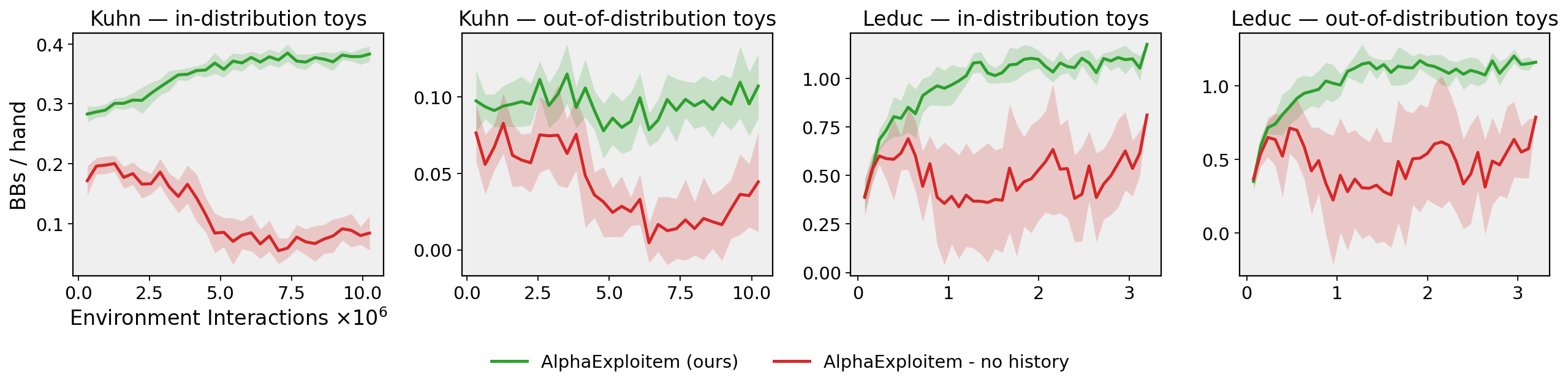
Figure 5: Masking the cross-hand channel ablates exploitation capability, with performance reverting toward non-adaptive baselines.
The effect is especially pronounced in Leduc, reflecting the greater value of context in larger games. Moreover, the size of the gain is similar on both OOD and ID opponents, indicating that the encoder successfully generalizes opponent class features, not merely memorizing toy-specific quirks.
Theoretical and Practical Implications
AlphaExploitem empirically establishes that effective cross-hand memory and adaptation facilitate significant enhancements in EV against flawed strategies without sacrificing robustness to NE adversaries. Practically, this represents a paradigm shift for agent design in repeated imperfect-information games: agents should not universally privilege NE approximation over adaptive exploitation, especially in settings with observable opponent histories and non-adaptive adversaries.
On the theoretical front, this study highlights the value of context-aware sequence models—in particular, hierarchical transformers—as estimators of the opponent’s stationary policy in the MDP induced by fixed adversaries. This methodology has ramifications far beyond toy poker benchmarks, offering a generic template for designing exploitation algorithms in repeated zero-sum (and non-zero-sum) games with persistent, although possibly nonstationary, adversaries.
Limitations and Future Directions
The work makes structural assumptions: all evaluation toys use stationary policies, and all experiments are conducted in the heads-up, unlimited buy-in regime. Although generalization to OOD policies is demonstrated empirically, adaptation to nonstationary or learning adversaries remains unexplored. The approach also faces scaling challenges; while efficient in Kuhn and Leduc, the construction of representative toy pools and the memory cost of long hand trajectories may be problematic in high-complexity variants such as No-Limit Hold’em or in multi-opponent scenarios.
Future developments may focus on recurrent memory mechanisms for infinite-horizon adaptation, explicit nonstationary opponent modeling, efficient toy pool synthesis for larger domains, and transfer to environments with human players, where adaptation and exploitation are maximally valuable.
Conclusion
AlphaExploitem validates the hypothesis that hierarchical sequence models conditioned on long-range behavioral histories can extract systematic value beyond the Nash equilibrium, exploiting both in-distribution and unseen suboptimal strategies without forgoing robustness to theoretically optimal play. This work reorients the design of competitive RL agents in imperfect-information games from pure NE-seeking to context-dependent adaptive exploitation, and lays the groundwork for deeper study of cross-hand adaptation in real and synthetic adversarial environments.

