- The paper introduces an exact geometric derivation for quantum typicality and bipartite entanglement using the Projected Central Limit Theorem on hyperspheres.
- It demonstrates that subsystem occupation probabilities follow a Beta distribution, yielding platykurtic suppression of extreme fluctuations compared to Gaussian approximations.
- A Bernoulli-factorized expansion for mutual information is derived, revealing distinct quantum coherence and classical contributions in finite quantum systems.
Exact Geometric Typicality, Platykurtic Suppression, and the Structure of Bipartite Entanglement from Projected Central Limit Theorem on Hyperspheres
Introduction and Foundational Framework
The paper "Exact Geometric Typicality and Bipartite Entanglement from the Projected Central Limit Theorem on Hyperspheres" (2605.29732) introduces a geometric approach to quantum typicality and bipartite entanglement. By leveraging the exact Projected Central Limit Theorem (PCLT) on high-dimensional hyperspheres, the authors derive a suite of results concerning occupation probabilities, purity, and mutual information in finite-dimensional quantum systems, departing from the traditional reliance on the asymptotic Gaussian approximations and random matrix theory.
The work elaborates how the distribution of subsystem occupation probabilities, conditional on the uniform measure over pure states, is exactly characterized by the Beta distribution via hyperspherical projection. This geometric perspective allows a transparent and elementary derivation of the Dirichlet law for subsystem probabilities and recovers Lubkin's purity formula, avoiding the technical machinery of Weingarten calculus or Wishart matrix ensembles. The most substantial new result is the detailed structural analysis of bipartite mutual information, including a Bernoulli-factorized, closed-form expansion that exposes deep algebraic features of typical quantum correlations.
Geometric Origin of Subsystem Fluctuations and Platykurtic Suppression
The standard ETH and typicality analyses approximate the distribution of measurement probabilities in high-dimensional Hilbert spaces using Gaussian statistics, justified in the thermodynamic (large-dimension) limit. However, for finite systems—especially those relevant in NISQ devices or mesoscopic quantum heat engines—these Gaussian tails are not only inaccurate but physically misleading, as they assign nonzero probability to unphysical (negative or above-one) values and overestimate rare fluctuations.
The paper addresses this by deriving, through the PCLT on Sn−1, that the squared length of projected subsystem vectors is Beta distributed, not Gaussian. Specifically, for a pure state in HS⊗HE, the measurement probability Pk for an outcome on subsystem S is distributed as Beta(dE,dE(dS−1)). This geometric derivation elucidates that the parameters for the Beta law directly map to the retained and traced environment dimensions.
A significant implication lies in the platykurtic shield—finite-size suppression of the probability tails compared to Gaussian predictions. In a concrete example with dS=2, dE=6 (so Pk∼Beta(6,6)), the cumulative probability of an extreme fluctuation Pk>0.95 is orders of magnitude smaller than predicted by the Gaussian approximation:
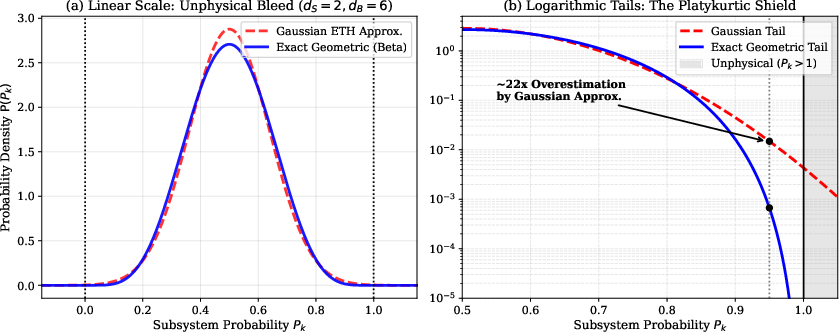
Figure 1: Geometric suppression of thermal fluctuations in a finite quantum system (dS=2, HS⊗HE0): The Beta distribution restricts probability support to HS⊗HE1, while the Gaussian assigns significant unphysical weight, with the tail probability for HS⊗HE2 overestimated by a factor exceeding 100.
This platykurtic suppression is foundational for correctly evaluating fluctuation rates and error thresholds in finite systems, in contrast with approaches justified only by the large-HS⊗HE3 limit.
From Geometric Moments to Entanglement Quantifiers
The algebraic simplicity of the geometric approach enables straightforward computation of average purities and bipartite entanglement measures. Using hyperspherical cross-moments and HS⊗HE4 phase-invariance, the purity is decomposed into diagonal and off-diagonal contributions, reproducing Lubkin's formula: HS⊗HE5, where HS⊗HE6.
Extending to bipartite von Neumann mutual information, the authors analyze HS⊗HE7 for Haar-random pure states with a tripartition HS⊗HE8, HS⊗HE9. Using digamma asymptotics and combinatoric identities, they derive the leading correction to the volume-law scaling as:
Pk0
and systematically characterize higher-order finite size corrections.
Bernoulli-Series Factorization and its Algebraic Interpretation
A principal contribution is the exact Bernoulli-factorized expansion for the mutual information:
Pk1
All higher-order corrections are proportional to Pk2 and only even powers of Pk3 appear; all odd-order corrections vanish identically. This is not just asymptotic: through exact algebraic reorganization of Page's formula, the full mutual information is shown to factor as
Pk4
where Pk5 is given by a single Bose–Einstein-type integral, providing a non-perturbative closed form.
At the Pk6 level, the rational structure is shown to decompose the bipartite quantum mutual information into a dominant Pk7 quantum coherence contribution, and a subtracted Cartan Pk8 Cartan (purely classical) term. This matches precisely the dimension counting for off-diagonal (quantum) and diagonal (classical) degrees of freedom, grounding the separation in the Lie algebraic structure of the generalized Bloch decomposition.
Physical and Mathematical Implications
The findings have immediate quantitative implications for the correct modeling of fluctuation tails and finite-size effects in mesoscopic quantum systems and quantum technologies. The strong platykurtic suppression directly refutes the use of large-deviation Gaussian estimates for error analysis in small environments, highlighting the necessity of the exact Beta structure.
The explicit Bernoulli factorization gives a transparent and rigorous account of how quantum coherence and classical probability contributions scale and decouple in finite systems for typical entanglement measures. The results reveal previously hidden symmetries in finite-size mutual information, with all corrections proportional to adjoint generator counts and none to mixed polynomial combinations.
Of particular technical interest is the identification of the closed-form, non-perturbative integral for Pk9, which serves as a Borel sum for the divergent asymptotic series. The result structurally parallels the use of S0-regularization and Casimir-type vacuum energy calculations, and might find application in related quantum information and statistical mechanics scenarios.
Future Directions
Potential avenues for further development include:
- Extending the geometric approach and the algebraic decompositions to Haar-averaged R\'enyi entropies and higher-order correlation functions, aiming to construct analytically similar non-perturbative expressions and factorized expansions.
- Applying the platykurtic suppression result to explicit error models in NISQ device calibration, depolarizing-channel thresholds, and small-scale quantum thermodynamics.
- Investigating analogous geometric structures and typicality decompositions in non-uniform or structurally constrained random pure state ensembles.
- Elucidating the robustness or adaptation of the factorization beyond the regime S1, and seeking generalizations to multipartite or non-tripartite partitions.
Conclusion
This work delivers a substantial technical advance by using hyperspherical geometry to derive the exact statistical structure of subsystem fluctuations and bipartite entanglement in finite quantum systems. The geometric derivation of the Beta law specifies the correct finite-sample fluctuation suppression, contradicting standard (asymptotic) Gaussian predictions. The Bernoulli-series factorization and the closed-form integral for the Haar-typical mutual information expose a precise algebraic separation between quantum and classical contributions, tightly linked to the underlying Lie algebraic dimensions. These results clarify the interplay between finite-size typicality, quantum coherence, and statistical geometry, resolving key questions in the analysis of quantum thermalization and entanglement structure for physically relevant regimes (2605.29732).