- The paper introduces EXACT-MPPI, a framework that integrates analytic signed-distance evaluation with GPU-batched MPPI for direct, footprint-aware navigation.
- It leverages precise distance computations for both rectangle and polygon footprints, achieving order-of-magnitude speedups over learned baselines.
- The study demonstrates robust deployment across diverse robotic platforms in clearance-limited environments, highlighting scalability and training-free adaptability.
Introduction and Motivation
Footprint complexity in mobile robots–driven by tasks requiring payload manipulation, articulated implements, or atypical chassis–challenges the fidelity and efficiency of local reactive navigation, especially in cluttered, clearance-limited environments. Most standard navigation pipelines, including classical modular map-based and end-to-end learned controllers, simplify the robot’s body shape (circle, rectangle, convex hull) and rely on occupancy grids or distance field representations, incurring excessive conservatism or loss of feasible behaviors in tight spaces. There is a key disconnect between high-resolution geometric clearance available in raw sensor data and the coarse representation that downstream planners rely on.
This paper presents EXACT-MPPI, a local navigation framework integrating analytic, exact signed-distance evaluation between 2D arbitrary (potentially non-convex) robot footprints and environment obstacle points, directly into a GPU-batched Model Predictive Path Integral (MPPI) controller. The method avoids intermediate mapping entirely and operates from perception (local point clouds) to control, supporting direct deployment across heterogeneous mobile robot platforms by merely updating footprints and kinematic models.
Methodology
Architecture Overview
The pipeline processes point clouds and a sparse guidance path (such as waypoints) to generate motion commands through the following sequence: preprocessing the point cloud to a fixed-size obstacle set, sampling and propagating trajectories under MPPI in a receding horizon, transforming obstacle points into each future predicted body frame, computing minimum signed distances to the true footprint, and using these distances in both the cost function (soft penalties) and for post-hoc feasibility screening (hard constraints).
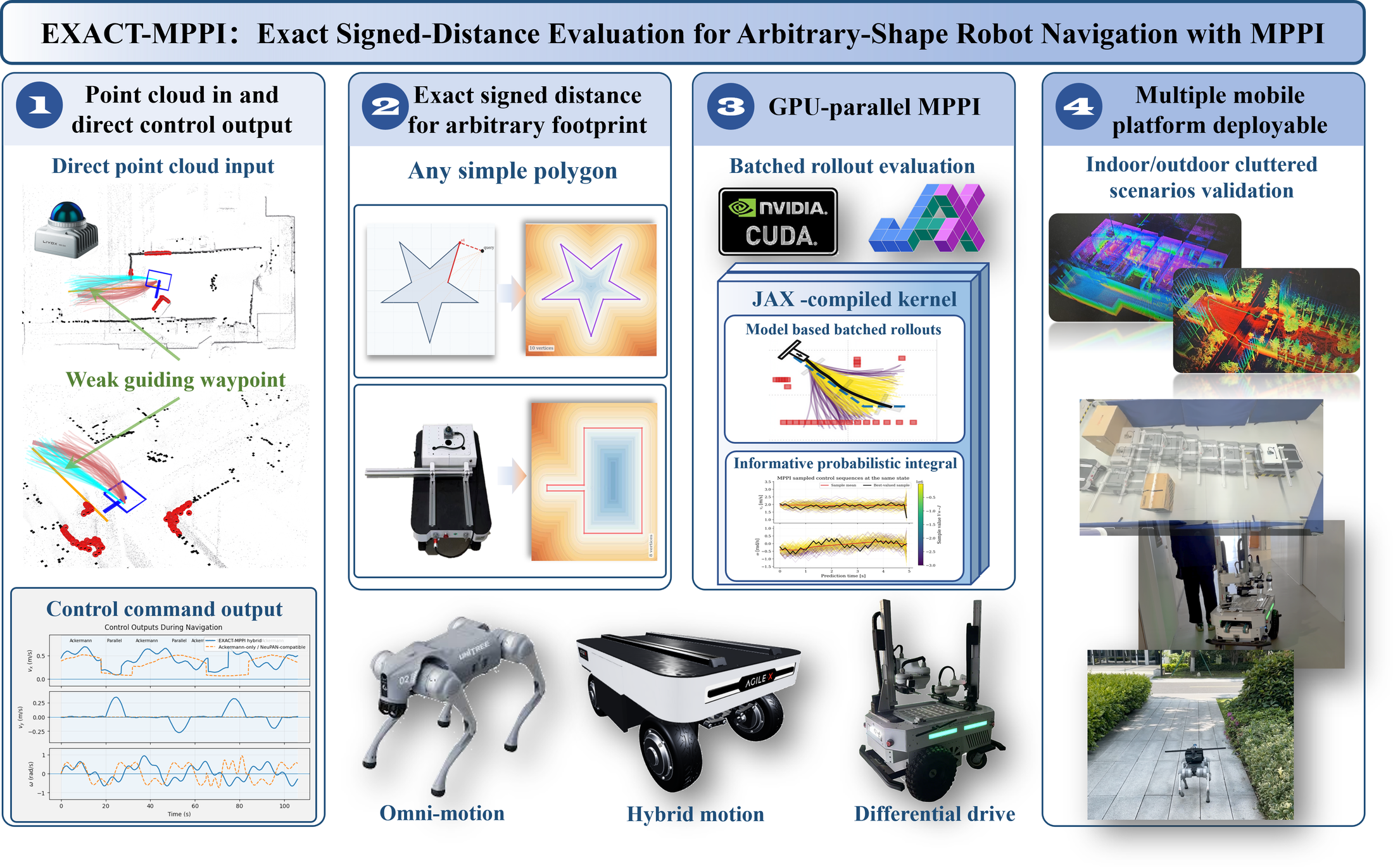
Figure 1: Overview of EXACT-MPPI, highlighting its perception-to-control pipeline, exact signed-distance evaluation, batched GPU MPPI, and deployment across diverse robot platforms.
Analytic Signed-Distance Evaluation
EXACT-MPPI provides two geometric primitives for effective robot footprints:
- Rectangle-cover specialization: For rectilinear vehicles, represented as unions of axis-aligned boxes, enabling highly efficient GPU reduction operations.
- General simple polygons: For arbitrary convex or non-convex bodies, points are evaluated with point-to-segment distances and an inside-outside test (ray casting).
For both, during each rollout, the relevant subset of the point cloud is transformed into the robot’s predicted frame and evaluated with the analytic signed-distance metric. This allows for precise collision margins and distinction of feasible but tight motions that would be precluded by convexification.
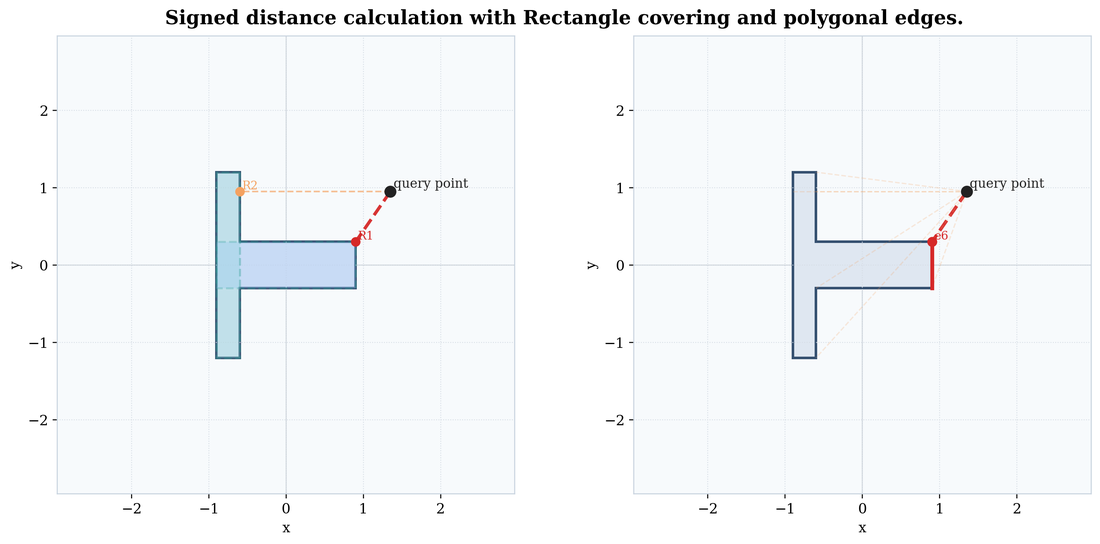
Figure 2: Distance evaluation for an orthogonal footprint, contrasting rectangle cover (left) and polygon edges (right).

Figure 3: Signed-distance fields for a variety of simple polygon footprints, including rectilinear, convex, and non-convex shapes.
MPPI Integration and Batched Computation
Rollouts in MPPI are sampled and propagated forward using robot-specific kinematics (differential-drive, Ackermann, omni, hybrid), and scored based on task objective, control regularization, and an obstacle penalty that leverages the minimum signed distance for safety. All operations—rollout propagation, point transformations, distance evaluation—are vectorized and compiled by JAX for GPU execution, enabling each control cycle to efficiently process millions of signed distance evaluations in real time.
Post-update, the nominal trajectory is validated for minimum clearance; rollouts violating the safety margin are hard-filtered by injecting an infinite cost. This MPPI architecture is agnostic to the complexity of the footprint, as long as the analytic evaluator can describe it.
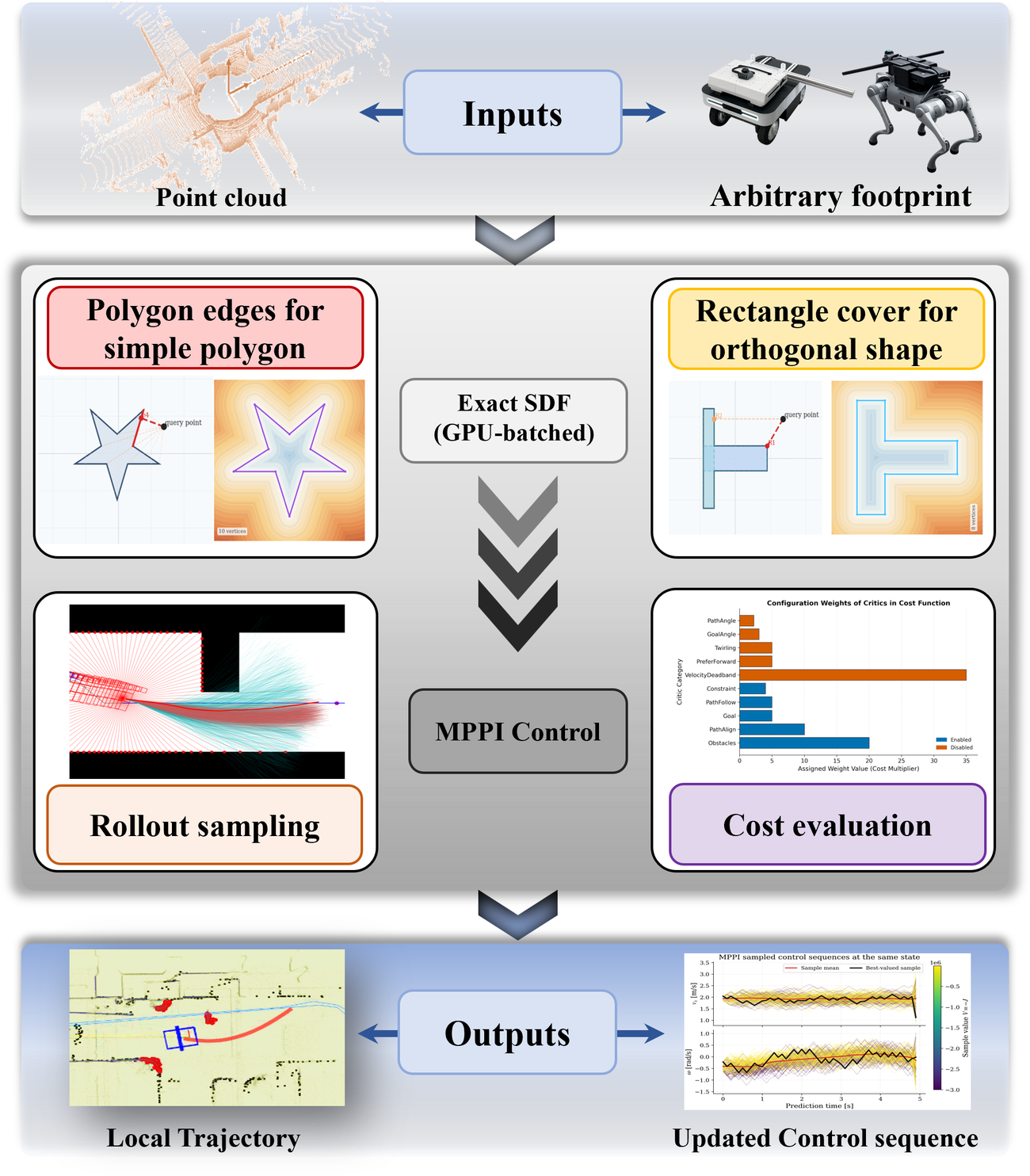
Figure 4: System architecture of EXACT-MPPI.
Experimental Results
Analytic vs. Learned Distance Modules
EXACT-MPPI’s analytic evaluator offers strong numerical evidence of both scalability and efficiency advantages over learned baselines. In benchmarks against DUNE, the neural point-to-robot encoder of NeuPAN, the analytic evaluator achieved order-of-magnitude lower inference times (e.g., 12.6–18.9× speedup for 100,000 points per footprint), with runtime that scales more benignly with footprint complexity and obstacle count. Critically, it requires no pre-training or footprint-specific retraining; deploying on a new footprint means only updating the polygon/rectangle description.
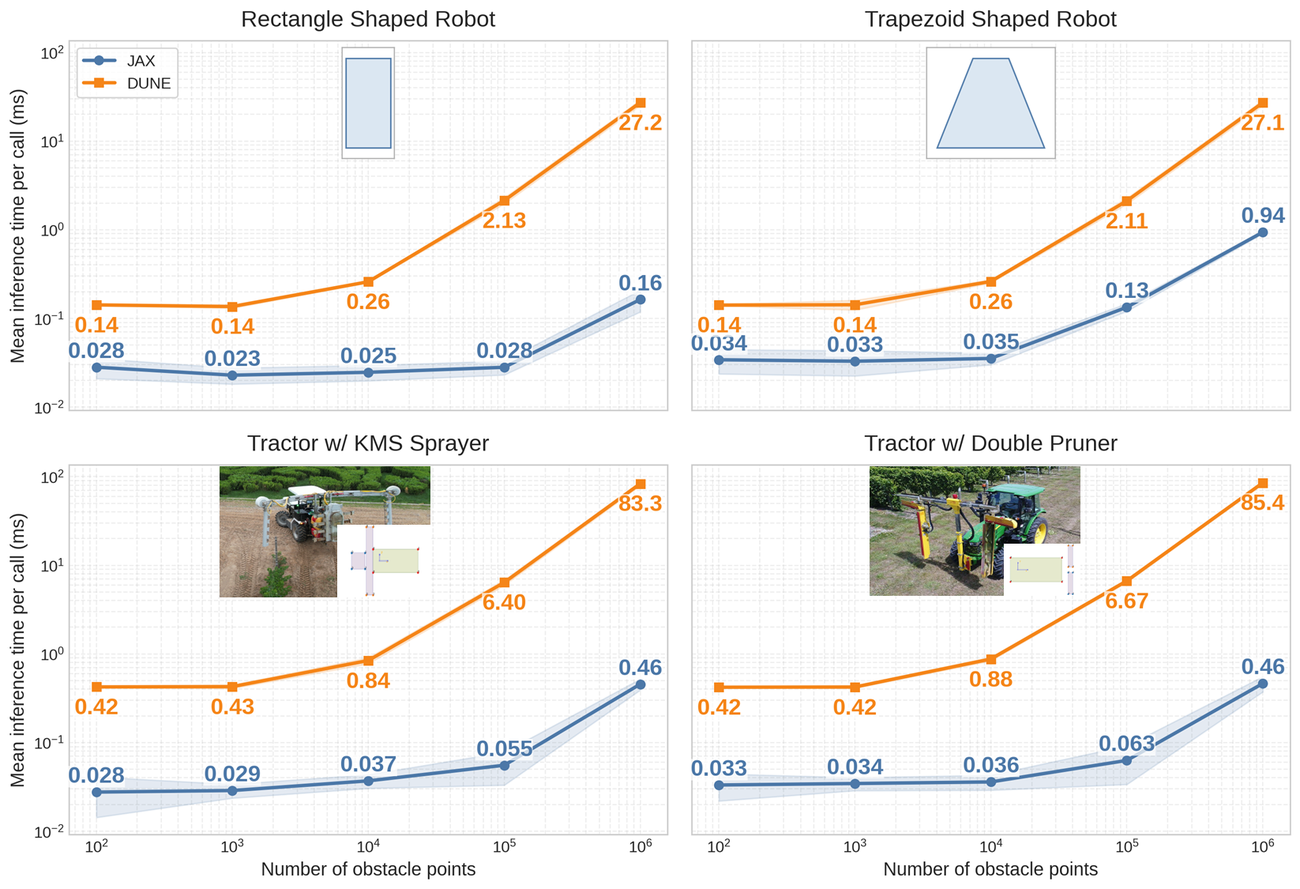
Figure 5: Inference time vs. obstacle point count for DUNE (learned) and JAX-based (analytic) evaluators across four footprints.
EXACT-MPPI preserves feasible navigation in tight spaces where both convex-hull-based MPPI and learned planners (NeuPAN) universally fail. In a sweep of corridor passage widths parameterized by the Degree of Narrowness (DoN), only EXACT-MPPI achieves nonzero success at DoN approaching unity, exploiting non-convex footprint detail to pass gaps that convex proxies declare impassable.
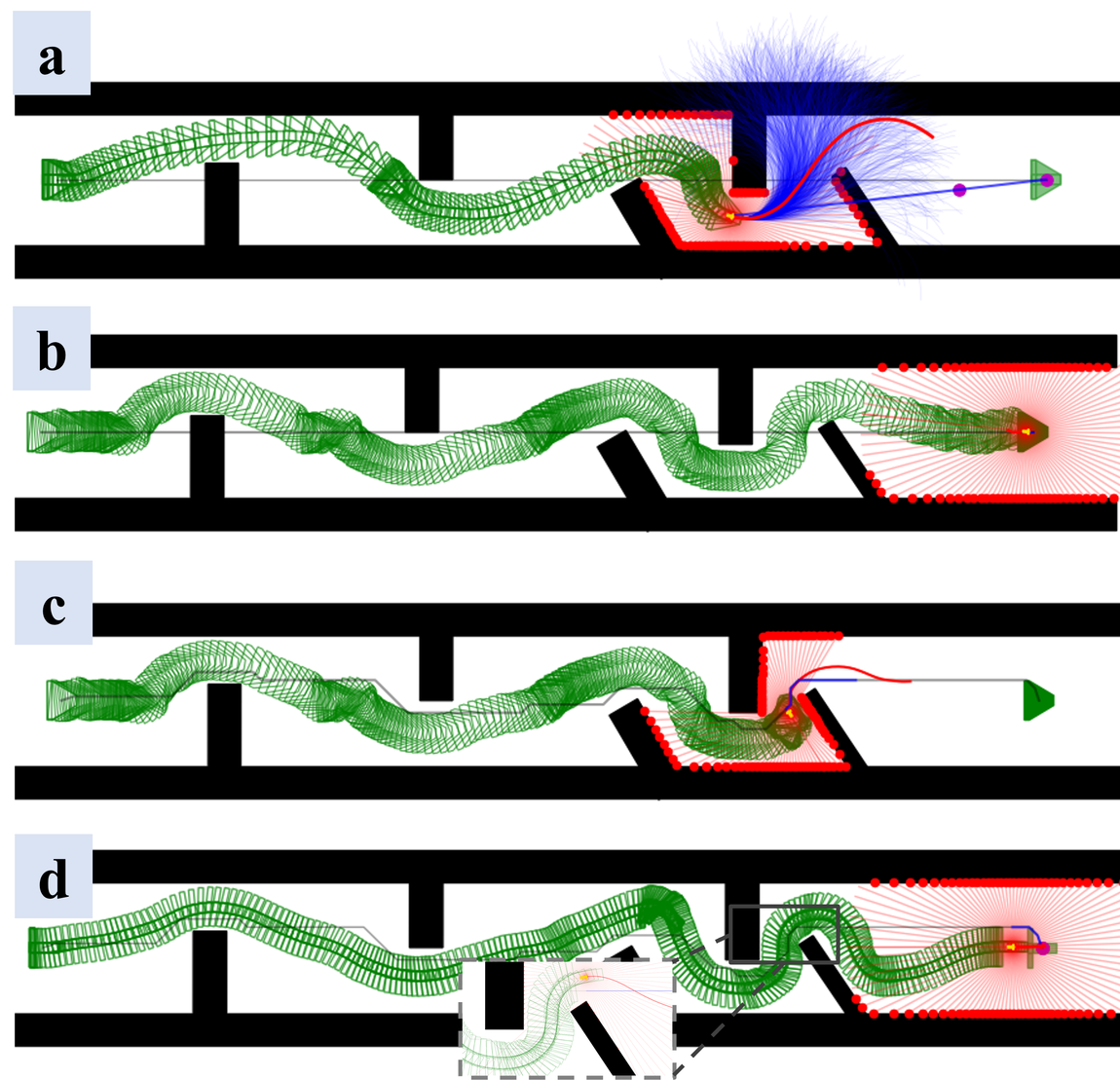
Figure 6: Representative cases from the corridor DoN sweep; explicit non-convex footprint enables passage that convex-hull abstraction eliminates.
Further, in omni-directional and real-world deployments (dual-arm indoor service robot, AgileX hybrid-motion robot, Unitree Go2 legged robot with extended bar), EXACT-MPPI robustly adapts to platform kinematics and footprint, confirming the validity of the cross-domain principle. It also outperforms or matches the success rates of sophisticated learning-based planners in dynamic-obstacle benchmarks, particularly when the robot carries large or configuration-dependent attachments.
EXACT-MPPI demonstrates seamless transfer across very different robotic platforms (differential-drive, dual-Ackermann, omni-directional, legged). The rectangle-cover (for efficiency) and polygon modes (for generality) collectively allow deployment without retraining, only modifying a configuration file for the footprint shape and kinematic model.
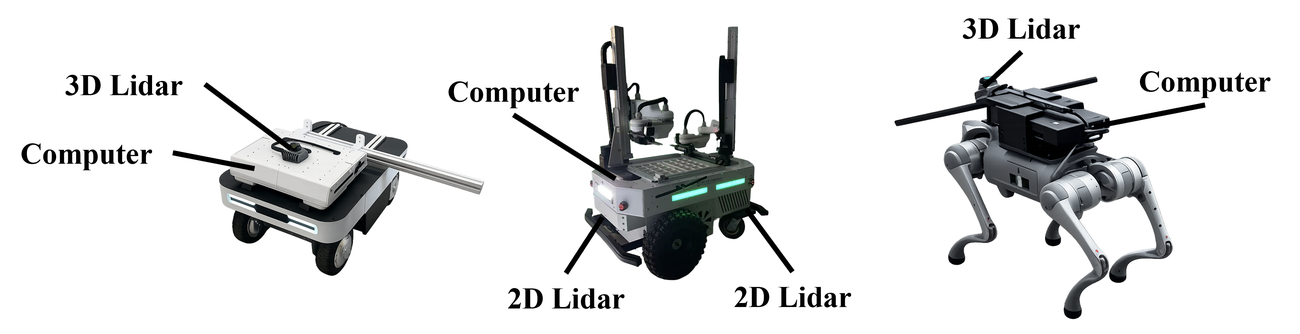
Figure 7: The three mobile robot platforms used in the hardware experiments: AgileX Ranger mini, differential-drive dual-arm robot, and Unitree Go2 quadrupedal robot.
Hybrid-motion extension is achieved via per-mode batch rollouts and selection with switching penalties, leading to improved task efficiency (e.g., 24% reduction in completion time vs. Ackermann-only for the Ranger mini in tight navigation scenarios). EXACT-MPPI’s batch vectorization is compatible with this mode selection process.
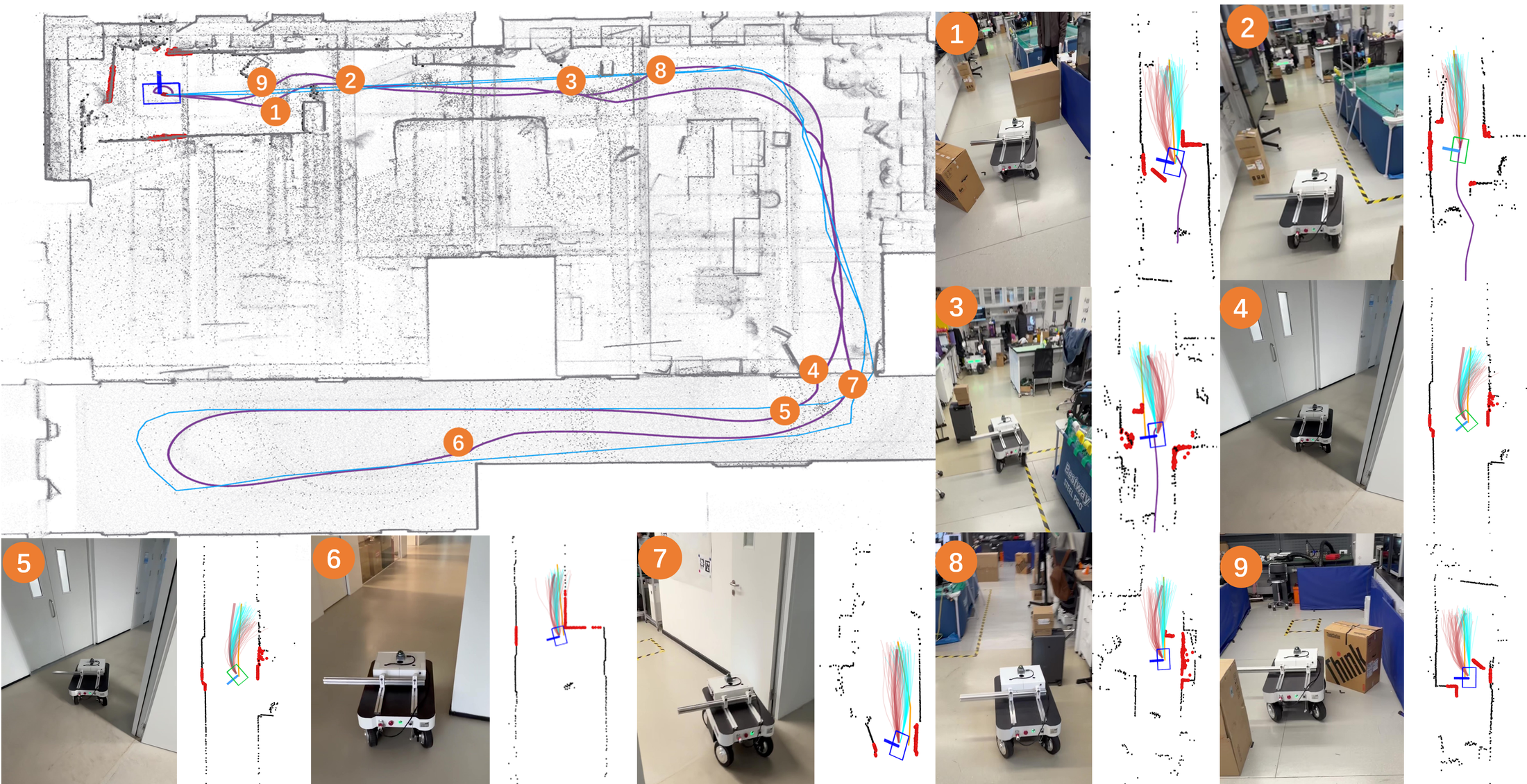
Figure 8: Hybrid-mode navigation on AgileX Ranger mini with trajectory reconstruction and local planning illustration.
Implications and Future Directions
Theoretical and Practical Implications
By fusing analytic signed-distance geometry into a GPU, batched, gradient-free sampling control algorithm, EXACT-MPPI avoids the need for both raster grid abstractions and learned distance surrogates, enabling fidelity, efficiency, and generality unattainable by classical planners or end-to-end policies alone. For reactive navigation in environments with footprint-scale constraints, convex-hull and box proxies are demonstrably insufficient—the analytic, explicit geometric model recovers feasible maneuver classes necessary for practical deployment in real warehouses, greenhouses, or service robotics where robots regularly manipulate payload or tool configuration.
EXACT-MPPI further demonstrates that the separation of local collision geometry from the guidance policy allows for plug-and-play adaptation to new platforms, a critical enabler for scalable, maintainable robot fleets.
Extension and Open Problems
Several limitations suggest directions for future work:
- Beyond 2D footprints: The present formulation does not consider overhanging obstacles or robot postural changes (full 3D body modeling).
- High-speed and dynamic feasibility: The use of kinematic rollout models restricts applicability to moderate-speed, low-dynamic regimes; extending to articulated or high-dynamic platforms would require incorporating additional model fidelity and state constraints.
- Dynamic obstacle prediction: Currently, only quasi-static obstacles are handled; explicit time-indexed predictions or learned motion models could further improve robustness in human-dense or fast-moving environments.
- Hierarchy and integration: Combining this local, map-free control with global semantic navigation, multi-modal perception, or learned higher-level guidance could unify the strengths of model-based and data-driven planning.
Conclusion
EXACT-MPPI establishes a paradigm for batched, analytically grounded signed-distance control, directly on raw point cloud data and true robot geometry. The framework achieves strong empirical performance, with clear evidence of enhanced feasibility and robustness in clearance-limited settings, order-of-magnitude computational gains vs. learned primitives, and practical deployment across an array of mobile robots and motion models. This architecture underscores the value of explicit geometric modeling and stochastic sampling control in real-world navigation, and charts a technical trajectory towards composable, training-free footprint-aware navigation modules suitable for large-scale, heterogeneous robotic fleets.
Figure 1: Overview of EXACT-MPPI, providing perception-to-control signed-distance navigation across diverse platforms and environments.