- The paper introduces a unified retrieval framework that retains native query languages for heterogeneous data sources.
- It uses LLMs for source selection and native query synthesis, achieving improved selection (65.71%) and retrieval (44.34%) accuracy.
- Experimental results demonstrate robust evidence consolidation and semantic alignment across 309 knowledge bases from 13 datasets.
Unified Retrieval over Heterogeneous Knowledge Sources with OmniRetrieval
Motivation and Framework Design
The paper "OmniRetrieval: Unified Retrieval across Heterogeneous Knowledge Sources" (2605.29250) addresses a central problem in information retrieval: real-world questions may require evidence from structurally diverse knowledge sources including unstructured corpora, relational databases, RDF knowledge graphs, and labeled property graphs. Most existing retrievers operate over a single modality and interface, which leads to fragmentation and limited expressive power. Attempts to unify retrieval with shared representations (e.g., embedding spaces, text linearization) incur modality gaps and loss of source-native structural affordances, impacting retrieval relevance and compositional reasoning.
The OmniRetrieval framework advocates retaining per-source distinctions, building a unifying layer that operates via three key stages: (1) source selection, (2) source-native query formulation, and (3) cross-source evidence consolidation. This paradigm enables direct engagement with each knowledge base's affordances and query languages, facilitating expressive query synthesis and scalable knowledge augmentation.
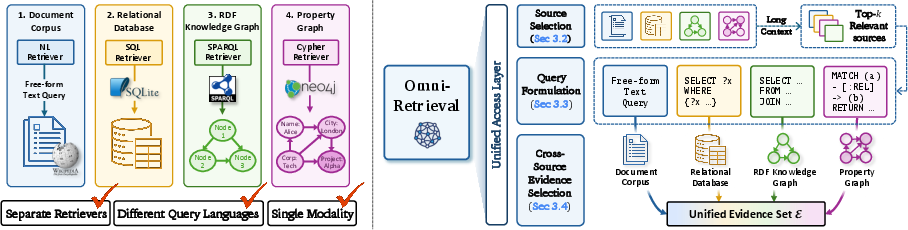
Figure 1: Distinct knowledge sources offer tailored structure and query languages; OmniRetrieval interacts with each via source selection, native query formulation, and cross-source condensation.
Methodology
Given a question q and a pool of knowledge sources B, each b∈B exposes a structural context cb (schema, ontology, corpus descriptor) and a native query language (SQL, SPARQL, Cypher, free-text). The goal is to select sources S⊆B, formulate native executable queries q^b for each, and consolidate the returned evidence.
Source Selection
The challenge is to route questions over heterogeneous source descriptors. Standard embedding-based ranking is insufficient due to modality gaps and loss of semantic structure. OmniRetrieval utilizes long-context LLMs that ingest raw descriptors and the query, ranking sources for engagement. The candidate list size k is parameterized, allowing broad exploration and deferred commitment.
For each candidate source, the framework instantiates per-source prompt templates for LLM-guided native query generation, grounded in the structural context cb. The approach supports multiple query languages with explicit schema linkage, entity recognition, and operation composition. This enables expressive queries such as joins, graph traversals, and aggregate computations in their respective modalities.
Cross-Source Evidence Selection
Executor outputs across sources—heterogeneous in format and size—are consolidated by an LLM-based evidence selector. Output is verbalized and filtered for relevance, enabling semantic alignment even when the correct source is not initially selected. Deferred commitment via evidence selection is shown to be critical for performance, particularly in ambiguous or multi-source scenarios.
Experimental Results
OmniRetrieval was evaluated on 309 knowledge bases across 13 datasets spanning unstructured, relational, RDF, and property graph sources. Metrics include source selection accuracy, retrieval accuracy (NDCG@10, execution match), and LLM-judge-based semantic assessment.
Key results:
- Source selection accuracy averaged 65.71% across backbones, outperforming single-paradigm baselines and KB Routing.
- Retrieval accuracy averaged 44.34%, with consistent improvements over baselines.
- LLM-as-a-Judge accuracy reached B0, closing much of the gap to oracle selection (74.55\%).
OmniRetrieval robustly recovers evidence from alternative sources when initial selection fails, highlighting the benefit of broad candidate inclusion.
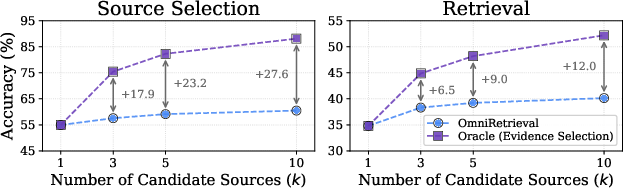
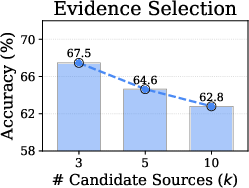
Figure 2: Increasing candidate list size B1 in source selection improves retrieval, but selector accuracy drops as B2 grows, emphasizing evidence selection's leverage.
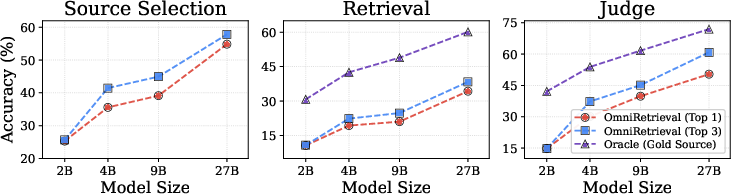
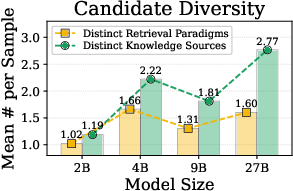
Figure 3: As backbone scale increases, candidate diversity and performance improve; evidence selection remains the pipeline's most impactful stage.
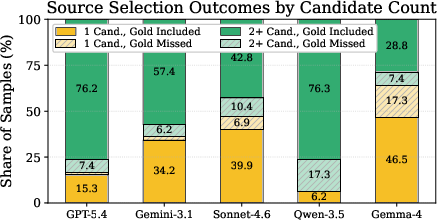
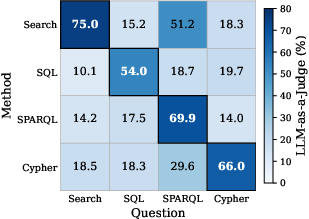
Figure 4: Source-selection success across single-/multi-candidate regimes and evidence-selection accuracy substantially exceed random baselines; Document Search paradigm exhibits broad cross-paradigm coverage.
Unified-representation methods, evaluated in a constrained pool, exhibited significantly lower performance, unable to capture native query compositionality and operator expressivity.
OmniRetrieval situates itself at the intersection of retrieval over heterogeneous sources and LLM-based agentic tool use. Prior works collapse knowledge into unified spaces (e.g., UniK, UDT, DiFaR), sacrificing structural operators. Classical schema-grounded generation (Text-to-SQL, Text-to-SPARQL, Text-to-Cypher) is limited to a single backend. OmniRetrieval uniquely synthesizes queries for each backend natively and consolidates heterogeneous outputs, positioning itself as a scalable, modality-agnostic retrieval layer.
Implications and Outlook
Practically, OmniRetrieval provides a universal interface for enterprise, scientific, and open-domain QA tasks, where knowledge boundaries are porous and native affordances are required. Theoretically, this work demonstrates that upholding structural distinctions rather than flattening representations enables robust cross-modality semantic retrieval and extensibility. As LLMs advance in context capacity and tool use, further gains can be expected from supervised evidence selection, operator specialization, and reinforcement learning for downstream task alignment.
Future developments in AI will likely see OmniRetrieval-like frameworks serving as middleware between multi-agent systems and heterogeneous data lakes, catalyzing agentic orchestration, federated QA, and knowledge-driven reasoning workflows.
Conclusion
OmniRetrieval establishes a principled approach for unified retrieval over heterogeneous knowledge sources, leveraging long-context LLMs for adaptive source selection, native query synthesis, and evidence consolidation. Empirical results demonstrate superior retrieval and semantic equivalence performance over baselines, validating the framework's design. This positions OmniRetrieval as a scalable foundation for universal, structure-aware knowledge integration in retrieval and agentic systems.

