- The paper introduces the GPlan framework to generate logically coherent, spatiotemporally valid intent sequences for mobile map recommendations.
- It details the PICD and SC-DPO methods that merge LLM reasoning with lightweight inference, achieving notable gains in accuracy and speed.
- Experimental results show significant improvements in metrics like Acc@1 and NDCG, with online tests confirming enhanced user engagement.
Generative Spatiotemporal Intent Sequence Recommendation via Implicit Reasoning in Amap
Problem Scope and Motivation
The paper introduces the Generative Spatiotemporal Intent Sequence Recommendation (GSISR) task, targeting interactive agents in mobile map applications like Amap. Unlike conventional next-item recommenders and retrieval-based frameworks, GSISR seeks to generate logically coherent, physically executable intent sequences grounded in complex spatiotemporal contexts. Each sequence specifies a parameterized series of in-app actions (intents), which must respect logical dependencies, user goals, and constraints imposed by physical location and time. The commercial application is in sequencing homepage recommendation cards, such as ride-hailing to hotel, hotel check-in reminder, and localized POI suggestions.
Existing sequential and generative recommendation baselines (e.g., SASRec, BERT4Rec, P5, TIGER) either focus solely on item-level probabilities or lack the ability to parameterize and contextually link recommendations. Such models often fail to guarantee logical coherence, exhibit repetitive loops, or generate physically infeasible plans.
Methodological Contributions: GPlan Framework
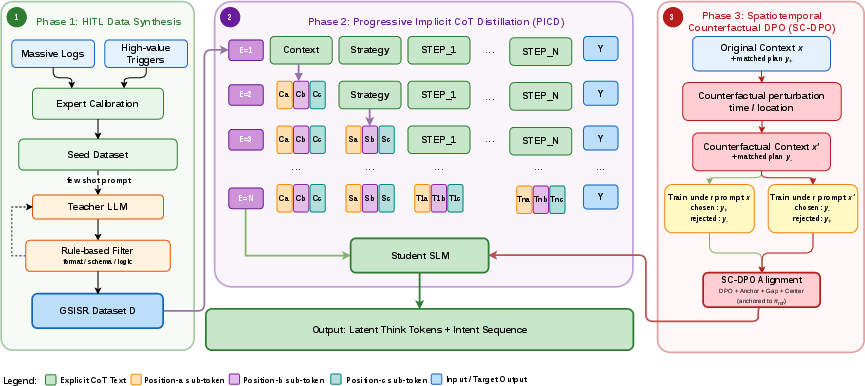
The GPlan framework is designed to internalize LLM-level reasoning into lightweight models suitable for industrial deployment, through two principal mechanisms:
- Progressive Implicit Chain-of-Thought Distillation (PICD):
- Structured CoT (e.g., context analysis, strategy, per-intent justification) is synthesized using a teacher LLM. Through a progressive curriculum, each reasoning block is incrementally replaced by a fixed-length triplet of latent tokens, resulting in a multi-token latent scaffold that preserves semantic structure without explicit CoT outputs.
- The compression schedule is forward and block-based, aligned to plan length. A novel compression-aware learning rate (CALR) is used: the LR is kept high during latent structure acquisition and switched to lower, cosine-decayed LR for refinement once most prefixes reach full latent compression. Loss is section-normalized to avoid distillation imbalance.
- Spatiotemporal Counterfactual DPO (SC-DPO):
HITL Data Synthesis and Training Design
Because raw LBS logs are insufficient for GSISR, a HITL pipeline is used, combining log pattern extraction, expert-calibrated anchor triplets, and large-scale teacher autoregressive synthesis. Extensive filtering ensures logical validity, schema correctness, and parameter dependency resolution, yielding a 100K-sample industrial dataset, robust against ill-posed trajectories.
The structure of expert demonstration includes explicit semantic blocks (CONTEXT, STRATEGY, STEP), with reasoning compressed into reserved latent tokens. The latent scaffold adapts to variable plan lengths, and ensures that each token maps to a segment of the planning logic (e.g., tool choice, parameter assignment, dependency linking).
Experimental Results and Ablation
GPlan outperforms both traditional sequential and generative baselines in major offline metrics, including Acc@1, NDCG, and Normalized Edit Similarity (NES):
- Acc@1 for GPlan-4B exceeds TIGER by +18.5pp (62.7 vs 44.2).
- GPlan-1.7B (60.5 Acc@1) is within $2.2$pp of GPlan-4B, showing strong distillation efficiency.
Ablations demonstrate:
- PICD preserves reasoning quality comparable to textual CoT-SFT, while achieving 3.7× inference speedup at 4B scale.
- CALR is essential for maintaining valid latent structure; cosine LR collapses scaffold, constant LR lacks plan refinement.
- SC-DPO provides significant gains in context sensitivity (LLM judge ST axis +0.06 over PICD), whereas vanilla DPO drifts downward across all axes and undermines planning fidelity.
Independent LLM judge metrics (GPT-4o) specifically assess sequence flow, lifecycle logic, and contextual fit. PICD + SC-DPO attains the highest mean semantic planning score (3.64), with strong evidence in context-specific parameterization.
Latency benchmarks confirm production viability: PICD inference time (4B, 503ms) is close to Direct-SFT and dramatically lower than CoT-SFT (1.85s).
Online Deployment and Theoretical Implications
In live A/B testing, GPlan-1.7B outperformed the incumbent CTR ranker, delivering a +0.87% UV-CTR lift on general traffic, and +1.04% in high-value cross-city slice, reinforcing practical utility in scenario-dependent recommendation.
Theoretically, the introduction of latent multi-token implicit reasoning advances state-of-the-art distillation paradigms by compressing structured CoT into an interface that preserves fine-grained planning while respecting online latency constraints, overcoming limitations of both explicit CoT emission and single-vector latent internalization. SC-DPO's reference-anchored counterfactual loss provides a more nuanced alignment mechanism than vanilla DPO—critical for context-dependent planning tasks where negatives correspond to mismatched context rather than globally invalid actions.
Future Directions
Future research will explore reinforcement learning from multi-turn user feedback, adaptive curriculum for long-horizon personalization, and scaling implicit reasoning to broader event-driven and lifecycle recommendation domains. The dataset and implementation release will support comparative studies and fine-grained evaluation in industrial spatiotemporal planning settings.
Conclusion
GPlan demonstrates a scalable pathway for embedding LLM-level spatiotemporal reasoning into deployable models for industrial recommendation, leveraging progressive latent distillation and context-sensitive preference optimization. Empirical results establish superiority in both accuracy and latency, as well as measurable online gains in production environments. The methodology sets a new benchmark for GSISR, with implications for both theoretical modeling of intent flows and practical recommender system deployment.