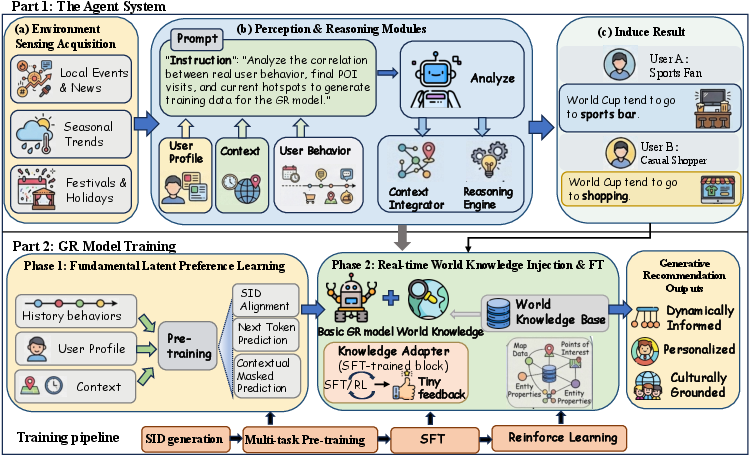
- The paper introduces AWARE, a framework that augments generative POI recommendation with personalized, time-specific world knowledge.
- The methodology uses an LLM agent to infer user behavior and retrieve localized signals, synthesizing a compact context narrative.
- The framework achieves significant HR@1 improvements (up to 12.4%) by integrating external context with traditional sequential models.
World Knowledge-Augmented Generative Next POI Recommendation: AWARE
Introduction
Location-based social networks (LBSNs) generate massive spatiotemporal user mobility data, enabling the next point-of-interest (POI) recommendation task to be formulated as a sequence prediction problem. Recent LLM-based generative approaches serialize user trajectories into natural language prompts and fine-tune LLMs for recommendation. However, the static nature of these models, with knowledge fixed at training, limits their ability to capture real-world context dynamics such as local events and trends which acutely motivate instantaneous user mobility decisions. Addressing this critical limitation, this work introduces AWARE (Agent-based World knowledge Augmented REcommendation), a framework that injects personalized, temporally-localized world knowledge into LLM-based POI generation through an agent-driven offline acquisition pipeline.
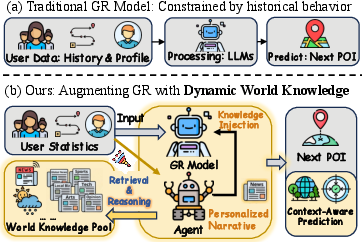
Figure 1: Traditional generative recommendations rely solely on historical check-ins, whereas AWARE integrates user-contextualized world knowledge via an LLM agent.
Framework Overview
AWARE is grounded on three conceptual pillars: agent-mediated personalized world knowledge creation, behavioral-contextual alignment, and generative model integration.
Methodological Details
Agent Reasoning Pipeline
AWARE's knowledge agent operates through a three-stage protocol:
- Behavioral Inference: Weighted parsing of the user's recent trajectory to infer dominant region, categories, and intent.
- External Retrieval: Formulation of queries specifically anchored to the user's temporal and geographic context, iteratively retrieving and cross-validating facts.
- Grounded Synthesis: Fusion of behavioral inference and external evidence into a singular narrative paragraph, stringently controlled for length and relevance.
Operational constraints ensure generation quality: a maximum of two retrieval rounds, enforced temporal fidelity (matching the historical timestamp for benchmark alignment), and hard output length caps (80 or 150 words), with validation and hard-truncation cascades.
Behavioral Prior Integration
To safeguard against noisy or misaligned knowledge injection, external narratives are complemented by three user-specific behavioral signals:
- Frequency Prior: Statistical ranking of a user's POI and category visits, used to reinforce patterns consistent with observed behavior.
- Transition Prior: Extraction and integration of most frequent POI-to-POI movement patterns.
- Periodic Recency: Contextual periodicity (e.g., same weekday/time) to capture recurrent behaviors.
Generative Pipeline
All knowledge is concatenated into a structured prompt. SIDs serve as POI tokens, with spatially-aware S2-prefix embedding augmenting geospatial locality. The generative model predicts the next POI's SID autoregressively.
Experimental Results
AWARE is evaluated on three LBSN datasets (Foursquare-NYC, Foursquare-TKY, Gowalla-CA) using HR@1 as primary metric. Against state-of-the-art baselines such as ROS, AWARE achieves 6.0% (NYC), 6.5% (TKY), and 12.4% (CA) relative improvement in HR@1, with gains especially pronounced in data-sparse scenarios:
|
NYC |
TKY |
CA |
| ROS |
0.3925 |
0.3380 |
0.2703 |
| AWARE |
0.4160 |
0.3599 |
0.3038 |
| Δ% |
6.0% |
6.5% |
12.4% |
Unlike sequential-only models, AWARE exhibits marked improvements (+14.9% HR@1) on "hard" held-out test cases where the ground-truth POI does not appear in the last 5 visits.
Ablation and Robustness
Component ablation reveals that world knowledge (removal: -3.1% HR@1), agent-based synthesis (-3.3%), and all user-specific priors (-2.3%) each yield significant independent gains, evidencing their non-redundant contributions. Limiting narrative length to 80 words sharply degrades performance, highlighting the necessity of information density.
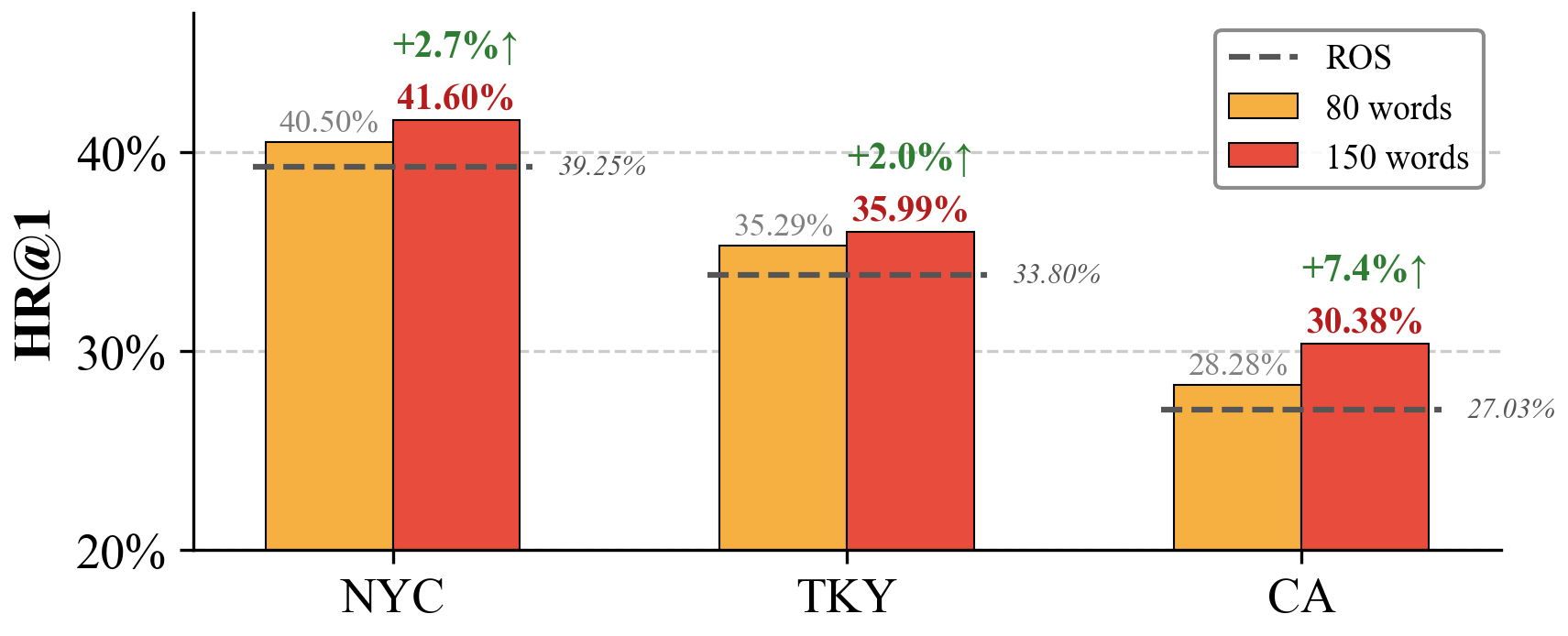
Figure 3: Longer hotspot texts (150 words) substantially improve HR@1 over shorter texts (80 words), especially in data-sparse settings.
Cross-city generalization, where models trained on NYC are evaluated on TKY and CA without adaptation, shows AWARE's world knowledge narratives transfer effectively, boosting generalization compared to methods reliant on city-specific behavioral priors.
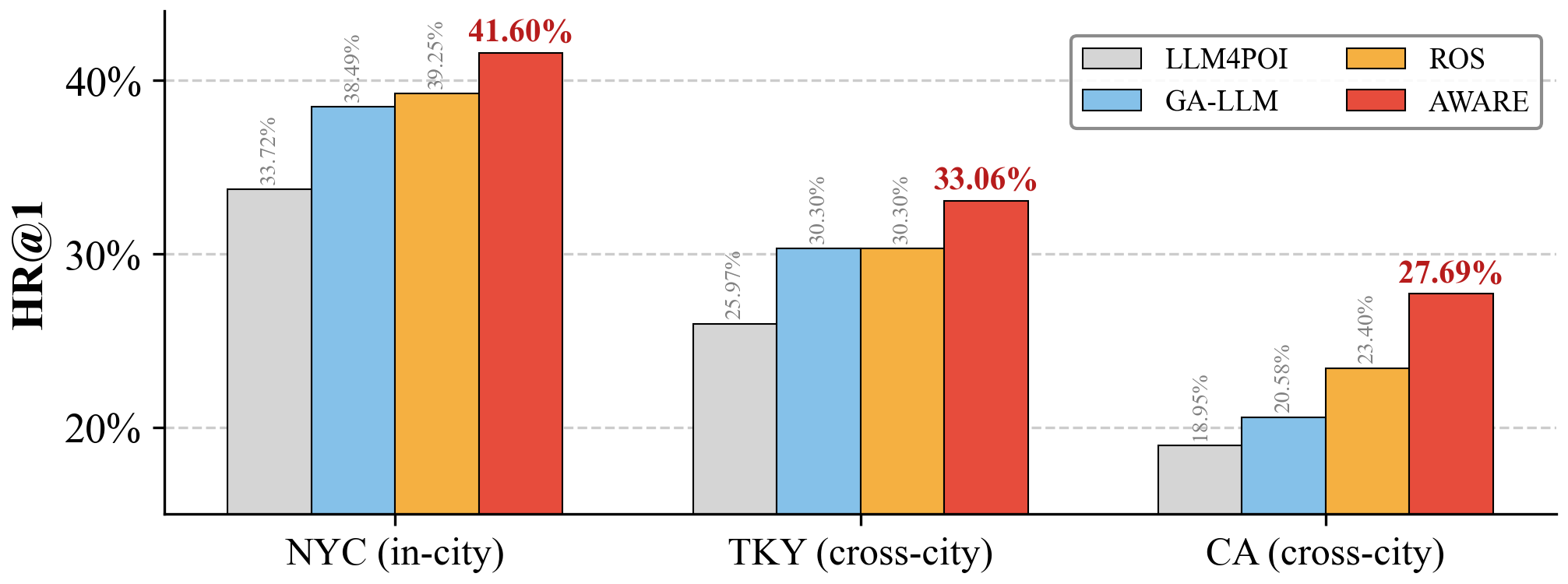
Figure 4: AWARE sustains superior HR@1 in both in-city and cross-city settings, indicating effective transferability of world knowledge.
Prediction error CDFs demonstrate that AWARE does not degrade spatial precision and exhibits a reduction in rare egregious errors.
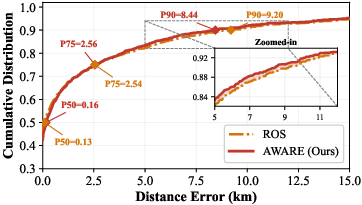
Figure 5: Relative to ROS, AWARE produces fewer large-distance errors in NYC, as seen by the rightward shift in the CDF.
Case Study and Interpretability
Qualitative analysis further illustrates AWARE's intent modeling capability. For example, in an ambiguous Saturday morning scenario where both sequential trajectory and recent neighborhood activity suggest multiple plausible POIs, ROS predicts "Train Station," while AWARE—leveraging historic frequency statistics and world narrative about local Caribbean restaurant trends—correctly predicts "Caribbean Restaurant."
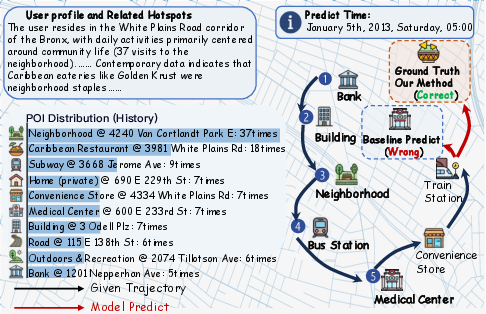
Figure 6: While both ROS and AWARE see frequent visits to a neighborhood area, only AWARE leverages contextual world knowledge to resolve the true target (Caribbean Restaurant).
Implications and Future Directions
AWARE introduces a clear methodological advance: it decouples world knowledge computation from serving-time inference, allowing the generative backbone to internalize up-to-date, contextually-anchored signals without latency or runtime retrieval. The demonstrated gains, especially in generalization and on cases where sequential signals are ambiguous, suggest the essentiality of external context for intent prediction tasks in mobility and other domains where human decisions are coupled with external non-static factors.
Practically, the framework's modularity (orthogonal to backbone choice) and its ability to leverage arbitrarily rich external corpora via LLM-enabled agents support scalable adaptation to rapidly changing environments. Extending AWARE to support online, periodic world knowledge refresh is a natural future step, as is direct utilization of structured event databases to minimize regional retrieval bias.
Theoretically, AWARE offers evidence that models can be guided to reason not just over "what" but "why" in user behavior, bridging the gap between descriptive and causal inference in generative recommendation.
Conclusion
AWARE systematically demonstrates that LLM agents can acquire, personalize, and inject dynamic world knowledge into generative POI recommendation systems, yielding consistent and significant improvements in precision, robustness, and generalization. Its technical design establishes a template for future agent-augmented, context-aware recommendation paradigms.