The sum-product conjecture is false for real numbers
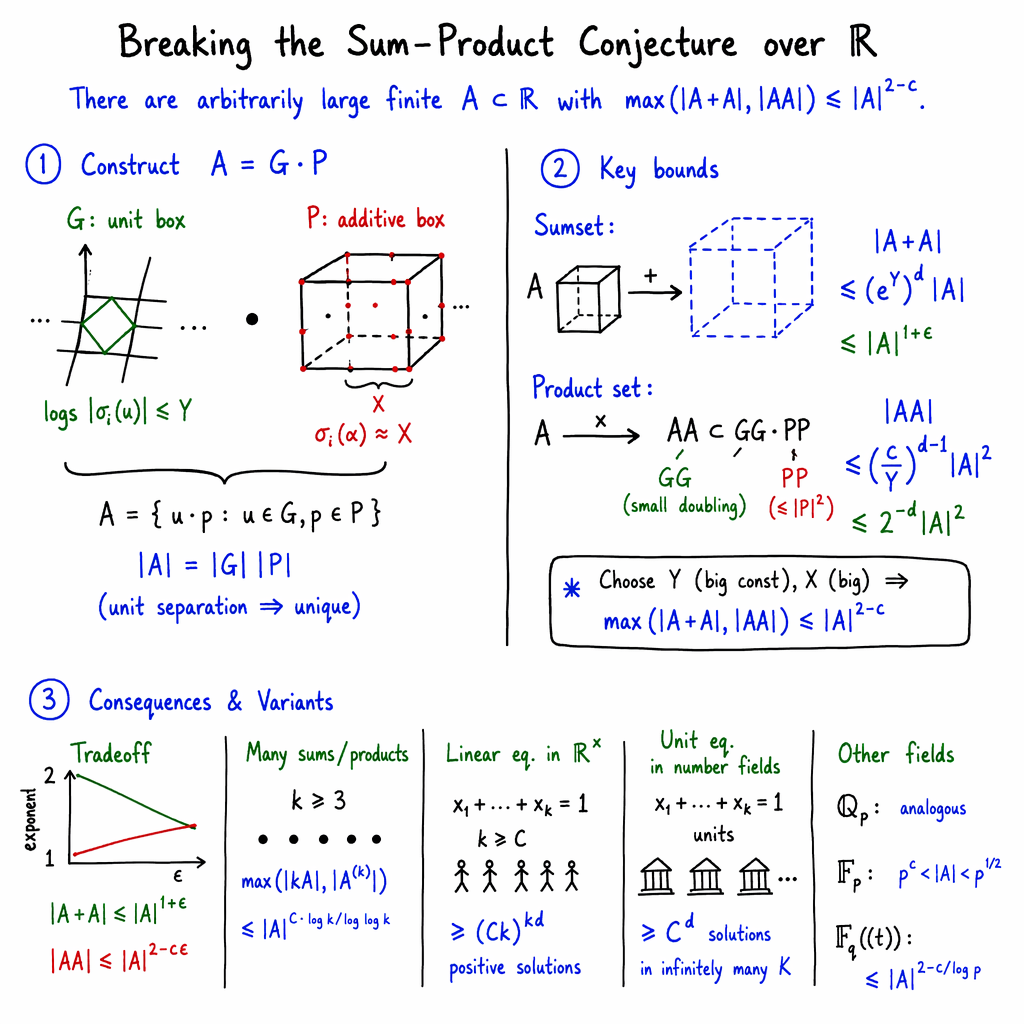
Abstract: We disprove the sum-product conjecture for real numbers by constructing arbitrarily large $A\subset \mathbb{R}$ (whose elements are algebraic integers in a number field of degree $\asymp \log\lvert A\rvert$) such that [\max(\lvert A+A\rvert ,\lvert AA\rvert)\leq \lvert A\rvert{2-c}] where $c>0$ is an absolute constant. We also disprove the many sums and products conjecture by constructing, for any $k\geq 3$, arbitrarily large $A\subset \mathbb{R}$ such that [\max(\lvert kA\rvert,\lvert A{(k)}\rvert)\leq \lvert A\rvert{C\frac{\log k}{\log\log k}}] for some constant $C>0$. We obtain similar constructions for $p$-adics, finite fields, and function fields in positive characteristic, and also obtain new lower bounds for the number of solutions to linear equations in a multiplicative group and the number of solutions to the unit equation in sufficiently many variables.
Paper Prompts
Sign up for free to create and run prompts on this paper using GPT-5.
Top Community Prompts
Explain it Like I'm 14
What is this paper about?
Imagine you pick a bunch of numbers and then make a new list by adding every pair of your numbers, and another list by multiplying every pair. A long-standing guess (the “sum–product conjecture”) said that for any set of real numbers, at least one of those two new lists must be almost as large as all possible pairs, roughly (where means “how many numbers are in ”).
This paper shows that guess is wrong for real numbers. The authors build special sets of real numbers where both the sum list () and the product list () are noticeably smaller than —by a fixed power. That means there’s a constant so that .
They also show even stronger “many sums and products” counterexamples, and extend their ideas to other number systems (like -adics and finite fields). As a bonus, their construction gives new results about how often equations like can be solved using numbers that all live in the same multiplicative group.
What questions are the authors asking?
- If you take a finite set of real numbers , must either or be almost as large as ? (The sum–product conjecture said “yes.”)
- For many repeated sums or products ( times), must either or be almost as large as ? (An even stronger version.)
- Can we create sets where both kinds of growth (sums and products) are small at the same time?
- What does this tell us about how many solutions there can be to equations like when the come from a multiplicative group?
How do they approach the problem?
Think of numbers in as living in a hidden, high‑dimensional world that still maps down to the real number line. The authors use special number systems called “totally real number fields.” Each number in such a field has different “views” (embeddings) into the real numbers—like seeing the same object reflected in mirrors from different angles.
They cleverly build using two ingredients:
- an additive “box” : numbers whose views all sit near the same large size ,
- a multiplicative “box” : units (numbers with multiplicative inverses) whose views aren’t too big or too small (bounded by a parameter when you look at their logarithms).
Then they set .
Why this works (simple analogies)
- Additive box : Think of a ‑dimensional grid of points inside a cube. Because all views of each number are near , adding two elements stays inside a slightly larger cube. So doesn’t explode in size.
- Multiplicative box (units): Think of the views of a number after taking logs. Units create a ‑dimensional grid in a flat hyperplane. Bounding their logs by makes a neat grid box with “small doubling”: multiplying two units doesn’t escape the box much. So isn’t much bigger than .
- Keeping well-behaved: A small, neat trick (using a constant from the golden ratio) shows that each product is unique in (no two different pairs give the same ). This relies on the fact that if all views are extremely close to $1$, the only possible unit is .
- Choice of the field: They pick fields where both the “additive grid size” and the “multiplicative grid size” are well‑controlled (technical terms: small discriminant and small regulator). There are infinitely many such fields of growing dimension . Bigger gives room to make large while keeping sums and products controlled.
Putting it together
- Sums: Because doesn’t stretch too much in any view, sits inside a somewhat larger additive box. That means is at most about a constant times (to the ) times . Choosing big lets for tiny .
- Products: Because has small multiplicative doubling, (small factor). Choosing as a fixed constant pushes that small factor below , making for some fixed .
What did they find?
- Main result: They build arbitrarily large real sets with both and strictly smaller than by a fixed power, i.e., for some absolute . This disproves the sum–product conjecture over the reals.
- Stronger, “many sums and products” result: For any , they construct large sets for which both and are only about , much smaller than the conjectured . This is close to the best possible dependence on currently known from other work.
- Equations with many solutions: They show that for large , there are multiplicative groups (of rank about ) where the number of solutions to is at least about . This matches the known upper bounds’ dependence on and shows the linear-in- factor can’t be improved in general.
- Variants in other number systems:
- -adic numbers: Similar counterexamples exist in .
- Finite fields : For large primes , they construct sets with and .
- Function fields in positive characteristic: They produce counterexamples with a noticeable exponent saving, especially strong in small characteristic.
- Explicit constants (if you really want one): A careful version of their construction gives a tiny explicit . It’s small, but the key point is: is a fixed positive number independent of .
Why does this matter?
- It overturns a guiding belief: For decades, mathematicians thought that adding or multiplying all pairs from a set of reals would force at least one of the “sum” or “product” collections to be almost as large as all possible pairs. This work shows that belief is false.
- It clarifies where the barrier is: Their counterexamples live in real numbers that come from embedding high‑degree algebraic number fields. So the original integer version of the conjecture might still be true—this remains open. The line between true and false seems to depend on how “arithmetic” or “algebraic” the set is.
- It connects areas: The proof blends ideas from additive combinatorics (growth under sum/product), geometry of numbers (counting lattice points), and algebraic number theory (number fields, units, discriminants, regulators). It also leads to new insights about counting solutions to linear equations in multiplicative groups.
Extra results and variations
Many sums and products
They show that for large , both and can grow only like . This strongly contradicts the older expectation of almost growth.
Equations like
They construct multiplicative groups where the number of non‑degenerate solutions grows like . This proves the existing upper bounds are sharp in how they depend on the rank .
Other number systems
- -adics : The same style of construction works with minor changes.
- Finite fields : Reducing the construction modulo a prime gives counterexamples for large and moderately large sets.
- Function fields (positive characteristic): A different but related approach gives strong counterexamples, especially effective in small characteristic.
How big is the saving?
The exponent saving can be made explicit, though very small. The breakthrough is the existence of a fixed , not its size. With more optimization, can likely be improved, but it won’t affect the main message.
A note about AI’s role
The authors say an early chat with GPT‑5.5 Pro helped suggest a small but neat lemma (a separation trick using the golden ratio). The main ideas and proofs are human‑crafted.
Takeaway
- The sum–product conjecture over the reals is false.
- There exist large sets of real numbers where both and are smaller than by a fixed power: .
- Even multiple sums/products (-fold) can stay surprisingly small.
- The method uses high‑dimensional “shadows” (embeddings) of algebraic numbers to keep both sums and products under control.
- The results open new directions for understanding when sums or products must grow—and when they don’t.
Knowledge Gaps
Unresolved gaps, limitations, and open questions
Below is a consolidated list of concrete knowledge gaps and limitations left open by the paper, phrased so they can guide follow-up research.
- Sum–product over bounded-degree fields and integers remains open:
- Does the sum–product conjecture (i.e., ) hold for or ?
- More generally, is the conjecture true for sets contained in a fixed number field of bounded degree (independent of )?
- What additional hypotheses (e.g., integrality, bounded height, bounded denominators) are sufficient to restore near-quadratic growth?
- Quantitative strength of the counterexamples:
- The main exponent saving is non-optimized and extremely small; can be improved substantially with better lattice-counting or number-theoretic inputs?
- Tradeoff optimality: for constructions with , the inequality of Solymosi forces ; can the construction be sharpened to approach this boundary (i.e., achieve )?
- Can one obtain a larger absolute saving in (larger ) without sacrificing to be as small as ?
- Structural restrictions under which the conjecture may still hold:
- Are there natural “pseudorandom” or “well-spaced” subclasses of (e.g., -separated sets in the usual absolute metric, sets with bounded multiplicative rank, or sets avoiding algebraic integers of small degree) for which the original sum–product lower bound remains valid?
- Classification problem: can one characterize (up to bounded complexity) all large with both and significantly subquadratic?
- Dependence on high-degree totally real fields:
- The construction relies on fields with degree and bounded root discriminant; can it be adapted to complex (non-totally-real) fields where there are many roots of unity, or to mixed signature fields, while retaining a power saving?
- Is there a version of the argument that works uniformly in families with controlled splitting behavior without restricting to totally real fields?
- Effectivity and explicitness:
- The sets are not given by explicit generators; can one provide fully explicit (algorithmically constructible) infinite families with provable bounds?
- Can the tower fields with bounded root discriminant and small regulators be made explicit with prescribed splitting at specified primes (beyond existence via class field theory/Golod–Shafarevich)?
- Optimizing the geometric-of-numbers steps:
- Can the packing/covering constants in the additive and unit lattices (e.g., Hensley’s volume bounds, separation constants for the unit lattice) be sharpened to improve exponents?
- Are there alternative window shapes (e.g., ellipsoids rather than boxes) that yield better constants for while keeping small?
- S-units and small split primes:
- The authors mention an earlier approach using elements divisible only by small split primes; can this S-unit method (with optimized Chebotarev input) produce better exponents than the unit-lattice approach?
- Can one combine sparse prime-supported multiplicative structure with additive boxes to improve the sum–product tradeoff?
- Many sums and products (-fold):
- Upper bounds: Is optimal in the exponent of ? Can the constant or secondary terms be improved?
- Lower bounds: Current general lower bounds are . Can one raise the lower bound to (matching the upper bound) by strengthening bounds on solutions to linear equations in multiplicative groups?
- Uniformity in : The construction depends on (through ). Can one produce a single for which the bound holds simultaneously for all with sharper exponents?
- Linear equations in multiplicative groups:
- Theorem shows optimal (linear-in-) dependence for . What is the best-possible dependence for (or subgroups of bounded-degree number fields)? Can the linear-in- lower bound be realized over ?
- Small : The exponentially-many-solutions lower bounds require large. For which smallest does exponential-in- growth first occur?
- Constants and effectivity: Determine explicit constants in the lower bounds and construct explicit groups witnessing the extremal behavior.
- Unit equation in number fields:
- Determine the minimal for which there are exponentially (in ) many non-degenerate solutions to with .
- For , it is conjectured there are sub-exponentially many solutions in ; can one prove sharp upper bounds reflecting the sub-exponential conjecture (or find families showing larger growth)?
- Quantify the dependence on the field parameters (degree, regulator, discriminant) in the number of unit-equation solutions.
- -adic variant:
- The -adic construction depends on having split completely and uses pro-2 towers; can one remove the “power-of-2 degree” limitation and/or make the construction uniform over all degrees?
- Make the constants explicit and uniform in ; determine the best achievable exponent saving and whether it can be made independent of .
- Finite field variant:
- Current result provides with and for very small . Can one:
- Push the range of closer to ?
- Obtain larger (even as a function of )?
- Extend systematically to with quantitative separation from subfields (to avoid subfield obstructions)?
- Provide explicit constructions (not only existence via reduction from number fields) with certified parameters.
- Function fields of positive characteristic:
- The saving deteriorates with ; can one achieve an absolute independent of by different methods?
- Close the gap with existing lower bounds (e.g., improve beyond $6/5$-type lower bounds or show matching exponents) and clarify the true growth threshold in .
- Extend the construction to other non-archimedean settings (e.g., global function fields with large genus) while retaining strong exponent savings.
- Robustness under additional constraints in :
- What happens if one enforces minimum spacing in the chosen real embedding (e.g., ) or bounds on the real heights? Does the counterexample persist?
- Are there “Erdős–Szemerédi-type” lower bounds that can be recovered under natural geometric constraints on ?
- Generality/transfer:
- Extend the methods to other rings or semirings (e.g., with zero divisors), identifying exactly which algebraic features are essential for constructing counterexamples.
- Investigate whether the lattice-based approach can be adapted to remove reliance on bounded-root-discriminant towers (e.g., by finer entropy or inverse theorems in additive combinatorics).
These questions point to several concrete directions: improving exponents and constants, making constructions explicit, extending to new algebraic settings, and identifying structural regimes where sum–product lower bounds remain valid.
Practical Applications
Immediate Applications
The results and methods in the paper yield several practical, deployable uses across mathematics, software, communications, and research practice. The items below name the sector, propose concrete tools/workflows or products, and note key assumptions or dependencies.
- High-dimensional lattice design from number fields with controlled discriminant/regulator
- Sector: communications, software (coding and signal processing), academia
- Application: Construct explicit high-dimensional lattices for sphere packing and lattice coding with favorable density via bounded-root-discriminant towers and unit-lattice geometry (the paper references this linkage). Useful for MIMO lattice coding and geometric modulation schemes.
- Tools/workflows: Implement scripts in SageMath/Pari-GP/Magma to (i) generate totally real fields from known towers (Martinet-style), (ii) compute unit groups/regulators, (iii) build additive/multiplicative “boxes” and resulting lattices, (iv) export to lattice-code libraries.
- Assumptions/dependencies: Availability of explicit towers with ΔK ≤ Cd and manageable regulators; computing units in large-degree fields is resource-intensive; decoding algorithms must be available for the designed lattices.
- Adversarial/benchmark instances for sum-product–based algorithms (finite fields and reals)
- Sector: software (algorithm testing), cryptography, TCS
- Application: Generate explicit sets A⊂ℝ or A⊂𝔽_p with simultaneously small |A+A| and |AA| to stress-test and benchmark algorithms that assume strong sum-product expansion (e.g., incidence-based routines, approximate-group detectors, combinatorial growth tests, robust hashing heuristics in 𝔽_p).
- Tools/workflows: Package the paper’s A=G·P construction into a test-set generator; add a finite-field reduction mode with injection checks (p>(4XeY)d) as per the paper; integrate into algorithm test suites.
- Assumptions/dependencies: Requires large p for faithful reduction mod p; constants are small, but sufficient for creating “hard” instances; ensure sets are not near subfields when testing 𝔽_p algorithms sensitive to subfield structure.
- Tightness benchmarks for S-unit equation solvers and Diophantine toolchains
- Sector: computational number theory (software), academia
- Application: Provide worst-case instances with exponentially many solutions (linear in rank d in the exponent) to benchmark and improve S-unit/linear-equation solvers in multiplicative groups (e.g., in SageMath/Magma).
- Tools/workflows: Automated pipelines that (i) construct fields with desired d, (ii) build rank-(d−1) unit groups, (iii) generate A=B×(Y) and form many k-sum solutions, (iv) feed into existing “unit equation” solvers to measure scaling and refine pruning strategies.
- Assumptions/dependencies: Heavy computation to enumerate units/solutions at large d; the bounds are existential but implementable for moderate d.
- Curriculum and training assets on additive combinatorics and number fields
- Sector: education (university), academia
- Application: Course modules and problem sets illustrating how geometry of numbers (lattice counting, discriminant/regulator control) yields counterexamples to sum-product growth; compare ℝ, 𝔽_p, and 𝑄_p variants.
- Tools/workflows: Jupyter notebooks/Sage worksheets that reproduce small-scale versions of A=G·P, visualize lattice embeddings, and empirically check |A+A|, |AA|.
- Assumptions/dependencies: Moderate computational algebra capabilities; scaffolding for students new to unit groups and embeddings.
- Research guidance on the use of sum-product heuristics
- Sector: academia, software (theory-backed tools)
- Application: Immediate caution for models/proofs relying on near-quadratic sum-product growth over ℝ or for sizable subsets in 𝔽_p; recalibrate assumptions in analyses that implicitly assume |A+A| or |AA| ≥ |A|{2−o(1)}.
- Tools/workflows: Checklist for reviewers/authors to identify where strong sum-product heuristics enter; use counterexample generators to test claims.
- Transparent AI-in-math workflows
- Sector: research policy, academia
- Application: Adopt minimal reporting standards for LLM-assisted ideation (as the authors did), including provenance of suggestions (e.g., lemma-level insights) and precise human/AI division of labor.
- Tools/workflows: Lab guidelines or journal checklists documenting AI use; version-controlled notebooks preserving chat prompts and code used.
- Assumptions/dependencies: Institutional policy alignment; ethical/reproducibility frameworks.
Long-Term Applications
The following uses require further research, scaling, or engineering, but they point to products or practices that could emerge if the constructions and constants are further optimized or the computational pipelines mature.
- Post-quantum cryptography and cryptanalysis around unit lattices and number fields
- Sector: security/cryptography
- Application: Explore cryptographic primitives that leverage unit-lattice structure in high-degree totally real fields (key exchange, commitments, hashing), or develop attack methodologies that exploit small growth under both addition and multiplication in structured rings/fields to challenge heuristics.
- Tools/products: Prototype schemes using rings with controlled discriminant/regulator; security analyses stress-tested against “small-growth” adversarial structures in ℝ and 𝔽_p.
- Assumptions/dependencies: Efficient sampling and arithmetic in large-degree fields; rigorous reductions; quantum resistance not implied by current results and must be proven.
- Robust pseudorandomness and extractor design beyond sum-product reliance
- Sector: TCS/software
- Application: Construct resilient combiners, extractors, and expanders that remain effective in the presence of sets with poor sum/product expansion; use counterexamples to sharpen lower bounds and inspire alternative mixing mechanisms.
- Tools/workflows: Theoretical frameworks tested against generated hard instances; libraries providing “adversarial growth” test suites.
- Assumptions/dependencies: New combinatorial constructs that bypass sum-product bottlenecks; improved lower bounds for linear equations in multiplicative groups may refine achievable parameters.
- Improved lattice-code families for communications
- Sector: communications
- Application: Systematic pipelines for building high-rate, high-dimension lattice codes from bounded-root-discriminant towers and unit-lattice shaping, targeting higher spectral efficiency with controlled decoding complexity.
- Tools/products: Codebooks derived from constructed lattices; hardware/firmware implementations for MIMO systems.
- Assumptions/dependencies: Availability of explicit towers with good constants and efficient decoding algorithms; tradeoffs between performance, complexity, and field degree.
- Algorithmic resilience in finite fields
- Sector: software/data engineering, cryptography
- Application: Design hashing, sketching, and sampling algorithms over 𝔽_p that remain robust even when inputs are drawn from sets with small sum and product growth up to sizes pc; incorporate detectors to avoid pathological inputs.
- Tools/workflows: Robustness tests using finite-field counterexamples; mitigations (e.g., mixing across multiple moduli or randomized embeddings).
- Assumptions/dependencies: Large primes and engineering to ensure injectivity during reduction; empirically validated robustness gains.
- Complexity-aware Diophantine solvers and theory
- Sector: computational mathematics
- Application: Refine worst-case complexity models and adaptive algorithms for S-unit and related equations acknowledging ~exp(k·d) solution counts; parallel and heuristic methods to handle high-rank scenarios.
- Tools/products: Solver libraries with tunable strategies and instance classifiers to predict when worst-case blowups occur.
- Assumptions/dependencies: Continued progress in unit computation, regulator estimation, and parallel search/pruning frameworks.
- Multiplicative-structure detectors in high-dimensional data
- Sector: data science/analytics
- Application: Methods to detect and characterize hidden multiplicative lattice-like structure (via log-embeddings) that can keep both “sum-like” and “product-like” diversity low—useful in anomaly or fraud detection where multiplicative dependencies are present.
- Tools/workflows: Feature maps via log-transforms, lattice-fitting with separation bounds, anomaly scoring based on deviation from random-expansion baselines.
- Assumptions/dependencies: Data domains where multiplicative relationships are meaningful; careful preprocessing to avoid numerical issues.
- p-adic and function-field computational platforms
- Sector: computer algebra systems
- Application: Extend libraries to generate sets in ℚ_p and function fields exhibiting small sum/product growth for algorithm testing and exploration in positive characteristic (with stronger savings in small characteristic).
- Tools/workflows: Embedding pipelines that enforce splitting conditions (via Golod–Shafarevich–style constructions); reduction workflows to 𝔽_p and 𝔽_q((t)).
- Assumptions/dependencies: Existence proofs (e.g., fields where p splits completely) translated into explicit constructions; scaling to meaningful dimensions.
- Policy frameworks for AI-assisted theorem discovery
- Sector: research policy, industry (AI)
- Application: Develop community standards for disclosure, auditability, and credit in AI-supported mathematical research, including reproducibility artifacts and risk management (e.g., hallucination control).
- Tools/workflows: Journals/repositories with AI-contribution statements; archival of AI interactions for verification.
- Assumptions/dependencies: Broad community consensus and infrastructure to archive/chat logs; legal/ethical alignment.
Notes on feasibility and dependencies
- Many constructions are existential with very small explicit constants; building large instances requires heavy algebraic number theory computation (units, regulators) and large-degree fields.
- Finite-field reductions require primes p large relative to parameters (p>(4XeY)d) to ensure injectivity and preserve structure.
- While the results weaken near-quadratic sum-product assumptions, many practical algorithms rely on more modest exponents (e.g., ≥|A|{1+ε}), so impact depends on parameter regimes.
- When using finite-field variants, ensure test sets are not masked by subfield structure unless that is the target of evaluation.
Glossary
- additive energy: A measure of how many additive relations a set has; high additive energy means many ways to write sums as equal. "the natural additive energy variant of the sum-product conjecture is false"
- algebraic integers: Elements of a number field that are roots of monic polynomials with integer coefficients. "whose elements are algebraic integers in a number field"
- Balog–Wooley example: A classic construction showing sets with simultaneously small sumset and product set up to logarithmic factors. "the standard Balog--Wooley example"
- Blichfeldt's lemma: A lattice point counting lemma that guarantees many lattice points in a large enough region. "For the lower bound we use Blichfeldt's lemma:"
- Brauer–Siegel type bounds: Asymptotic bounds relating discriminant, regulator, and class number in number fields. "the regulator control follows from standard Brauer--Siegel type bounds in this setting"
- class field towers: Iterated class field extensions used to build infinite towers of number fields with controlled invariants. "bounded-root-discriminant towers go back to Martinet's use of class field towers"
- covolume: The volume of a fundamental domain of a lattice; inversely measures lattice density. "control the covolume of the lattices of the algebraic integers and units respectively"
- Dirichlet's unit theorem: Describes the structure (rank) of the unit group of a number field. "By Dirichlet's unit theorem (see, for example, \cite[Chapter 1.7]{Ne99})"
- discriminant: A numerical invariant of a number field measuring arithmetic complexity and lattice covolume. "Let be the discriminant of "
- embedding (field embedding): An injective field homomorphism of a number field into the reals (here, real embeddings). "There are embeddings "
- Evertse–Schlickewei–Schmidt theorem: A result bounding the number of solutions to linear equations in multiplicative groups. "\begin{theorem}[Evertse-Schlickewei-Schmidt]"
- field norm: The product of all embeddings of an algebraic number; a multiplicative map to the base field. "since "
- Frobenius element: A canonical element of a Galois group associated to a prime, encoding splitting behavior. "The Frobenius element at is an element of this Galois group"
- function fields (positive characteristic): Fields analogous to number fields but over finite fields, here with characteristic p. "function fields in positive characteristic"
- Galois group: The group of field automorphisms of a Galois extension; encodes its symmetries. "the Galois group of the maximal pro-$2$ extension of "
- Golod–Shafarevich theorem: A criterion implying infinitude of certain pro-p Galois groups from generator–relation counts. "by the Golod-Shafarevich theorem~\cite{GolodShafarevich} in its refined form due to Gasch\"utz and Vinberg"
- Hensley’s volume bound: Estimates for the (d−1)-dimensional volume of a hyperplane slice of a sup-norm ball. "Hensley \cite{He79} proved that"
- inertia group: The subgroup of a Galois group controlling ramification at a prime. "has inertia group of order $2$"
- L\infty ball (sup-norm ball): The set of points with coordinates bounded in absolute value; used in lattice counting. "the ball of radius "
- Laurent series field : Formal power series in t with finitely many negative powers over a finite field. ""
- Mahler measure: A measure of the size of an algebraic number related to the product of max(1, |conjugates|). "Schinzel's lower bound for the Mahler measure"
- Martinet’s constant: A constant bounding root discriminants in certain infinite class field towers. "The constant is sometimes called Martinet's constant (see \cite{HaMa01})"
- Minkowski embedding: The map embedding a number field’s integers into Euclidean space via its real embeddings. "via the Minkowski embedding"
- multiplicative group rank: The rank (number of free generators) of a finitely generated abelian multiplicative group. "multiplicative groups $\Gamma\leqR^\times$ of rank "
- number field: A finite extension of the rational numbers. "There are embeddings "
- p-adic numbers (, ): Completions of the rationals with respect to the p-adic metric and their integer rings. "the set constructed in Lemma \ref{lem-main} embeds into "
- pro-2 group: A profinite group that is an inverse limit of finite 2-groups. "the maximal pro-$2$ extension of "
- regulator: A measure of the “size” of the unit lattice of a number field. "Let be the regulator of "
- residue field: The field obtained by reducing modulo a prime ideal in a number field’s ring of integers. "with residue field "
- roots of unity: Complex numbers whose powers equal 1; finite torsion in unit groups. "(modulo the roots of unity) "
- Schinzel’s bound: A lower bound related to Mahler measure implying separation of units. "from Schinzel's lower bound for the Mahler measure"
- sum-product conjecture: The assertion that for finite sets, either the sumset or product set is nearly maximal. "The sum-product conjecture in a given ring"
- tamely ramified: Ramification where the inertia group order is coprime to the residue characteristic. "An extension of fields is called tamely ramified at a prime "
- totally real number field: A number field whose embeddings are all real. "totally real number fields of degree over "
- transference method: A technique transferring combinatorial structure between settings (e.g., reals to finite fields). "combined with the transference method of Vu, Wood, and Wood"
- unit distance conjecture: A geometric combinatorics conjecture about the number of equal-length distances in the plane. "the recent OpenAI counterexample to the unit distance conjecture"
- unit equation: The equation with variables restricted to units. "the number of solutions to the unit equation in sufficiently many variables"
- unit lattice: The lattice formed by taking logs of absolute values of embeddings of units. "The multiplicative part is a box in the unit lattice."
- unit group (): The group of invertible elements in the ring of integers of a number field. "The group of units of "
- Vinogradov notation: The symbols and denoting inequalities up to absolute constants. "the Vinogradov notation and "
- weak polynomial Freiman–Ruzsa conjecture: A structural statement about sets with small doubling, recently resolved. "the recent resolution of the weak polynomial Freiman--Ruzsa conjecture"
Collections
Sign up for free to add this paper to one or more collections.